
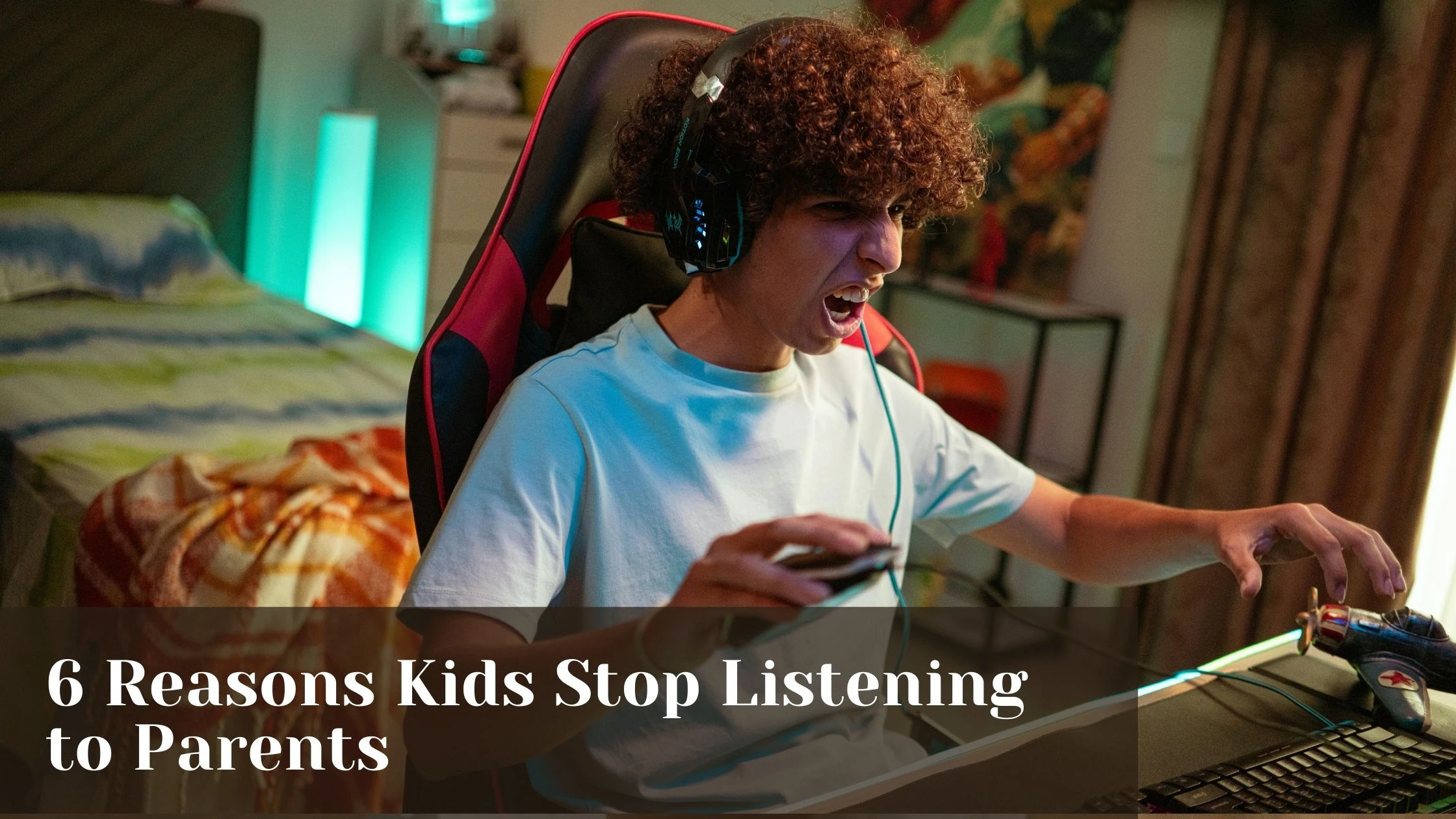
You’ve said it four times. The shoes are still in the hallway. The homework is still on the table, untouched. The request — one reasonable, clearly stated request — has apparently vanished into the air between your mouth and your child’s ears, and now you’re standing in the kitchen deciding whether to say it a fifth time or just put the shoes away yourself because you’re already late.
You’re not alone in this. In a survey of over five hundred mothers asked to identify the most common relationship challenge they face with their children ages 2 to 10, the overwhelming top answer wasn’t tantrums, or conflict, or screen time. It was: ignoring requests or directions. Simply put, according to parent coach Meghan Leahy, whose research produced these results: kids are not listening to their parents.
The instinct, when this happens repeatedly, is to get louder. To add a consequence. To give one more warning, one more countdown, one more speech about respect and responsibility. And the research is fairly consistent about what all of those approaches produce: more of the same, or worse. Because the reason children stop listening is almost never that the volume or the threat level was insufficient.
It’s almost always one of six other things.
First, a Finding That Reframes the Whole Problem
Before the six reasons, one research finding that changes what question you’re actually trying to answer.
A 2018 PLOS ONE multilevel meta-analysis on parenting behaviors and child compliance — analyzing 19 studies and 75 effect sizes of experimentally manipulated discrete parenting behaviors identified which specific parenting behaviors reliably produce child compliance. The results were striking: praise (specific behavioral approval) produced significant increases in compliance (d = 0.43). Consistent time-out produced significant effects (d = 0.69). Verbal reprimands — the repeated “stop that,” “come here,” “I told you to” — produced smaller and less consistent effects, suggesting that what most parents reach for most instinctively is among the least effective tools available.
What the meta-analysis didn’t find in the experimental literature was evidence that more words produce more compliance. The research literature on child compliance consistently shows the opposite: the longer the instruction, the more ambient the demand, the more diluted its signal becomes in the child’s environment — and the easier it becomes to treat as background noise.
This doesn’t mean consequences don’t matter. It means the starting point for understanding why a child has stopped listening is almost never insufficient enforcement. It’s almost always the quality of the relationship and the communication environment — which is where the six reasons below live.
The 6 Reasons
Reason 1: The Connection Account Is Overdrawn
This is the one most parents find hardest to hear, because it lands in the most tender place: the quality of the daily relationship, beneath the requests and the instructions and the family logistics.
Child therapists, parent coaches, and developmental researchers are in unusually strong agreement on this point: compliance follows connection. A child who feels genuinely seen, enjoyed, and delighted in by a parent will do more for that parent than a child who experiences the relationship primarily as a series of requirements and corrections — not because they’re being strategic, but because the biological drive to cooperate is most active inside relationships characterized by warmth.
Parent-Child Interaction Therapy research — published in a 2024 PMC clinical trial study (Skowron and colleagues, JCCP) found that as parents became more predictable and warm interactive partners through treatment, children learned that following directions was not overly demanding or punishing and became more pleasant and reinforcing interactive partners as a result. The cooperation came after the connection improved — not before.
The PMC complementarity study tracking 1,030 parent-child dyads (Journal of Family Psychology, 2022) found that father-child warmth complementarity — the moment-to-moment warm responsiveness of each to the other — was associated with an increase in observed father-child cooperation and a decrease in conflict. Warmth produced cooperation. Control produced compliance only in structured situations. Outside of structure, warmth was the engine.
The specific recommendation that research and clinical practice converge on is simple and uncommonly powerful: ten minutes of uninterrupted, child-directed, fully present one-on-one time, daily. Not a reward, not a special occasion — a regular deposit in the connection account that the relationship runs on. The child who regularly experiences a parent’s full, undivided, unjudging attention has a fundamentally different relationship with that parent’s requests than the child who experiences the parent mostly through instructions and corrections.
What this looks like:
Let the child lead the activity. Follow their lead without redirecting, correcting, or adding educational content. Be fully there. The quality of attention, not the length of it, is what counts. And then watch what happens to the quality of the interactions that follow.
Reason 2: There Are Too Many Words
The second reason is practical and almost universally true of parents who are trying hardest: they explain too much.
The parent who says “I need you to go get your shoes — and I’ve asked you three times already, and we’re going to be late, and this is becoming a pattern, and I really need you to start taking responsibility for your things” has not issued a clearer instruction than the parent who says “shoes, please.” They have issued a longer one. And length, in the world of parent instructions to children, is the enemy of compliance.
The research on punitive discipline in early elementary school (PMC, Stormshak and colleagues) identified what Patterson’s coercion theory calls “nattering” — the constant low-level verbal pressure of nagging, lecturing, and threatening — as one of the parenting behaviors most consistently associated with child noncompliance and the escalation of oppositional behavior. The mechanism is habituation: when instruction is constant and ambient, the child’s nervous system calibrates it as background noise. The tenth reminder is indistinguishable from the first, because the first didn’t produce any consequence worth attending to.
The PLOS ONE meta-analysis on parenting behaviors and compliance is equally direct: verbal reprimands and repeated instructions produced among the weakest and least consistent compliance effects of any parenting behavior studied experimentally. The research on what actually produces compliance points away from more words, not toward them.
The neural mechanism is also worth knowing. Stanford University research, published in the Journal of Neuroscience, found that teenagers’ brains are neurologically programmed to tune into new voices and put less emphasis on their parents’ voices — a major change from childhood, when young brains are wired to pay more attention to a parent’s voice. The parental voice, by adolescence, has become so familiar that it has lost the reward-activating quality it had in early childhood. This is not rudeness. It is neurology.
What this looks like:
One instruction. Once. In a calm, clear, direct tone without lecture preceding it or following it. Then wait for the response. The child who knows that one request will not be followed by twelve repetitions has to do something with the first one. The child who has learned that the first request is merely the opening of a negotiation that continues until they comply or the parent gives up — that child has no structural reason to respond to anything until iteration five or six, when the pattern historically escalates.
Reason 3: The Instructions Aren’t Actually Clear
This reason sounds simpler than it is, and it accounts for a surprising amount of the compliance breakdown that parents experience as defiance.
“Can you clean up your room?” is not a clear instruction. It is an invitation to disagree about what “clean” means. “Tidy your room” is a request with no defined endpoint. “Put your books on the shelf and your clothes in the hamper” is a clear instruction with observable completion criteria.
“Be ready for school” means different things to a seven-year-old and a parent who has already mentally catalogued seven things that need to happen before the door opens. “Shoes on, coat on, backpack at the door” is three clear instructions with specific, observable endpoints.
Children, particularly younger children, are not being difficult when they fail to complete vague instructions. They are frequently working with genuinely incomplete information about what completion looks like — and in the absence of that information, they do what all people do: they make a judgment call that usually overestimates how much they’ve already done.
The PCIT clinical research (PMC, Skowron et al.) is precise on this point: in early treatment sessions, parents practice giving simple commands with low demand on the child — “please hand me a crayon from the box” — and progressively move to more complex real-world commands. The simplest commands with the most specific observable endpoints produced the most reliable compliance. The progression from simple to complex was deliberate, not accidental. Clarity of the endpoint is itself a compliance factor.
What this looks like:
Before repeating an instruction, ask whether the child has full information about what compliance actually looks like. “Clean your room” repeated four times at increasing volume is less effective — and requires significantly more energy from everyone — than “put the Legos in the bin, then come find me” said once with eye contact and then followed through.
Reason 4: The Follow-Through Is Inconsistent
Here is the one that the research is most direct about, and that parents resist most energetically, usually because of how completely exhausting consistent follow-through actually is.
Children don’t learn from what parents say. They learn from what parents do when the instruction isn’t followed. And a child who has extensive experience of instructions that were not followed through — where the countdown reached zero and nothing happened, where the consequence was threatened and then not applied, where the repetition eventually wore the parent down until the whole situation just evaporated — has been taught, through direct experience, that instructions are proposals rather than requirements.
The Stormshak PMC study on parenting practices and child disruptive behavior found that inconsistency — defined as unpredictable follow-through on instructions and consequences — was among the parenting factors most consistently associated with the development of oppositional and aggressive behavior in early elementary school. More than harshness alone. More than warmth alone. Inconsistency specifically. The child’s nervous system is learning the rules of the environment, and inconsistent follow-through teaches: these rules are not real.
Patterson’s coercion theory — the foundational framework for understanding child noncompliance that has been empirically validated across four decades — describes the specific learning history that produces a chronic non-listener: the child has been accidentally trained, through hundreds of inconsistent interactions, that resisting instructions eventually works. Not always. Just often enough that persistence pays off better than immediate compliance. The child who doesn’t listen is frequently a child who has been operantly conditioned, through ordinary family life, to hold out.
What this looks like:
Fewer instructions, followed through on more reliably, is categorically more effective than more instructions followed through on sporadically. The specific calculation worth making before giving any instruction is: am I willing and able to follow through on this right now, in this moment, if they don’t comply? If the answer is no, don’t give the instruction. Give it when the answer is yes. Predictability is what teaches a child that the rule is real.
Reason 5: The Relationship Between You Has Become Primarily Corrective
This reason builds on the first, but it operates at a slightly different level — not just the quantity of connection but the ratio of positive to corrective interactions in the daily texture of the relationship.
A child who experiences a parent primarily as the source of corrections, redirections, reminders, and disapproval develops something specific in their nervous system: an association between the parent’s attention and an incoming criticism. That association, once formed, produces a predictable response to parental engagement: defensiveness, withdrawal, or the kind of flat non-compliance that isn’t quite defiance but isn’t quite responsiveness either. The child has learned to brace before responding to the parent, because what follows parental engagement is usually uncomfortable.
The 9-year longitudinal study on parent-child communication and aggression (Meter, Ehrenreich et al., PMC 2021, Utah State University, N=297 youth ages 9–18) found that parents’ positive talk directed toward the child was linked with the child’s engagement in less aggression across preadolescent and adolescent development. The key predictor of positive behavioral outcomes wasn’t the absence of negative communication alone — it was the presence of meaningful positive communication. The relationship needed to contain something worth protecting, worth cooperating with, worth listening to.
The PCIT research formalizes this as a ratio: the PRIDE skills framework (Praise, Reflection, Imitation, Description, Enjoyment) requires a specific, empirically validated ratio of positive to directive interactions before compliance improves. The research is specific: before a child becomes reliably responsive to instructions, they need enough experience of positive engagement with the parent that the relationship itself has become something worth maintaining — and something the child doesn’t want to put at risk through defiance.
The clinical standard emerging from PCIT and related parent training models suggests that approximately five positive interactions for every corrective one is the minimum ratio for a warm, cooperative parent-child relationship. Most parents in the thick of compliance struggles are running far below that ratio without realizing it.
What this looks like:
Count, for one day, your positive to corrective interactions with the non-listening child. Not to judge yourself — to get data. Then deliberately, incrementally shift the ratio. Notice what you enjoy about them. Name it. Out loud. Specifically. “I love how you described that — the way you told that story was really vivid.” Not as a manipulation toward compliance, but as an investment in the relationship that compliance eventually comes from.
Reason 6: They’re at a Stage Where Turning Away Is the Developmental Task
The last reason is the one that’s hardest to take action on, because the action it requires is internal rather than behavioral. And it is the most important reason for parents of children older than twelve.
The Stanford Journal of Neuroscience study described earlier found something that should be read by every parent of an adolescent and then read again: starting at about age 13, kids’ brains tune in less to the voices of their parents and more to novel voices. Prior to age 12, children’s brains experience their mothers’ voices as uniquely rewarding. After that, the brain’s reward response increases for unfamiliar voices, while the parental voice loses its earlier privileged status. The neurobiological shift toward different voices occurred between the ages of 13 and 14, and there were no differences between boys and girls.
This is not behavioral. It is not relational. It is neurological — the adolescent brain is being rewired, on a biological schedule that is not optional, to find the voices of peers more rewarding than the voice of a parent. This is individuation at the neurological level. It is the brain making the young person ready to leave, gradually and correctly, the family of origin and build a life among peers.
The parent who experiences this as personal — who interprets the adolescent’s tuning-out as rejection, contempt, or evidence that something has gone wrong in the relationship — is not wrong that the child is listening less. They are wrong that it is about them. And the response that this misinterpretation generates — more pressure, more confrontation, louder demands for acknowledgment — activates the counterwill that the biology is already producing, and makes the relationship genuinely worse in ways the neurobiology alone would not.
The University of Illinois Urbana-Champaign ScienceDaily study on adolescent advice-taking (Kelly Tu, 2024) found that adolescents may appear not to listen to their parents while still benefiting from their input. Children’s responses ranged from agreeing and accepting to rejecting and dismissing, but most were somewhere in the middle. The researchers found that even when youth reacted with ambiguous or non-committal responses — “maybe” or “I don’t know” — they still showed more adaptive coping the following year when their mothers had provided cognitive reappraisal suggestions. The advice was absorbed even when it appeared to be rejected. The listening was happening below the surface of the visible interaction.
What this looks like:
For adolescents specifically: say the important thing once, clearly, without requiring visible acknowledgment that it landed. Trust the research that says it probably did. Invest in the quality of the relationship through non-directive time, genuine curiosity, and the kind of low-pressure parallel presence (in the car, on a walk, while cooking) that adolescent brains find less activating than direct face-to-face instruction. The adolescent who feels genuinely connected to a parent is more influenced by that parent than they will ever let on. The connection is the lever. The volume is not.
What Changes When the Reasons Are Addressed
The parent who reads this list honestly will probably recognize more than one of these reasons operating simultaneously — because they tend to compound each other. Thin connection produces more instructions, which produces more corrections, which further thins the connection, which produces more noncompliance, which produces even more instructions at even higher volume. The coercion cycle, as Patterson described it, is self-reinforcing once it begins.
The exit from it is not discipline reform. It is relationship repair — specifically, the deliberate, consistent investment in connection that shifts the child’s experience of the parent from “source of requirements” to “person whose regard I want to maintain.”
That shift doesn’t happen in a single conversation. It happens across dozens of ten-minute moments of genuine, uninterrupted attention. Across a ratio of warmth that begins to outweigh correction. Across fewer, clearer, more reliably followed-through instructions that teach the child that the rules here are real, and predictable, and manageable.
It is slower than a louder consequence. It lasts longer than a new rule. And it produces something that enforcement alone never has: a child who listens not because they have to, but because the relationship has become one they want to be in good standing with.
That is what compliance built on connection feels like. And it’s worth the work to get there.
Has a specific shift — in how you structured requests, in how you invested in connection, in how you followed through — changed the dynamic with your non-listening child? Share in the comments. Specific turning points from real families are the most useful thing another struggling parent can read.
Sources & Further Reading:
- Leahy, M. (MLParentCoach.com, 2018; referenced survey of 500+ mothers): Why Don’t Kids Listen to Their Parents? — Top Parenting Challenge Identified as “Ignoring Requests or Directions”
- Kok, R. et al. (PLOS ONE / PMC, 2018): Parenting Behaviors That Shape Child Compliance: A Multilevel Meta-Analysis — 19 Studies, 75 Effect Sizes, Discrete Parenting Behaviors
- Skowron, E.A. et al. — University of Oregon/Children’s Hospital Los Angeles/Colorado (PMC / JCCP, 2024): Randomized Trial of Parent–Child Interaction Therapy Improves Child-Welfare Parents’ Behavior, Self-Regulation, and Self-Perceptions
- Janssen, L.H.C. et al. — Leiden University (PMC / Journal of Family Psychology, 2022): Interpersonal Complementarity as a Predictor of Parent-Child Relationship Quality — N=1,030 Parent-Child Dyads
- Stormshak, E.A. et al. — University of Oregon (PMC, 2000): Parenting Practices and Child Disruptive Behavior Problems in Early Elementary School
- Meter, D.J. & Ehrenreich, S.E. et al. — Utah State University (PMC, 2021): Listening In: How Parent-Child Communication Relates to Social and Physical Aggression from Ages 9–18 — N=297 Youth, 9-Year Longitudinal
- Mistry, P. & Chang, L. et al. — Stanford School of Medicine (Journal of Neuroscience, 2022): Functional MRI Study on Brain Responses to Maternal vs. Novel Voices in Adolescents Ages 13–16.5 — Neurobiological Shift in Parental Voice Response, Ages 13–14
- Tu, K.M. — University of Illinois Urbana-Champaign (ScienceDaily, 2024): Does It Matter If Your Kids Listen to You? Adolescent Disclosure and Coping After School Transition — N=100 Youth and Mothers
- Zapf, H. et al. (PMC / JCPP Advances, Wiley, 2024): A Systematic Review of the Association Between Parent-Child Communication and Adolescent Mental Health
- Helm, S. et al. (PMC / Springer, 2023): Systematic Review of Parent–Child Communication Measures — 106 Studies, 12 Instruments, Ages 8–21
- Patterson, G.R. (1982): [Coercive Family Process — Castalia Publishing (Foundational Coercion Theory and Nattering Research)]
- Baudat, S. et al. — University of Lausanne (PMC, 2022): How Do Adolescents Manage Information in the Relationship with Their Parents? — Latent Class Analysis of Disclosure, Keeping Secrets, and Lying