
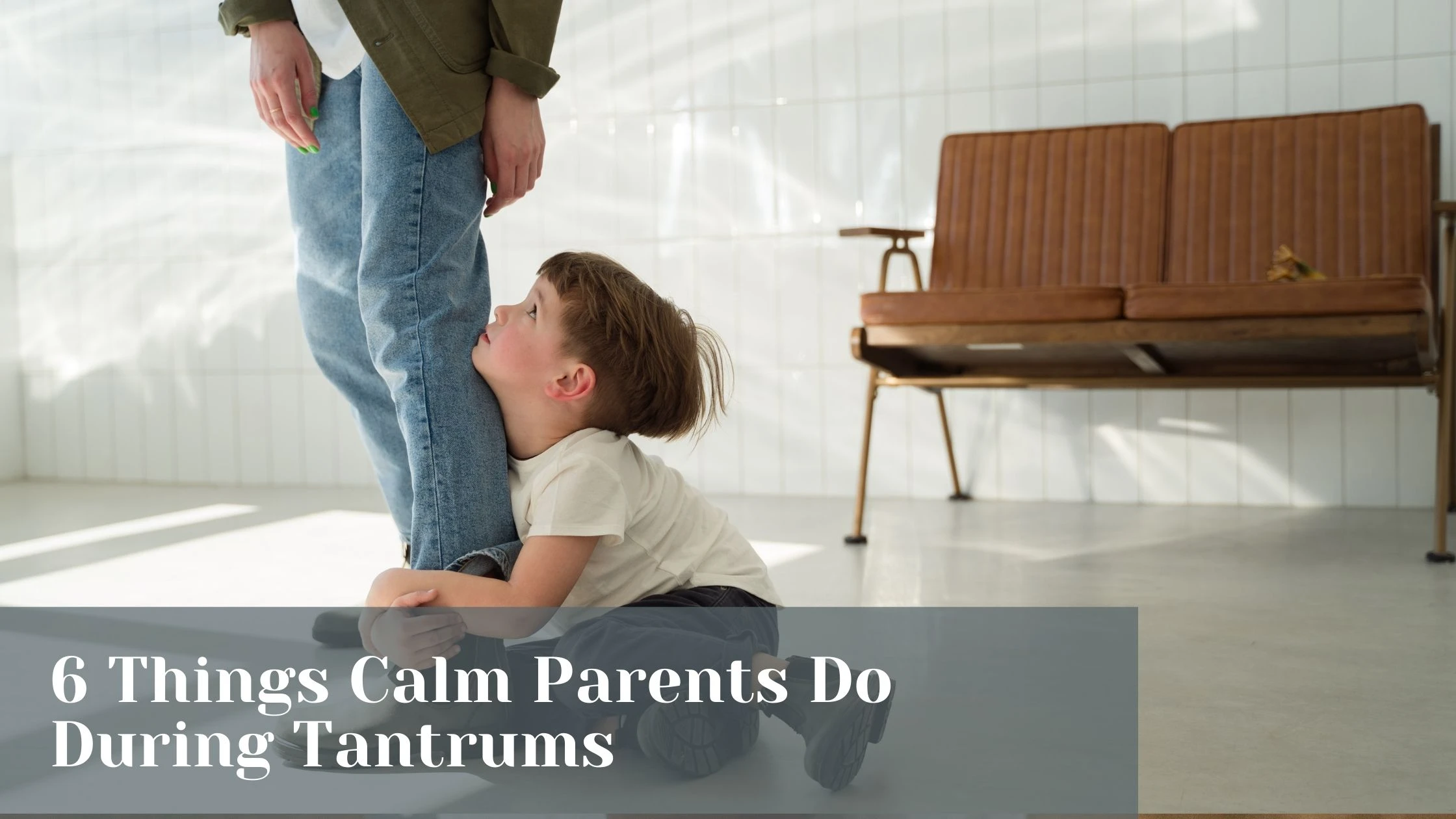
It arrives without much warning. One moment everything is manageable, and then — something about the crackers being broken, or the wrong cup, or the shoe that won’t cooperate — and suddenly you are standing in the middle of a full physiological storm: the crying that escalates to screaming, the body that goes rigid or boneless, the floor that becomes an unavoidable destination, the noise that carries through walls and draws glances in public places.
Tantrums are among the most universally experienced and most consistently distressing events in early parenting. They are also among the most misunderstood — because the instinct in the middle of one is almost always to do the thing that makes it worse. To escalate. To negotiate. To give in and end the noise. To deliver a lecture about why this behavior is not acceptable. To match the energy with energy of your own.
The research on what actually shortens a tantrum, prevents its reinforcement, and — most importantly — builds the child’s regulation capacity over time points in a direction that is different from most of what instinct suggests. It points toward a specific set of things that calm parents do in these moments. Not parents who are naturally unflappable, and not parents who feel nothing. Parents who have understood something about what is happening neurologically in their child, and who have developed enough of a practiced response that they can execute it even when the screaming is at full volume and the grocery store is watching.
Here are six of those things.
What the Research Tells Us About Tantrums First
Before the six things, two findings that reframe everything that follows.
Temper tantrums are generally believed to be a normal phenomenon that naturally fades as children grow. The StatPearls clinical review confirms this: tantrums occur once a day, on average, with a median duration of 3 minutes in 18- to 60-month-old children, with mood and behavior returning to normal between episodes. They are developmentally expected, neurologically inevitable, and in the vast majority of cases, they pass.
What determines how they develop over time — whether they become less frequent and shorter, or more entrenched and longer — is primarily what happens around them. Caregiver responses to children’s expressions of emotions shape how children learn to communicate about and manage their emotions. When parents respond supportively to children’s displays of emotions — validating, encouraging expression, soothing when needed — children are more comfortable experiencing and expressing a range of emotions and increasingly secure that such expressions do not compromise the relationship. The tantrum is the moment. The parent’s response is the lesson.
The 6 Things
1. They Regulate Themselves First — Because Their Nervous System Is the Child’s Template
This is the thing that is hardest to do and most consequential to do. It is also the thing that most directly separates a calm parent’s response from an escalating one — and its mechanism is physiological, not philosophical.
Children’s nervous systems are not independent systems. They are, from the earliest moments of life, calibrated to and co-regulated by the nervous systems of their primary caregivers. Infants’ cries diminished when their mothers carried them, including decreasing of distress vocalizations, reduced motor activity, and increased heart rate variability, indicating a more adaptive autonomic state — physiological and neurobiological mechanisms underlying the calming effects of maternal carrying involve oxytocin signaling, vagal activation, and enhanced autonomic regulation.
This co-regulation doesn’t end in infancy. Starting in infancy, parents establish behavioral and affective patterns with their children that provide external regulation for children who cannot fully regulate themselves. Better-coordinated exchanges are thought to directly support young children’s emotional, behavioral, and physiological regulation. The child in a tantrum is a dysregulated nervous system looking — below the level of conscious awareness — for a regulated one to synchronize with.
Parent self-regulation is multifaceted, involving emotional, cognitive, and biological processes that support or constrain parenting behavior. It is highly relevant to disciplinary contexts in which parents’ regulatory difficulties can contribute to harsh discipline, which is linked to children’s maladjustment. The parent who escalates in response to a tantrum is not simply failing to stay calm. They are providing a dysregulated nervous system as the template for the child’s own — which extends the tantrum, not resolves it.
Only when parents are able to regulate their own emotions effectively can they respond to their children and their children’s emotions with supportive behaviors. This is the non-negotiable foundation on which everything else rests.
What this looks like:
When the tantrum arrives, pause before responding. Not to disengage — to reset. An actual breath, slow and deliberate. Shoulders down. Voice consciously lowered, even if you haven’t said anything yet. The goal is not the performance of calm but its neurological reality — because your child’s nervous system is reading yours directly, and what you bring to the room is what the room contains.
2. They Don’t Try to Reason, Explain, or Teach — Not Yet
The tantrum is in full voice. The parent’s instinct is to explain why the thing the child wanted isn’t possible, or why the behavior isn’t acceptable, or what the consequence will be if this continues. These explanations feel like they should help. The research on what is actually happening in the child’s brain during a tantrum tells us why they don’t.
During a tantrum, the child’s prefrontal cortex — the region responsible for language comprehension, logical reasoning, perspective-taking, and integrating new information — is significantly less available. The limbic system is running the event. The amygdala has taken over. Trying to reason with a brain in this state is the neurological equivalent of trying to have a detailed conversation in the middle of a fire alarm: the architecture required for receiving the message is offline.
Caregivers’ supportive responses to children’s negative emotions may help children remain organized in the face of elevated physiological arousal, and thus more capable of accessing their own regulatory strategies, and more receptive to their caregivers’ efforts to provide coregulation. The word in that sentence that matters most is “organized” — and organization is what the tantrum has disrupted. The path back to organization is physiological regulation, not logical instruction. Explanation can come later, when the prefrontal cortex is back online. During the tantrum, it is mostly wasted.
The StatPearls clinical review is direct about what belongs in the tantrum moment and what doesn’t: ignore the tantrum — the caregiver may need to leave the room, building, or premises with the child and wait for it to stop. Do say yes when meeting the child’s physical and safety needs, but don’t give in to demands. Notice what is absent from this list: the explanation, the warning, the negotiation, the consequence speech.
What this looks like:
During the peak of the tantrum, say less, not more. The full explanation of why the cookies were not available before dinner can happen after. The discussion of the behavior and what different choices are available can happen after. The consequence, if there is one, can be delivered after. In the middle, the most useful thing a parent can offer is calm physical presence and minimal verbal engagement — which does not escalate the situation and does not give the tantrum an audience that rewards its continuation.
3. They Stay Present Without Amplifying
There are two common parenting responses to a tantrum that the research consistently identifies as counterproductive. The first is escalation — matching the energy, raising the voice, bringing the parent’s own emotional arousal into the space in a way that intensifies the child’s. The second is abandonment — leaving the child entirely alone with a dysregulated nervous system, removing the co-regulating presence that the child’s own system needs to find its way back to calm.
Calm parents do neither. They stay present — physically close, emotionally available — without amplifying. They are in the room. They are not lecturing, threatening, or engaging with the content of the tantrum. They are simply a regulated presence, stable and available, while the storm passes.
When parents respond supportively to children’s displays of emotions, children are increasingly secure that such expressions do not compromise the relationship or run the risk of eliciting punitive or withdrawing responses from key caregivers. Furthermore, caregivers’ supportive responses to children’s negative emotions may help children remain organized in the face of elevated physiological arousal.
The research on parent-child co-regulation as a developmental process is specific about the mechanism: the parent-child relationship can be considered a dynamic system that self-organizes into predictable behavioral, emotional, and physiological patterns — when patterns are more predictable, they foster the homeostatic rhythms upon which self-regulation processes are built. The parent who is consistently, predictably present during difficult moments — neither escalating nor disappearing — is building exactly this predictability. The child learns, across dozens of tantrum experiences, that the storm has a shape: it arrives, it peaks, it subsides, and the parent is still there.
What this looks like:
Stay in the child’s vicinity without hovering directly over them. Sit on the floor nearby. Keep your body relaxed. If physical contact helps — a hand on the back, a loose hold — offer it. If it escalates, release it. Don’t leave the room unless the situation requires it for safety. Don’t fill the space with words. Simply be a calm, available presence. The message this communicates — that the feeling is survivable, that the relationship is stable, that nothing catastrophic is happening — is the message the child’s nervous system needs most.
4. They Name the Feeling Without Trying to Fix It
When the tantrum is at its loudest, the parent’s instinct is to resolve it — to make the feeling stop by offering a solution, a distraction, a substitution for the thing that was denied. This instinct is caring. It is also, the research shows, one of the ways in which tantrums are accidentally reinforced and one of the ways in which children miss the developmental work that tantrums contain.
The feeling underneath a tantrum is real. The frustration of the blocked goal, the overwhelm of the sensory experience, the genuine distress of not getting the thing that was wanted — these are not performances. They are actual emotional states, and they deserve acknowledgment. What doesn’t help is bypassing them: substituting distraction for acknowledgment, or rushing to the solution before the feeling has been named.
The affect labeling research — pioneered by Lieberman and colleagues at UCLA — found that putting a word to an emotional experience measurably reduces amygdala activation and increases prefrontal regulation. The child who can access the word “frustrated” or “disappointed” or “so upset” in the moment of the tantrum is, neurologically, in a different and more regulated state than the child who cannot. The parent who provides that word — simply, without drama, in a calm voice — is offering one of the most efficient regulatory interventions available.
Caregivers may also provide explicit guidance in identifying and understanding emotions by narrating children’s experiences. This is the simple practice: “You are really upset that we couldn’t stay longer.” “You wanted that so much and it felt so hard when you couldn’t have it.” “That was really disappointing.” These sentences don’t fix anything. They do something more important: they communicate that the feeling is understood, that it is survivable, and that the parent is not frightened by it.
What this looks like:
When the peak of the tantrum has passed slightly — when the screaming has eased enough that a low, calm voice might register — name what you see. Not as a correction, not as a question, not as the beginning of a lesson. Just a simple, accurate reflection: “You’re so frustrated right now.” “That was really hard.” “I know you wanted that.” Then stop. The naming is enough. The fixing can wait, or may not be needed at all once the feeling has been seen.
5. They Hold the Limit — Warmly, Without Wavering
This is the one that requires the most from the parent when the tantrum is at its worst — particularly in public, particularly when the child’s distress is genuine and visible, particularly when giving in would end the noise immediately. And it is the one that the research most consistently identifies as the difference between a tantrum pattern that fades and one that grows.
The mechanism is straightforward: if the tantrum achieves the goal — if the demanded thing is eventually provided, if the limit softens under sufficient pressure, if the consequence of enough escalation is the removal of whatever triggered the distress — then the child’s behavioral system learns that tantrums work. Not through deliberate strategy. Through the same operant conditioning that governs all behavior: behavior that produces the desired outcome is repeated.
Do not give in to demands. Giving in to demands may reinforce undesired behaviors. The StatPearls clinical summary reflects decades of behavioral parent training research: the warm, consistent limit that holds through the tantrum — without punishment, without anger, without abandonment — teaches the child that this particular strategy doesn’t change the outcome. Over time, with consistent holding, the strategy is extinguished.
The research on parental discipline techniques and observed tantrum severity confirms the direction: parental discipline techniques predict changes in observed temper tantrum severity in toddlers. The techniques that reduce severity over time share a common feature: they hold the limit consistently while maintaining warmth. Not harshness — warmth. The message is not “your feeling is wrong.” It is “the limit is real, and I love you inside it.”
What this looks like:
When the tantrum is about a denied request, hold the denial. Not with a speech, not with escalating consequences, but with a quiet, consistent “the answer is still no” delivered once if needed and then not repeated. You can be fully present, fully warm, fully empathetic to the distress — and still not change the answer. These two things are not in conflict. In fact, the parent who holds the limit warmly is communicating something more important than the specific limit: that the relationship is stable regardless of the child’s emotional state, and that the child’s distress does not have the power to override reality. That is, over time, a regulatory resource.
6. They Reconnect and Teach After — Not During
The final thing calm parents do is something that happens after the tantrum has resolved — and it is the part most frequently skipped. The tantrum is over. The child has returned to their baseline. The parent, relieved, moves on. The moment passes without any deliberate follow-up, and the opportunity it contained is lost.
The post-tantrum window is, neurologically, the best teaching window available. The child’s prefrontal cortex has come back online. They are regulated, often surprisingly cheerful, and accessible to a kind of reflection that was genuinely impossible twenty minutes ago. This is when the brief, warm, curious conversation can happen — not a lecture, not a consequence debrief, not a replay of what went wrong, but a genuine connection that acknowledges what happened and plants a small seed for next time.
When parents respond supportively to children’s negative emotions, children are more comfortable experiencing and expressing a range of emotions — both positive and negative — and increasingly secure that such expressions do not compromise the relationship. The reconnection after a hard moment is one of the most powerful ways of communicating exactly this: the relationship is stable, the storm didn’t break anything, we are still us.
The practical teaching that can happen in this window is also specific and age-appropriate. For toddlers: a warm hug and a simple “that was really hard, huh?” is sufficient. For preschoolers: “When you felt so upset, what was going on?” For older children: “Next time you feel that frustrated, what’s something you could try?” None of this requires a lengthy conversation. Five minutes of genuine, warm reconnection and one forward-looking question is all the post-tantrum window needs to do its work.
What this looks like:
When the child has returned to calm — and they signal this clearly, often through seeking connection, starting to play, or approaching the parent — make warm contact. Not a lecture about what just happened. Not a “now are you ready to apologize?” Not a cool withholding that communicates the parent is still upset. A genuine, uncomplicated return to warmth: “You okay? That was a lot.” And then, when the moment feels right: “What do you think was so hard?” And then, from there, one small sentence about next time. That’s the whole lesson. It’s more than enough.
The Bigger Picture of What These Six Things Build
A parent who does these six things consistently — who stays regulated, says less, remains present without escalating, names the feeling, holds the limit warmly, and reconnects after — is not just managing individual tantrums more effectively. They are building something in their child over months and years that extends far beyond the tantrum itself.
They are building the child’s co-regulatory experience: the repeated, embodied knowledge that big feelings have a beginning, a middle, and an end; that they are survivable; that the relationship is stable inside them; that a calm, available person can be present during the worst of it without being destroyed by it or requiring the child to perform recovery faster than they can manage it.
That experience — accumulated across dozens of tantrum cycles, across the ordinary repetition of early childhood — becomes the child’s own internal model for how feelings work and what to do with them. It becomes, over time, self-regulation. Not because someone taught it in a lesson, but because it was lived, repeatedly, from the inside of a relationship where the parent stayed calm.
That is what calm parents are actually doing during tantrums. Not managing the noise. Building the architecture.
When is the hardest moment for you to stay regulated during a tantrum? The specific trigger — what it sounds like, what it asks of you, where it happens — is almost always worth looking at. Share in the comments what you’ve found, and what’s helped.
Sources & Further Reading:
- Sisterhen, L.L. & Wy, P.A.W. — StatPearls Publishing (Updated February 2023): Temper Tantrums — Epidemiology, Median Duration 3 Minutes, Behavioral Management, AAP Guidelines, Reinforcement of Demands — Clinical Review
- van den Akker, A.L., Mo, J., Leijten, P. et al. — Erasmus University Rotterdam (Research in Child and Adolescent Psychopathology, 2023): Parental Discipline Techniques and Changes in Observed Temper Tantrum Severity in Toddlers — Warm Consistent Limit-Holding vs. Capitulation Trajectories
- van den Akker, A.L. et al. — Erasmus University Rotterdam (PMC / Journal of Developmental & Behavioral Pediatrics, 2022): Temper Tantrums in Toddlers and Preschoolers: Longitudinal Associations with Adjustment Problems — N=861 (Mage=36 months), Tantrum Frequency and Duration, 3 Behavioral Profiles, Externalizing and Internalizing Outcomes
- Esposito, G. et al. — Riken Brain Science Institute / PMC (Co-regulation multilevel review, PMC, 2023): Coregulation: A Multilevel Approach via Biology and Behavior — Physiological Calming from Maternal Carrying, Oxytocin Signaling, Vagal Activation, Autonomic Co-Regulation
- Skowron, E.A. & Cipriano-Essel, E. — University of Oregon (PMC / Development and Psychopathology, 2023): The Importance of Parent Self-Regulation and Parent-Child Coregulation in Research on Parental Discipline — Emotional, Cognitive, and Biological Domains, Harsh Discipline Pathways
- Lunkenheimer, E., Tiberio, S., Buss, K. et al. — Penn State University (PMC / Development and Psychopathology, 2020): Understanding Parent-Child Coregulation Patterns Shaping Child Self-Regulation — Positive vs. Negative Synchrony, Dynamic Systems Theory, Affect Contingency and Self-Regulation Outcomes
- Buhler-Wassmann, A.C. & Hibel, L.C. — UC Davis (PMC / Infant Behavior and Development, 2021): Studying Caregiver-Infant Co-regulation in Dynamic, Diverse Cultural Contexts — Autonomic Nervous System Co-regulation, Heart Rate Synchrony, Cortisol Buffering, and Secure Attachment Formation
- Morris, A.S., Criss, M.M., Silk, J.S. & Houltberg, B.J. — Oklahoma State University (PMC / Child Development Perspectives, 2017): Conceptualizing Emotion Regulation and Coregulation as Family-Level Phenomena — Punitive and Minimizing Parental Responses to Negative Emotion, Supportive Coregulation, Physiological Organization
- Kujawa, A.J., Proudfit, G.H., & Klein, D.N. — University of Pittsburgh (PMC / Research in Child and Adolescent Psychopathology, 2023): Multi-Method Investigation of Parental Responses to Youth Emotion — Prospective Effects on Emotion Dysregulation and Reactive Aggression — Parental Validation vs. Invalidation, Longitudinal Pathways
- Gottman, J.M., Katz, L.F. & Hooven, C. — University of Washington (1996–2014): Meta-Emotion Philosophy and Emotion Coaching — Parental Response to Child Negative Emotions, Validation Without Fixing, Regulation Outcomes in Children
- Lieberman, M.D. et al. — UCLA (Psychological Science, 2007): Putting Feelings Into Words: Affect Labeling Disrupts Amygdala Activity in Response to Affective Stimuli — fMRI, Naming Emotion Reduces Limbic Activation and Increases Prefrontal Regulation — Foundation of “Name It to Tame It”
- Metcalfe, R.E., Dishion, T.J. et al. — University of Oregon (PMC / Clinical Practice in Pediatric Psychology, 2022): Emotion Regulation, Coercive Parenting, and Child Adjustment: Serial Mediation Clinical Trial — Fathering Through Change RCT, N=426 Fathers, Coercive Parenting Reduction → Child Behavior Improvement (d=.30)
- Coyne, S.M. et al. — Brigham Young University (PMC / Computers in Human Behavior, 2021): Tantrums, Toddlers, and Technology — Parental Digital Emotion Regulation, Difficult Temperament, and Problematic Media Use — Why Screens as Tantrum-Stoppers Undermine Self-Regulatory Development
- Henneghan, A. & Shields, M. — Frontiers in Child and Adolescent Psychiatry (2024): Cure for Tantrums? Longitudinal Associations Between Parental Digital Emotion Regulation and Children’s Self-Regulatory Skills — N=265, T1 2020 / T2 2021, PDER Predicts Higher Anger and Lower Effortful Control One Year Later