
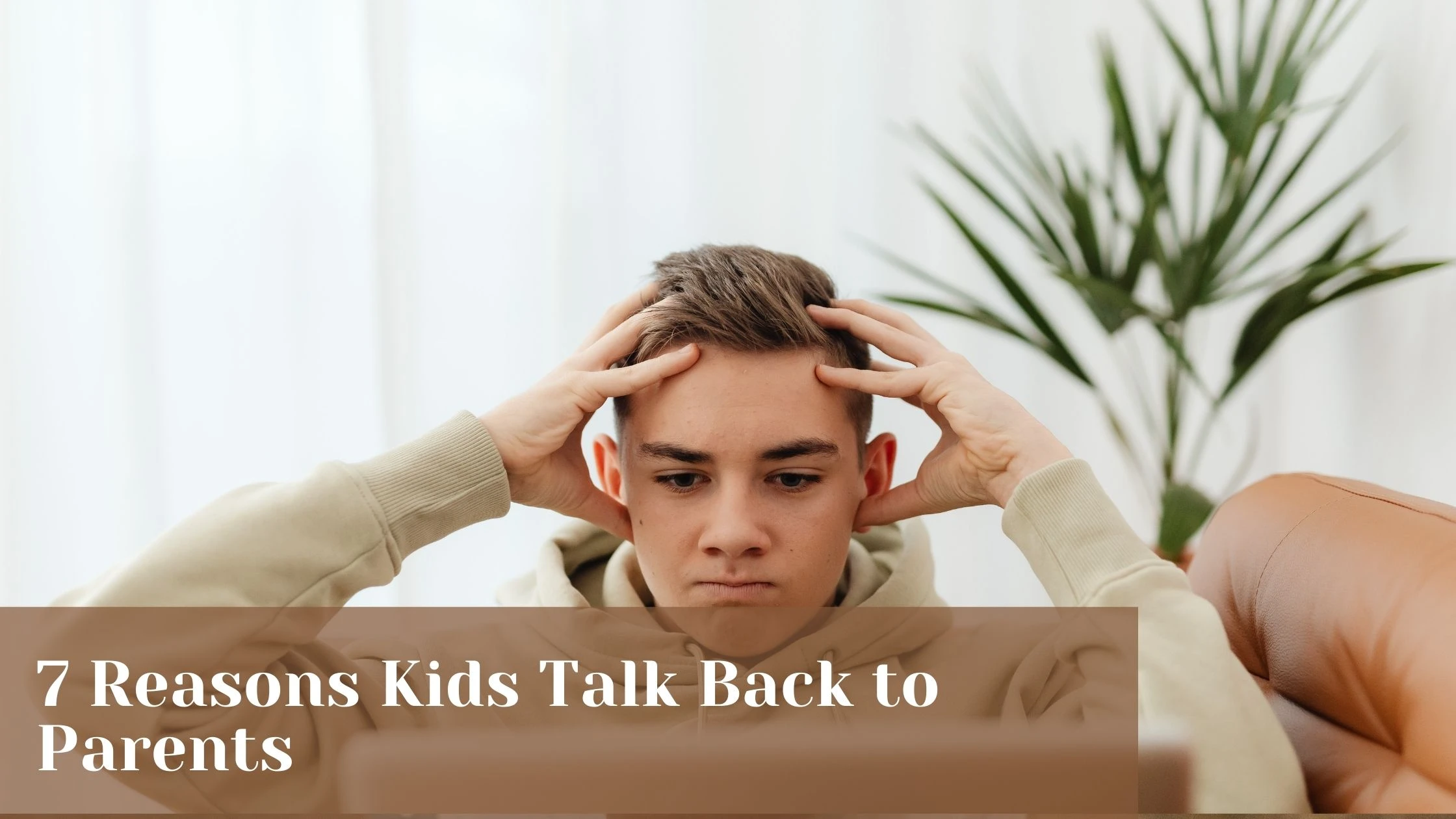
You said no to something. It was a reasonable no. A clear no. The kind of no you shouldn’t have to defend. And what came back at you was not compliance, or even quiet disappointment. What came back was an argument — delivered at volume, laden with complaints about fairness, possibly including a comparison to some other family where this particular no does not exist.
You know this moment. Most parents know it from both directions: the child you were once, testing the limits with your own parents; and the parent you are now, on the receiving end of a version of your own voice from twenty years ago.
Backtalk goes by many names — talking back, mouthing off, arguing, defiance, disrespect — and most of it gets treated as a discipline problem, something to be corrected through firmer consequences or more consistent limit-setting. Sometimes that’s right. More often, something more interesting is happening: a child or teenager is expressing something real through the only channel that feels powerful enough to carry the weight of it.
The seven reasons below are not excuses for backtalk, and none of them mean the behavior should go unaddressed. What they are is a diagnostic map: a way of looking at what’s underneath the snap, the argument, or the eye-roll long enough to address the cause rather than only the symptom.
First, Why the Standard Response Often Makes It Worse
Before the seven reasons, one research finding that reframes the typical parent-escalation cycle.
A 2024 PMC study — Bailey and colleagues, University of Virginia, published in the Journal of Adolescence tracked adolescent responses to paternal verbal aggression across parent, peer, and partner relationships using cross-lagged panel models. The finding was precise: verbal aggression from parents contributes to internalizing symptoms, externalizing problems, and challenges establishing autonomy in interactions with parents. When parents respond to backtalk with escalating verbal pressure, the cycle doesn’t resolve — it worsens. The parent becomes, in the child’s experience, confirmation that the only way through a conflict is louder and harder.
The Pittsburgh University PMC study on parental non-supportive responses to youth emotion — using ecological momentary assessment across a sample of 162 clinically referred youth (mean age 12.03) found that non-supportive parental responses to emotion — specifically rejection, coercion, and anger — prospectively predicted both emotion dysregulation and reactive aggression nine months later. The coercion the parent used to stop the backtalk increased the very emotional reactivity that the backtalk was coming from.
Understanding why the backtalk is happening doesn’t eliminate the need for limits. It changes the ground from which the limits operate — and makes the conversation that follows one the child can actually use.
The 7 Reasons
Reason 1: Their Autonomy Need Is Being Thwarted and Their Brain Is Alerting
This is the most developmental reason on the list, and it is the one most easily mistaken for defiance when it is actually biology.
Autonomy — the experience of acting with genuine choice, rather than under perceived coercion — is one of three innate psychological needs identified in Ryan and Deci’s Self-Determination Theory. When the autonomy need is thwarted, the response is not quiet acceptance. It is resistance — sometimes vocal, sometimes disruptive, sometimes the specific form of loud complaint that parents experience as talking back.
A PMC study on parental psychological control and autonomy granting — examining the combination across parent and child reports found directly that when youth do not perceive support for their growing desire for greater independence, they are more likely to respond to maternal control by engaging in defiant and noncompliant behavior to exert their autonomy. The defiance wasn’t a personality failure. It was a need-based response to a perceived deprivation.
The Frontiers in Psychiatry PMC study on parental psychological control and adolescent social problems found that adolescence is an important period for separation-individuation: adolescents pursue autonomy and hope to get rid of parental authority and control. The developmental drive toward independence is not a luxury — it is the neurologically programmed process through which a child becomes a functional adult. Resistance to perceived coercion is part of the mechanism. The intensity of the resistance often reflects the intensity of the felt coercion.
This is what Dr. Gordon Neufeld, building on the foundational work of Austrian psychoanalyst Otto Rank, named counterwill: the instinctive defensive resistance to feeling controlled or coerced that is present across the lifespan and most intense in toddlerhood and adolescence — the two periods when developmental individuation surges. As the Neufeld Institute explains: the more a child feels pushed, the harder they push back — not as a strategy, but as a reflex.
What this means practically:
The question worth asking when backtalk follows a directive is not only “what consequence should follow this?” but “how much of what I’m doing is coercive in a way I haven’t considered?” Offering genuine choice within non-negotiable limits, explaining the reasoning rather than issuing the rule, inviting the child into the decision before the decision is made — each of these reduces the autonomy threat without eliminating the limit. The same boundary, held with collaborative language, often produces a fraction of the resistance.
Reason 2: The Relationship Has Accumulated More Correcting Than Connecting
Backtalk rarely emerges in a single exchange. It accumulates — through a series of interactions, over days and weeks, in which the child has experienced the parent primarily as a source of requirements, corrections, redirections, and disapproval. When the corrective interactions significantly outweigh the connective ones, something happens to how the child hears a parental voice: it begins to register, automatically, as an incoming criticism, and the defensive posture arrives before the words have finished.
A PMC study on parental styles and adolescent emotional well-being — using the SDT framework to distinguish supportive from thwarting parenting found that thwarting parenting practices — including psychological control and rejection — directly predicted frustration of the basic need for relatedness: the child’s sense of being genuinely connected to and cared for by the people around them. When relatedness is chronically frustrated, the behavioral expression of that frustration often looks like hostility toward the people responsible for it.
The Parent-Child Interaction Therapy research, synthesized across multiple PMC trials, consistently finds that as parents increase warmth and decrease directive-corrective ratio, children’s cooperative behavior improves without any change to the limit structure. The PRIDE skills framework — requiring a specific ratio of positive to directive interactions before compliance improves — establishes through clinical evidence that backtalk is often less about any specific no and more about the accumulated experience of being managed rather than enjoyed.
What this means practically:
Count, for a day, how many interactions with your child involve some form of correction, redirection, or disapproval — and how many involve genuine delight, curiosity, or warmth with no agenda. If the ratio is heavily corrective, the backtalk is less about the current request and more about a relationship that is running low. The adjustment that makes the most difference isn’t stricter consequences. It’s a better ratio.
Reason 3: They Don’t Feel Heard Before They Feel Managed
Here is a mechanism that produces backtalk with near-mechanical reliability: the child raises a concern or objection, the parent moves immediately to the position or consequence, and the child — who needed to feel that their perspective had been acknowledged before being overridden — escalates the objection to make sure it’s been received.
The escalation is not manipulation. It is communication attempting to be completed. The louder version of the argument is often the child’s way of saying: you haven’t actually heard what I’m telling you yet.
The 2021 Utah State University PMC longitudinal study on parent-child communication and aggression — tracking 297 youth across nine years found that conversation-oriented family communication — where children feel free to express themselves, where disagreement is engaged rather than shut down, and where parents treat communication as the primary vehicle of relationship — produced children with more conflict communication skills and fewer aggressive behavioral outcomes. The children in conformity-oriented families, where parental positions were communicated as non-negotiable and dissent was treated as defiance, showed higher aggression over time.
The JCPP Advances systematic review on parent-child communication and adolescent mental health (Zapf and colleagues, 2024) found that openness of parent-child communication — specifically the child’s experience of being able to express themselves without fear of negative reaction — was one of the most consistent predictors of positive mental health and behavioral outcomes. Closed communication predicted backtalk and worse. Open communication predicted disclosure and cooperation.
What this means practically:
Before giving the position, give the acknowledgment. Not agreement — acknowledgment. “You think that’s unfair and you have a specific reason. Tell me what it is.” This often takes thirty seconds. It also frequently reduces the intensity of what follows, because the child’s nervous system has received confirmation that the communication has been completed. The limit holds. The response to it changes.
Reason 4: They’re Carrying Stress From Somewhere Else and You’re the Safest Place to Put It
Some backtalk has nothing to do with the immediate exchange, and everything to do with what the child has been carrying since hours before the conversation started.
The peer conflict at lunch. The comment from the teacher that landed wrong. The anxiety about something they haven’t figured out yet. The child arrives home at neurological full capacity and then you ask them to take off their shoes or do their homework and what comes out is disproportionate — jagged and hot in a way that doesn’t match the size of the request.
The Pittsburgh PMC study on parental responses to youth emotion is precise about the mechanism: reactive aggression — which includes the kind of verbal outburst that looks like backtalk — is driven by emotion dysregulation, and emotion dysregulation accumulates across daily stressors before it finds its expression. The child who snaps at a parent over a reasonable request is often not reacting to the request. They’re offloading something that has been building since the last time they felt safe enough to let it out.
Counterintuitively, the child who backtalks at home most is frequently the child who is holding it together elsewhere most successfully. School, peers, coaches, classrooms — all of these require the child to manage behavior, suppress reactions, and stay regulated. The family home is where the regulation can relax. The parent is the person trusted to hold the overflow.
The University of Virginia paternal verbal aggression study (Bailey et al., PMC 2024) found that relationships with parents that are warm and supportive are the ones adolescents most want to protect — and, paradoxically, the ones into which they’re most likely to discharge accumulated stress. The child who can’t talk back to the teacher brings the day’s residue home to the person who won’t leave.
What this means practically:
When backtalk arrives at a moment that doesn’t fit — when the size of the response is clearly disproportionate to the request — try a different first question before moving to the response the behavior technically calls for. “That seemed to come with a lot of heat. What’s actually going on?” said with calm genuine curiosity sometimes unlocks something entirely different from what the backtalk appeared to be about. The fact that it found its way to you is not a failure of respect. It is, in a certain light, evidence of trust.
Reason 5: The Rule Doesn’t Make Sense to Them and No One Has Explained Why
Here is a reason most parents resist hearing, because it feels like it opens the door to unlimited negotiation: some backtalk is a child’s entirely reasonable response to a rule that was issued without explanation.
Children from about age seven onward have the cognitive capacity to understand reasoning — and the developmental drive to understand the logic of the world they’re being asked to comply with. A rule issued as a mandate, with no context, no logic, and no acknowledgment of the child’s perspective, is asking the child to suppress not only their behavior but also their entirely intact capacity to think. For many children, that suppression produces backtalk the way a compressed spring produces force: the more the thinking is held down, the harder it pushes back.
The parental monitoring research from the PMC study on early adolescent social technology use makes this concrete: when parents fail to communicate their reasons behind rules and regulations, adolescents are more likely to rebel against this authority that counters their need for autonomy. When reasons are explained, teens are more likely to respect those rules. The rule itself was the same. The communication surrounding the rule changed the behavioral response entirely.
The SDT research on autonomy-supportive versus controlling parenting (Frontiers in Psychology, PMC 2022) establishes this more broadly: supportive parenting practices — which include offering explanation and rationale for rules — increase need fulfillment and adjustment. Thwarting parenting practices — coercive rule-giving without explanation — produce the frustration of the autonomy and competence needs that backtalk often expresses.
What this means practically:
Explaining a rule is not the same as inviting negotiation. A child who hears “because I said so” experiences it as a coercion. A child who hears “because I want you in bed at nine so your brain is rested” has something to work with. Even a child who disagrees with a rule is more likely to comply with it, eventually, if they can see the logic underneath it. And their argument, when it comes, can now be directed at the logic rather than at you — which is a narrower and more manageable target for everyone.
Reason 6: This Is How Conflict Was Modeled at Home
This reason arrives as recognition more often than surprise: somewhere in the way the household handles disagreement, the child has been watching how adults behave when they don’t get what they want.
The parent who argues loudly with their partner, who sighs heavily when frustrated, who rolls their eyes at positions they find unreasonable, or who shuts down conversations rather than engaging them — that parent is offering a live curriculum in how people express displeasure. Children, who are extraordinarily accurate social observers, absorb that curriculum and reproduce it. The backtalk often sounds uncannily like a parent’s own voice under pressure — and it sometimes takes a moment to recognize the source.
The Utah State longitudinal communication research found that children’s aggressive communication patterns were predicted by family communication patterns over time. The research on social learning theory across six decades is consistent: children learn through observation, and the adults they observe most closely are their primary models for how conflict is conducted.
The George Mason University fMRI study on parenting environment and social-emotional brain function (Chaplin, PMC 2022) found that parenting affects children through multiple routes — including modeling and neural calibration. Higher negative parenting was associated with heightened activation in emotional arousal networks in response to negative stimuli. Children of more negative parenting environments aren’t just imitating tone — their brains are calibrated to a higher baseline of emotional reactivity, making the backtalk a physiological outcome as much as a behavioral one.
What this means practically:
When backtalk sounds familiar, it’s worth tracking where it first appeared in the family system — not to assign blame, but to locate the model that needs adjustment. The parent who genuinely changes how they handle their own frustration and conflict — in their adult relationships, in the small moments of daily friction — is changing the curriculum the child is working from. The influence is not immediate or linear. It is real, and it is available.
Reason 7: They Have Unmet Emotional Needs They Can’t Yet Name or Articulate
The last reason is the quietest one, and often the one underneath several of the others.
A child who feels consistently misunderstood, unseen, overlooked, or dismissed — a child whose emotional experience regularly goes unacknowledged in their family — develops a pressure in the relational space that needs somewhere to go. Backtalk is frequently that somewhere. Not a deliberate performance of disrespect, but a behavioral statement of the emotional register that more articulate communication has not been able to convey.
The Pittsburgh PMC study on parental responses to youth emotion found that non-supportive parental responses to negative emotion — including rejection and dismissal — prospectively predicted emotion dysregulation and reactive aggression nine months later. The child whose expressions of frustration, disappointment, or sadness are regularly met with “you’re fine” or “stop overreacting” doesn’t learn to manage those emotions. They learn to redirect them — often outward, often at the nearest available person.
The SDT parenting research is specific about the need at stake: when the need for relatedness — genuine emotional connection and care — is thwarted over time, the behavioral consequence is not withdrawal alone. It is also hostility toward the source of the thwarting. The child who argues loudly over a bedtime may be expressing something that has nothing to do with bedtime.
Gottman’s meta-emotion research found that children whose emotional experience was regularly validated and engaged — through emotion coaching — showed significantly better behavioral outcomes, including lower rates of conduct problems and verbal aggression. The connection between emotional validation and behavioral compliance runs through the child’s experience of being genuinely seen. When that experience is regular, it reduces the need for the behavioral volume that announces the self.
What this means practically:
When backtalk has become a pattern — not an occasional spike but a consistent feature of interactions — the most useful question is not “how do I stop this behavior” but “what is this child trying to communicate that I haven’t yet received?” The backtalk is rarely the message. It’s the delivery mechanism for a message the child doesn’t yet have words for. Finding those words — through patient, curious, non-defensive engagement — often reduces the backtalk in ways that consequences alone never do.
What Changes When You Understand the Reason
These seven reasons don’t require a parent to tolerate disrespect or abandon the expectation of civil communication. They require something more demanding: the capacity to stay curious about what’s underneath before moving to what happens in response to it.
A child who is told “we don’t talk to each other that way” has received a behavioral instruction. A child who is told “we don’t talk to each other that way — and I want to understand what’s actually going on” has received the same behavioral instruction inside an entirely different relational container. One closes the conversation. The other keeps it open — and the actual information lives in the open.
The child who backtalks the most is, in a reliable number of cases, the child who needs conversation the most and has the fewest tools to initiate it in a form adults can receive. The backtalk is a bid — for attention, for acknowledgment, for autonomy, for emotional recognition, for the experience of being taken seriously by someone whose opinion of them matters.
Those are not trivial things to want. And they do not, in most cases, require dramatic intervention. They require a parent who can, sometimes, hear what’s underneath the volume.
What has actually worked in your household for addressing backtalk — not just stopping it, but getting at what’s underneath it? Share in the comments. Specific approaches from real families are often more useful to another parent than any general principle.
Sources & Further Reading:
- Bailey, N., Allen, J.P. et al. — University of Virginia (PMC / Journal of Adolescence, 2024): Adolescent Responses to Paternal Verbal Aggression: Assessing Spillover and Compensatory Processes Using RI-CLPM
- Tiberio, S.S. et al. — University of Pittsburgh (PMC / Research in Child and Adolescent Psychopathology, 2022): Parental Responses to Youth Emotion: Prospective Effects on Emotion Dysregulation and Reactive Aggression — Multi-Method, N=162, Mean Age 12.03, 9-Month Follow-Up
- Abidin, R.R., Yudiana, W. & Fadilah, M. (PMC / Frontiers in Psychology, 2022): Parenting Style and Emotional Well-Being in Adolescents — SDT Framework, Supportive vs. Thwarting Parenting, Basic Psychological Needs
- Chaplin, T.M. — George Mason University (PMC / Current Topics in Behavioral Neuroscience, 2022): Effects of Parenting Environment on Child and Adolescent Social-Emotional Brain Function — fMRI Review of Modeling and Neural Calibration
- Barber, B.K. & Harmon, E.L. (PMC, 2014): Parental Psychological Control and Adolescent Adjustment — The Role of Adolescent Emotion Regulation
- Soenens, B. et al. (ResearchGate): Parental Psychological Control and Problem Behaviours in Youths: A Three-Level Meta-Analysis
- Qian, W. et al. (PMC / Frontiers in Psychiatry, 2022): Parental Psychological Control and Adolescent Social Problems — Mediated by Emotion Regulation
- Skowron, E.A. et al. — University of Oregon (PMC / JCCP, 2024): Randomized Trial of Parent–Child Interaction Therapy — PRIDE Skills, Warmth Ratio, and Compliance Outcomes
- Meter, D.J., Ehrenreich, S.E. et al. — Utah State University (PMC / Journal of Child and Family Studies, 2021): Listening In: How Parent-Child Communication Relates to Social and Physical Aggression from Ages 9–18 — N=297, 9-Year Longitudinal
- Zapf, H. et al. (PMC / JCPP Advances, Wiley, 2024): Systematic Review of the Association Between Parent–Child Communication and Adolescent Mental Health
- Marci, T. et al. (PMC, 2025): Parental Monitoring of Early Adolescent Social Technology Use in the US — Explaining Rules Reduces Rebellion
- Ryan, R.M. & Deci, E.L. (2000): Self-Determination Theory and the Facilitation of Intrinsic Motivation — American Psychologist
- Han, C.S. & Brussoni, M.J. — University of British Columbia (PMC, 2022): Parental Autonomy Support in the Context of Parent–Child Negotiation
- Neufeld, G. (Neufeld Institute, adapted from Otto Rank): Understanding Counterwill — Instinctive Resistance to Coercion, Developmental Function, and Attachment
- Gottman, J.M., Katz, L.F. & Hooven, C. (1997): Meta-Emotion Philosophy, Validation, and Behavioral Outcomes — Emotion Coaching Research