
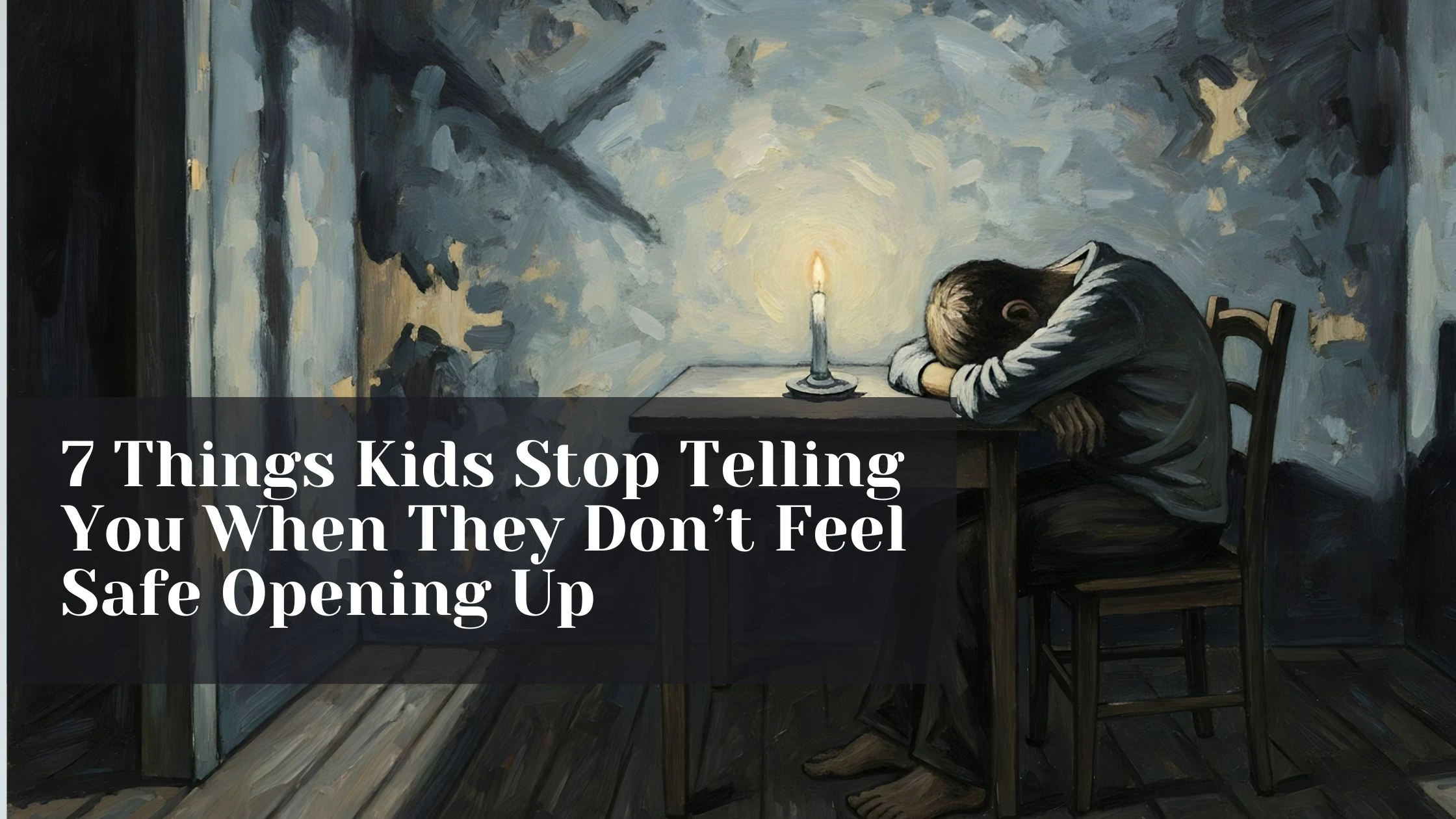
Your ten-year-old comes home from school, drops their backpack by the door, and heads straight to their room. You call out, “How was your day?” They respond with the automatic “Fine” without even slowing down. The door clicks shut.
You remember when they used to burst through that same door, words tumbling out before their shoes were off, telling you about everything—who said what at lunch, how the math test went, the argument they had with their friend, the weird thing the substitute teacher did. Now, you get one word. Fine.
What happened? When did your child, who once told you everything, start telling you nothing?
Here’s the uncomfortable truth most parents don’t want to face: children don’t suddenly become uncommunicative because of adolescence or hormones or “just a phase.” They stop talking because somewhere along the way, they learned that opening up isn’t safe. Not physically unsafe—emotionally unsafe. They learned that sharing their inner world leads to outcomes that feel bad enough that silence becomes the better option.
The Foundation: What Makes Communication Safe
Before we explore what children stop sharing, we need to understand what creates emotional safety in the first place. This isn’t about being a perfect parent or never making mistakes. It’s about understanding the fundamental conditions children need to feel safe bringing you their whole, authentic selves.
Psychiatrist and neuroscientist Dr. Daniel Siegel developed what he calls “The Four S’s” that children need from their caregivers to develop secure attachment: Safe, Seen, Soothed, and Secure. These principles, drawn from decades of attachment research and neuroscience, describe the emotional environment where children feel comfortable being vulnerable.
Safe means the child trusts that you won’t be a source of fear—that expressing emotions or sharing struggles won’t result in punishment, shame, or emotional overwhelm.
Seen means the child experiences that their inner world—their thoughts, feelings, and experiences—are accurately perceived and validated by you.
Soothed means the child knows that when they’re distressed, you’ll help them navigate those difficult emotions rather than dismissing or amplifying them.
Secure means the child develops an internalized sense that they’re worthy of love and that you’re reliably there for them.
Research from psychologist John Gottman, who spent decades studying family dynamics at the University of Washington, identified what he calls “emotion coaching” versus “emotion dismissing” parenting styles. In his groundbreaking 1996 research published in the Journal of Family Psychology, Gottman and colleagues found that parents who practice emotion coaching—noticing low-intensity emotions, viewing negative emotions as opportunities for connection, validating feelings, and helping children label emotions—raise children with better emotional regulation, higher self-esteem, and more willingness to communicate openly.
The stakes are high. According to research cited by Gottman, the most important predictor of a child’s emotional and psychological stability is the closeness of the parent-child relationship. When children don’t feel safe opening up, that closeness erodes—and with it, their willingness to share the seven things we’re about to explore.
The 7 Things Children Stop Sharing
1. Their Mistakes and Failures
Your child bombs a test. Gets cut from the team. Forgets an important assignment. Messes up something they promised they’d do. In a safe relationship, they’d come to you with this. In an unsafe one, they hide it, lie about it, or wait until you find out on your own.
What makes this unsafe to share: When children’s mistakes are met with anger, disappointment that feels like rejection, lectures about irresponsibility, or punishment that feels disproportionate, they learn that failure isn’t something they can bring to you. They learn that your love and approval feel conditional on their success, even if you’d never consciously want them to feel that way.
Gottman’s research on emotion coaching emphasizes that children need to know that their caregivers see difficult moments as opportunities for intimacy and teaching, not occasions for criticism or withdrawal of affection. When parents can respond to failures with curiosity rather than judgment—”That must have been disappointing. What happened?” instead of “How could you let this happen?”—children learn that imperfection doesn’t threaten the relationship.
What happens instead: Children become skilled at hiding evidence of failure. Report cards mysteriously don’t make it home. Emails from teachers get deleted. They construct elaborate stories to explain why they can’t participate in something they were cut from. The energy that could go into learning from mistakes goes into concealing them.
The long-term impact: Research published in 2021 examining emotion socialization found that children who feel safe sharing negative experiences develop better self-regulation skills and more resilience. Children who hide their failures from parents often develop perfectionism, fear of trying new things, and a belief that their worth depends on achievement.
2. How They Really Feel About Things (Especially When Those Feelings Are “Negative”)
“I hate my brother.” “I’m sad that we moved.” “I’m scared about starting middle school.” “I’m angry that you and Dad fight so much.” “I feel lonely even though I have friends.”
These are real, valid feelings that children experience. But many children learn early that certain feelings aren’t acceptable to express.
What makes this unsafe to share: When children express difficult emotions and hear responses like “You don’t really hate your brother” or “There’s nothing to be scared about” or “You’re being too sensitive,” they receive a clear message: your feelings aren’t valid, and I’m not comfortable with your emotional reality.
Gottman’s meta-emotion research, spanning work from 1996 through recent applications, shows that parents often have specific philosophies about which emotions are acceptable. Some parents are comfortable with sadness but uncomfortable with anger. Some tolerate frustration but dismiss fear. Children quickly learn which emotions get validating responses and which get shut down.
According to research on parental emotion coaching styles published in 2021, emotion dismissive parents tend to avoid and ignore emotions, conveying to children that emotional expressions are unwarranted. The impact is devastating: children learn to suppress their emotional experiences, which impairs their developing ability to regulate emotions throughout life.
What happens instead: Children develop what psychologists call “display rules”—they show only the emotions they believe are acceptable while hiding their actual feelings. A child might smile and say they’re excited about something when they’re actually terrified. They might act fine when they’re falling apart inside. Their internal experience and external presentation become disconnected.
The neuroscience: Dr. Siegel’s work on brain integration explains that when children can name and process their emotions with a supportive adult, they’re building neural pathways in the prefrontal cortex that allow for healthy emotional regulation. When emotions are dismissed or invalidated, the child’s brain doesn’t develop these integrative capacities as effectively.
3. Their Fears and Worries
“What if something bad happens to you?” “I can’t stop thinking about that scary thing I saw.” “I’m worried nobody likes me.” “I’m afraid I’m not smart enough.”
Children have complex inner lives filled with worries that can feel overwhelming. When they feel safe, they bring these worries to you. When they don’t, they carry them alone.
What makes this unsafe to share: Minimizing fears (“That’s silly, there’s nothing to worry about”), becoming visibly anxious yourself when they share worries (which communicates that their fears are in fact threatening), or rushing to fix every problem instead of helping them develop coping skills all send the message that their worries aren’t welcome.
Research on parenting anxious children published in a 2017 study comparing parents of anxious versus non-anxious children found that parents of anxious children showed significantly lower emotional awareness and less emotion coaching. They were less able to detect subtle emotions in themselves and their children, and less likely to communicate understanding of and empathy for their child’s emotions.
The crucial finding: It’s not that these parents didn’t care—it’s that they didn’t know how to hold space for their child’s difficult emotions. Some parents model maladaptive emotional coping strategies because they can’t regulate their own anxiety about their child being anxious.
What happens instead: Children learn to keep their worries secret. They lie awake at night processing fears alone. They develop anxiety symptoms—stomachaches, headaches, sleep problems—that parents can see but can’t connect to the emotional world the child is hiding. In extreme cases, untreated childhood anxiety that children feel they must hide can develop into more serious mental health issues.
The alternative: Gottman’s five steps of emotion coaching include: become aware of low-intensity emotions in your child, view your child’s emotions as a time for intimacy and teaching, communicate understanding and acceptance toward your child’s emotions, help your child label their emotions, and assist with problem-solving when appropriate. Notice that problem-solving comes last—first comes awareness, validation, and emotional labeling.
4. Problems With Friends or Peers
“Jessica was mean to me today.” “Nobody sat with me at lunch.” “The kids in my class make fun of how I talk.” “My best friend is mad at me and I don’t know why.”
Social struggles are some of the most painful experiences of childhood. But many children learn that sharing these struggles doesn’t help and might make things worse.
What makes this unsafe to share: When parents respond to social problems by immediately jumping to solutions (“Just make new friends!” “Tell the teacher!” “Stop caring what they think!”), minimizing the pain (“Kids can be mean, you just have to toughen up”), or becoming so upset themselves that the child ends up comforting the parent, children learn to keep social struggles private.
There’s also a particular pain that happens when parents don’t believe children about social difficulties. “Are you sure that’s what happened?” “Maybe you misunderstood.” “You probably did something to upset them first.” These responses communicate that the child’s perception of their own social experience isn’t trusted.
The research: A 2021 study on parent emotion socialization found that parenting programs including emotional communication components were among the most effective for reducing behavioral problems and improving children’s emotional competence. Teaching parents to validate their child’s social-emotional experiences without immediately solving or dismissing them was key.
What happens instead: Children internalize that their social struggles are something to be ashamed of. They stop telling you who their friends are, what happens at school socially, who’s being kind or unkind. You lose access to a huge portion of their daily emotional experience. By the time problems escalate to bullying or serious social isolation, you’re finding out from teachers or other parents because your child stopped telling you months or years ago.
Daniel Siegel emphasizes that being “seen”—having your experiences accurately perceived and validated—is fundamental to secure attachment. When children’s social experiences aren’t seen and validated, they learn that a core part of their life isn’t something they can share with the most important people in their world.
5. Things They’re Excited About (That You Might Not Value)
“I got to level 45 in my game!” “Look at this video I found!” “Can I tell you about this thing that happened in the book I’m reading?” “I learned how to do this cool trick!”
These moments of joy and enthusiasm seem insignificant, but they’re how children invite you into their world. When that invitation is consistently declined, they stop extending it.
What makes this unsafe to share: Rolling your eyes at their interests, half-listening while looking at your phone, responding with “That’s nice, honey” in a tone that communicates you don’t actually care, or immediately redirecting to something you think is more important (“That’s great, but did you finish your homework?”) all send a clear message: what matters to you doesn’t matter to me.
This is subtle emotional dismissal, and children are exquisitely attuned to it. They can tell when you’re genuinely interested versus performing interest. And when they consistently experience that their joys don’t matter to you, they learn to keep those joys to themselves.
The deeper impact: Gottman’s research on emotional attunement shows that when parents honor their child’s feelings and experiences—including their excitement about things parents might find trivial—children develop a sense that their internal experiences are real and valid. This builds self-worth and emotional intelligence.
Conversely, when enthusiasm is consistently met with indifference or dismissal, children learn that their inner world isn’t valuable. This doesn’t just affect what they share—it affects how they feel about themselves.
What happens instead: Children develop separate compartments in their lives. There’s the version they show you, which sticks to topics they know you care about. And there’s the real version, with all their actual interests and enthusiasms, which they only share with people who actually seem to care—friends, online communities, sometimes nobody at all.
By the time they’re teenagers, you might find yourself wondering how your child became so distant, so hard to talk to. But they learned years earlier that their real self wasn’t particularly interesting to you. They adapted.
6. When They Feel Hurt by Something You Did
“It hurt my feelings when you said that in front of my friends.” “I felt embarrassed when you told that story about me.” “I don’t like it when you compare me to my sister.” “It scared me when you and Mom were yelling at each other.”
This is perhaps the most difficult thing for children to share because it requires them to voice criticism of the people they depend on most. And for many children, this feels impossible.
What makes this unsafe to share: When children try to express hurt about parental behavior and are met with defensiveness (“I wasn’t yelling, I was just talking loudly!” “You’re being too sensitive!” “After everything I do for you, this is how you talk to me?”), denial (“That didn’t happen” or “I never said that”), or anger and punishment, they learn that parental imperfection is not discussable.
Siegel’s work on rupture and repair emphasizes that perfection isn’t necessary for healthy development—what matters is the ability to recognize when disconnections happen and actively work to repair them. He states clearly: “The rupture is inevitable, but the repair is what’s essential.”
When children can’t safely tell you that you’ve hurt them, repair becomes impossible. The hurts accumulate. The relationship develops unseen wounds. And children learn that protecting their parents’ feelings is more important than expressing their own.
What happens instead: Children learn to dissociate from their hurt. “It didn’t really bother me.” “I’m fine.” “I don’t care.” They develop sophisticated emotional defenses against the pain of being hurt by the people who are supposed to protect them. They might express that hurt indirectly through behavior—acting out, withdrawing, becoming oppositional—because the direct path of communication has been closed.
Research on parental meta-emotion shows that parents who can tolerate their children’s negative emotions—including negative emotions about the parent—raise children with better emotional regulation and healthier relationships. Parents who can’t tolerate this feedback raise children who learn to hide their authentic experiences.
7. Their Questions About Big, Uncomfortable Topics
“Why did Grandma die?” “What’s sex?” “Why did you and Dad get divorced?” “Why do some kids not have enough food?” “Am I going to die?” “Why do people hate other people because of how they look?”
Children have profound questions about life, death, suffering, sexuality, family dynamics, and human nature. When they feel safe, they bring these questions to you. When they don’t, they seek answers elsewhere—from peers, from the internet, from their own often-frightening imaginations.
What makes this unsafe to share: Shutting down questions (“You’re too young to understand that” or “We don’t talk about that”), becoming visibly uncomfortable or changing the subject, giving dishonest answers because you’re uncomfortable with the truth, or overreacting with anger or anxiety all communicate that certain topics are off-limits.
Children need adults who can tolerate their questions about difficult realities. When you can’t be that person, they learn that their deepest curiosities and concerns about life aren’t things they can share with you.
Research on parent-child communication emphasizes that creating a safe space for children to express thoughts and emotions without judgment is crucial for their well-being. Attempting to fully understand the child’s experience is essential to being able to relate to and empathize with the child.
What happens instead: Children stop asking. They form understanding of complex topics from whatever sources they can find, which are often unreliable, age-inappropriate, or outright harmful. The questions don’t go away—they just go underground.
By adolescence, when they’re facing even more complex questions about identity, sexuality, relationships, and their place in the world, the pattern is firmly established: these aren’t things I can talk to my parents about. The very moments when they most need wise, caring guidance become the moments they navigate alone.
The Invisible Accumulation
Here’s what makes this pattern so insidious: each individual instance feels small. One dismissed feeling, one minimized worry, one eye-roll at their enthusiasm, one defensive response when they express hurt. In the moment, it seems insignificant.
But children’s brains are pattern-recognition machines. As Siegel’s research on the developing mind shows, repeated interpersonal experiences literally shape brain architecture. Each small moment of emotional safety or unsafety is data points the child’s brain uses to answer fundamental questions: “Is it safe to share my feelings? Do my experiences matter? Will I be rejected if I’m vulnerable?”
Gottman’s longitudinal research tracking children over time found that patterns of parental emotion coaching versus emotion dismissing in childhood predicted children’s self-regulation, social competence, and mental health years later. These weren’t single moments—they were accumulated patterns that built the foundation of how children understood themselves and their relationships.
When You Realize They’ve Stopped Telling You
Maybe you’re reading this and recognizing that your child has already stopped sharing these seven things. Maybe you’re realizing that you’re hearing more “fine” and “nothing” than actual information about their inner world. Maybe you’re wondering if it’s too late.
Here’s Siegel’s hopeful message about attachment: “All parents can have a secure attachment with their children, regardless of what their own childhood experiences were like. The key is developing a coherent narrative of your own upbringing.”
Translation: The patterns can change. Relationships can repair. But it requires parents to do their own work of understanding why emotional safety is hard for them to provide. Maybe you were raised in an emotion-dismissing environment yourself. Maybe you struggle with your own emotional regulation. Maybe your child’s feelings trigger your own unprocessed pain.
Rebuilding Emotional Safety
If you want to create conditions where your child feels safe opening up again, here’s what research suggests:
Acknowledge the pattern: “I’ve noticed you don’t talk to me much about how things are going. I wonder if I’ve done things that made it feel unsafe to share with me. I want to change that.”
Practice repair: Siegel emphasizes that ruptures are inevitable but repair is essential. When you respond badly to something your child shares, come back to it. “I didn’t respond well when you told me about that. You deserved better. Can we talk about it again?”
Get curious, not reactive: Gottman’s emotion coaching framework starts with noticing low-intensity emotions and viewing them as opportunities for connection. Before you fix, lecture, or judge, get curious. “Tell me more about that. How did that feel? What was that like for you?”
Validate before you redirect: “That sounds really hard” or “I can understand why you’d feel that way” before you offer perspective or solutions. Children need to feel heard before they can hear you.
Make it safe to tell you hard things: “I want you to know you can tell me anything, even if you think it will upset me or even if it’s something I did that hurt you. Our relationship is strong enough to handle hard conversations.”
Seek help when you need it: If you find yourself unable to tolerate your child’s emotions, if their vulnerability triggers your defensiveness, if you’re repeating patterns from your own childhood that you don’t want to repeat, consider working with a therapist. Research consistently shows that parenting interventions focused on emotion coaching significantly improve parent-child relationships and child outcomes.
The Relationship Worth Fighting For
Your child telling you “nothing” when you ask about their day isn’t teenage attitude. It’s the natural endpoint of accumulated moments when sharing didn’t feel safe.
But here’s the hopeful truth: children want to connect with their parents. They want to share their world, their feelings, their questions, their joys and their struggles. When the environment becomes safe enough, they will.
It might not happen overnight. They might test whether it’s really safe by sharing small things and seeing how you respond. They might stay guarded for a while, having learned that vulnerability isn’t safe. But consistent emotional safety, over time, rebuilds trust.
Research shows that the closeness of the parent-child relationship is the most important predictor of a child’s emotional and psychological stability. When that relationship includes emotional safety—when children can bring you all seven of these things we’ve explored—they develop the capacity for healthy emotional regulation, authentic relationships, and resilient mental health.
That’s worth fighting for. That’s worth doing the uncomfortable work of looking at how you respond to your child’s vulnerability. That’s worth changing patterns that might stretch back through generations of your family.
Because the alternative—a child who moves through life believing their feelings don’t matter, their struggles should be hidden, their joys are insignificant, and their true self is too much for the people who should love them most—that’s too heartbreaking to accept.
Your child is still there, behind the “fine” and the “nothing.” They’re hoping for someone to notice. They’re hoping it might be safe to share again. They’re hoping you’ll create the conditions where their whole, authentic self is welcome.
That starts with understanding what they’ve stopped telling you—and why.
If you’re a parent reading this, what resonates most? Have you noticed your child becoming less communicative? What’s one thing you could do differently to create more emotional safety? Share your thoughts in the comments—sometimes the most powerful parenting insights come from being honest about what’s hard.
If this article gave you new perspective on why children withdraw, please share it with a parent who might be struggling to understand why their once-talkative child has gone quiet. Sometimes awareness is the first step toward creating the relationship both parent and child want.