
Your daughter brings home a test with a 92% written at the top in red ink. Most parents would be thrilled—that’s an A! But when you congratulate her, she bursts into tears. “I got two wrong,” she sobs. “I’m sorry. I should have studied harder. I should have been more careful.” You’re confused. Why is she apologizing for an excellent grade? Why does she look genuinely terrified that you might be disappointed?
Or maybe it’s this: Your son tells you he made the soccer team, but instead of excitement, you notice something’s off. His smile doesn’t quite reach his eyes. When you press him about it, he finally admits he got placed on the B team, not the A team. “I know you wanted me to make the top team,” he says quietly, shoulders slumped. “I’m sorry I let you down.” You never said any such thing. You didn’t even know there were different teams. But somehow, he’s carrying the weight of disappointing you for something you don’t actually feel disappointed about.
If scenarios like these feel familiar, your child might be living with a fear that’s surprisingly common and profoundly damaging: the fear of disappointing you.
The Hidden Weight Children Carry
Before we dive into the specific signs, let’s talk about what’s really happening when children fear disappointing their parents. Because this isn’t about occasional worry or wanting to make you proud—that’s normal and healthy. We’re talking about something deeper and more pervasive.
According to research published in December 2024, the fear of disappointing parents is an emotional burden that has long-term repercussions. Children experiencing this fear live under chronic stress because they are constantly anticipating criticism or disapproval. This pressure can result in anxiety, inability to make decisions, and an absence of confidence.
A 2024 study on parental expectations and maladaptive perfectionism found that the crippling self-scrutiny associated with trying to meet parental expectations fosters a hyperawareness of perceived failure and a dread of disappointing oneself and others. This fear is so powerful that it can lead to anxiety, depression, burnout, and even physical health problems like chronic fatigue syndrome, gastrointestinal disorders, and immune system dysfunction—effects that can persist throughout life.
What makes this particularly heartbreaking is that many parents have no idea they’re creating this dynamic. You might think you’re being encouraging when you celebrate achievements. You might believe you’re preparing your child for the real world when you push them to do their best. You might be genuinely proud of them. But somewhere along the way, your child internalized a message you never intended to send: “Your worth depends on your performance. Love is conditional on success. Mistakes are unacceptable.”
Research from a 2016 study at the National University of Singapore found that when parents become intrusive in their children’s lives, it may signal to children that what they do is never good enough. As a result, children may become afraid of making the slightest mistake and will blame themselves for not being “perfect.” Over time, this maladaptive perfectionism increases the risk of developing symptoms of depression, anxiety, and in very serious cases, even suicidal thoughts.
So how do you know if your child is carrying this burden? Let’s look at the five most common signs.
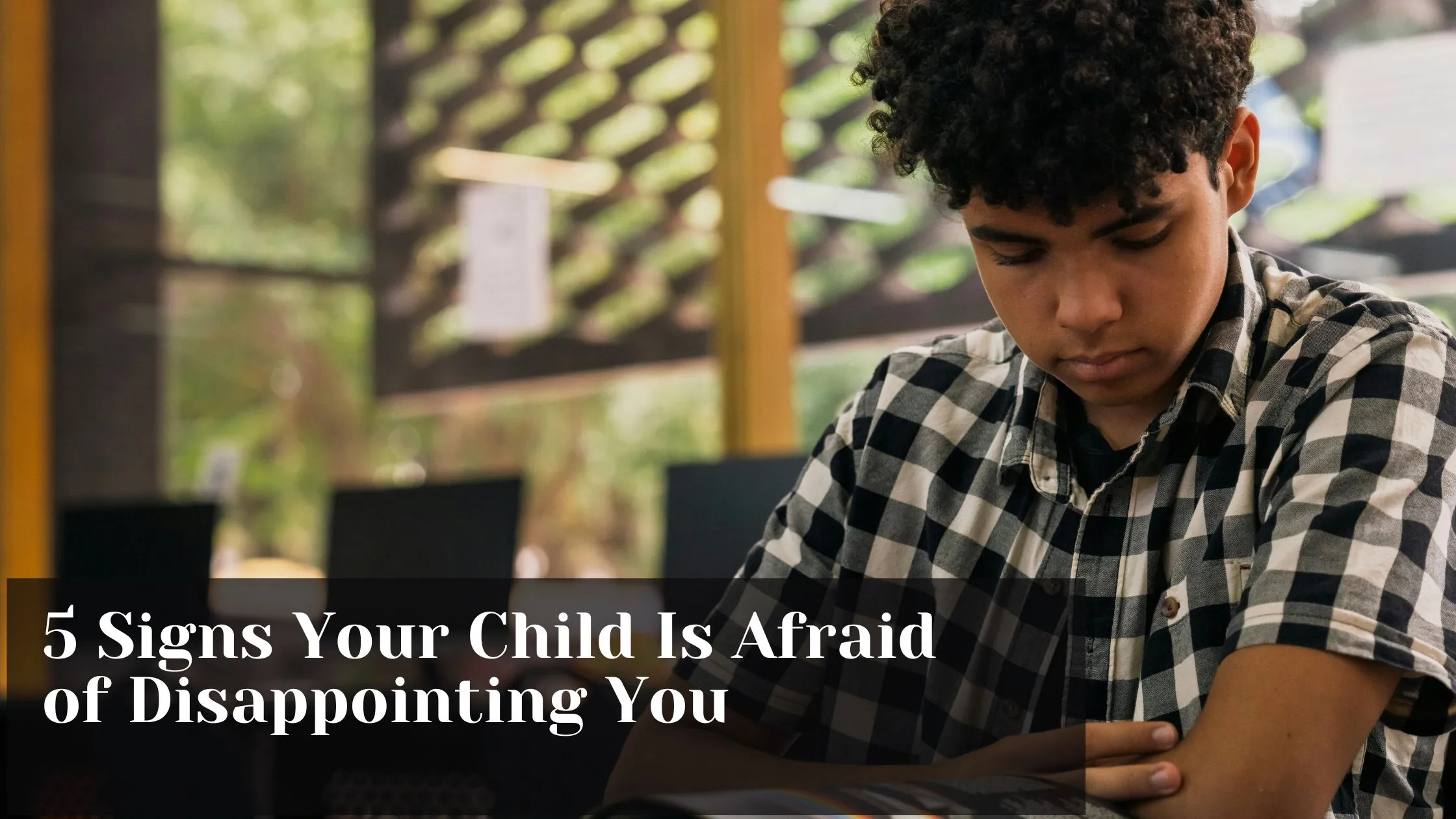
5 Signs Your Child Is Afraid of Disappointing You
1. Extreme Perfectionism and Meltdowns Over Minor Mistakes
This is perhaps the clearest signal that a child fears disappointing their parents. When children become devastated by small errors, spend excessive time trying to make work “perfect,” or refuse to try new things for fear of not excelling immediately, they’re showing signs of performance anxiety rooted in fear of disappointing you.
What this looks like:
- Erasing homework repeatedly until the paper tears
- Crying over a single wrong answer on a test despite a good overall grade
- Refusing to turn in assignments they deem “not good enough”
- Spending hours on projects that should take minutes
- Avoiding new activities unless they can guarantee success
- Becoming visibly distressed when they make any mistake, no matter how small
According to a 2025 study examining parental expectations, children who perceive their parents as excessively worried about their mistakes tend to report higher levels of perfectionism, possibly due to increased parental intervention that inadvertently promotes perfectionistic tendencies. The study found that emerging adults experiencing high parental psychological control and authoritarian parenting tend to exhibit maladaptive perfectionism, with consequences including lower life satisfaction, increased depression and anxiety, and lower academic achievement.
Why this matters: Perfectionism in children isn’t about high standards—it’s about fear. Research published in July 2025 explains that perfectionism often comes from a fear of failure or a desire to avoid disappointment or criticism. When your child’s drive for perfection is fueled by anxiety rather than genuine pride in their work, it’s a red flag.
The 2016 Singapore study found that about 60% of children studied were classified as high and/or increasing in self-criticalness, while 78% were classified as high in socially prescribed perfectionism (the perception that others have unrealistically high expectations of them). Both aspects tend to co-occur, with 59% of children having both—and these children demonstrated elevated depression and anxiety symptoms.
What you can do: Shift your language from outcome-focused to process-focused praise. Instead of “Great job getting an A!” try “I’m proud of how much effort you put into studying.” Model making mistakes yourself and responding to them with self-compassion rather than self-criticism. Say things like, “Oops, I messed that up! That’s okay, I’ll try again.” Show them that mistakes are normal parts of learning, not evidence of personal failure.
2. Hiding Mistakes or Lying to Avoid Your Reaction
When children become secretive about difficulties, hide bad grades, lie about mistakes, or go to extreme lengths to conceal anything imperfect, they’re showing you they don’t feel safe bringing you problems.
What this looks like:
- “Forgetting” to show you graded tests or assignments
- Lying about homework being complete when it isn’t
- Hiding evidence of mistakes (throwing away papers, deleting messages)
- Becoming defensive or creating elaborate excuses when caught in errors
- Visibly anxious when you ask about school or activities
- Changing the subject whenever you inquire about their day
According to research on lying in children from April 2024, more often than not, children lie because of fear of disappointing or displeasing parents. When children don’t trust that parents will support and guide rather than punish them for mistakes or wrongdoing, lying becomes a protective strategy.
Why this matters: Lying is often a symptom, not the problem. When children lie, research from July 2025 suggests it’s often a sign of unmet needs—particularly the need to feel safe from shame, criticism, or consequences that feel disproportionate. Children who fear disappointing their parents learn that honesty leads to outcomes they can’t handle emotionally, so they resort to concealment.
A 2025 study published in the British Journal of Educational Psychology examined how mothers talk to their children about failures and setbacks. The research found that 40% of mothers either minimally acknowledged or dismissed their child’s emotions when discussing disappointments. When parents don’t create space for mistakes and the emotions that accompany them, children learn to hide both.
What you can do: Create psychological safety around mistakes. When your child does confess a problem, resist your immediate emotional reaction. Take a breath. Thank them for their honesty first, before addressing the issue itself. Say something like, “Thank you for telling me the truth. I know that was hard. Now let’s talk about what happened and how we can fix it together.” When honesty is rewarded with patience and problem-solving rather than anger or disappointment, children learn they can trust you with difficult truths.
3. Excessive Anxiety Before Evaluation or Performance Situations
When children experience physical symptoms of anxiety before tests, performances, or any situation where they’ll be evaluated, they’re showing you that the stakes feel impossibly high.
What this looks like:
- Stomachaches or headaches before tests or evaluations
- Difficulty sleeping the night before performances or presentations
- Panic attacks or intense anxiety about graded assignments
- Over-preparing to an unhealthy degree
- Catastrophizing about potential outcomes: “If I don’t get an A, I’ll fail the class, won’t get into college, and my life will be ruined”
- Physical symptoms: shaking hands, racing heart, nausea
Research published in March 2025 examining school-based performance anxiety programs found that maladaptive perfectionism and perceived parental pressure significantly impact how children experience test anxiety and fear of failure. The study demonstrated that adolescents with higher self-criticism perfectionism and socially prescribed perfectionism (believing others have unrealistically high expectations) experienced more severe anxiety around performance situations.
Why this matters: Performance anxiety at this level isn’t about caring about doing well—it’s about believing that failure means personal worthlessness or parental disappointment. According to November 2025 research on fear of failure, external pressure from parents, teachers, or coaches can make kids equate love or approval with success. When children believe mistakes mean they’re “less than” or that parental love is conditional on achievement, anxiety becomes debilitating.
The same research notes that fear of failure rarely exists alone—it’s often part of a trio with anxiety and perfectionism. Children trapped in this cycle may avoid trying new things, hide their mistakes, procrastinate, or even sabotage themselves before they can “fail.”
What you can do: Decouple your love from their performance. Explicitly and frequently tell your child: “I love you whether you get an A or an F. Your grades don’t change how I feel about you.” When they’re anxious before a test, don’t add pressure by saying “Just do your best!” (which perfectionists interpret as “Be perfect!”). Instead, try: “Whatever happens, we’ll handle it together. Tests show what you know on one day—they don’t show who you are as a person.”
4. Over-Apologizing and Excessive Guilt
Children who fear disappointing you often apologize for things that don’t warrant apologies and carry guilt that’s disproportionate to any actual wrongdoing.
What this looks like:
- Saying “I’m sorry” constantly, even for things outside their control
- Apologizing for normal childhood behaviors or needs
- Taking responsibility for things that aren’t their fault
- Expressing guilt about disappointing you in situations where you’re not actually disappointed
- Seeming to anticipate criticism or disappointment that isn’t coming
- Difficulty accepting compliments or reassurance
Why this matters: Excessive apologizing indicates that your child has internalized the belief that they’re constantly falling short. They’re apologizing not for what they did, but for who they are. According to the December 2024 research on fear of disappointing parents, when children grow up with conditional parental regard—approval only when expectations are met—they start believing that love is not something given, but earned. They develop internal rules like “I must never fail” and “I must always make them proud.”
When parents communicate (even unintentionally) that certain emotions, needs, or mistakes are unacceptable, children learn to apologize for their very existence. They become hypervigilant for signs of parental disapproval and try to preemptively apologize to avoid it.
What you can do: When your child apologizes unnecessarily, gently point it out: “You don’t need to apologize for that. You didn’t do anything wrong.” Help them distinguish between situations that warrant apologies and situations that don’t. Model healthy apologies yourself—ones that are specific, proportionate, and followed by repair rather than excessive self-flagellation. Show them what balanced accountability looks like.
5. Reluctance to Share Struggles or Ask for Help
When children stop coming to you with problems, when they insist they’re “fine” even when they’re clearly not, or when they’d rather fail silently than ask for support, they’re showing you they don’t believe you’re safe to approach with difficulties.
What this looks like:
- Insisting everything is “fine” even when you can tell it’s not
- Refusing help with homework or projects even when struggling
- Becoming evasive when you ask about school, friends, or activities
- Seeming to withdraw emotionally from the family
- Preferring to handle everything alone rather than involving you
- Only sharing successes, never struggles or failures
The 2025 British Journal of Educational Psychology study found that when mothers acknowledged their child’s emotions and discussed ways to work collaboratively on future problems, there was a notable decrease in the child’s fear of mistakes. However, 79% of mothers in the study rarely discussed collaborative resources—ways they could work together with their child to solve problems.
Why this matters: Children who won’t share struggles are protecting themselves from something—usually criticism, disappointment, or the feeling that they’ve let you down. When asking for help feels like admitting failure, and failure feels like losing your love or approval, children choose isolation over vulnerability.
This is particularly concerning because it sets up a pattern that can persist into adulthood. Adults who grew up afraid to disappoint their parents often struggle with asking for help, admitting mistakes, or being vulnerable in relationships. The fear becomes so internalized that they can’t distinguish between their own standards and the standards they believe others have for them.
What you can do: Actively create opportunities to normalize struggling and needing help. Share your own difficulties: “I’m having trouble figuring out this project at work. I think I need to ask my colleague for help.” When your child does come to you with a problem, celebrate the vulnerability, not just the solution: “I’m so glad you told me about this. It takes courage to admit when something is hard.” Explicitly tell them: “I’d rather you ask for help and succeed than struggle alone and fail. Needing help doesn’t disappoint me—it shows wisdom.”
The Parent-Child Dynamic That Creates This Fear
If you’re reading these signs and recognizing your child, you might be feeling guilt, confusion, or defensiveness. “But I’ve never told them they’re disappointing!” “I thought I was being supportive!” “I just want them to succeed!”
I believe you. Here’s what’s complicated: the fear of disappointing parents is often created through subtle dynamics that parents don’t consciously intend.
According to the research on parental expectations, emerging adults experiencing high parental psychological control—including guilt induction, withdrawal of love, or excessive monitoring—show increased anxiety and overdependence on parental approval. The research emphasizes that in environments where parental love feels conditional, children learn to do things right “at all costs” since making a mistake has the potential to result in emotional consequences.
This can happen even in loving families. Maybe you emphasize achievement a little too much. Maybe you compare siblings. Maybe you express disappointment in subtle ways—a sigh, a change in tone, a momentary look of frustration. Maybe you praise your child effusively for successes but respond to struggles with problem-solving rather than empathy. Maybe your own anxiety about their future comes across as pressure on their present performance.
Children are extraordinarily attuned to their parents’ emotional states. They pick up on what makes you proud and what makes you worried. They internalize not just what you say explicitly, but what your reactions communicate implicitly. And if your reaction to mistakes feels bigger than your reaction to successes, or if love feels more accessible when they’re performing well, they learn that approval is conditional.
Breaking the Cycle: How to Raise Children Free from This Fear
The good news is that once you recognize this pattern, you can change it. Here’s how:
Examine your own relationship with achievement and failure
Often, the pressure we put on our children mirrors the pressure we experienced or the pressure we put on ourselves. If you were raised in an achievement-oriented household, if you struggle with perfectionism, if your self-worth is tied to success—your child is learning these patterns from you. Working on your own relationship with failure and worthiness is one of the most important things you can do for your child.
Separate your child’s worth from their achievements
Say it out loud, frequently and explicitly: “Your value doesn’t come from your grades/performance/achievements. You are valuable because you exist, because you’re you. Nothing you do or don’t do changes that.” Don’t just say it—demonstrate it. Show equal interest and warmth whether they succeed or fail.
Make mistakes a normal part of family life
Share your own mistakes openly. “I completely messed up that presentation at work today” or “I forgot to pay that bill and now we have a late fee.” Show them how you handle mistakes: with self-compassion, problem-solving, and perspective. Create a family culture where mistakes are expected, normalized, and used as learning opportunities.
Respond to struggles with empathy before solutions
When your child shares a difficulty, resist the urge to immediately fix it or teach a lesson. First, sit with them in the difficulty. “That sounds really hard. I can see why you’re upset.” The 2025 British Journal study found that when mothers acknowledged children’s emotions and discussed collaborative resources (what they could do together), children’s fear of mistakes decreased significantly.
Focus praise on effort, strategy, and character, not outcomes
Instead of “You’re so smart!” try “You worked really hard on that.” Instead of “Great job getting first place!” try “I noticed how much you practiced and how you kept trying even when it was difficult.” This teaches them that their effort and character matter more than external validation.
Create unconditional acceptance
This doesn’t mean no boundaries or consequences. It means your child knows, deep in their bones, that your love isn’t performance-based. That they can come to you with anything—failure, mistakes, struggles, fears—and you will still be their safe place. That disappointing you is uncomfortable but not devastating because your regard for them isn’t contingent on their performance.
The Long-Term Impact of Fear of Disappointment
Understanding what’s at stake makes this work even more important. Research from the December 2024 study found that teenagers who have high parental expectations tend to record decreased emotional well-being and worry more when considering failure. The study notes that family communication is often impaired—children fear disappointing their parents and therefore conceal errors, don’t discuss issues, and suppress their needs. This creates emotional distance over time, even when there is great affection.
The fear can become so intense that people avoid taking risks or pursuing new opportunities because they’re afraid that failure will reflect poorly on their family. The psychological patterns established during childhood resonate throughout life as anxiety, depression, burnout, and health problems.
But when children grow up without this fear? When they know that their parents’ love is unconditional, that mistakes are opportunities rather than catastrophes, that struggling doesn’t mean disappointing? They develop resilience, healthy self-esteem, emotional intelligence, and the confidence to take appropriate risks. They become adults who can ask for help, admit mistakes, pursue meaningful goals without debilitating anxiety, and have authentic relationships.
That’s what’s possible on the other side of this work.
Moving Forward with Compassion
If you’ve recognized your child in these signs, take a breath. Feeling guilty doesn’t help anyone. What matters now is what you do next.
Your child developed this fear because they love you and want your approval—that’s actually a sign of a strong attachment. The good news is that the same relationship that created the dynamic can heal it. Children are remarkably resilient when parents are willing to acknowledge patterns and make changes.
Start small. Pick one thing from the “what you can do” sections and focus on it this week. Maybe it’s explicitly telling your child that your love isn’t conditional on their grades. Maybe it’s sharing one of your own mistakes and how you handled it. Maybe it’s responding to their next struggle with empathy before problem-solving.
Notice your own reactions. When your child makes a mistake, what’s your immediate internal response? What does your face do? What tone does your voice take? These micro-reactions communicate more than your words ever will.
And remember: you don’t have to be perfect at this. Trying to be the perfect parent who never creates any pressure is just another form of perfectionism. You’ll mess up. You’ll have moments where old patterns resurface. That’s okay. What matters is the overall trajectory, the genuine effort to change, and your willingness to repair when you notice you’ve slipped into old dynamics.
Your child doesn’t need you to be perfect. They just need to know that they don’t have to be perfect either.
Have you noticed these signs in your child? Have you struggled with the fear of disappointing your own parents? Share your experience in the comments below. Sometimes naming these patterns out loud helps us break free from them.
And if this post helped you see your child’s anxiety in a new light, please share it with another parent. We’re all trying to raise confident, resilient children who know they’re loved unconditionally. Every parent who recognizes and addresses this dynamic creates a ripple effect that benefits not just their own family, but generations to come.