
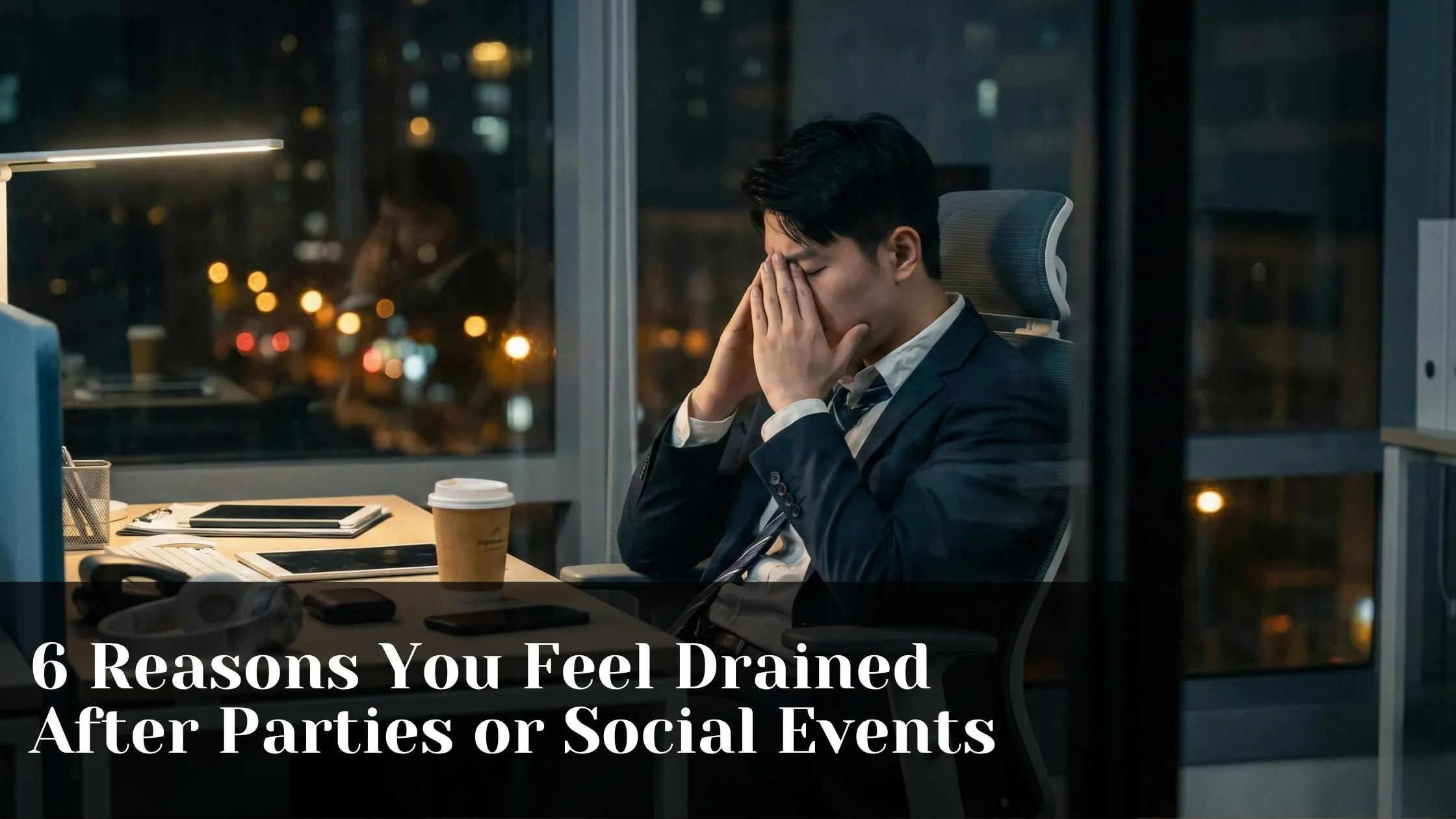
You’ve just attended a friend’s birthday party. By all accounts, it was lovely—good food, friendly people, interesting conversations. But as you walk to your car, you feel like you’ve run a marathon. Your head is pounding. Every sound feels too loud. You can barely form coherent sentences. All you want is silence, darkness, and solitude. Meanwhile, others from the same party are already planning the next gathering, seemingly energized by the evening you found completely depleting.
Or maybe it’s this: You’ve spent the day at a family event. You smiled, chatted, caught up with relatives, played with kids. It should have been fun. And it was, sort of. But now you’re home, and instead of feeling happy or fulfilled, you feel completely hollowed out. You have zero energy for anything else. The thought of one more conversation—even with your partner—feels unbearable. You need to be alone to recover, but you’re not sure from what, exactly, since nothing terrible happened.
If these scenarios resonate, you’re not alone. And more importantly, you’re not broken. There are real, research-backed reasons why social events can feel utterly exhausting—even when they’re enjoyable, even when nothing went wrong, and even if you genuinely like the people you were with.
The Social Energy Paradox: Why Fun Can Still Be Draining
Here’s what confuses most people about social exhaustion: how can something enjoyable be draining? Shouldn’t positive experiences leave us feeling energized?
According to research from the University of Helsinki, participants reported higher levels of fatigue three hours after socializing—whether they were introverts or extroverts. Everyone experiences social exhaustion eventually. It’s not abnormal to find socializing tiring. What varies is how quickly that exhaustion sets in and how intense it feels.
Research from October 2025 emphasizes a crucial point: social fatigue is a reflection of energy depletion after socializing, not enjoyment. You may not realize how active your brain is when you’re socializing, but you’re reading facial expressions, tracking tone of voice, navigating group dynamics, managing emotional responses, and possibly masking discomfort. This is enormous cognitive load.
The key insight: Just because something was enjoyable doesn’t mean it wasn’t draining. Let’s explore the six most common reasons parties and social events leave you depleted.
6 Reasons Social Events Drain You
1. Your Brain Processes Dopamine Differently (Introversion Is Neurological)
If you’re an introvert, the exhaustion after social events isn’t weakness or antisocial tendencies—it’s neuroscience. Your brain is literally wired to respond to social stimulation differently than extroverts’ brains.
According to Colin DeYoung, psychology professor at the University of Minnesota, extroverts have a more activated dopamine system than introverts. When extroverts engage in social interaction, their brains release more dopamine, creating a sense of reward and energy. For introverts, solitude or low-stimulation activities provide more dopamine than highly social ones.
Why this happens: Your brain’s reward system simply doesn’t fire the same way in social situations. You’re not getting the same neurological payoff for the energy expenditure that social interaction requires. This isn’t preference—it’s brain chemistry.
Research from September 2024 emphasizes that introverts are not shy or socially withdrawn—they simply draw energy from their inner world and feel drained by too much social interaction. Unlike extroverts who feel energized by socialization, interacting with others depletes introverts.
The cost: When you spend hours at a party, you’re essentially doing an activity that doesn’t refuel you while simultaneously depleting your energy reserves. By the end, you’re running on empty.
2. You’re Carrying Enormous Cognitive Load Without Realizing It
Even when socializing feels effortless, your brain is actually working incredibly hard. The cognitive demands of social interaction are staggering—and most people don’t realize how much energy they’re expending.
What your brain is doing simultaneously:
- Processing rapid streams of verbal information
- Reading and interpreting facial expressions and body language
- Monitoring your own presentation and adjusting in real time
- Managing conversational timing and turn-taking
- Generating appropriate responses quickly
- Tracking multiple conversations if in a group
- Suppressing inappropriate thoughts or reactions
- Empathizing with others’ emotional states
Research from BBC Science Focus in May 2025 notes that everyone will feel exhausted after a lot of socializing; it’s just that the upper limit varies from person to person. Studies found that if a person was trying hard to make a good impression or meeting lots of new people, they were more likely to feel drained afterwards.
Why this drains you: According to October 2025 research, every social encounter requires mental energy—you read body language, monitor your tone, manage impressions, and empathize with others. This isn’t just happening occasionally—it’s constant throughout the entire event.
The accumulated effect: Hours of this cognitive load leaves your brain genuinely exhausted, similar to how you’d feel after hours of intense mental work. Except at a party, you don’t get breaks the way you would during focused work.
3. You’re Masking, Performing, or Managing Impressions
Sometimes the exhaustion isn’t from socializing itself—it’s from the enormous effort of monitoring yourself, managing how you’re perceived, and potentially hiding your authentic reactions or feelings.
What this looks like:
- Maintaining a pleasant expression even when you’re uncomfortable
- Moderating your natural energy level to match the room
- Censoring thoughts before speaking
- Performing interest in conversations that bore you
- Managing anxiety while appearing relaxed
- Hiding that you’re ready to leave hours before you actually can
Research from May 2025 found that if you have to spend a long time suppressing your true feelings, or showing a certain emotion that’s at odds with what you really feel, you could be more prone to emotional exhaustion and burnout. Jobs that require “service with a smile” make servers more tired, and care workers unable to show their grief or fear may find themselves emotionally drained.
Why this depletes you: You’re essentially running two parallel processes: the actual social interaction and the monitoring/managing of yourself throughout it. This dual processing requires enormous executive function resources.
Research from November 2025 describes what happens the next day: headaches, body feeling sore and drained almost like the onset of flu, and being so tired you can barely function. This physical manifestation reflects the genuine toll that sustained performance takes.
4. Your Nervous System Is Overstimulated by Sensory Input
For highly sensitive people and many introverts, parties aren’t just cognitively demanding—they’re sensory overwhelming.
What’s overstimulating:
- Noise from multiple conversations, music, laughter
- Visual stimulation from movement, decorations, screens
- Physical proximity and touch
- Smells from food, perfume, crowded spaces
- Temperature fluctuations
- Background sounds and competing audio inputs
Why this matters: Research from February 2024 found that crowds, people, noise, conversations, and music make extroverts feel lively, but for introverts, all of that makes them feel drained. According to research, introverts tend to burn out faster because of their high level of baseline brain activity—they’re already processing more internal stimuli, so adding external stimulation quickly leads to overload.
Research from September 2024 notes that introverts are incredibly sensitive to noises, which can contribute to anxiety and distraction. When your nervous system processes sensory information more deeply, parties can feel like assault rather than entertainment.
The cumulative effect: By the end of the event, your nervous system is in overdrive, having processed hours of competing stimuli without adequate breaks. You need silence and low stimulation to recover.
5. You’re Emotionally Absorbing What’s Happening Around You
If you’re highly empathetic, you’re not just managing your own emotional state at social events—you’re unconsciously processing everyone else’s too.
What this feels like:
- Picking up on tension, anxiety, or discomfort in others
- Feeling responsible for making sure everyone’s having a good time
- Absorbing others’ moods (becoming anxious when around anxious people)
- Emotional exhaustion from being attuned to the room’s energy
- Needing time alone afterward to “clear” emotions that aren’t yours
Why this drains you: You’re essentially doing emotional labor for multiple people simultaneously. Your mirror neurons are working overtime, causing you to unconsciously mimic and internalize others’ emotional states.
According to research, constantly interacting with friends, family, or coworkers without adequate breaks can deplete emotional and mental energy, contributing to increased irritability, impatience, or stress.
6. The Event Required Specific Types of Draining Interactions
Not all social situations are equally exhausting. Certain types of interactions require significantly more energy than others.
Most draining scenarios:
- Meeting many new people (constant introductions and small talk)
- Situations requiring impression management (work events, meeting partner’s family)
- Environments with conflict or tension
- Events where you don’t know people well and can’t relax
- Gatherings where you feel obligated to attend rather than genuinely wanting to be there
- Situations requiring “performance” (being the host, giving speeches, entertaining)
Research from May 2025 found that if a person was trying hard to make a good impression or meeting lots of new people, they were more likely to feel drained afterwards. Conflict and complaint also took more energy.
The contrast: Compare this to spending time with one or two close friends in a low-key setting—same amount of time, vastly different energy expenditure. The specific nature of the interaction matters enormously.
What to Do When You’re Socially Drained
Research from September 2024 offers practical strategies:
Honor your need for recovery: After socializing, you may need quiet time to recharge. Set aside at least 10-30 minutes daily that are entirely yours for solitude and reconnection with yourself.
Be selective about events: According to research, learn to say “no” to events that you know will be emotionally draining and “yes” to social events you’ll genuinely enjoy. Prioritize quality over quantity in social commitments.
Set time limits in advance: Before attending an event, decide how long you’ll stay. This gives you permission to leave when your energy depletes rather than pushing through to exhaustion.
Identify your triggers: Notice which specific situations drain you most. Large groups? Small talk? Loud environments? Knowing your triggers helps you prepare or avoid them.
Accept your wiring: Research emphasizes that introversion isn’t a bad trait. Learning to accept yourself helps you honor your needs without shame.
The deeper truth: Feeling drained after parties doesn’t mean you’re antisocial or unfriendly. It means your nervous system, brain chemistry, and energy patterns work in a particular way that requires recovery time after social stimulation.
Do you regularly feel drained after social events? Which reason resonates most with your experience? Share in the comments below.
And if this helped you understand why socializing depletes you, please share it. Millions experience this but think something’s wrong with them. Understanding it’s normal and explainable changes everything.