
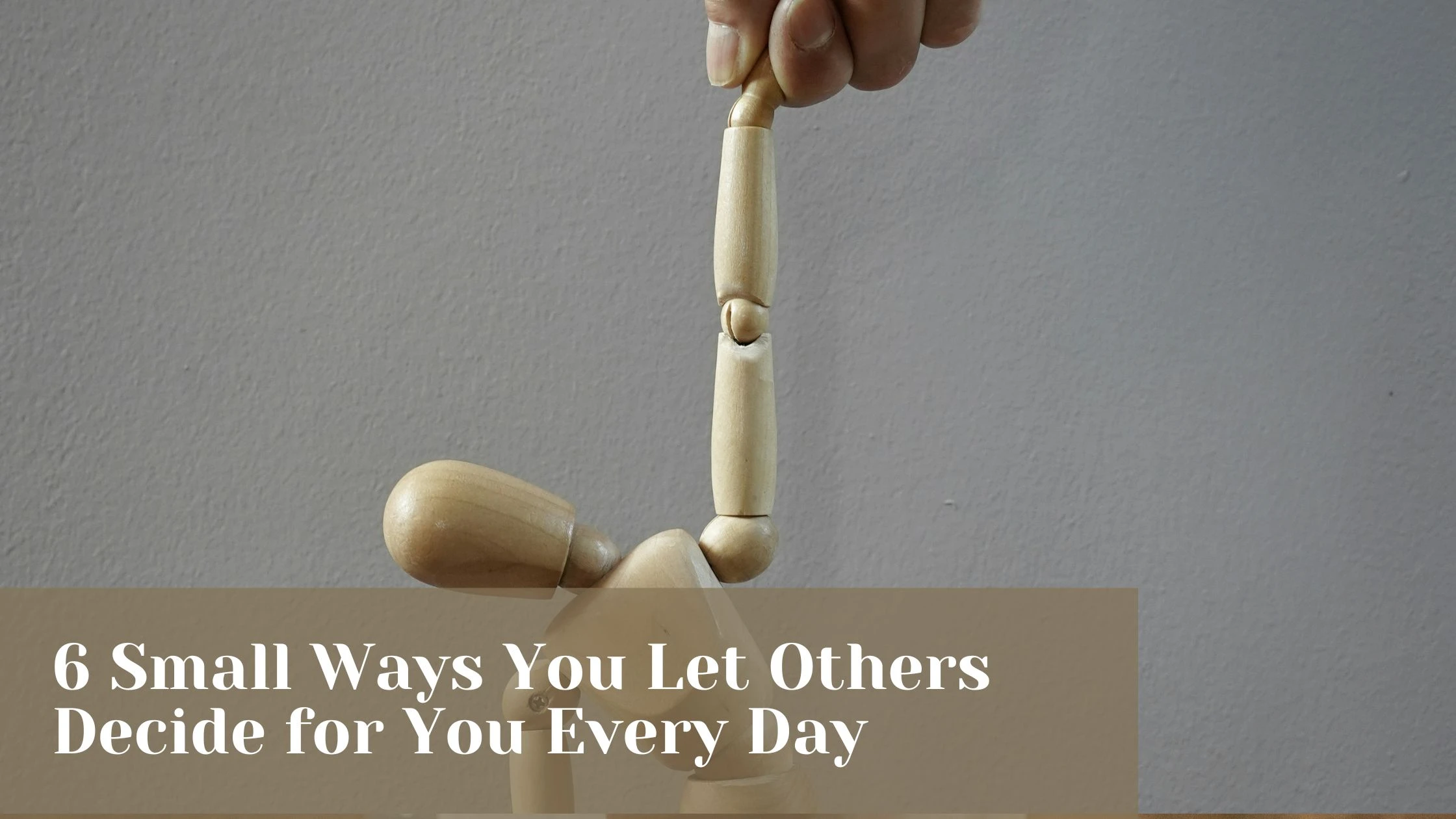
Your coworker suggests a restaurant for lunch, and even though you were craving something entirely different, you smile and say, “Sure, that works for me.” Your friend picks the movie, your partner chooses the weekend plan, and your manager sets the direction of a project you’ve been quietly thinking about differently for weeks. None of it feels like a big deal in the moment. Each small yes is easy, harmless, even kind. But by the end of the day, you sit with that low, familiar feeling — a strange sense of having been present everywhere and yet somehow absent from your own life.
This is what it feels like to let others decide for you. Not in dramatic, obvious ways. Not in moments where control is clearly taken. But in the dozens of small, quiet, everyday moments where your own preferences, instincts, and needs get quietly stepped aside to accommodate someone else’s.
And here’s what makes it so difficult to address: none of these moments feel significant on their own. Each one seems reasonable, even generous. But patterns are built from small moments, not large ones. And the pattern of consistently deferring to others — in what you eat, what you say, how you spend your time, what you believe is okay to want — has a cumulative effect on your sense of self that is far more significant than any single decision ever could be.
Research in self-determination theory, developed by psychologists Edward Deci and Richard Ryan, consistently identifies autonomy — the felt sense that one’s choices genuinely belong to oneself — as one of the most fundamental human psychological needs. When that need goes unmet day after day, not through dramatic violations but through the slow erosion of small surrenders, the psychological cost accumulates. People report lower self-esteem, higher anxiety, reduced sense of identity, and a creeping feeling of being a guest in their own life rather than the author of it.
The six patterns below are not character flaws. They are deeply human responses, often rooted in early experiences that made accommodation feel safer than assertion. But recognizing them is the beginning of something important.
1. You Ask “What Do You Think?” Before Knowing What You Think
There’s nothing wrong with seeking other people’s perspectives. In fact, the ability to genuinely consider other viewpoints is a mark of emotional intelligence and intellectual humility. But there’s a meaningful difference between consulting others after forming your own opinion and using other people’s opinions as a substitute for forming one in the first place.
Many people have developed a reflex of outsourcing their initial judgment — scanning the room before committing to a view, checking with a trusted friend before deciding how to feel about something, asking “what would you do?” before sitting with what they themselves actually want to do. It feels like openness. It feels like being a good listener, a collaborative person, someone who doesn’t rush to conclusions.
But beneath this reflex is often something quieter and less comfortable: a learned distrust of one’s own perception. Maybe growing up, instincts were frequently corrected or overridden. Maybe having a strong opinion once led to conflict or rejection. Maybe the message received, explicitly or implicitly, was that other people’s reads on things were simply more reliable than yours.
What this looks like in daily life:
- Waiting to see how others react to news before deciding how you feel about it
- Scrolling through reviews obsessively before trusting a gut feeling
- Texting a friend before making even low-stakes decisions
- Feeling vaguely anxious when asked your opinion before you’ve had time to “check in” with someone else
Psychologist and researcher Brené Brown describes this pattern as a consequence of what she calls “hustling for worthiness” — the experience of not trusting one’s own inner compass because it was never consistently affirmed as trustworthy. The antidote isn’t to stop seeking others’ input. It’s to practice pausing long enough to notice what you actually think before you look for confirmation that it’s okay to think it.
2. You Say Yes to Things You Mean to Say No To
This is perhaps the most universally recognized pattern on this list, and yet it remains one of the hardest to interrupt — because in the moment, saying yes almost always feels easier than the alternative. Saying no to an invitation means potentially disappointing someone. Saying no to a request at work means risking being seen as uncooperative. Saying no to a family obligation means navigating guilt that can feel almost physically heavy.
So yes gets said instead. And then, sometime later — driving to the event you didn’t want to attend, sitting in the meeting that didn’t need your presence, doing the favor that quietly resentment has been building around — the cost of that yes becomes clear. Not just in time or energy, but in something more subtle: the message it sends to your own nervous system, over and over, that your needs and preferences are negotiable in a way that other people’s are not.
Research on people-pleasing behavior, sometimes clinically referred to as fawn response, suggests that for many individuals this pattern developed as an adaptive strategy — a way of maintaining safety or connection in environments where conflict felt dangerous or disapproval felt catastrophic. The yes wasn’t a lie. It was a shield. The problem is that shields, carried long enough, start to feel like skin. And eventually it becomes genuinely difficult to know the difference between what is wanted and what has simply been decided is easier to want.
What this looks like in daily life:
- Agreeing to plans and immediately feeling a drop in your mood
- Saying “I don’t mind” when you do, in fact, mind
- Volunteering for things you don’t want to do to avoid the discomfort of being asked
- Discovering resentment in situations you “chose” to be in
The yes that comes from genuine desire and the yes that comes from the fear of what a no might cost can feel almost identical in the moment. Learning to tell the difference is slow work — but it begins with simply pausing after a request arrives and asking honestly: if the other person’s reaction were guaranteed to be fine either way, what would actually be wanted here?
3. You Edit Yourself Before Speaking
Most people are familiar with the experience of thinking something, deciding it might be unwelcome, and choosing not to say it. This is not inherently problematic — social functioning requires a degree of self-monitoring, and not every thought benefits from being voiced. But there’s a version of this self-editing that goes well beyond social grace. It’s the pattern of consistently modifying, softening, or withholding your actual thoughts, preferences, and reactions in order to remain acceptable, likable, or safe to the people around you.
This might look like starting a sentence with full conviction and then hearing it become smaller as it comes out of your mouth — hedged, qualified, walked back before anyone has even responded. It might look like laughing along with something that didn’t feel funny, or agreeing with an opinion that grated quietly, or staying silent in a conversation where something important was going unsaid because the room’s energy made speaking feel risky.
Over time, this consistent self-editing does something insidious. It doesn’t just shape what others know about you — it shapes what you know about yourself. When the authentic response is reliably intercepted before it reaches expression, the connection to one’s own genuine reactions gradually weakens. People report not knowing what they think, not being sure how they feel, being unable to access their own preferences with confidence. This is not a personality trait. It is the predictable result of years of practiced self-erasure.
What this looks like in daily life:
- Frequently starting sentences with “Maybe this is just me, but…” or “I could be wrong…”
- Noticing a reaction and immediately wondering if it’s the right reaction to have
- Leaving conversations with a vague feeling of having performed rather than participated
- Finding it easier to express yourself in writing, or alone, than in real time with others present
Psychologists studying authentic self-expression note that the ability to communicate one’s genuine experience — even imperfectly, even in small ways — is closely linked to psychological health and relational intimacy. Every small moment of genuine expression, even in low-stakes situations, is practice in trusting that who you actually are is worth showing up as.
4. You Adopt Other People’s Moods Without Realizing It
This one is subtle enough that many people don’t recognize it as a form of deference at all. But consider: how often does the emotional tone of the people around you quietly become your own? A partner wakes up in a bad mood and the whole morning takes on a gray quality that didn’t exist before. A colleague is visibly stressed and suddenly there’s an edge in the air that gets absorbed and carried for the rest of the afternoon. A family member is disappointed and the internal landscape shifts to accommodate that disappointment, often before any words have even been exchanged.
Emotional contagion — the neurologically documented tendency to unconsciously mirror and absorb the emotional states of others — is a normal feature of human social wiring. Mirror neurons in the brain respond automatically to the emotional expressions of people nearby, creating a biological basis for empathy and attunement. This is not a flaw. It is part of what allows people to connect.
But there is a version of this process that goes beyond natural empathy into something more like emotional subordination — a pattern where one’s own internal state is so easily displaced by others’ moods that there is rarely much sense of having a genuinely stable emotional baseline of one’s own. For people with high sensitivity or a history of needing to closely monitor others’ emotional states for safety reasons, this pattern can be particularly strong.
What this looks like in daily life:
- Feeling fine until you sense someone else isn’t, and then not feeling fine anymore
- Absorbing tension from a room even when the tension has nothing to do with you
- Struggling to access your own mood when someone nearby has a strong one
- Feeling responsible for managing or resolving other people’s emotional states
Developing what psychologists call emotional differentiation — the ability to remain present with others’ feelings without losing contact with your own — is one of the more meaningful and underrated aspects of emotional maturity. It allows for genuine empathy without the self-dissolution that comes from having no boundary between where someone else’s emotional experience ends and yours begins.
5. You Let the Room Decide What’s Worth Celebrating
There is a particular kind of loneliness that comes from achieving or experiencing something meaningful to you — and then looking around to see if the people nearby seem to think it’s worth feeling good about. If they do, permission is granted. If they don’t, the good feeling quietly deflates, sometimes before it was ever fully felt.
This outsourcing of emotional permission is one of the quieter and more painful ways that self-determination gets eroded in everyday life. It shows up in the instinct to minimize accomplishments before anyone else can — “it’s not that big a deal, really” — as a way of preempting the possibility that others might agree. It shows up in the difficulty of feeling genuinely proud of something without external validation to anchor the feeling. It shows up in the strange experience of having something good happen and feeling almost nothing, because the emotional processing has been outsourced for so long that the internal machinery for it is no longer easily accessible.
Research on contingent self-esteem — self-worth that depends on external outcomes and others’ approval — consistently shows that it is one of the least stable and most psychologically costly ways of relating to oneself. Not because achievement and recognition aren’t meaningful, but because when the ability to feel good about oneself is entirely dependent on what others reflect back, the foundation is always borrowed and always at risk of being withdrawn.
What this looks like in daily life:
- Feeling the need to downplay good news before sharing it
- Finding it hard to stay pleased about something once others seem unimpressed
- Needing someone else to confirm that an experience was as good as it felt
- Struggling to celebrate privately, without an audience
Learning to feel things on one’s own authority — to let an accomplishment be meaningful because it is meaningful to you, regardless of whether the room agrees — is not arrogance. It is one of the quieter and more profound forms of self-respect.
6. You Let Discomfort-Avoidance Make Your Choices
This last pattern is perhaps the most pervasive, because it operates almost entirely below the level of conscious decision-making. Many of the choices made on a given day are not really choices at all — they are the path of least resistance, selected not because they reflect what is genuinely wanted but because they avoid the discomfort of friction, confrontation, or vulnerability.
Staying in a job that isn’t working because the discomfort of leaving feels larger than the discomfort of staying. Continuing in a friendship dynamic that has stopped feeling mutual because raising it would require a difficult conversation. Keeping an opinion to yourself in a group setting because the momentary discomfort of potential disagreement feels like too high a price. Agreeing to a plan that doesn’t serve you because proposing an alternative means risking the other person’s displeasure.
In each of these cases, the decision is technically made — but it isn’t really authored. It’s dictated by whichever option requires the least immediate discomfort. And when discomfort-avoidance becomes the primary operating principle for how choices get made, the life being lived is shaped far more by what is being moved away from than by what is being moved toward.
Psychologist Steven Hayes, whose work in acceptance and commitment therapy has been foundational in understanding avoidance-based behavior, describes this pattern as experiential avoidance — the chronic tendency to arrange life around avoiding internal discomfort rather than in the direction of what genuinely matters. The research is clear that this pattern, while understandable and very human, consistently produces a narrower, less satisfying life over time — because growth, connection, and authentic self-expression all require tolerating some degree of discomfort along the way.
What this looks like in daily life:
- Making decisions that feel safe rather than ones that feel right
- Noticing that most choices are about avoiding something rather than moving toward something
- Feeling vaguely stuck without being able to identify a clear external reason
- A recurring sense that other people seem to be living their lives while yours is somehow happening to you
What You Can Do With This
Recognizing these patterns isn’t an invitation to self-criticism. Most of them developed for very good reasons — in families, classrooms, and relationships where accommodation was genuinely safer than assertion, where other people’s needs consistently took precedence, where learning to read the room was a survival skill rather than a choice. These patterns were adaptive once. The question worth sitting with is whether they are still serving the person they were designed to protect.
Start Noticing Before Trying to Change
The first and most important step is simply observation without judgment. Before the goal becomes doing things differently, the goal is noticing when these patterns arise. When a yes gets said — what was actually felt in the moment before it? When an opinion gets softened — what was the original, unedited version? When a mood is adopted from the room — what was present before that happened? Awareness, practiced consistently, begins to create the small but significant gap between impulse and action where genuine choice becomes possible.
Practice Having Preferences in Low-Stakes Situations
Reclaiming self-determination doesn’t require grand gestures. It can begin with the smallest things: choosing the restaurant when given the option rather than deflecting, answering “what do you want to watch?” with an actual answer, allowing a good feeling to exist for a few moments before checking whether others seem to share it. These micro-practices matter not because the decisions themselves are significant, but because each one is a small repetition of the message that preferences are real, valid, and worth expressing.
Learn to Tolerate the Discomfort of Visibility
Many of these patterns share a common root: the experience of being visible — of having a preference, taking up space, or being potentially disagreed with — feels unsafe in some low-level but persistent way. Working with that discomfort, rather than around it, is where the deeper change lives. This might look like sharing an opinion in a low-stakes conversation and sitting with the slight anxiety that follows, rather than immediately qualifying or retracting it. Each experience of surviving visibility — of being seen and remaining okay — slowly updates the nervous system’s threat assessment of what it means to take up space.
Consider Therapeutic Support
For many people, these patterns have deep roots — in attachment histories, family systems, or experiences that taught them that their own needs were secondary or unsafe to express. Working with a therapist, particularly one who specializes in attachment or self-development, can offer a space to explore those roots with care and to develop a more securely grounded relationship with one’s own inner life. This is not a small thing, and it deserves to be said plainly: choosing to understand and reclaim your own voice is one of the most meaningful investments a person can make.
A Final Thought
Every day is full of small moments where a choice is made — consciously or not — about whether to show up as yourself or to fold into whoever and whatever the situation seems to call for. Most of these moments pass unnoticed. That’s precisely what makes them so significant. The life being built isn’t constructed in the large, landmark decisions. It’s assembled, quietly and incrementally, from the texture of all the small ones.
Letting others decide for you in the small ways isn’t weakness. It’s often the residue of a very human history — of trying to belong, to avoid pain, to stay connected in the ways that were available. But you are not obligated to keep living from that history. Every small moment of genuine self-expression, every preference named, every yes that is actually meant, every no that is actually true, is a quiet act of authorship over your own life.
And those moments add up to something. They add up to a self that is present — not just going through the motions, but actually here, making choices that belong to you.
Did any of these patterns feel familiar? Which one resonated most with your own experience? Share in the comments below — this kind of conversation is exactly where growth begins, and your reflection might give someone else the language they’ve been looking for.
If this post gave you something to think about, please pass it along to someone who might need it. Sometimes the most generous thing we can do for the people we care about is hand them a mirror.