
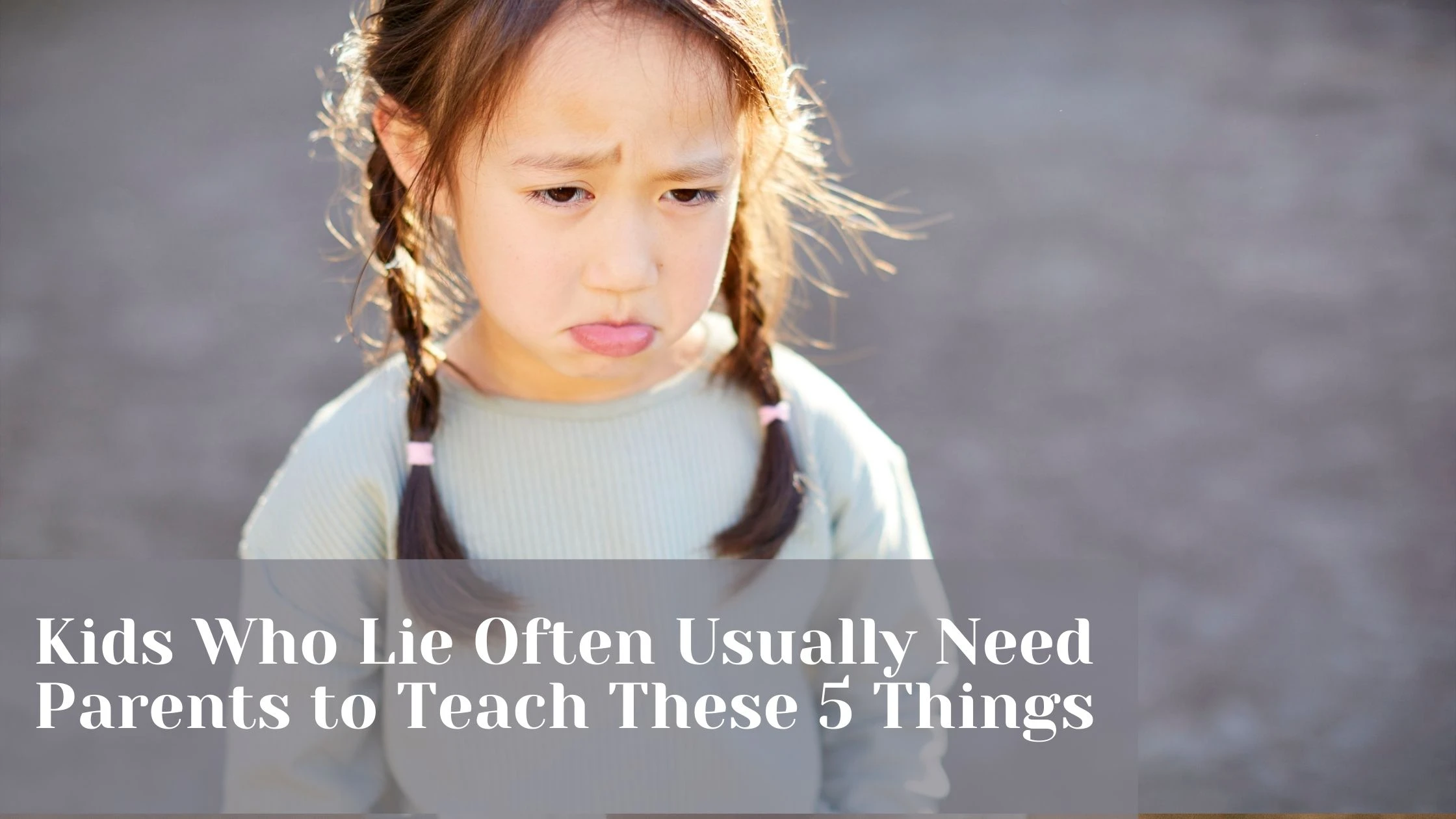
Your seven-year-old comes home from school, backpack swinging, and tells you with absolute confidence that yes, they finished all their homework at lunch. Two hours later you find the untouched worksheets stuffed under their mattress.
Your stomach tightens. Your voice rises a pitch. “Why did you lie to me?”
And your child, faced with the full weight of your disappointment, shrugs — or panics — or bursts into tears. Neither of you really understands what just happened.
Here’s what most parenting advice gets wrong about this moment: it treats the lie as the problem. Ground them for it. Take away screen time because of it. Make them understand that lying has consequences. The instinct makes sense. But it also misses something fundamental about what lying in children actually signals — and what it quietly asks of you.
Before You React, Here’s What’s Actually Happening
Dr. Victoria Talwar, Professor of Educational and Counselling Psychology at McGill University and one of the world’s leading researchers on children’s deception, has spent decades studying exactly this. Her work — including a landmark 2011 study published in Child Development — found something that should stop every parent in their tracks: children in harsh, punitive environments don’t lie less. They lie more, and they get better at it, faster.
The children in her study who faced consistent punishment for misbehavior were not only more likely to lie when caught — they were more skilled at maintaining those lies under questioning. Because when the cost of being caught is high enough, the brain finds a way.
Talwar puts it plainly: “If we want to foster honesty, the biggest factor is whether a child believes the truth will be met with safety and support.”
This doesn’t mean consequences don’t matter. It means that before any consequence can teach anything, a child has to believe that telling the truth is survivable.
And that belief? It’s not something children are born with. It’s something parents build — or fail to build — through thousands of small moments.
Why Lying Is Actually a Sign of a Developing Brain
Here’s the part that genuinely surprises most parents: your child’s ability to lie is, technically, a cognitive milestone.
Research published in PMC by Evans and Lee (2013) demonstrated that children begin attempting deception as young as age two — but crucially, younger toddlers often can’t lie successfully, not because they’re more moral, but because their executive functioning skills haven’t caught up yet. Lying requires holding two conflicting pieces of information in mind simultaneously, suppressing the truth, and managing the other person’s perception. That’s cognitively demanding work.
Developmental psychologists Talwar and Lee proposed a staged model of lying development (2008): primary lies emerge around ages 2–3, secondary lies (more strategic, cover-up focused) around age 4, and by 7–8, children begin maintaining elaborate, consistent deceptions. Each stage reflects not moral decline, but neurological growth — a maturing prefrontal cortex, expanding theory of mind, and sharper perspective-taking skills.
What does theory of mind have to do with lying? Everything. To deceive someone, a child has to understand that you don’t know what they know. That your reality and their reality can differ. A 2021 longitudinal study from Frontiers in Psychology confirmed that theory of mind development directly predicted the emergence of more sophisticated lying between ages 3 and 4.
The child who lies fluently isn’t a bad kid. They’re a kid whose brain is doing exactly what brains are supposed to do. The question for parents isn’t how do I stop this. It’s what does my child still need to learn?
The 5 Things Frequent Liars Are Usually Missing
1. The Belief That Telling the Truth Is Physically Safe
Not philosophically safe. Not “Mom says honesty is important” safe. Viscerally, bodily safe.
When a child lies reflexively — the kind of instinctive, fast lie that shoots out before they’ve even thought about it — what’s usually happening is a threat response. The nervous system has learned that certain kinds of truth create danger: raised voices, harsh consequences, withdrawal of warmth, explosive reactions. So it does what nervous systems do. It finds an exit.
Dr. Talwar’s 2011 natural experiment placed children from punitive and non-punitive school environments in the same deception test. The children from the punitive environment were dramatically more likely to lie — and more capable of concealing it. Her conclusion was stark: in environments where punishment is severe and swift, “lying may have an adaptive effect by protecting you from getting in trouble.”
What this looks like at home is more subtle than corporal punishment. It can look like a parent who explodes when a child admits to something going wrong. A parent whose disappointment is so heavy and prolonged that a child would do anything to avoid it next time. A home where mistakes are treated as character failures rather than events that can be fixed.
What builds safety instead:
- Staying physically calm when your child confesses something hard, even if you’re internally furious
- Separating your response to the lie from your response to whatever triggered it
- Saying, and meaning: “I’m glad you told me. That was brave.”
The goal isn’t to eliminate consequences. It’s to make sure your child’s nervous system learns that truth, even inconvenient truth, doesn’t destroy the relationship.
2. The Ability to Name and Navigate Their Own Emotions
Many children lie not because they’re calculating, but because they’re overwhelmed and have no other tool.
Your nine-year-old broke something, feels a wave of shame and panic, and lies — not because they planned it, but because the emotional volume was too loud for any other response. The lie was the only exit they could find in the moment.
A 2022 Frontiers in Psychology systematic review found that children who struggle with emotion regulation are at significantly greater risk for antisocial behavior — including deception — in later years. The children who could identify and work through difficult feelings were far more capable of responding to hard situations with honest communication rather than avoidance.
Emotion regulation isn’t a personality trait. It’s a learned skill. And it’s built through what researchers call “emotion coaching” — a parenting approach identified by psychologist John Gottman in which caregivers help children label feelings, validate them, and work through them rather than suppressing or dismissing them.
A 2021 meta-analysis cited in ScienceDirect (Havighurst et al., 2022) confirmed that emotionally supportive parenting is directly associated with children developing stronger self-regulation — which in turn makes them less likely to reach for avoidance behaviors like lying when things go wrong.
What this looks like in practice isn’t complicated, but it requires slowing down:
- “You look upset about something. What happened?”
- “That makes sense — I’d feel embarrassed too.”
- “When you feel like that next time, what could you do instead of hiding it?”
A child who can say “I was scared you’d be angry, so I lied” is a child who has crossed an enormous developmental threshold. That kind of self-awareness doesn’t arrive automatically. You teach it, conversation by conversation.
3. An Understanding of Consequences That Belong to Them — Not Just Fear of You
There’s a critical difference between a child who tells the truth because they’re afraid of what happens if they get caught, and a child who tells the truth because they’ve internalized an understanding of why honesty matters.
The first child is managing your reaction. The second is managing their own values.
Researchers at Oberlin College, led by psychologist Nancy Darling — who has studied teen lying behavior for over two decades — found that children are more likely to tell the truth when their parents combine clear expectations with warmth and rational explanation. Not “because I said so.” Because here’s what happens when trust breaks down, and here’s why that matters to our relationship.
A 2014 study published in Child Development found that punitive discipline — yelling, harsh punishments — was directly linked to higher rates of lying, particularly among children who feared relational rupture. The fear didn’t create honesty. It created better liars.
What creates internalized values is something slower and less satisfying: repeated, patient conversations about why honesty is part of how your family operates. Not lectures. Conversations. The difference is that in a conversation, the child’s perspective gets to exist.
“What do you think happens to trust when someone lies, even about something small?”
“Have you ever been lied to? What did that feel like?”
“In our family, we believe that mistakes can be fixed — but only if we know about them.”
A child who understands the logic of honesty, not just the rules around it, develops something punishment can never manufacture: a conscience that works when no one is watching.
4. A Model of What Honest Adults Actually Look Like
Children don’t learn honesty from lectures about honesty. They learn it from watching you.
A 2010 study published in PMC (Heyman et al.) examined what researchers called “parenting by lying” — the common practice of parents lying to children (white lies, social lies, compliance lies) while simultaneously insisting their children be truthful. The findings were uncomfortable: a substantial number of parents who reported strongly valuing honesty also admitted to lying to their children regularly, often to manage behavior. And children, who are extraordinarily observant, absorb both messages.
What they absorb is not just the explicit rule (“don’t lie”). It’s the meta-message underneath: lying is what adults do when the truth is inconvenient.
This doesn’t mean parents need to be brutally honest about everything. It means children need to see you navigating honesty in real time — with imperfection, with difficulty, with grace.
When you make a mistake, name it. “I told you I wasn’t upset, but I actually was. I’m sorry I wasn’t honest about that.”
When you’re asked a hard question, be real about the complexity. “That’s a tough one. I want to think about how to answer it honestly.”
When you choose not to share something, explain why without deception. “That’s something private between adults — not something I’m hiding from you, just not mine to share.”
A 2020 study by Engarhos, Shohoudi, Crossman, and Talwar published in Developmental Science found that children who observed adults modeling truthful behavior — even when the truth was uncomfortable — were significantly more likely to be honest themselves. The effect was stronger than explicit moral instruction. Watching mattered more than being told.
5. Psychological Safety Around Imperfection
Underneath the majority of children’s lies is a single, driving fear: I will not be enough if they know the truth.
Not always a conscious thought. But present in the body, in the split-second decision to say “I didn’t do it” when the evidence is sitting in plain sight. What the child is really protecting isn’t the lie — it’s their standing in your eyes.
A longitudinal analysis on children’s lying and behavior problems published in Frontiers in Psychology (2022) found that frequent lying for personal reward was most common among children who had also developed broader behavioral problems — anxiety, externalizing behaviors, difficulty with self-regulation. The lying wasn’t the root issue. It was a symptom of a child who had learned that falling short was genuinely threatening.
The antidote to this isn’t simply telling your child you love them. It’s demonstrating, repeatedly and concretely, that your love doesn’t hinge on their performance. That you can hold disappointment and warmth in the same moment. That being wrong, being caught, being messy doesn’t cost them anything fundamental with you.
This is what it sounds like:
“I’m not happy about what happened. But I’m really glad you told me, because now we can figure it out together.”
“You made a mistake. That doesn’t make you a bad kid. It makes you a kid who made a mistake.”
“The truth is always the better choice in this house. Not because nothing happens — but because we handle things better together than apart.”
When a child genuinely believes that imperfection is survivable in your presence, lying loses most of its power. There’s simply less to protect.
What to Do When the Lie Has Already Happened
Awareness is one thing. The moment of catch — when you’re holding the evidence and your child is looking at their shoes — is another.
A few things that actually help:
Stay in your window of tolerance. The more explosive your reaction, the more data you’re giving your child about why lying was a reasonable strategy. This doesn’t mean pretending you’re not upset. It means choosing not to process your upset at your child in that instant.
Ask before you accuse. “Tell me what happened” opens more than “Why did you lie to me?” The first invites the full picture. The second triggers defensiveness before the conversation has started.
Acknowledge the emotional logic. “I get why that felt easier in the moment. You were worried I’d be upset, right?” This isn’t excusing the lie. It’s showing your child that you understand them — which, paradoxically, makes them more willing to tell the truth next time.
Let the natural consequence do the work. Where possible, the consequence of the lie itself — not an additional punishment layered on top — teaches the clearest lesson. Trust is harder to rebuild than it is to maintain. Let your child feel that in a manageable, real way.
The Long Game
Children who lie frequently aren’t signaling that they’re heading for trouble. They’re signaling that they haven’t yet been taught — fully, consistently, through safe experience — that truth is worth the risk.
That’s not a character verdict. It’s a curriculum gap.
And unlike so many things in parenting, this one is genuinely fixable. Not by cracking down harder. Not by catching every lie and making it costly. But by becoming a parent your child trusts will not fall apart when they bring you something real and difficult and true.
Dr. Talwar’s decades of research point toward a deceptively simple conclusion: honesty flourishes in safe environments. Not permissive ones. Not consequence-free ones. Safe ones — where the relationship is strong enough to hold the truth without fracturing.
That’s the environment you’re building every time you stay calm when it’s hard. Every time you model honesty when it’s inconvenient. Every time you make imperfection survivable.
That’s not just teaching your child not to lie. That’s teaching them to trust you. And in the long run, that’s far more valuable.
Have you noticed a shift in your child’s honesty when you changed how you responded? Share what worked for your family in the comments — these conversations help more parents than you’d think.
Sources & Further Reading:
- Talwar, V. & Lee, K. (2011). A punitive environment fosters children’s dishonesty. Child Development
- Evans, A.D. & Lee, K. (2013). Emergence of Lying in Very Young Children. PMC
- Zhao et al. (2021). Theory of Mind, Executive Function, and Lying in Children. Frontiers in Psychology
- Heyman, G.D. et al. (2010). Parenting by Lying. PMC
- Engarhos et al. (2020). Learning through Observing: Effects of Modeling Truth- and Lie-Telling on Children’s Honesty. Developmental Science
- Talwar, V. (2022). The Truth About Lying: Teaching Honesty to Children at Every Age and Stage. APA LifeTools
- Frontiers in Psychology (2022). Children’s Lying and Behavior Problems