
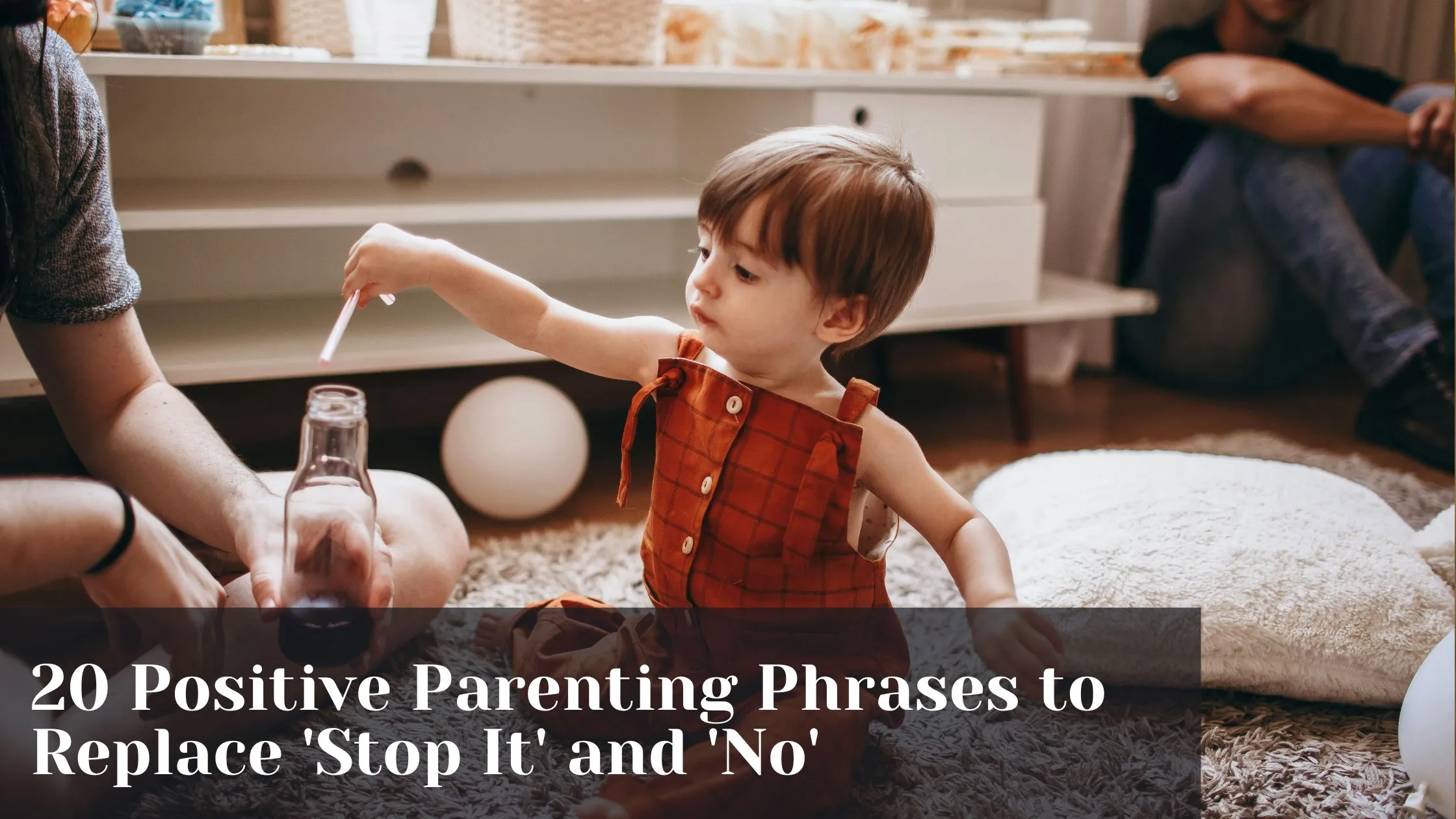
Your toddler is halfway up the bookshelf again. “Stop it!” comes out before you can think of anything else, and it works, sort of, for about four seconds before they are back at it or on to something equally alarming. The phrase did not actually tell them what to do instead. It just told them to freeze, and freezing rarely lasts.
Swapping “no” and “stop it” for a specific, direct phrase is not about being permissive or avoiding the word no forever. It is about giving your toddler something they can actually act on, since a toddler who hears “get down” has a clear next move, while a toddler who hears “stop it” mostly just knows something is wrong without knowing what to do about it.
This is not a new idea, but it is one that is easy to understand in theory and hard to pull off in the moment, mostly because the old phrases are fast, automatic, and already sitting on the tip of the tongue by the time a toddler is halfway up a bookshelf. Building a small library of ready to go phrases ahead of time, rather than trying to invent one on the spot, is what makes the swap realistic rather than aspirational.
This guide covers why the swap actually helps, what separates a positive parenting phrase from permissiveness, twenty specific phrases organized by situation, and the delivery details that matter as much as the words themselves.
Why Swapping Out “No” and “Stop It” Actually Helps
A lot of parenting advice claims that hearing “no” triggers some dramatic stress response in a toddler’s brain. That specific claim shows up constantly online without much behind it, so it is worth setting aside and looking at what the research actually supports instead.
A 2014 eye tracking study published in the Journal of Memory and Language found that children between two and five years old consistently showed poorer comprehension of negative sentences compared to affirmative ones, especially when the negative sentence pointed to something absent, such as “the boy with no apples.” This does not mean toddlers cannot understand negation at all. It means a negative instruction asks more of a young brain than a direct, positive one, and that extra processing load is exactly what gets in the way during a fast moving moment like a toddler climbing furniture.
There is also real evidence that a broader positive discipline approach, not just word choice but the overall style, produces measurable results. A 2024 randomized trial in Frontiers in Public Health tested a six week Positive Discipline group program with mothers of young children and found a significant improvement in parenting self efficacy for the group that received the training compared to the group that did not. Separately, a large multi year evaluation of the Positive Discipline in Everyday Parenting program across several Canadian family agencies found substantial reductions in physical punishment and real increases in proactive parenting behavior.
Put together, this points to something more modest and more useful than a viral claim about brain chemistry. Direct, positive phrasing is easier for a toddler to process in the moment, and a consistent positive discipline approach shows measurable benefits for both parent confidence and actual parenting behavior over time.
There is a second, more practical reason this matters day to day. A phrase like “stop it” names the problem but leaves your toddler to guess at the solution, and toddlers are not especially good at generating alternatives on the fly, particularly mid meltdown or mid climb. A phrase like “feet on the floor” skips the guessing entirely. It hands over the actual behavior you want, which shortens the gap between hearing the instruction and being able to follow it.
None of this means “no” is harmful or should be avoided out of fear. It means a direct alternative tends to work faster and more reliably in the exact moments parents care most about, which is reason enough to have twenty of them ready.
What Makes a Phrase “Positive Parenting” and Not Just Permissive
A common misunderstanding trips a lot of parents up here. Positive parenting phrases are not about avoiding boundaries. They are about stating the boundary in a way a toddler can act on immediately.
The Positive Discipline framework, referenced in both studies above, describes this as being kind and firm at the same time. Kind means the tone stays calm and respectful rather than harsh. Firm means the boundary itself does not move. “Feet stay on the floor” is both kind and firm. It is not a suggestion, and it is not delivered as a threat either. It simply states the expectation clearly.
This distinction matters because a phrase swapped out of guilt or softness, without the boundary actually holding, teaches something very different than intended. A toddler who hears “let’s use gentle hands” but is still allowed to hit without consequence learns that the phrase is just noise. The words only work when the limit behind them is real.
It helps to picture the two failure modes on either side of this balance. Too firm without kindness looks like barking commands, which tends to produce compliance out of fear rather than understanding, and often fades once the fear does. Too kind without firmness looks like a parent repeating a gentle request five or six times while a toddler continues the exact behavior, which teaches that the request itself carries no real weight. The twenty phrases below are built to sit in the middle of those two failure modes, but the phrase alone cannot do that work. The tone and the follow through around it are what actually hold the line.
20 Phrases to Try, Organized by Situation
Each phrase below follows the same structure: a direct, positive action, paired with enough specificity that your toddler knows exactly what to do rather than only what to stop. Adjust the wording to fit your own voice and the specific object, place, or person involved in the moment.
Safety and Physical Risk
These moments usually call for speed over explanation. Keep the phrase short enough to say in one breath while you are already moving toward your toddler.
1. “Feet on the floor.” Use for climbing on furniture or counters. Clear, short, and tells them exactly what to do.
2. “Walking feet inside.” Use for running indoors near hard corners or stairs. Pairs well with a quick demonstration of the pace you want.
3. “Hold my hand near the street.” Use for parking lots or busy sidewalks. States the expectation and the reason folded into one short line.
4. “Gentle with the [object].” Use for rough handling of something fragile or another child’s toy. Naming the specific object keeps it concrete rather than abstract.
5. “Two hands on the railing.” Use for stairs. Specific, physical, and easy for a toddler to actually follow.
Sharing, Hitting, and Conflict
Conflict between children moves fast, and toddlers rarely have the words ready on their own. These phrases hand over language your toddler can borrow in the moment, which is often the actual skill being taught here.
6. “Use your words to ask.” Use when a toddler grabs a toy from another child. Gives them the actual tool to use instead of the behavior you want stopped.
7. “Hands are for building, not hitting.” Use in the moment of or right after a hit. Naming what hands are for reframes the body part rather than only naming the offense.
8. “You can be upset. You cannot hit.” Use when big feelings are driving the behavior. Separates the emotion, which is allowed, from the action, which is not.
9. “Ask for a turn.” Use for toy conflicts between siblings or peers. Short enough to repeat calmly multiple times if needed.
10. “Let’s find you something else while you wait.” Use when a turn truly needs to be waited out. Offers a real alternative instead of just asking for patience with nothing to do.
Messes, Mealtime, and Materials
Most of these are not urgent in the way a safety moment is, which means there is a little more room to state the phrase calmly and let your toddler process it before repeating.
11. “Food stays on the plate.” Use for throwing food. States the expectation without a lecture about waste or manners.
12. “Paper is for drawing, walls are for looking at.” Use for coloring outside the intended surface. Redirects to the correct surface rather than only naming the wrong one.
13. “Let’s keep the water in the tub.” Use for bath splashing that is getting out of hand. Keeps the fun of water play while narrowing where it happens.
14. “Toys go back in the bin when we’re done.” Use as a routine phrase during cleanup, not just a one time correction. Consistency here matters more than any single wording.
15. “Sit to eat, stand to play.” Use for a toddler wandering with food in hand. Draws a clear line between two activities rather than forbidding movement generally.
Public Meltdowns and Big Emotions
This category works a little differently from the other three, since the goal is rarely to stop the emotion itself. A toddler in the middle of a big feeling usually needs to move through it, not suppress it on command, so these phrases aim at support and structure rather than a quick fix.
16. “I see you’re upset. Let’s take a breath together.” Use at the start of a meltdown, before it fully escalates. Names the feeling and offers a concrete first step.
17. “You can cry. I’m right here.” Use when a toddler is overwhelmed and needs to release emotion rather than immediately comply. Presence often matters more than words in this moment.
18. “Let’s find a quiet spot.” Use in a loud or crowded public setting when overstimulation is building. Offers an action rather than just asking for calm.
19. “Show me with your hands what you need.” Use when a toddler is too upset to speak clearly. Gives a nonverbal option that still moves things forward.
20. “We’re going to leave in two minutes. Let’s finish up together.” Use before a transition that is likely to trigger resistance. Warning ahead of time, paired with an invitation to help end the activity, tends to soften the switch.
Instead of This, Try This
20 direct, positive phrases to replace “no” and “stop it,” grouped by situation.
Safety and Physical Risk
Sharing, Hitting, and Conflict
Messes, Mealtime, and Materials
Public Meltdowns and Big Emotions
How to Deliver Them So They Don’t Sound Scripted
The exact wording matters less than most lists suggest. Tone, pacing, and body position carry as much weight as the words themselves, and a perfectly worded phrase delivered in a rushed, sharp tone will not land the way a calmer version of the same idea does.
Get down to your toddler’s eye level before speaking whenever the situation allows it. A phrase delivered from standing height, especially with a raised voice, reads as a command from above rather than a shared moment, even if the words themselves are gentle.
Keep the phrase short and say it once, then follow through with action if needed rather than repeating it five times in a row. Repetition without action teaches a toddler that the first four requests do not really mean anything.
Adjust the specific wording to fit your own voice. A phrase that feels stiff or unnatural coming out of your mouth will sound stiff to your toddler too. Use the structure, a positive direction plus a clear boundary, and swap in language that actually sounds like you.
Pay attention to your own facial expression as much as your words. A calm phrase delivered with a tense, frustrated face sends a mixed signal that toddlers pick up on quickly, often responding more to the face than to the words themselves. A brief pause to soften your own expression before speaking can change how the whole exchange lands.
Save physical touch, a hand on the shoulder or a hand held out, for phrases where connection matters more than instruction, such as the emotional regulation phrases in the last category. For a fast safety correction, touch can wait until after the phrase, since the priority in that moment is stopping the immediate risk.
Common Mistakes
Even with a solid list of phrases ready, a few habits tend to undercut them without a parent realizing it in the moment. Watching for these is often more useful than memorizing more phrases.
Turning the phrase into a lecture. A short, direct phrase works because it is short. Adding a long explanation in the heat of the moment usually loses a toddler’s attention halfway through and undercuts the clarity of the original phrase.
Softening the boundary along with the tone. Kind and firm are both required. Dropping the firm half in an effort to sound gentle teaches a toddler that the phrase is optional, not that it is respectful.
Using the same phrase for every situation. A single catchall phrase, repeated regardless of context, starts to lose meaning. Matching the phrase to the specific moment keeps it functional rather than becoming background noise.
Expecting instant compliance the first time. A new phrase takes repetition before a toddler responds to it reliably. One use that does not immediately work is not a sign the phrase has failed.
Skipping follow through. A calm, positive phrase still needs a consequence or a physical redirect behind it when a toddler does not comply. Words alone rarely stop a determined toddler mid climb.
Only using these phrases when calm yourself. It is tempting to reach for the old, sharp version of a phrase the moment your own patience runs thin. The phrases work best when they become the default response, not a technique reserved only for the moments you feel most composed.
Quick Answers to Common Questions
Do I need to eliminate the word “no” entirely? No. The word no still has its place, especially for immediate safety situations where there is no time for a longer phrase. The goal is to reduce reliance on it as the default response, not to erase it completely.
How long does it take before these phrases start working? Most parents notice a toddler responding more consistently after a few weeks of steady use, though this varies by child and by how consistently the phrase is paired with real follow through. A single use rarely produces immediate, lasting change.
What if my toddler ignores the phrase completely? Follow through with a physical redirect, moving them away from the stairs, taking the object gently, rather than repeating the phrase louder. The action backs up the words and teaches that the phrase is connected to something real.
Can these phrases work for children older than toddlers? Many of them adapt well to preschoolers and early elementary age children, though older children can usually handle a bit more explanation alongside the direct phrase than a toddler can.
Is it a problem if I sometimes slip back into “stop it” or “no”? Not at all. Consistency matters more in the aggregate than perfection in every single moment. A parent who mostly uses direct, positive phrasing with the occasional slip is still giving their toddler far more clarity than one relying on “no” as a default.
Do these phrases work the same way for every toddler? Not exactly. A toddler who is more verbal may respond well to phrases with a bit more explanation attached, while a toddler who is still building language often does better with the shortest possible version. Watch how your own toddler responds and adjust the length and complexity accordingly.
What should I do if a phrase works one day and fails completely the next? This is normal and usually has more to do with your toddler’s state, tired, hungry, overstimulated, than with the phrase itself. On harder days, expect to pair the phrase with more physical follow through rather than assuming the words have stopped working for good.
The short version: a direct, positive phrase gives a toddler something to actually do, backed by a boundary that holds. The words matter less than most lists suggest. What matters is staying kind, staying firm, and following through.