
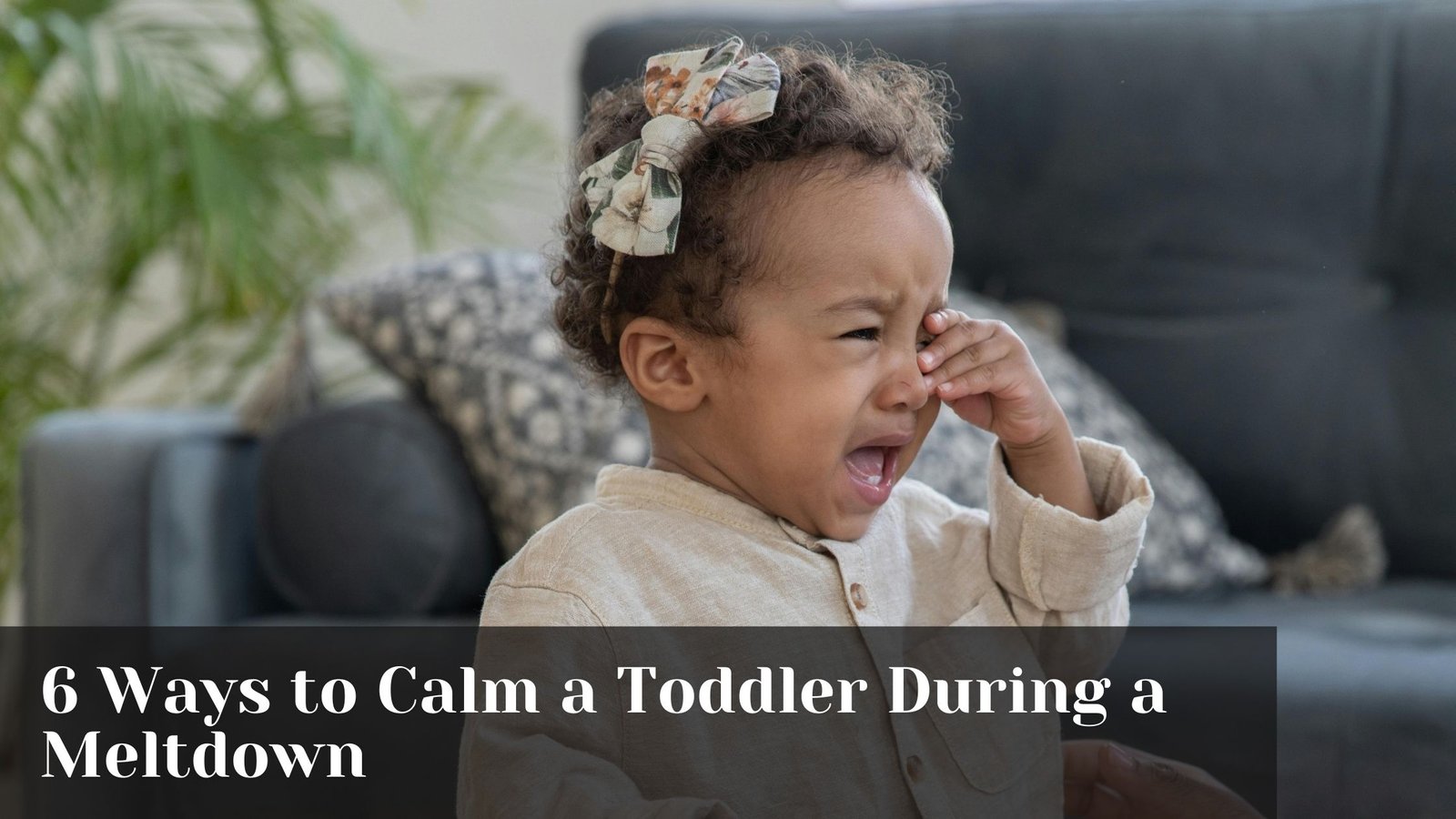
You are in the meltdown right now. Or you’ve just been in one and you’re trying to understand what happened. Or you’re anticipating the next one — which, statistically, is coming — and you’d like to go into it with something more useful than the combination of patience and improvisation that has been getting you through.
This blog is the practical one. Not the why of toddler meltdowns — the language gaps, the developing prefrontal cortex, the clash between the autonomy drive and the incapable body — though all of that is real and useful to understand. This is the what do I actually do in the next three minutes while my child is on the floor of the grocery store and everything I’ve tried has made it worse blog.
The research on what actually helps a dysregulated toddler return to baseline is specific, and some of it is genuinely counterintuitive. Several things that feel like they should help don’t. Several things that feel too simple to make any difference do. Here are the six most evidence-grounded approaches, in roughly the order they become useful.
What’s Happening in the Toddler Brain During a Meltdown
One paragraph of neuroscience, because it changes what makes sense to try.
During a meltdown, the toddler’s limbic system — the brain’s emotional and threat-detection center — has taken over. The prefrontal cortex, responsible for language processing, logic, perspective-taking, and the capacity to hear reason, is significantly less available. In neurological terms, when your child is having a meltdown, they are experiencing an “amygdala hijack.” The emotional part of their brain is reacting to a stressor as if it were a predator, and this triggers a “fight, flight or freeze” reaction.
Everything that works to calm a meltdown works because it operates on the nervous system directly — not through language and logic, but through physiology. The approaches below are the ones with the most evidence for doing exactly that.
The 6 Ways
1. Regulate Yourself First — Your Nervous System Is the Temperature of the Room
This is the same first step in every difficult parenting moment — and it matters here more than anywhere else, because the mechanism by which a regulated adult calms a dysregulated toddler is direct and physiological, not linguistic.
Children’s nervous systems do not exist independently. From the earliest weeks of life, they are calibrated to and co-regulated by their primary caregivers. There is evidence that stimulation of pressure receptors in the skin increases vagal activity, and that infant vagal activity increases during mother-child interactions. Touch may convey information that is necessary for the coordination of communicative rhythms between parent and infant. The relationship between a parent’s nervous system and a toddler’s is not metaphorical. It is physiological — and it operates in both directions. When you are self-regulated — calm and in control of your reaction — your child’s brain senses “safety” from your presence and can begin to replicate that calmness. When your breath is slow and deep, your child’s body will begin to take those cues and their breath will begin to slow down and become deeper, helping them to calm down.
Conversely, the parent who escalates — whose voice rises, whose body tightens, whose frustration transmits into the room — is providing a dysregulated nervous system as the template for the toddler’s own. The meltdown does not shorten in response to the escalated parent. It intensifies.
Rational and intelligent parents can easily fall into the trap of doing all the wrong things with riled-up kids. Our tendency to provide reassurance during a red-zone moment is remarkable in how typical it is and how spectacularly it can fail.
What this looks like:
Before you re-engage with the meltdown, take an actual breath — not a metaphorical one. Drop your shoulders. Lower your voice, even if you haven’t spoken yet. The goal is not the performance of calm but its physiological reality. Your child’s nervous system is reading yours, directly and continuously. What you bring to the room is what the room contains.
2. Get Low and Close — Don’t Tower
The instinct when a toddler is on the floor and escalating is to stand over them — partly because the floor is not where we spend most of our time, and partly because the upright, authoritative posture is the one we tend to associate with being in charge of a situation. That posture communicates something specific to the toddler’s nervous system: a large, elevated figure is a threat signal, not a safety signal. And in a meltdown, the nervous system that needs safety most is the one that most needs not to receive a threat signal.
Our children will respond more calmly if we ourselves are calm. Make eye contact, get on their level, and keep your voice even. Getting down — sitting on the floor, crouching at the child’s level, positioning yourself as a companion rather than an authority — changes what the child’s threat-detection system reads in the parent’s body. It signals: I am with you, not above you. This situation is not a confrontation. You are safe.
The physical proximity is equally important. The child in a meltdown needs the adult’s regulated nervous system within range — not across the room, not leaving, not hovering above, but near. The Circle of Security research is clear on this: when a child is distressed, the caregiver’s primary function is to be the safe haven — the regulated presence the dysregulated nervous system can return to. Give them a little bit of time to process what you’ve said, staying with or next to them the whole time.
What this looks like:
When the meltdown begins, don’t stand over it. Come down to the floor. Get close — within arm’s reach. If the space is overstimulating (a store, a party, a crowded environment), move to a quieter one if at all possible: if you can’t simply pack up and leave the supermarket, find a quieter area where fewer people are around. A little privacy can help your child by reducing stimulation. Be present. Be at their level. Be close.
3. Offer Touch — If They’ll Accept It
This is the one with the most direct physiological mechanism — and the one most dependent on reading the individual child in the specific moment, because some toddlers in the middle of a meltdown will accept and be soothed by physical contact, and some will escalate when touched, and the difference matters.
For toddlers who accept it: physical touch, particularly moderate, firm contact — a hug, a hand on the back, a gentle hold — activates specific physiological calming pathways. Studies have found that therapeutic touch can increase vagal tone, oxygen saturation, and dopamine levels, while decreasing cortisol and stress levels. Caregiving affective touch can secure interoceptive predictions, reducing prediction errors and providing calming effects, reducing infant distress.
The deep pressure mechanism is specific: deep pressure touch is a type of touch commonly considered pleasant and calming, occurring in hugs, cuddling, and massage. Moderate pressure has been found to be necessary for the beneficial effects, and leads to greater stress and anxiety reduction as well as higher ratings of pleasantness. The firm, gentle hug that many parents instinctively offer during a meltdown is not just comforting in a social sense. It is activating the pressure receptors that increase vagal tone, which is the physiological pathway back to calm.
Caregiver touch tends to provoke a state of calm alertness. As caregiver touch tends to provoke a state of calm alertness, parents may use touch to ensure that their infants are available and ready to engage in patterns of communication.
What this looks like:
Offer rather than impose. As you get close and low, open your arms: “Do you want a hug?” or simply extend your arms and see if the child comes toward you. If they do — hold them firmly and calmly. If they pull away or escalate — respect that, stay close, and wait. For children who escalate with direct holding, a hand on the back or a gentle touch on the arm is often enough to transmit the co-regulatory signal without triggering the rejection. Try, read the response, adjust.
4. Name the Feeling Simply, Once — Then Stop Talking
One sentence. Not a lecture, not a series of questions, not a negotiation, not an explanation of why the thing they wanted isn’t available. One simple, accurate sentence that names what you see: “You are so upset right now.” “That was really disappointing.” “You really wanted that.” Then stop.
The reason this works is neurological. The affect labeling research — pioneered by Lieberman and colleagues at UCLA and replicated across multiple neuroimaging studies — found that putting a word to an emotional experience measurably reduces amygdala activation and increases prefrontal cortex availability. Naming a feeling doesn’t just describe it. It changes the brain’s processing of it. The toddler who receives the word “upset” in a calm, compassionate voice is receiving both the vocabulary and a co-regulatory signal simultaneously: the parent has seen the feeling, it is understood, and it is survivable.
The only way to help our child calm down and emerge from their meltdown or tantrum is to connect with their emotional brain. You do this by helping them label and understand their emotions — by expressing empathy and using words to describe how they might be feeling and what thoughts might be behind those feelings. Avoid using logic and resist the temptation to teach — this is not the time.
The critical addition here is: one sentence, then silence. The parent who continues talking after the initial labeling is adding input to a nervous system that is already overwhelmed by input. One thing you don’t want to do is try to reason with a child who is upset. “Don’t talk to the kid when they’re not available.” The naming is sufficient. What follows it is your calm, available presence — which is doing more work than any sentence could.
What this looks like:
In a low, even voice: “You’re really upset. I’m right here.” That’s the sentence. Then quiet. Resist the impulse to explain, reassure elaborately, or continue talking. The quiet presence after the naming is the most important part of this step — because it removes the additional input that would prevent the nervous system from beginning its own return to baseline.
5. Lower the Environmental Input — Less Is More
The meltdown state is, among other things, a state of sensory and cognitive overload. Adding more stimulation — more noise, more movement, more people, more voices, more demands — extends the overload. Removing stimulation — reducing noise, finding a quieter space, decreasing the number of people in the immediate environment, minimizing visual complexity — gives the nervous system the space it needs to begin regulating.
This is why parents can provide some calming tools to help reduce stimulation and provide sensory support. Creating a calm, predictable environment can help the toddler regulate more quickly. The calm-down space — a corner, a hallway, a car, a quieter aisle — is not a punishment space. It is a sensory environment that the overwhelmed nervous system can manage better than the one that produced the overload.
In public, this presents the most practical challenge — because leaving a grocery store mid-shop, or a party mid-event, feels like a significant disruption. And yet the research on what shortens meltdowns is consistent: reducing the environmental load is more effective than attempting to manage the behavior within the overstimulating environment. Offer sensory breaks: recognize signs of sensory overload and offer opportunities for sensory breaks in a quiet, calming space where the child can decompress and regulate their senses.
The same principle applies to parental verbal output: more words add cognitive load during a meltdown. The parent who explains, reasons, warns, and negotiates through the peak of a meltdown is adding input to a system that is already past its processing capacity. Saying less is not giving up. It is removing noise from a system that needs quiet to find its way back.
What this looks like:
During the peak of the meltdown — when the screaming is loudest and the dysregulation most complete — reduce everything you can: your voice, your words, the environmental stimulation, the number of people present. If possible, move to a quieter space. Stay present and close, but let the space be quiet. The nervous system, given less to process, processes its way back more quickly.
6. Offer a Physical or Sensory Anchor
This final way is the one that most directly engages the body’s own regulation systems — and the one that works best when the physiological activation has peaked and is beginning to subside. The nervous system that is returning from a meltdown is looking for something to anchor to: a physical sensation that is simple, predictable, and regulating. Movement, water, fresh air, a familiar object, a specific texture — any of these can provide the sensory anchor that completes the return to baseline.
Water is one of the most consistently effective anchors across ages and temperament profiles. Washing hands, running water over the face, drinking a glass of cold water — the sensation is sufficiently engaging to give the nervous system something to attend to, and the temperature contrast between activation and the cool water is physiologically grounding. Offering a different book, moving to a new location, or making a funny face might help. Try making tasks into a game. The reengagement with something concrete — something in the physical world that requires the senses rather than the language centers — gives the recovering nervous system a foothold.
Movement is equally useful for some toddlers: a brief walk, being carried, swinging, or rocking activates the vestibular system in ways that support regulation. The vestibular system — which processes movement and balance — has direct connections to the arousal-regulation systems of the brainstem. This is why rocking a distressed infant works, and why the same basic mechanism continues to work for toddlers and older children.
A familiar, comforting object — a specific soft toy, a blanket, a beloved item — can also serve as a sensory anchor. The object carries the toddler’s existing association of safety and calm; its presence in an activated moment is a sensory signal of those associations.
What this looks like:
As the meltdown begins to subside — when the screaming is easing and the body is less rigid — offer something sensory and concrete: “Let’s get some water.” “Come with me for a minute.” “Here’s your [specific object].” Don’t announce it as a distraction or a reward. Simply offer it. The concrete, sensory, manageable experience gives the recovering nervous system something to land on that isn’t the peak of the activation that just passed.
The One Thing These Six Share
Each of these six ways is doing the same thing from a different angle: reducing the activation in the toddler’s nervous system by not adding to it. Not escalating, not adding verbal input, not adding sensory load, not adding threat signals — and instead, providing the co-regulatory elements the toddler’s own developing system cannot yet reliably provide for itself: a calm nearby presence, physical safety, the correct word for the feeling, sensory quiet, and a concrete anchor back to baseline.
This is what co-regulation looks like in practice. Not managing the behavior from the outside, but offering the regulated nervous system that the developing one is looking for and, across thousands of these interactions, gradually learning to build within itself.
The meltdown that is met with these six things is a meltdown that ends somewhat sooner, and a toddler who learns, across dozens of such experiences, something that no instruction could teach: that big feelings have a shape, that they peak and then they pass, that a calm person can be present inside them without being destroyed by them, and that the world — which sometimes doesn’t cooperate with what you want — is still safe and navigable on the other side of the worst of it.
That is the learning that matters most. And it happens not through any strategy, but through the accumulated, repeated experience of a parent who stays regulated through the storm.
A Note on When to Do Nothing
For some toddlers in some meltdowns, the most effective response is the most minimal one: a calm, close presence that simply waits. Not touching, not talking, not redirecting — simply being there while the activation completes itself. Sometimes children will hit or kick during a tantrum. If the child is upset but safe, sit with the child and show calm behavior until the tantrum subsides. The parent who can be a quiet, regulated witness to a toddler’s biggest feelings — without fixing, fleeing, or escalating — is offering something more valuable than any technique: the lived experience of feelings being survivable. That is the deepest lesson of all.
Which of these six do you find hardest to access in the middle of a meltdown? For most parents, it’s one specific one — the place where their own activation takes over. Naming it honestly to yourself is the beginning of doing something different. Share what you’ve found in the comments — and what has shifted when you’ve tried it.
Sources & Further Reading:
- Carozza, S. & Leong, V. — University of Cambridge (Frontiers in Neuroscience / PMC, 2021): The Role of Affectionate Caregiver Touch in Early Neurodevelopment and Parent-Infant Interactional Synchrony — Touch → Vagal Tone → Heart Rate Regulation → Co-Regulatory Calm
- Field, T. & Diego, M. — Touch Research Institute, University of Miami (Infant Behavior and Development, 2008): Vagal Activity in Response to Mother-Child Interactions — Pressure Receptor Stimulation, Vagal Activity, and Physiological Calming Mechanisms
- Gursul, D., Hartley, C. & Slater, R. — University of Oxford (PMC / Journal of Neuroscience, 2021): Pleasant Deep Pressure: Expanding the Social Touch Hypothesis — Hugs, Cuddling, Massage, and the Physiological Calming Pathway — Moderate Pressure More Effective Than Light
- Morin, A. et al. (PMC / Frontiers in Neuroscience, 2023): Therapeutic Touch and Therapeutic Alliance in Pediatric Care and Neonatology — Touch → Vagal Tone, Dopamine, and Cortisol Reduction — Biobehavioral Synchrony Mechanisms
- Lunkenheimer, E., Tiberio, S., Buss, K. et al. — Penn State University (PMC / Development and Psychopathology, 2020): Understanding Parent-Child Coregulation Patterns — Positive vs. Negative Synchrony, Affect Contingency, Self-Regulation Outcomes — Parent State Sets Room Temperature
- Buhler-Wassmann, A.C. & Hibel, L.C. — UC Davis (PMC, 2021): Studying Caregiver-Infant Co-regulation — Autonomic Nervous System Co-Regulation, Heart Rate Synchrony, Parasympathetic Calming Pathways
- Lieberman, M.D. et al. — UCLA (Psychological Science, 2007): Putting Feelings Into Words: Affect Labeling Disrupts Amygdala Activity — fMRI — Naming Emotion Reduces Limbic Activation, Increases Prefrontal Availability — “Name It to Tame It”
- Potegal, M. & Davidson, R.J. — University of Wisconsin (JDBP, 2003): Temper Tantrums in Young Children: Behavioral Composition and Structure — N=335, Ages 18–60 Months, Anger Then Distress Sequence, Physiological Arc of Meltdown
- van den Akker, A.L. et al. — Erasmus University Rotterdam (PMC, 2022): Parental Discipline Techniques and Changes in Observed Temper Tantrum Severity in Toddlers — Warm Consistent Non-Capitulating Presence vs. Reinforcement Trajectories
- Sisterhen, L.L. & Wy, P.A.W. — StatPearls Publishing (Updated 2023): Temper Tantrums: Clinical Review — If Child Is Safe, Sit With Child and Show Calm Behavior; Do Not Reason During Peak; Sensory Reduction; Post-Meltdown Teaching Window
- Mayo Clinic — Child and Teen Health (Updated 2024): Temper Tantrums in Toddlers: How to Keep the Peace — Calm Presence, Redirection, Low Voice, Eye Contact, Child Safety, Post-Tantrum Explanation
- Child Mind Institute — Lopes, E. & Dickstein, D. (Updated 2025): How to Handle Tantrums and Meltdowns — Don’t Talk When Child Isn’t Available, Selective Attention, Reinforce Compliance Attempts, Avoid Reasoning at Peak
- Kastner, L. PhD — University of Washington Department of Psychiatry (ParentMap, Updated 2024): 7 Tips for Managing Meltdowns of Easily Distressed Children — Amygdala Hijack, Parent Regulation First, Oxygen Bag Analogy, Child Models Parent Emotion Regulation
- Esposito, G. et al. — Riken Brain Science Institute (PMC, 2023): Coregulation: A Multilevel Approach via Biology and Behavior — Maternal Carrying, Oxytocin Signaling, Vagal Activation, Autonomic Co-Regulation in Toddlerhood