
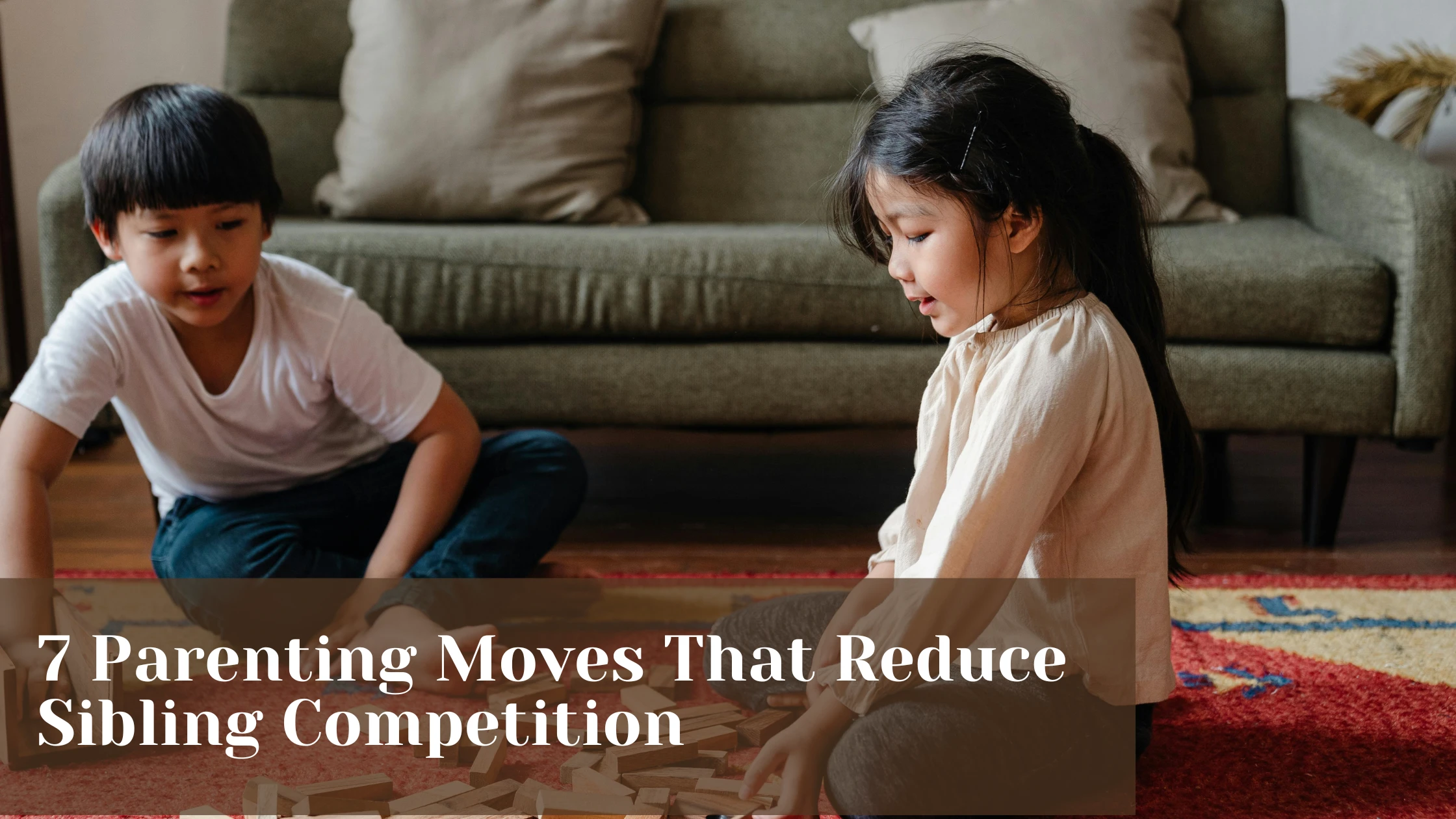
You’re in the kitchen making dinner when you hear it start. “Mom! She got the bigger piece!” Your nine-year-old is standing by the counter, holding up her slice of pizza next to her sister’s, face flushed with indignation. Before you can respond, your seven-year-old fires back: “That’s not fair! She always gets more!” Within seconds, what should have been a simple family meal has devolved into tears, accusations, and both children convinced that you love the other one more.
Or maybe it’s this: You praise your older son for getting an A on his math test. Your younger son, who’s been struggling in school, immediately deflates. Later, you overhear him saying to himself, “I’m the dumb one. I’ll never be as smart as him.” Your heart sinks. You were just trying to celebrate an achievement, but somehow you’ve accidentally confirmed in your younger child’s mind that love and approval are finite resources to be competed for.
Sound familiar? If you’re raising multiple children, sibling competition is probably a daily reality in your home. The fights over who gets the front seat. The tears when one child receives praise and the other doesn’t. The constant comparisons, the keeping score, the feeling that no matter what you do, someone feels shortchanged.
But here’s what most parents don’t realize: while some sibling rivalry is developmentally normal and even beneficial, the intense competition that many families experience isn’t inevitable. It’s often accidentally fueled by well-meaning parenting patterns that we don’t even realize we’re perpetuating.
Understanding Sibling Competition: What’s Normal and What’s Not
Before we explore how to reduce competition, let’s clarify what we’re actually dealing with—because not all sibling conflict is created equal, and understanding the distinction is crucial.
According to research from the Sibling Aggression and Abuse Research and Advocacy Initiative, sibling rivalry is a form of competition for parents’ favor, love, attention, and financial resources. Although siblings may not be mindful of each other’s feelings, rivalry does not involve harm or control. It often includes jealousy, competition, and bickering and can continue across the lifespan.
Importantly, the same research notes that sibling conflict is normal and expected. It can be very frequent, but most conflicts are mild, and some amount of conflict is good for socio-emotional development. During sibling conflicts, children can learn listening skills, cooperation, seeing another person’s point of view, and managing emotions. They can also learn how to solve problems and experience the consequences of their actions.
The goal isn’t to eliminate all competition or conflict between siblings. That’s neither possible nor desirable. The goal is to reduce the toxic competition—the constant comparison, the feeling that parental love is a limited resource, the belief that a sibling’s success means your failure.
Research from Cleveland Clinic explains that the feeling of competition is at the root of sibling rivalry. Not all competition is negative—it can make you work harder. But in sibling dynamics, it can become toxic and damaging when it is taken too far or fostered by parents.
So what are the parenting patterns that accidentally foster this toxic competition? And more importantly, what can you do instead?
7 Parenting Moves That Reduce Sibling Competition
1. Stop Labeling and Comparing—Even When You Think It’s Positive
This is perhaps the most common and insidious way parents accidentally fuel sibling competition. We label our children without even realizing we’re doing it—and those labels create roles that siblings then feel compelled to compete within.
What this looks like:
- “She’s my shy one” while talking about your other child who’s outgoing
- “He’s the athletic one” implying the other isn’t
- “She’s always been the studious one in the family”
- “He’s my wild child” (which positions another as the “good” one)
- Any comparison that positions children against each other: “Why can’t you be more like your sister?”
According to research from Positive Parenting Solutions, one of the easiest mistakes parents make is labeling and comparing children. Even subtle labels fuel sibling rivalry and can unintentionally lead to a feeling of competition between them. If Mom refers to one sibling as the “studious one” by default, the other assumes they’re not particularly studious. If she affectionately refers to one as “her wild one” or “her handful,” the sibling will likely feel rather superior as the “well-behaved” one.
Why this matters: Labels create identity boxes that children feel trapped in. When you consistently describe one child as “the smart one,” you’re inadvertently telling the other child that intelligence isn’t their domain. This creates a competitive dynamic where children feel they need to stake out territory—if one is “the athlete,” the other becomes “the artist” by default, even if they might have enjoyed both.
Labels also become self-fulfilling prophecies. Children live up (or down) to the identities we assign them. And when those identities are comparative—positioning one child’s strengths against another’s—competition becomes baked into the family dynamic.
What to do instead: Describe each child’s unique qualities without comparison or implication that another child lacks those qualities. Instead of “She’s the smart one,” try “She really loves reading and does well in school.” Instead of “He’s the athletic one,” say “He’s really passionate about soccer.” Notice how the second versions celebrate the child without implying anything about siblings.
When you must describe challenges, avoid labels entirely: Instead of “He’s my difficult child,” try “He’s having a hard time with transitions right now” (temporary, specific, solvable rather than fixed identity).
2. Give Each Child Individual Time and Attention—Not Equal, But Sufficient
Children compete for parental attention because from their perspective, it’s a scarce resource. When they feel they have enough of your focused attention, the need to compete diminishes dramatically.
What this looks like:
- Dedicated one-on-one time with each child regularly (even just 10-15 minutes daily)
- Time that’s protected—not interrupted by phones, siblings, or other demands
- Attention that’s focused on connection, not correction or instruction
- Letting each child know they’re important enough to have your undivided attention
Research from September 2025 emphasizes that the most important strategy to minimize sibling rivalry is deliberate daily one-on-one time with each child to build connections. Simply ten to fifteen minutes per day when your child has you to themselves goes a long way toward reducing sibling competition for your attention.
Why this matters: Well-behaved kids are often ignored while misbehaving kids get attention—even if that attention is negative. When you proactively fill each child’s “attention basket,” their attention-seeking behaviors (including competing with siblings) decrease.
Children don’t need equal time—they need sufficient time. One child might need more connection than another because of temperament, age, or current challenges. That’s okay. The key is that each child feels they have reliable, protected access to you.
What to do instead: Schedule regular one-on-one time with each child and treat it as sacred. This might be a bedtime routine with one child while your partner handles the other, a weekly breakfast date, or even just focused connection during a car ride. The specifics matter less than the consistency and the message it sends: “You matter enough to have my full attention.”
During this time, let the child lead. Don’t use it to lecture about behavior or homework. Just be together, enjoy each other, and connect.
3. Celebrate Individual Achievements Without Creating Hierarchies
Praising children for accomplishments is important, but when siblings are present, we need to be thoughtful about how we do it—because children are always listening and comparing.
What this looks like:
- Celebrating one child’s achievement in ways that don’t diminish others
- Avoiding competitive language: “You’re the best!” (better than whom?)
- Focusing on effort and improvement rather than innate ability or outcomes
- Making sure each child hears genuine appreciation for their unique strengths
According to research from Chroma Early Learning Academy, reinforcing positive sibling interactions is crucial for reducing rivalry. Parents can praise cooperative behavior and help children appreciate each other’s strengths, which mitigates competition and jealousy.
Why this matters: When children hear constant praise for a sibling’s achievements in areas they don’t excel in, they internalize the message that success in that domain isn’t available to them. This creates competition—either striving desperately to match the sibling or giving up entirely and staking out different territory.
The language we use matters too. “You’re so smart!” suggests intelligence is a fixed trait that you either have or don’t. But “You worked really hard on that!” celebrates effort, which is within everyone’s control.
What to do instead: When praising one child in front of siblings, focus on specific effort rather than general ability: “I noticed how carefully you practiced your times tables this week” rather than “You’re so good at math!” This makes it about their work, not their inherent superiority.
Better yet, find ways to celebrate each child’s unique strengths regularly so that praise doesn’t feel scarce or competitive. Keep a mental tally: if you’ve praised one child’s athletic performance several times this week, make sure you’re also finding genuine things to celebrate about your other children.
4. Refuse to Referee—Teach Mediation Skills Instead
When parents constantly intervene in sibling conflicts and decide who’s right and who’s wrong, we inadvertently fuel competition. Children learn that parental favor is something to win, and siblings become opponents rather than teammates.
What this looks like:
- Letting children work out minor conflicts themselves
- When intervention is necessary, putting both children “in the same boat” rather than choosing sides
- Teaching conflict resolution skills rather than imposing solutions
- Mediating rather than judging
Research from Positive Discipline Association emphasizes that when parents referee sibling scuffles and choose sides, rivalry naturally escalates. As parents, the job is to mediate, not play judge and jury. Bring the parties together and help them devise a solution they can feel good about. That way, there are no winners or losers, and they’ll learn valuable skills they’ll use in future conflicts.
Why this matters: When you consistently determine who’s right and wrong in sibling disputes, you create a win-lose dynamic. One child feels vindicated and superior; the other feels like the “bad kid.” This reinforces competition and resentment.
Additionally, constant intervention prevents children from developing the crucial skills of negotiation, compromise, and problem-solving. They never learn to work things out because you always do it for them.
What to do instead: When conflict erupts, resist the urge to immediately determine fault. Instead, try these approaches:
Leave It: “I notice you’re having a conflict. I believe you two can work it out. Please come let me know when you’re done.”
Live It: “I notice you’re having a conflict. I’m going to sit nearby and read while you work it out.” (Being present without interfering)
Let ’em Go: Give them space and time to resolve it, checking in later to see how they handled it.
When you must intervene (safety issues, escalation), treat both children the same: “I see you’re both really upset. Let’s all take a break and talk when we’re calm.”
5. Respect Personal Ownership and Boundaries—Don’t Force Sharing
This might be counterintuitive, but forcing children to share—particularly new or special items—actually increases competition and resentment rather than teaching generosity.
What this looks like:
- Protecting each child’s special belongings from forced sharing
- Teaching the difference between personal items and family items
- Respecting that “no” is a complete sentence when it comes to personal possessions
- Understanding that true sharing comes from generosity, not coercion
Research from September 2025 explains that learning to share is important, and so are boundaries. When kids are forced to turn something over to a sibling (especially when it’s a new gift), it sends them a very clear message: sharing feels bad, and I don’t want to do it again. Instead of forcing your child to “give your sister a turn,” you can say, “That’s Megan’s new toy, and she’ll let you have a turn when she’s ready.” This creates a feeling of safety for Megan.
Why this matters: When children know their possessions aren’t safe from siblings—that at any moment you might decree they must share something precious—they become hypervigilant and possessive. They compete to claim ownership and resist sharing because experience has taught them that sharing means losing.
But when children feel secure that their belongings are protected, they’re actually more likely to share generously because they’re not operating from scarcity and fear.
What to do instead: Establish clear categories: personal items (your room, your special toys, your birthday gifts) and family items (shared toys, games, art supplies). Personal items don’t have to be shared unless the owner chooses to. Family items are available to everyone with turn-taking.
When a sibling wants something that belongs to the other, teach them to ask permission: “Can I play with your game?” The owner can say yes, no, or “not right now, but maybe later.” Respect that response.
This teaches both children valuable lessons: owners learn that their boundaries will be respected (creating safety that paradoxically leads to more sharing), and askers learn that other people’s belongings aren’t theirs to take and that hearing “no” is part of life.
6. Model Cooperation, Not Competition, in Your Own Relationships
Children learn more from what they see than what they’re told. If they observe competition, comparison, and win-lose dynamics in your relationships—whether with your partner, friends, or even how you talk about colleagues—they’ll replicate those patterns with siblings.
What this looks like:
- Demonstrating how you and your partner work together as a team
- Speaking respectfully about your partner, even during disagreements
- Modeling apologies and conflict resolution
- Avoiding competition or keeping score in your own relationships
- Speaking positively about cooperation and collaboration
According to Cleveland Clinic research, role modeling is one of the most powerful and effective ways to teach children how to get along with their siblings. Show your children how to share by dividing up the last piece of pie or working together on a chore. Intentionally say sorry when you have a conflict with your significant other and let them hear you saying those words to each other.
Why this matters: If your children see you and your partner slamming doors during arguments or keeping score about who does more housework, they learn that relationships are competitive arenas where you win or lose. But if they see you working through disagreements calmly, apologizing genuinely, and celebrating each other’s successes, they learn that relationships can be cooperative and mutually supportive.
This extends beyond your marriage. How do you talk about your sister getting a promotion? Do you sound genuinely happy, or is there a note of competition? How do you handle it when a friend succeeds in an area where you’re struggling? Children are always watching and learning what relationships are supposed to look like.
What to do instead: Narrate your cooperative behaviors: “Dad and I are going to work together to get dinner ready—he’ll cook while I help you with homework, and then we’ll swap.” Let children overhear you genuinely celebrating a friend’s success. Model apologizing: “I’m sorry I snapped at you earlier when I was stressed. That wasn’t fair.”
When you do disagree with your partner, demonstrate healthy conflict: staying calm, listening, compromising, and resolving rather than “winning.” Your children are learning their relational blueprint from watching you.
7. Create Cooperative Goals and Shared Experiences
When siblings work together toward common goals or share positive experiences as a team, it fundamentally shifts the dynamic from competition to collaboration.
What this looks like:
- Family projects that require everyone’s contribution
- Team games where siblings are on the same side against parents
- Shared responsibilities where they need each other to succeed
- Family traditions that create “us” identity rather than “me vs. you”
- Celebrating family wins, not just individual achievements
Research from January 2025 describes a strategy where if children want to use electronics, they must play together—on teams, cooperating, enjoying each other’s company. This transforms screen time from solitary competition into collaborative connection.
Why this matters: Competition creates a zero-sum mindset: your win is my loss. But cooperation creates a growth mindset: when we work together, we all benefit. When siblings experience success as a team, they start seeing each other as allies rather than opponents.
Research from December 2025 notes that incorporating fun family traditions, such as game nights or collaborative projects, can enhance sibling bonds. These shared experiences create lasting memories and foster a sense of unity. By actively promoting positive interactions, parents can cultivate an environment where siblings support and uplift each other.
What to do instead: Design opportunities for cooperation:
- Family game nights where siblings team up against parents
- Household projects where they must work together (building something, organizing a space, planning an event)
- Challenges where collective success is celebrated: “If you both complete your chores before dinner, we’ll have time for a family movie”
- Shared responsibilities: “You two are in charge of planning our Saturday activity together”
When they succeed as a team, celebrate the teamwork: “I love how you two worked together to clean up so quickly! You make a great team.” This reinforces their identity as collaborators rather than competitors.
When Sibling Competition Crosses the Line
While normal rivalry and conflict are part of sibling relationships, sometimes competition escalates into something more concerning. Research from the Sibling Aggression and Abuse Research and Advocacy Initiative helps parents identify when to seek professional help:
Signs that rivalry has become problematic:
- Frequent or intense physical aggression that may lead to injury or fear
- One-sided conflict where one child is consistently the aggressor
- Cruelty or threats that involve violent language or intent of emotional harm
- Competition that causes genuine distress, anxiety, or depression in one or both children
- Persistent patterns despite consistent use of healthy parenting strategies
If you’re seeing these patterns, don’t hesitate to reach out to a family therapist who can help address underlying dynamics and teach more effective coping strategies.
The Deeper Truth About Sibling Relationships
If there’s one thing I want you to walk away with, it’s this: the sibling relationship is likely the longest relationship your children will ever have. Long after you’re gone, they’ll have each other—but only if you’ve helped them build a foundation of cooperation rather than competition.
The patterns you establish now shape whether your children grow up as friends or as people who politely tolerate each other at family holidays. Whether they call each other in crisis or feel too much resentment from childhood competition to truly connect as adults.
This doesn’t mean you can prevent all conflict or create perfectly harmonious siblings through sheer parenting will. Temperament, age differences, and individual personalities all play roles. But you can avoid accidentally fueling toxic competition through the seven patterns we’ve discussed.
When you stop labeling and comparing, give sufficient individual attention, celebrate without creating hierarchies, refuse to referee, respect boundaries, model cooperation, and create shared goals—you’re fundamentally changing the family dynamic from scarcity to abundance. You’re teaching your children that love isn’t a limited resource they must compete for, that each person’s success doesn’t diminish others, and that siblings can be each other’s greatest allies.
That’s a gift that will serve them for a lifetime.
Moving Forward with Your Family
Changing established patterns takes time and consistency. If your home has been characterized by intense sibling competition, don’t expect overnight transformation. You’re rewiring relational dynamics that may have been in place for years.
Start with one or two of these strategies that resonate most with your family’s specific challenges. Maybe you recognize that labeling is your biggest issue, or maybe you realize you’ve been inadvertently choosing sides in conflicts. Pick one pattern to change and work on it consistently for a few weeks before adding another.
Be patient with yourself and your children. Old habits die hard, and there will be setbacks. The goal isn’t perfection—it’s gradual movement toward healthier patterns.
And remember: some amount of sibling rivalry is normal, expected, and even beneficial. The goal isn’t to eliminate all competition or create siblings who never disagree. It’s to ensure that underneath the normal bickering and occasional conflicts, there’s a foundation of cooperation, mutual respect, and the knowledge that they’re on the same team.
Your children might not thank you for this work now. They might continue fighting over who got the bigger piece of pizza. But years from now, when they’re adults who genuinely enjoy each other’s company, who call each other for advice, who show up for each other in crisis—that’s when you’ll know this work mattered.
What patterns of sibling competition do you see in your home? Which of these strategies resonates most with your family’s needs? Share your experience in the comments below—your insights might help another parent recognize patterns they hadn’t seen before.
And if this post gave you new perspective on reducing sibling rivalry, please share it with another parent navigating the same challenges. Every family deserves the peace that comes from siblings who see each other as teammates, not competitors.