
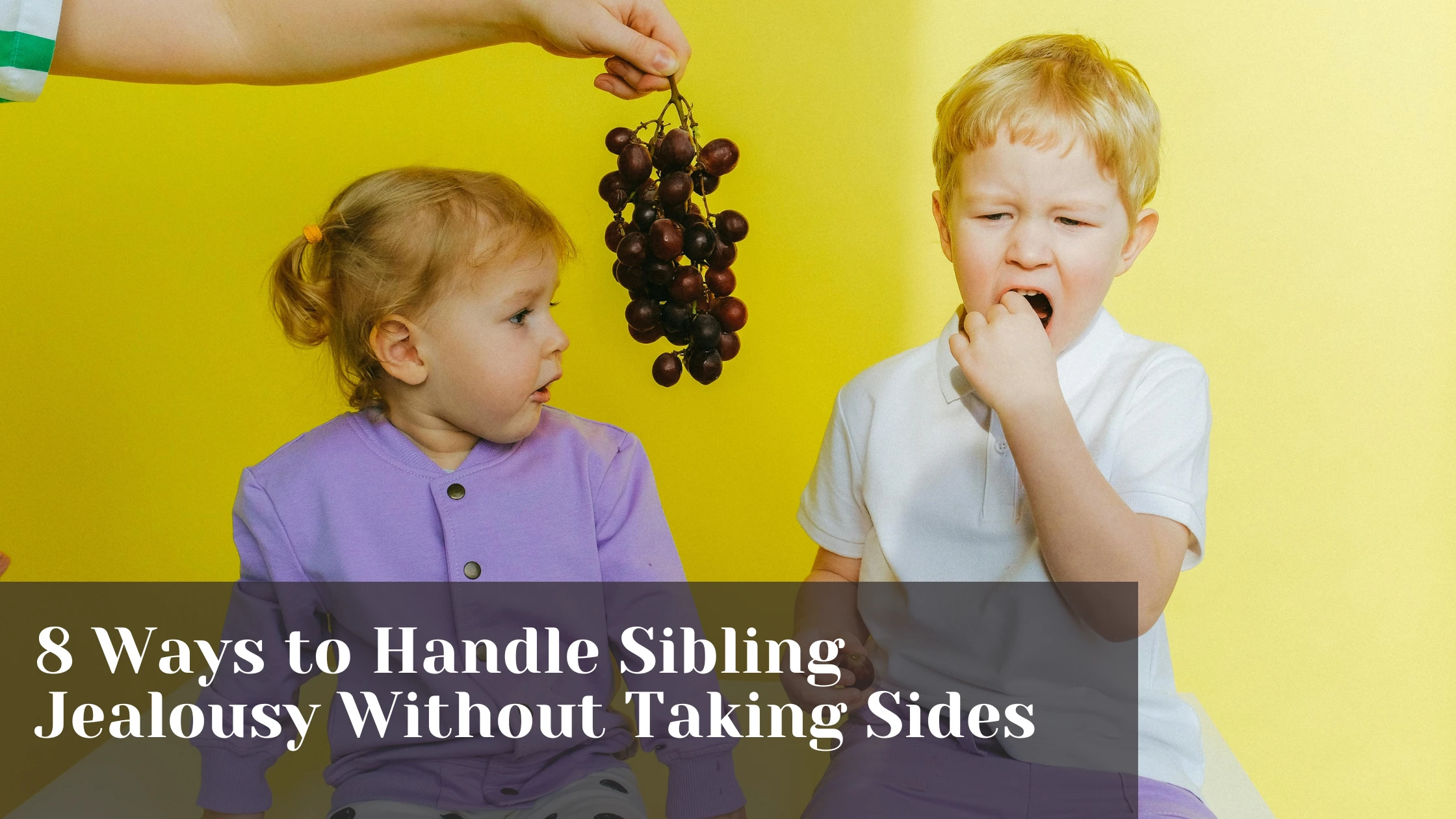
Your older child storms into the kitchen, face red with anger: “You always let him get away with everything! You love him more than me!” Meanwhile, your younger child is crying in the other room because their sibling knocked over the block tower they’d been building for an hour. Both children are looking to you to decide who’s right, who’s wrong, who gets your sympathy, and who deserves consequences.
In that moment, every instinct might pull you toward taking a side. The younger child needs comfort. The older child needs discipline for knocking over the tower. But here’s the uncomfortable truth: the minute you choose a side, you’ve lost. Someone becomes the victim, someone becomes the villain, and the jealousy that’s already burning becomes a raging fire.
Sibling jealousy is one of the most common and persistent challenges parents face—yet most parents respond in ways that actually intensify rivalry rather than resolving it. The good news? Decades of research on sibling relationships reveal that there are effective approaches to managing jealousy without choosing favorites, without ignoring genuine problems, and without becoming the constant referee in an endless war.
Understanding the Roots of Sibling Jealousy
Before exploring how to respond, we need to understand what we’re actually dealing with. Sibling rivalry is defined as competition or jealousy that develops between siblings for the love, affection, and attention of either one or both parents. It’s considered a universal phenomenon that occurs in nearly every family across cultures.
Research from developmental psychology shows that sibling relationships are characterized by several unique features. They involve long history and intimate knowledge, opportunities for both conflict and support, large individual differences in quality, and age differences that create power dynamics while also enabling teaching and helping exchanges.
Here’s what makes sibling jealousy particularly intense: Unlike relationships with friends or classmates, children don’t choose their siblings. They’re stuck in this relationship whether they want to be or not. And unlike friendships where children can walk away when conflicts arise, siblings share physical space, parental attention, and family resources—creating constant opportunities for comparison and competition.
A 2010 study on the development of sibling jealousy emphasizes that jealousy is composed of affective, behavioral, and cognitive dimensions that emerge within what researchers call the “social triangle”—the jealous child, the beloved parent, and the rival sibling. The jealousy isn’t just about the siblings themselves; it’s fundamentally about competition for parental love and attention.
But here’s the hopeful part: Research consistently shows that the sibling relationship can be a natural laboratory for learning how to manage disagreements, regulate emotions, understand others’ perspectives, and develop social competence. When parents respond effectively to sibling conflict and jealousy, they’re not just keeping the peace—they’re teaching skills that will benefit children throughout their lives.
The 8 Ways to Navigate Sibling Jealousy
1. Stay Neutral and Avoid Determining Who’s “Right”
When siblings come to you with conflict, your first instinct might be to investigate, determine fault, and deliver justice. But this approach almost always backfires, especially when jealousy is involved.
Research from 2004 examining parent mediation in children’s disputes published in the Journal of Family Psychology found that when parents act as judges determining which child is right or wrong, it can actually escalate conflict because children learn that their goal should be winning the parent’s favor rather than resolving the actual issue.
What staying neutral looks like:
- “You both seem upset about what happened. Let’s talk about it together.”
- “I wasn’t there, so I don’t know exactly what happened. Tell me each of your perspectives.”
- Avoiding phrases like “Who started it?” or “Whose fault was this?”
- Focusing on how to solve the problem going forward rather than determining blame
Why this matters: When you take a side, even if you’re technically correct about who was at fault, the “losing” child experiences it as proof that you favor their sibling. This reinforces the jealousy and teaches children that conflicts are zero-sum games where one person wins and another loses.
A 2014 study on parent mediation empowering sibling conflict resolution found that when parents avoided taking sides and instead facilitated children’s own resolution processes, siblings developed better conflict resolution skills and showed decreased rivalry over time.
The exception: If there’s a clear safety issue or one child has been physically aggressive, you do need to address that behavior. But you can do so without making it about choosing a favorite: “Hitting is not okay in our family. I’m going to help you both calm down, and then we’ll talk about what happened and how to handle it differently.”
2. Validate Both Children’s Feelings Without Comparing
One of the most damaging patterns in sibling rivalry happens when parents inadvertently compare children’s emotional reactions: “Your sister isn’t crying about sharing. Why are you being so dramatic?” This intensifies jealousy by suggesting that one child’s way of feeling or reacting is superior to the other’s.
What validation looks like:
- “You’re both frustrated right now, for different reasons.”
- Speaking to each child individually: “It sounds like you’re really upset that your tower got knocked down” and separately, “It sounds like you were frustrated about not getting to play with those blocks earlier”
- Acknowledging that different children experience situations differently: “This really matters to you, even if it might not bother someone else as much”
The research foundation: Studies on sibling relationships and development emphasize that siblings have different temperaments, developmental stages, and needs. When parents can validate each child’s individual experience without comparison, children feel seen and are less likely to compete for acknowledgment that their feelings matter.
Research from 2007 examining parent and sibling influences found that children’s conflict behaviors across the preschool period were influenced by how parents responded to their emotional expressions. When parents validated feelings without comparison, children developed better emotion regulation and showed less aggressive conflict behaviors with siblings.
3. Focus on Teaching Problem-Solving, Not Delivering Justice
Instead of determining who was right and imposing consequences, shift your role from judge to coach. Your goal isn’t to punish the guilty party—it’s to help both children develop skills for handling similar situations in the future.
What problem-solving coaching looks like:
- “Okay, you both want to use the blocks. How can we solve this so it works for both of you?”
- “What are some different ways you could handle this situation?”
- Offering options if they’re stuck: “Some families take turns, some share and play together, some set a timer. What sounds good to you?”
- Teaching them to generate their own solutions: “What do you think would be fair?”
Research on sibling conflict resolution from 2014 found that when parents empowered children to participate in conflict resolution rather than imposing solutions, children showed improvements in their ability to resolve conflicts independently. This approach reduced reliance on parents as mediators and decreased overall sibling conflict.
A 2002 study published in Child Development examining constructive and destructive sibling conflict found that when conflicts involved elements of shared decision-making and compromise, they were associated with gains in social understanding and relationship quality. Conflict isn’t inherently bad—what matters is how it’s navigated.
The key insight: When children learn to solve problems together with parental support rather than competing for parental favor, the jealousy decreases because they’re working as a team toward solutions rather than as rivals for your judgment.
4. Create Individual Time With Each Child (And Make It Sacred)
One of the most persistent sources of sibling jealousy is the genuine fear that parental love and attention are limited resources that must be competed for. The most powerful antidote to this fear is consistent, individual attention for each child.
Research examining sibling jealousy shows that children’s jealous responses to parental attention directed at siblings are significantly reduced when they have secure, reliable one-on-one time with parents. When children know they’ll get individual attention, they’re less desperate to compete for it.
What this looks like:
- Scheduling regular one-on-one time with each child—even 15 minutes daily can make a difference
- During that time, giving them full attention without distractions
- Letting each child choose the activity during their time
- Making this time non-negotiable, not something that gets skipped when schedules are busy
- Not canceling one child’s time to deal with the other child’s issue unless it’s a genuine emergency
Why this is so powerful: Studies on sibling relationships show that when children feel secure in their individual relationship with parents, they’re less threatened by the sibling relationship. The individual time communicates: “My love for you isn’t diminished by my love for your sibling. You don’t have to compete.”
A 2025 meta-analysis examining parenting styles and sibling conflicts published in Frontiers in Psychology found that authoritative parenting—which includes responding to each child’s individual needs—was associated with reduced sibling conflict, while neglectful and inconsistent parenting predicted increased conflict and rivalry.
5. Avoid Comparisons (Even Positive Ones)
“Why can’t you be more like your brother?” is obviously harmful. But even positive comparisons—”You’re so much more responsible than your sister”—fuel jealousy by creating a hierarchy and making children’s worth relative to one another.
Research on sibling rivalry identifies social comparison as especially relevant in explaining the relationship between differential parental treatment and problem behavior. When children are constantly compared—either favorably or unfavorably—they internalize the message that their value depends on how they measure up against their sibling.
What avoiding comparisons looks like:
- Praising children for their individual qualities without reference to siblings: “You worked really hard on that project” instead of “You did so much better on this than your brother did”
- Celebrating achievements individually: “You scored a goal! I’m proud of you” not “You scored more goals than your sister did when she played”
- Recognizing that different children have different strengths, and that’s okay
- Never using one child as an example to motivate another
The research evidence: Studies from 2025 on sibling rivalry in blended families emphasize that perceived favoritism and differential treatment are among the strongest predictors of sibling conflict and jealousy. When children perceive they’re being measured against their siblings, rivalry intensifies dramatically.
6. Teach Children to Manage Jealous Feelings (Not Just Jealous Behaviors)
Most parents focus on stopping the behaviors that result from jealousy—the hitting, the tattling, the mean comments. But addressing only the behavior without helping children understand and manage the underlying jealous feelings is like treating symptoms without addressing the disease.
What teaching emotional management looks like:
- Naming the feeling: “It sounds like you’re feeling jealous that I’m spending time with your sister right now”
- Normalizing it: “Feeling jealous sometimes is normal. Everyone feels that way occasionally”
- Teaching coping strategies: “When you’re feeling jealous, you can use words to tell me: ‘I need some attention too.’ You don’t have to hit or be mean”
- Helping them understand the feeling won’t last forever: “This feeling is uncomfortable right now, but it will pass”
The developmental importance: Research from 2025 examining sibling relationships and emotional resilience emphasizes that siblings serve as critical contexts for learning emotional regulation. When parents help children name and navigate jealous feelings rather than just suppressing jealous behaviors, children develop emotional intelligence that benefits all their relationships.
Studies on sibling conflict in preschool years show that when sibling relationships include both support and some conflict, and children are helped to resolve that conflict constructively, it’s associated with greater perspective-taking abilities and social competence.
7. Set Fair Rules and Consequences (But Fair Doesn’t Mean Identical)
One common trap parents fall into is trying to treat all children exactly the same to avoid accusations of favoritism. But children are at different developmental stages with different needs—and truly fair treatment recognizes those differences.
What fairness actually means:
- Age-appropriate expectations: Bedtimes, chores, and privileges that reflect developmental stage
- Individual needs: One child might need more help with homework; another might need more physical activity
- Explaining the logic: “Your sister goes to bed later because she’s older. When you’re that age, you’ll have a later bedtime too”
- Consistent application of rules within developmental levels
Research from 2025 on sibling rivalry recommends assigning chores and obligations based on age and ability while allowing younger children leadership roles in age-appropriate tasks. Feelings of unfairness in responsibilities or privileges lead to resentment and rivalry, but appropriate differentiation helps children understand that fair means getting what you need, not getting identical treatment.
The 2025 meta-analysis on parenting and sibling conflict found that authoritative parenting—which includes clear expectations and consistent enforcement—reduced sibling conflicts more effectively than permissive approaches where rules were unclear or inconsistently applied.
8. Model How to Handle Jealousy and Conflict in Your Own Relationships
Children learn more from watching how you navigate difficult emotions than from anything you explicitly teach them. If you become defensive, comparative, or hostile when you feel threatened or jealous in your own relationships, they’re learning those patterns.
What healthy modeling looks like:
- Talking about your own jealous moments and how you handled them: “I felt a little jealous when Dad spent the whole day with his friend, but then I remembered I get to do the same thing sometimes, and Dad and I will have time together tomorrow”
- Demonstrating conflict resolution with your partner: Staying calm, using respectful language, finding compromise
- Showing them it’s okay to have uncomfortable feelings and still behave well: “I’m feeling frustrated right now, so I’m going to take some deep breaths before we continue this conversation”
The intergenerational component: Research published in multiple studies shows that parental modeling of emotion regulation and conflict resolution significantly predicts children’s ability to manage their own sibling conflicts. Children whose parents demonstrate healthy emotional management and fair conflict resolution develop better sibling relationships.
When Sibling Jealousy Becomes Serious
The strategies we’ve discussed assume relatively normal sibling rivalry. But sometimes jealousy crosses into territory that requires more intensive intervention.
Warning signs that professional help might be needed:
- One sibling shows persistent aggression toward another that feels beyond normal conflict
- A child expresses genuine hatred toward a sibling or wishes they didn’t exist
- Jealousy manifests as anxiety, depression, or behavioral regression
- Physical violence that escalates or seems beyond developmental norms
- One child seems persistently favored while another is consistently scapegoated
Research on sibling rivalry disorder identifies it as a diagnosable condition (F93.3 in ICD-10) when disturbance is severe enough to warrant clinical attention. Management typically involves both child-focused interventions and parent training, often using approaches like Parent-Child Interaction Therapy.
Studies examining when sibling conflict becomes problematic show that while some conflict is developmentally normal and even beneficial, severe or persistent aggression can have lasting negative effects on both the aggressor and the victim’s development.
The Long-Term Benefits of Getting This Right
When you handle sibling jealousy without taking sides, something remarkable happens over time. Children learn:
- Conflict doesn’t require a winner and loser
- Multiple people can have valid perspectives simultaneously
- Problems can be solved collaboratively
- Love isn’t a limited resource that must be competed for
- Relationships survive disagreement and difficult emotions
Research on sibling relationships and emotional resilience emphasizes that positive sibling relationships promote resilience by offering consistent emotional outlets, social learning opportunities, and safe spaces for emotional expression. The skills children learn navigating sibling relationships—particularly when parents facilitate healthy conflict resolution—transfer to all their future relationships.
Studies tracking sibling relationships into adulthood show that while adult sibling relationships are structurally different than childhood relationships, they’re often based on the history established earlier. The jealousy and rivalry patterns from childhood can persist into adulthood, or they can transform into supportive, meaningful relationships—largely depending on how parents navigated the conflicts during formative years.
Moving Forward: From Rivalry to Relationship
Sibling jealousy is exhausting. The constant conflicts, the competition for your attention, the feeling that you can never satisfy everyone—it’s one of the hardest aspects of parenting multiple children. But understanding that jealousy is normal, that it serves developmental purposes, and that how you respond shapes whether it becomes toxic or transforms into healthy competition can change your entire approach.
You don’t have to be perfect. You’ll take sides sometimes. You’ll make unfair decisions occasionally. You’ll give one child more attention than another on particular days. What matters is the overall pattern—and whether that pattern communicates to each child that they’re valued individually, that conflict can be resolved without winners and losers, and that your love isn’t a prize to be won through competition.
The goal isn’t to eliminate sibling conflict or make jealousy disappear entirely. The goal is to teach children how to navigate these feelings and situations in ways that build relationship skills rather than destroying them. When you refuse to choose sides, when you validate all feelings while teaching problem-solving, when you ensure each child feels secure in their individual relationship with you—you’re giving your children tools they’ll use for a lifetime.
And someday, when they’re adults and the rivalry has transformed into genuine friendship and support, they’ll have you to thank for refusing to pick a favorite.
How do you handle sibling jealousy in your family? What approaches have worked, and which have made things worse? Share your experiences in the comments—parents managing multiple children benefit from knowing they’re not alone in finding this challenging.
If this article gave you new strategies for navigating sibling conflict, please share it with a parent who’s struggling with rivalry between their children. Sometimes the most powerful shift comes from understanding that staying neutral and teaching skills matters more than determining who’s right.