
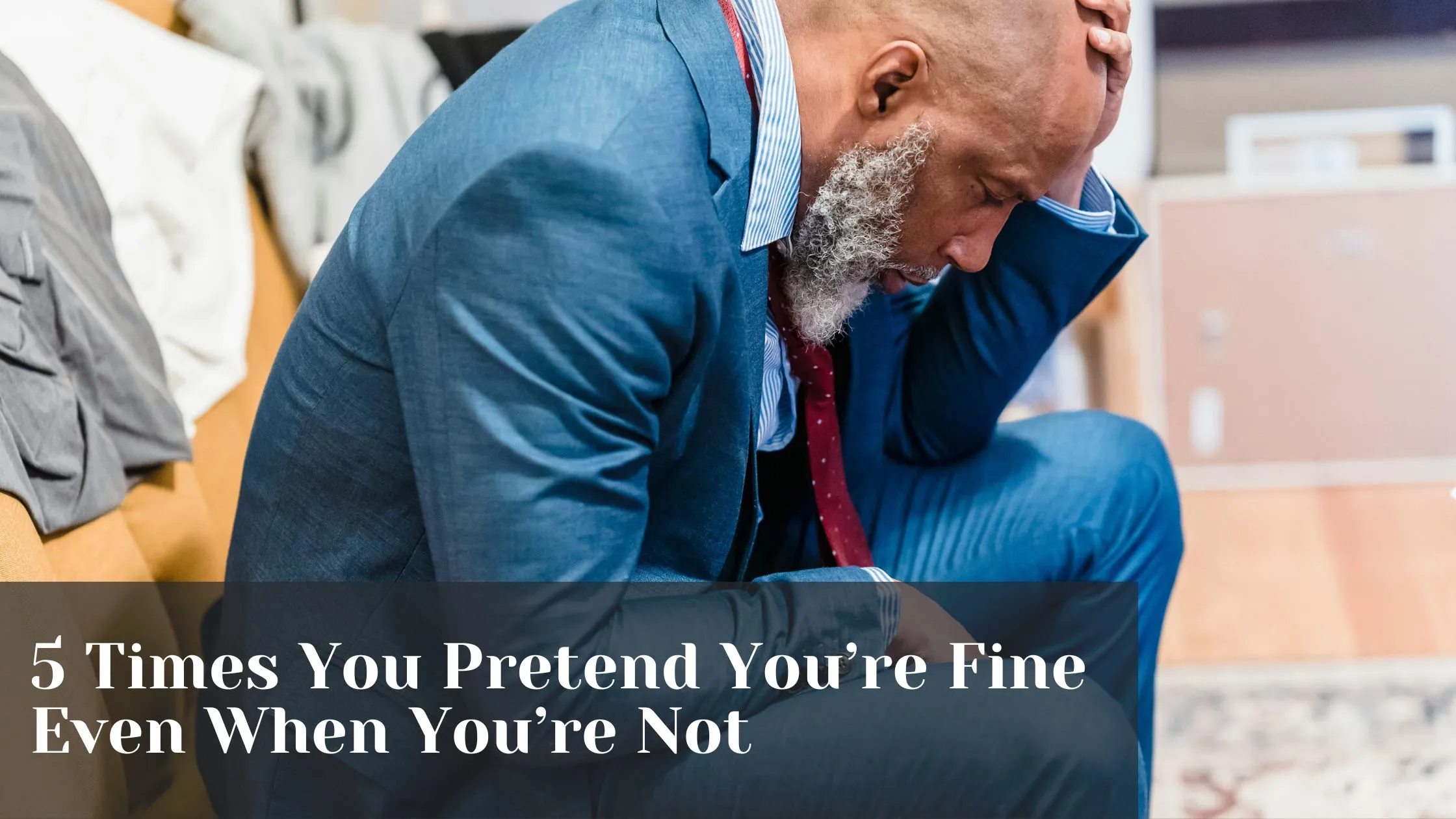
Someone asks “How are you?” and before you can even process the question, “I’m fine!” has already left your mouth—automatic, reflexive, practiced. But inside, you’re drowning. You’re overwhelmed, exhausted, barely holding it together. Your partner just left, your job is crushing you, or you’re grieving a loss that feels unbearable. But “fine” is what comes out, because it’s safer than the truth. The conversation moves on. You’ve successfully avoided vulnerability once again.
Or maybe it’s this: You’re at a family dinner, and everyone’s celebrating your recent promotion. They’re so proud, so happy for you. Meanwhile, you’re terrified—imposter syndrome is eating you alive, the new responsibilities feel overwhelming, and you haven’t slept properly in weeks. But you smile, you thank them, you play the role of the successful family member they expect. Because admitting you’re struggling would shatter the image they have of you—and maybe the image you have of yourself.
If you’ve lived these moments—and most of us have—you know that peculiar exhaustion of performing fine-ness when you’re anything but. You’ve mastered the art of the smile that doesn’t reach your eyes, the casual “I’m good” that closes the door on deeper conversation, the laugh that hides the pain just beneath the surface.
Welcome to the hidden cost of emotional suppression—where “fine” becomes a fortress that keeps everyone out, including your authentic self.
The Psychology of “I’m Fine”: When Avoidance Becomes Automatic
Before we explore the specific moments when we pretend to be fine, let’s understand what’s really happening psychologically when we suppress our true emotional state.
According to research from September 2025, “I’m fine” is a common phrase, often said automatically, used to deflect concern, avoid vulnerability, or push through emotional exhaustion. While it might serve as a temporary coping mechanism, chronic use of this phrase can lead to emotional disconnection and long-term psychological harm.
Research published in October 2025 examining why people say “I’m fine” when they’re not identified several core drivers:
- Culture: If you grew up in an environment where being emotionally vulnerable felt unsafe, you may have learned to suppress your feelings to maintain peace or avoid judgment
- Perfectionism and shame: Some individuals fear being seen as weak or unstable and default to “I’m fine” to maintain an image of control
- Emotional burnout: When you’re mentally and emotionally exhausted, pretending to be okay might feel like the only manageable option
- Low self-esteem: If you don’t believe your emotions are valid or important, you may suppress them to avoid “burdening” others
The key insight: Emotional suppression isn’t just about hiding feelings from others—it’s about hiding them from yourself. And that disconnect has profound consequences.
Let’s explore the five most common moments when “fine” becomes your default setting.
5 Times You Pretend You’re Fine
1. When Someone Asks How You’re Really Doing
This is perhaps the most universal moment—someone actually cares enough to ask beyond the surface “how are you,” and instead of telling the truth, you deflect, minimize, or outright lie.
What this looks like:
- “How are you holding up?” → “I’m fine, really!” (while you’re barely holding it together)
- “You seem off lately, is everything okay?” → “Yeah, just tired” (when it’s so much more than tired)
- “I’m worried about you” → “Don’t be! I’m totally fine” (shutting down their concern immediately)
According to research from December 2025, when someone would ask how they were, people would run a calculation in their head: “How much can I say without being a burden?” The answer was usually: nothing substantial. So “fine” became the default.
Why you do this: Research from July 2020 notes several reasons we deny our problems: We want to be seen as strong and capable. We’re afraid of judgment or shame. We don’t want to be a burden. And perhaps most painfully, if we acknowledge our problems to others, we have to face them and admit to ourselves that we’re not happy, our lives aren’t perfect, or we need help.
The cost: According to research from December 2025, when you’re always “okay,” people stop asking real questions. They assume you’re strong, self-contained. You become the person everyone leans on but nobody thinks to check on. You’re in rooms full of people feeling completely alone because nobody knows you—they know the version you perform for them, but not the actual you underneath.
2. When You’re Overwhelmed but Feel Like You “Should” Be Able to Handle It
This is the moment when life’s demands exceed your capacity, but you keep pushing because asking for help or admitting struggle feels like failure.
What this looks like:
- Juggling work, family, and personal responsibilities while telling everyone you’re “managing fine”
- Being asked if you need help and automatically saying “No, I’ve got it!” even when you’re drowning
- Working yourself to exhaustion because you believe you should be able to handle everything
- Comparing yourself to others who seem to manage similar loads effortlessly
Research from May 2025 notes that many of us learned to suppress emotions—especially uncomfortable ones—as a survival strategy. Emotional suppression is the act of consciously or unconsciously pushing away feelings that feel too overwhelming, painful, or socially unacceptable.
Why you do this: According to research from July 2025, this is the paradox of high-functioning mental health—when your life looks put-together, but your internal world is anything but. You’ve trained yourself so well to hold everything together that you can’t remember what it feels like to fall apart without shame.
The deeper issue: Research examining emotional suppression found that pretending to be okay is one of the most energy-draining things a person can do. You’re constantly editing yourself, managing your tone and facial expression, playing a role. And after years of doing this, you wake up one day and realize: “I don’t even know how I actually feel anymore.”
3. When Showing Emotion Might Make Others Uncomfortable
This is when you suppress your feelings not for yourself, but to manage other people’s discomfort with your pain, anger, or distress.
What this looks like:
- Downplaying serious issues because you sense others don’t want to hear it
- Forcing a smile at social events when you’re grieving or struggling
- Making jokes about your pain to lighten the mood for others
- Changing the subject when your honest feelings might make the conversation heavy
Research from July 2020 explains that many of us grew up in families where we weren’t allowed to be angry or sad. We were told to stop crying or we were punished when we expressed our feelings, or our feelings were ignored. As a result, we learned to suppress our feelings and to numb them with food, alcohol, or other compulsive behaviors.
Why you do this: According to research, we live in a culture that romanticizes resilience but forgets to value honesty. We reward people for “pushing through,” for being “low maintenance,” for not making a fuss. Vulnerability still makes people uncomfortable, even though everyone craves it.
The pattern: You become an emotional caretaker, managing not just your own feelings but everyone else’s comfort level. Research notes that related to this is our desire to be easygoing or low-maintenance. We don’t want to be difficult (that might lead to conflict) and we don’t want to be a burden or need anything because that might drive people away.
4. When You’re Afraid Your Struggle Isn’t “Valid” Enough
This is the insidious voice that tells you your problems aren’t serious enough to warrant concern, so you minimize them even when they’re genuinely affecting you.
What this sounds like internally:
- “Other people have it so much worse”
- “I should be grateful for what I have”
- “This is just a first-world problem”
- “I’m being dramatic”
- “I don’t have a right to complain”
Research from October 2025 found that when you spend years bottling up feelings, minimizing them becomes automatic. You get good at saying things like “It’s not a big deal” or “Other people have it worse.” You convince yourself that your pain is insignificant compared to what others go through.
Why you do this: You’ve internalized a hierarchy of suffering where your pain must meet some threshold of “bad enough” before it deserves attention or care. This often comes from childhood experiences where your feelings were dismissed, from comparison culture on social media, or from messages that emotions are inconvenient or weak.
The cost: Research notes that downplaying your emotions doesn’t make them go away—it just pushes them deeper. And that distance between what you feel and what you express can grow into a quiet kind of loneliness.
5. When Admitting You’re Not Fine Means Facing What’s Wrong
Sometimes “fine” is easier than the alternative: acknowledging that something fundamental in your life needs to change.
What this looks like:
- Staying in an unfulfilling job and insisting “it’s fine” rather than facing career uncertainty
- Maintaining a relationship that’s not working and claiming “we’re good” instead of addressing problems
- Living a life that doesn’t align with your values but saying “I’m happy” to avoid existential questions
Research from July 2020 explains that pretending we don’t have problems, difficult emotions, or conflicts is a facade—the image we want to present to the rest of the world. And if we acknowledge our problems to others, we have to face them and admit to ourselves that we’re not happy, our lives aren’t perfect, or we need help.
Why you do this: Denial feels safer than change. Research notes that denial is understandable—it seems easier to avoid certain problems, traumatic memories, and difficult feelings. However, we all know that avoidance isn’t a good long-term strategy. Often, the longer we try to ignore things, the bigger the problems become.
The deeper truth: If acknowledging you’re not fine means you have to make difficult decisions—leave relationships, change careers, set boundaries, or fundamentally alter your life—”fine” becomes a way to maintain the status quo, even when that status quo is slowly destroying you.
The Hidden Costs of Chronic “Fine-ness”
The consequences of persistently pretending you’re fine extend far beyond the immediate moment. Research from July 2025 found that emotional suppression is often linked to anxiety, depression, and burnout. Not expressing what we feel doesn’t make the feelings go away—it just makes them louder in our bodies.
Physical health impacts: Research from 2024 examining emotion suppression and physiological stress found that suppressing emotions can lead to physical stress on your body, impacting blood pressure, memory, and self-esteem.
Relational disconnection: Carl Rogers’s concept of “incongruence”—the disconnect between our real self and our presented self—quietly chips away at mental wellbeing. This creates emotional disconnection not just from others, but from yourself.
Loss of authentic self: Research from 2025 found that after years of emotional suppression, you might look like you have it all together, but feel hollow underneath.
Moving Toward Authentic Expression
If you recognize yourself in these patterns, here’s what can help:
Name it to tame it: Research recommends putting words to your emotions—identifying what you’re feeling and where you feel it in your body. This reduces the intensity and helps you process more clearly.
Replace “fine” with something honest: You don’t need to share everything, but try shifting to something more real: “I’m having a rough day” or “I’m working through some stuff.”
Find one safe person: Research suggests finding just one person you can be honest with. Tell them: “I need to practice not saying I’m fine when I’m not. Can I be real with you?”
Practice self-compassion: Research recommends speaking kindly to yourself, repeating phrases like “It’s okay that I feel this way” or “Doing my best looks different every day.”
Remember: Being “fine” isn’t the goal. Being real is. And when we stop pretending, we don’t just feel better—we give others permission to do the same.
Which of these moments resonates most with you? When do you find yourself defaulting to “fine” even when you’re not? Share in the comments below.
And if this post helped you recognize patterns of emotional suppression, please share it. Millions of people carry this weight, thinking they’re the only ones performing fine-ness. Understanding that it’s a widespread pattern is the first step toward choosing something different.