
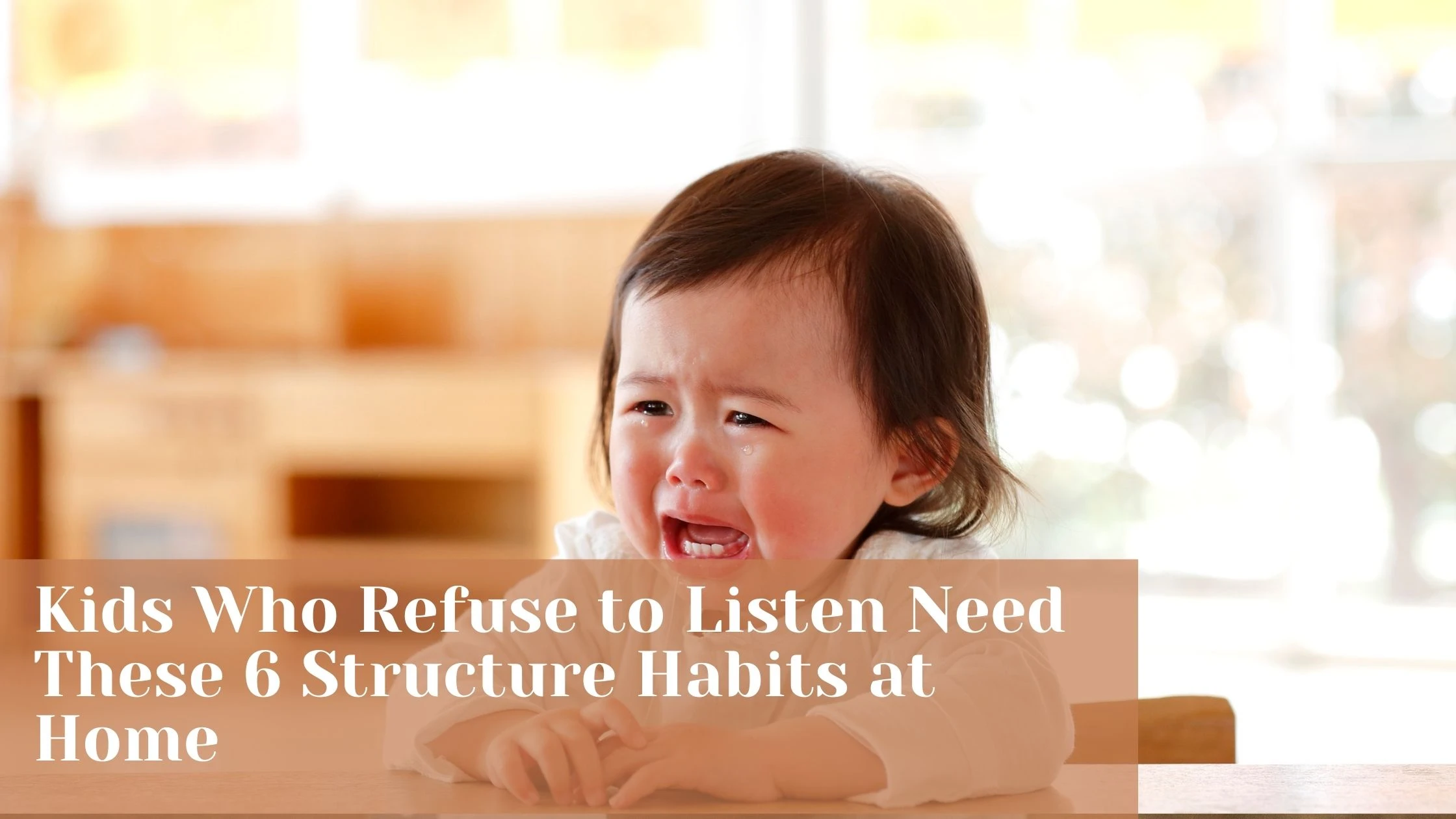
It’s 7:45 in the morning and you’ve said “shoes, please” four times. The shoes are still not on. Your child is lying sideways on the couch, staring at the ceiling, conducting some private experiment in which the sound of your voice is apparently inaudible.
You know this child can hear you. You’ve watched them detect the crinkle of a snack bag from three rooms away. They’re not hard of hearing. They’re something else entirely: a child who has discovered, through no particular malice, that “listening” is optional and the actual cost of not doing it is mostly just you saying the same thing louder.
By the fourth ask, you’re not asking anymore. You’re negotiating, or threatening, or physically locating shoes yourself because the school bus is in seven minutes and this is not the morning for a power struggle.
And tomorrow, it happens again.
If this is your daily life, the problem almost certainly isn’t the shoes. It’s not even, at its core, about listening. What looks like a child who won’t listen is usually a child living inside a home environment that has never clearly taught them when to listen, why it matters, and what happens when they don’t — consistently enough to mean anything.
That’s not a character failure. It’s a structural one. And structure, unlike character, can be built.
The Real Reason “Because I Said So” Stopped Working
Before we get to the six habits, it’s worth sitting with something that most parenting advice skips: the relationship between household chaos and a child’s ability to comply isn’t what most parents assume.
Most parents assume a child who won’t listen needs more authority: firmer commands, swifter consequences, a parent who means business. The research tells a more complicated story.
A landmark PMC study on household chaos and behavioral self-regulation (Blair et al., 2015) followed 1,292 children from birth through kindergarten and found that household chaos — defined as homes with little structure, unpredictable routines, and high noise and disorder — predicted poor behavioral regulation in children independent of poverty, parenting warmth, and a dozen other variables. The chaotic environment itself impaired kids’ developing executive function. Children who grew up in disorganized homes arrived at school less able to follow instructions, manage transitions, and sustain attention — not because their parents were unkind, but because their nervous systems had never been trained by consistent, predictable structure.
This gets to something important: your child’s brain is not a passive observer of the environment. It’s actively learning from it. Every day, it’s asking: What happens next? What does “no” mean? What’s the cost of ignoring that? Can I predict this? A child whose environment delivers consistent, predictable answers to those questions develops a nervous system calibrated for compliance. A child whose environment delivers inconsistent, shifting answers develops one calibrated for testing.
A 2021 ScienceDirect study examining family routines and child behavior problems found that children who participated more regularly in family routines showed fewer behavioral problems and stronger socio-emotional skills — not because routines are magically civilizing, but because predictable structure reduces the anxiety that fuels testing behavior. When children know what to expect, they’re not constantly probing to find out.
Child psychologist Dr. Ross Greene, whose research on behaviorally challenging children has been foundational in rethinking defiance, puts it this way: most of these children are not willfully oppositional. They are children whose environment has never given their developing skills the consistent scaffolding those skills require. The solution is not more punishment. It’s building better architecture.
Here is what that architecture looks like.
The 6 Structure Habits That Change Everything
Habit 1: Anchoring the Day With Predictable Transitions
Children who don’t listen are often children who feel ambushed by the rhythm of the day. They’re still deep inside an activity when “time to go” materializes without warning. They’re not resistant to the transition — they’re simply unprepared for it. And an unprepared child defaults to the only available response: staying put.
A 2024 systematic review of 170 studies on routines and child development published in the Journal of Family Theory & Review (Selman et al., 2024) found that predictable daily routines were consistently associated with better self-regulation, reduced anxiety, and more cooperative behavior across childhood — with the mechanism being that routine gives children’s developing brains a map. When a child knows what’s coming, the prefrontal cortex can prepare a response rather than generate an emergency one. Cooperation becomes easier when it isn’t also a surprise.
This doesn’t mean a regimented, military schedule. It means the skeleton of the day is consistent and communicated in advance. Morning has a sequence. After school has a shape. Evenings flow in a recognizable pattern. And critically, transitions are announced before they arrive — not mid-stride.
“Five minutes until we leave” isn’t just courtesy. For a child who won’t listen, it’s the structural cue that their nervous system needs to begin preparing for what’s next. It converts an ambush into a plan.
What this looks like in practice:
Post a simple visual schedule for younger children — not elaborate, just the sequence of the day in pictures or words. Use a consistent transition signal: a timer, a song, a phrase. “When you hear the timer, it’s shoes time” works better than “Okay, let’s go” dropping from nowhere. Give warning. Give it again. Then follow through at the exact moment you said you would — which brings us directly to the next habit.
Habit 2: Following Through Every Single Time
This one is the hardest. And it is also the most important.
Research published in PMC by Stormshak, Bierman, and colleagues (2009) examined parenting practices in 631 families with behaviorally disruptive children and found one of the most consistent predictors of child oppositional behavior was parental inconsistency — specifically, giving commands that were not followed through. The term they borrowed from Gerald Patterson’s earlier foundational work captures it precisely: nattering — the pattern of repeated, irritable requests that are ignored because the child has learned, correctly, that ignoring them is safe.
Patterson’s research, spanning four decades, demonstrated that children are brilliant empiricists. They don’t decide to disobey based on mood or character. They decide based on data. And the data they have is: what actually happens when I don’t do what I’m told? If the answer is “another ask” or “a louder ask” or “eventually mom does it herself” — then the child isn’t being defiant. They’re responding rationally to their environment.
What breaks this pattern is not harsher consequences. It’s relentless follow-through — choosing your instructions carefully, giving fewer of them, and meaning every single one. The formula that child behavior researchers return to again and again is deceptively simple: say it once, calmly. Give a brief pause. If compliance doesn’t come, enact the consequence you stated. Without drama, without a lecture, without the fourth ask.
A parent who follows through consistently trains a child’s brain to treat instructions as signal rather than noise. This retraining takes weeks, not days. The child will test harder before they test less, because the behavior that worked before is dying slowly, not instantly. But it does die, if the follow-through is unwavering.
What this looks like in practice:
Before you speak an instruction, ask yourself: am I willing to follow through on this right now, in the next 60 seconds, if they don’t comply? If the answer is no — if you’re too tired, too busy, or it doesn’t actually matter that much — then don’t give the instruction. Save your words for the instructions you will actually enforce. A smaller number of consistently-enforced requests teaches compliance far more effectively than a constant stream of requests that lead nowhere.
Habit 3: Enough Sleep to Make Listening Biologically Possible
There is a physiological floor beneath which no amount of structure, consequences, or connection will reliably produce a child who can listen. And that floor is sleep.
A comprehensive PMC review on sleep and emotion regulation in children and adolescents (Lollies et al., 2022) synthesized decades of experimental and correlational research and found a robust, consistent relationship: sleep deprivation impairs emotional lability, restless-impulsive behavior, and the very inhibitory control that makes following instructions possible. Crucially, this wasn’t about children who slept terribly — even modest restrictions of one hour per night produced measurable deteriorations in children’s capacity to regulate behavior.
The connection to listening is direct. What parents observe as a child “tuning out” or “refusing” is often a prefrontal cortex that doesn’t have enough neurological fuel to override the impulse to ignore. Research from the University of Georgia published in 2025 using data from the largest long-term study of brain development in the U.S. found that sleep quality and duration were linked to distinct patterns of brain connectivity in the regions responsible for behavioral regulation — and children with less connectivity in those regions were significantly more likely to exhibit poor impulse control and act out. The behavioral problems weren’t coming from attitude. They were coming from an underslept brain.
A separate 2022 PMC study (Gruber et al.) found that even a single hour of sleep restriction, compared to a single hour of sleep extension, produced measurable differences in teacher-rated impulsive behavior in children ages 7 to 11. The difference between a manageable morning and a catastrophic one is sometimes genuinely, literally, biological.
What this looks like in practice:
Current sleep recommendations from the American Academy of Sleep Medicine: 10–13 hours for ages 3–5, 9–12 hours for ages 6–12, 8–10 hours for teenagers. If your child is chronically sleeping less than this, behavioral difficulty is not a character issue. It’s a physiological one. A consistent, earlier bedtime routine — same time, same sequence, screens off 30–60 minutes before — is one of the most high-leverage structural changes a parent can make, and it costs nothing.
Habit 4: Shared Mealtimes as a Daily Practice of Attention
This habit gets dismissed as a lifestyle preference. It isn’t. It’s behavioral scaffolding in disguise.
A ScienceDirect study on family routines and child behavior problems (Evans et al., 2021) found that participation in regular family routines — with shared mealtimes as one of the most consistently measured — predicted fewer behavioral problems and stronger socio-emotional development. The data from the Early Childhood Longitudinal Study found that preschool children who participated in five or more family routines had more than twice the odds of high social-emotional health compared to those who participated in fewer. Storytelling at mealtimes was the single most salient predictor of better social-emotional outcomes.
The mechanism is not magic. Shared mealtimes are daily, low-stakes rehearsal for the exact social skills that “listening” requires: attending to someone else, waiting your turn to speak, participating in a shared experience rather than a private one. They also provide the relational capital that makes children want to respond to parents — because research at the Child Mind Institute is consistent that motivation to comply is rooted in the quality of the relationship, not the severity of the consequence.
A foundational study in the Journal of Child and Family Studies (Hosokawa et al., 2023), which surveyed 1,515 third-grade students and their parents, found that family routines were positively associated with family cohesion and expressiveness, and that cohesiveness and expressiveness were each negatively associated with children’s externalizing behavior problems. In plain terms: the families who ate together regularly had children who acted out less — not because eating dinner is magical, but because the relational environment those dinners built was the environment in which cooperation could grow.
What this looks like in practice:
Shared mealtimes don’t have to be elaborate or conflict-free to work. They need to be consistent and device-free — for everyone, including parents. Even four nights a week is meaningfully different from none. The conversation doesn’t have to be structured; it just has to be present. Something as simple as everyone sharing one thing from their day teaches children that sitting together, being present, and attending to another person’s experience is the default setting of this family — which shapes their baseline orientation toward cooperation more than most parents realize.
Habit 5: Giving Instructions That Are Actually Instructions
Many children who “won’t listen” are children whose parents have accidentally taught them that instructions are suggestions, negotiations, or the opening position in a debate. This happens through language, and it’s fixable through language.
“Can you put your plate in the sink?” is a question. A child who answers “no” and keeps watching their show is not defiant — they’re answering the question they were asked. “Would you mind getting ready for bed?” invites a counter-offer. “Let’s all clean up now, okay?” appends a request for agreement to a command, which means compliance now requires the child to say yes.
Decades of behavior research — synthesized in the Patterson (1986) model of coercive family processes and widely confirmed since — have established that clear, specific, non-repeated instructions produce dramatically higher compliance rates than vague, repeated, or interrogative ones. The specific qualities that matter: one instruction at a time (not a list), stated directly (“Put your shoes on”) rather than as a question, given when you have eye contact, and not repeated until the follow-through window has elapsed.
The language pattern matters because children’s developing brains — and particularly children with already-shaky inhibitory control — need clean signal, not noise. A child who hears “Okay, so it’s really time to go, we talked about this, you need to find your shoes, we’re going to be late, can you please just get ready?” has been given approximately seven competing pieces of information, zero of which land with the clarity of a single, direct instruction.
Dr. Morgan Eldridge, clinical psychologist at the Child Mind Institute, makes this point about defiant behavior at every age: when interactions between children and parents become predominantly negative — repetitive, nagging, charged — children disengage from the relationship that motivates compliance in the first place. Fewer, calmer, clearer instructions do more than a cascade of frustrated ones.
What this looks like in practice:
Do a one-week audit of how you give instructions. Notice how often you phrase them as questions, how often you repeat them before the first one has had a chance to land, and how often you give more than one at a time. Then practice cutting down to one instruction, phrased as a statement, given with eye contact, followed by a pause of five to ten seconds before anything else is said. The pause is where the learning happens. Most parents fill it with a second instruction, which teaches the child that the first one was just a warm-up.
Habit 6: Naming the Expectation Before the Moment, Not During It
The most underused structural habit in parenting is what might be called the pre-briefing: the two-minute conversation before an event, a transition, or a situation where you know listening is likely to be hard — where you describe, calmly and specifically, what you expect.
Children who struggle to listen in the moment are often children who struggle to shift gears quickly under pressure. This is executive function, again. What looks like defiance at the grocery store checkout, at the dinner table, at the end of a playdate, is often a brain that didn’t have time to prepare a compliant response because compliance requires forethought that wasn’t available in the moment.
A 2022 PMC study on predictable home environments and child mental health (Patrick et al., 2021) found that the practice of family routines — which includes predictable communication about expectations — robustly predicted better child mental health and fewer externalizing behaviors. This protective effect held even after controlling for income, parental depression, food insecurity, and household stress. The predictability of the environment wasn’t a luxury. It was a buffer.
Pre-briefing is predictability applied to expectations. Before you arrive at the restaurant: “At dinner tonight, we stay in our seats until everyone is done. If you need to move around, you tell me and we take a short walk outside together.” Before the playdate ends: “In about ten minutes, your friend is going home. When I give you the five-minute warning, I need you to start wrapping up the game, not starting a new one.” Before the sibling who knows how to push every button walks in the door: “Your brother is coming home upset from school today. I need you to give him space for the first fifteen minutes.”
This is not helicopter parenting. It’s cognitive preparation. A child who has been told what to expect and what’s expected of them in a calm moment is neurologically in a better position to deliver it than one who receives the expectation at the same moment compliance is required.
What this looks like in practice:
Build in two minutes of pre-briefing before any situation you know is likely to be difficult. Not a lecture — a briefing. Short, specific, matter-of-fact. “Here’s what’s going to happen. Here’s what I need from you. Here’s what happens if that works or doesn’t work.” Then let it land. The more consistently you pre-brief, the more children’s brains begin to anticipate the structure rather than being surprised by it.
The Week You Start: What to Expect
Parents who implement structural changes often report the same experience in the first ten days: things get worse before they get better.
This is not failure. This is a predictable response to an environment that is tightening up. When a child has learned that the consequences of not listening are mostly rhetorical — more warnings, more frustration, more noise — and suddenly the environment shifts and the consequence arrives quietly, on time, exactly as stated, the child will escalate. They’ll test harder, push further, cry more, because the strategy that always worked isn’t working anymore and they don’t yet have a replacement.
The behavioral science term for this is an “extinction burst” — the intensification of a behavior just before it extinguishes. It feels like the structure is making things worse. It isn’t. It’s doing exactly what structure is supposed to do: closing off the loopholes while the child’s nervous system recalibrates to the new reality.
Stay consistent through that week. Not harsh — consistent. The structure is not a punishment. It’s information about how this household works, delivered reliably enough that the child’s brain can finally absorb it.
What You’re Actually Building
Structure habits are not about control. They’re about predictability — and predictability, for a developing nervous system, is the closest thing to oxygen that a behavioral environment can provide.
A Springer Nature study on family routines and children’s behavior, surveying over 1,500 families, concluded that consistent routines are associated not just with better behavior but with a more cohesive, expressive, and low-conflict family environment. The routines didn’t just change children’s behavior. They changed the relational texture of the household entirely.
A child who learns to listen isn’t a child who has been subdued into compliance. They’re a child whose world is organized enough that cooperation has become the path of least resistance. They know what comes next. They know what’s expected. They know what follows when expectations are met or not met. And inside that clarity, they can rest — and respond.
That’s what structure gives a child who refuses to listen. Not rules. Not consequences. A world they can finally predict, in a family they can finally trust to mean what it says.
Have you found one specific structural habit that shifted how your child listens at home? The routines that actually work in real families are far more useful than any expert theory — share yours in the comments.
Sources & Further Reading:
- Blair, C. et al. (PMC, 2015): Predictors of Behavioral Regulation in Kindergarten — Household Chaos, Parenting, and Early Executive Functions
- Stormshak, Bierman et al. (PMC, 2009): Parenting Practices and Child Disruptive Behavior Problems in Early Elementary School
- Selman, A.M. et al. (Wiley, 2024): Routines and Child Development: A Systematic Review — Journal of Family Theory & Review
- Evans, G.W. et al. (ScienceDirect, 2021): Family Routines and Child Problem Behaviors — The Role of Sociodemographic and Contextual Factors
- Patrick, S. et al. (PMC, 2021): A Predictable Home Environment May Protect Child Mental Health During COVID-19
- Hosokawa, R. et al. (Springer, 2023): Associations Between Family Routines, Family Relationships, and Children’s Behavior — Journal of Child and Family Studies
- Lollies, F. et al. (PMC, 2022): Sleep and Emotion Regulation in Young People — Systematic Review
- Gruber, R. et al. (PMC, 2021): Bidirectional Associations Between Adolescents’ Sleep Problems and Impulsive Behavior Over Time
- Oshri, A. et al. (University of Georgia, 2025): Not Getting Enough Sleep Affects How Kids’ Brains Function
- Greene, R. (Psychology Today): Life With a Pathologically Defiant Child — The Skill-Building Approach
- Eldridge, M. & Bernstein, H. (Child Mind Institute, 2025): How to Parent a Defiant Teen