
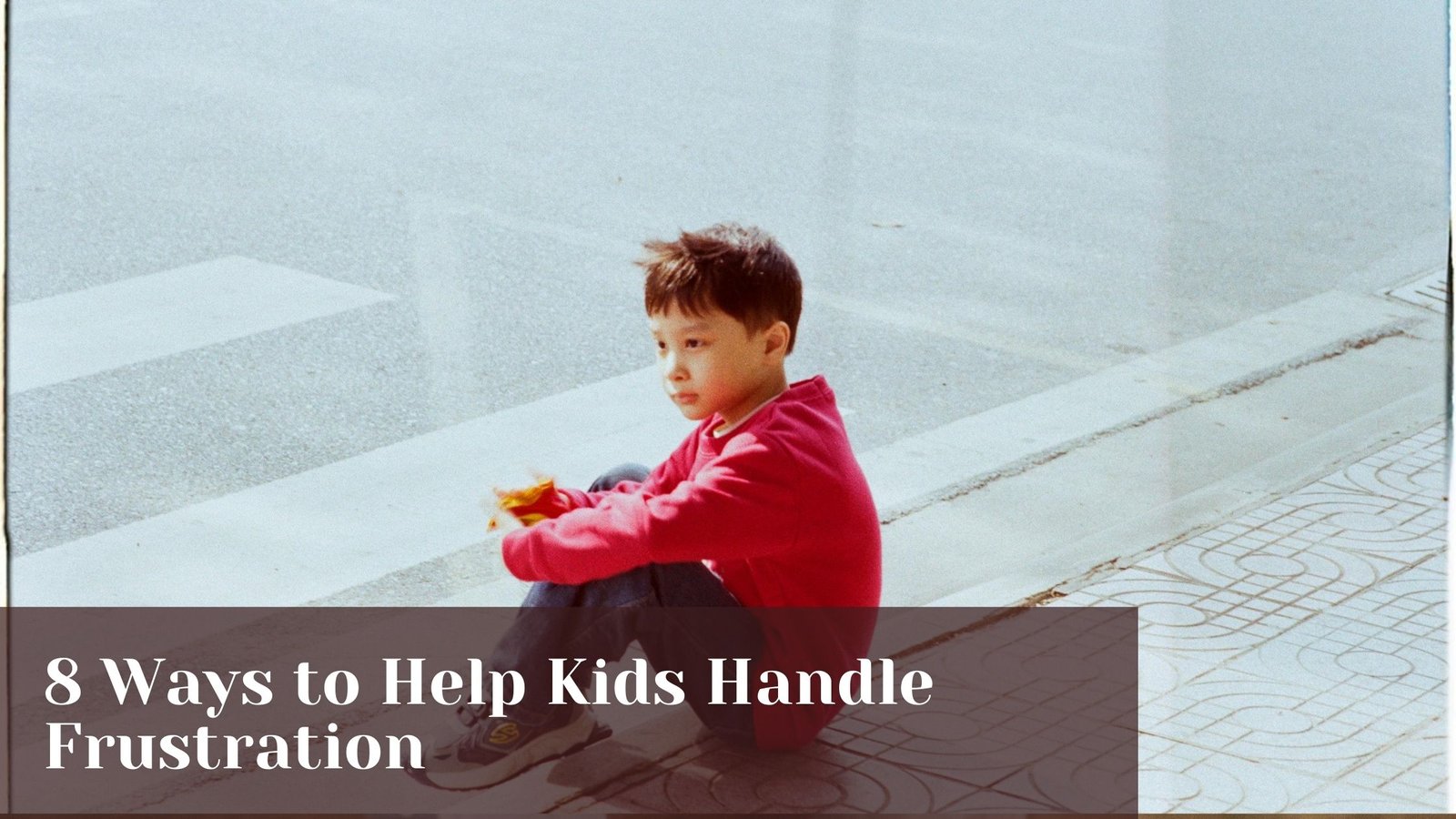
The puzzle piece won’t fit. The drawing doesn’t look the way it looked in their head. The game was won by someone else. The zipper is stuck. The homework problem has been wrong four times in a row, five times, six.
And then — the pencil goes across the room. Or the tears arrive suddenly and completely. Or a door closes harder than necessary. Or the whole thing gets shoved off the table with a sound that makes everyone in the house look up.
Frustration is among the most universal of human experiences, and among the ones children handle least gracefully — not because they are deficient in character, but because managing frustration well is a genuinely sophisticated skill that requires the interaction of multiple neural systems that are still developing throughout childhood and well into adolescence. The prefrontal cortex — the region most responsible for regulating emotional responses, tolerating delay, and accessing problem-solving under stress — is the last region of the brain to fully mature, a process that isn’t complete until the mid-twenties.
That timeline matters. It means a child who struggles with frustration is not failing to do something they’re fully capable of. They’re doing something very hard with neural resources that are genuinely limited. And it means the support a parent offers in frustrating moments is not just comfort — it’s active neurological scaffolding. The parent who helps a child navigate frustration well is, over time, building the internal architecture for frustration tolerance that will eventually operate without their help.
Here are eight research-grounded ways to do that.
What the Research Establishes First
Frustration tolerance — the capacity to persist in the face of blocked goals, delayed rewards, and difficult tasks without becoming behaviorally or emotionally dysregulated — is not a fixed trait children either have or don’t. It is a developmentally acquired skill, and one that a significant body of research has found to be genuinely consequential.
A behavioral measure of frustration tolerance administered to students in grades 4 through 10, developed by Meindl, Duckworth and colleagues (Emotion, 2019), found that frustration tolerance predicted academic achievement both immediately and two years later — independently of IQ, self-reported grit, and other cognitive measures. The child who can stay with difficulty is the child who learns more, and the data on this is not subtle. Frustration tolerance, measured behaviorally, is one of the most robust non-cognitive predictors of academic and life outcomes available.
The equally important finding is that frustration tolerance is responsive to parenting. The quality of the environment in which a child experiences frustrating moments — specifically, whether that environment validates, coaches, and supports, or dismisses, punishes, and bypasses — shapes whether the child’s frustration tolerance capacity grows. The eight ways below are eight dimensions of that environment.
The 8 Ways
1. Validate the Frustration Before You Do Anything Else
This is the step most parents skip — not from indifference, but from the deeply human instinct to fix what’s broken. The child is upset. The upset is producing behavior that is difficult to be around. The most available path is to move directly to solution: “Let me help.” “Try it this way.” “It’s not a big deal.” “Let’s just do something else.”
Each of these responses is well-intentioned. Each of them also communicates something the child experiences as invalidating: that the feeling they’re having is not worth sitting with. And that message, delivered repeatedly across hundreds of frustrating moments in childhood, teaches the child that negative emotions should be managed by bypassing them — not by moving through them. That lesson becomes a regulation strategy. And it is not, the research shows, a good one.
The foundational research by Gottman, Katz and Hooven on parental meta-emotion philosophy — replicated and extended across three decades of subsequent work — established that how parents respond to their children’s negative emotions is one of the most robust predictors of children’s self-regulation. Parents who use an emotion coaching philosophy tend to be aware of negative emotion in their children and assist their children in dealing with negative emotions such as anger, sadness, and fear. The children of emotion-coaching parents show better emotion regulation, higher frustration tolerance, better academic performance, and stronger peer relationships than children whose parents dismiss, punish, or bypass negative emotions.
When parents engage in coaching of children’s negative emotions, children show better emotion regulation, which in turn relates to children’s better adaptive functioning.
The first step in emotion coaching is not problem-solving. It is acknowledgment: communicating, clearly and without evaluation, that the feeling makes sense. “That’s so frustrating. You’ve been working on this for a long time.” “I can see why you’re upset — that’s a hard thing to get wrong again.” “That makes sense that you’re frustrated.” The child whose frustration is met with acknowledgment is a child whose nervous system is receiving a co-regulatory signal: I see what’s happening, it’s okay, we can be here together. From that regulated position, they can begin to move.
What this looks like:
When frustration arrives, pause before problem-solving. Mirror what you see: “That was really hard.” “You’re frustrated right now.” “I get it.” Resist the impulse to minimize (“it’s not that bad”), to silver-line immediately (“but you almost got it!”), or to redirect (“let’s try something different”). The feeling needs to be present and acknowledged before any learning can happen.
2. Name the Feeling — Out Loud, With Precision
Acknowledgment alone is powerful. Precise emotional labeling adds something additional — and the neuroscience behind it is specific and worth knowing.
The affect labeling research, pioneered by Matthew Lieberman and colleagues at UCLA and replicated across multiple neuroimaging studies, found that putting a word to an emotional experience reduces activity in the amygdala — the brain region responsible for generating the alarm response — and increases activity in the prefrontal cortex, the region responsible for regulating it. Naming a feeling doesn’t just describe it. It changes the brain’s processing of it. The child who can access the word “frustrated” in the moment of frustration is in a measurably different neurological state than the child who cannot.
Emotion regulation has been identified as a transdiagnostic risk factor for psychopathology, making it an ideal target for prevention and treatment. And the parental contribution to emotion regulation during middle childhood, according to the systematic review of malleable parenting factors in emotion socialization, includes specifically the practice of labeling and discussing emotions — not just accepting them, but providing the vocabulary that makes them navigable.
The precision of the label matters. “Upset” and “frustrated” are not the same. “Frustrated” and “disappointed” are not the same. “Annoyed” and “furious” are not the same. The child who builds a rich emotional vocabulary over years of having their emotions precisely named has access to a more refined regulatory toolkit than the child whose emotional landscape is described only in the broadest terms. They can identify the specific feeling, communicate it to others, and — eventually — select the regulation strategy most suited to it.
What this looks like:
When you see frustration arriving, name it: “You’re frustrated.” When you can be more specific, be more specific: “It sounds like you’re frustrated because you’re working really hard and it’s not working the way you want.” Build vocabulary actively by being curious about gradations: “Is it more disappointed, or more annoyed?” Not as a quiz — as a genuine inquiry. The vocabulary is built across thousands of such moments.
3. Teach Them That Frustration Is a Signal, Not a Verdict
Children who handle frustration poorly have often developed an unconscious interpretation of what frustration means: it means they can’t do it. It means the task is wrong for them. It means something has gone wrong with the situation, or with them, and the appropriate response is to escape. Frustration arrives as a verdict rather than as information.
That interpretation is the problem, not the frustration itself. Frustration is a normal, adaptive, biologically encoded response to blocked goal attainment. While frustration is a normative affective response to blocked goal attainment, and is, in appropriate intensities, functionally useful: it signals that more effort or a different strategy is needed, that something important is being worked on, and that the brain is in the specific state of productive struggle that produces growth.
The growth mindset research by Dweck and Yeager — which has produced one of the most replicated and consequential bodies of work in educational psychology over the past three decades — establishes the mechanism precisely: children who believe that abilities are fixed interpret struggle as evidence of inadequacy. Children who understand that abilities develop through effort interpret struggle as evidence of work in progress. Students who are taught to reframe their interpretations of why a task might be difficult improve their performance during demanding tasks.
The reframe this requires is specific and teachable: frustration means you’re at the edge of what you currently know or can do. It is the sensation of the brain working on something genuinely challenging. It is information about where the growing edge is — not a verdict on whether you belong there.
What this looks like:
When frustration arrives, narrate its meaning: “That feeling means your brain is working really hard.” “Frustration usually shows up right before something starts to click.” “It’s hard because it’s supposed to be hard at this stage — you haven’t learned it yet.” Over time, this reframe becomes the child’s own interpretation of what frustration means — and that interpretation is one of the most powerful determinants of whether they stay with difficulty or leave it.
4. Offer a Physical Off-Ramp Before You Problem-Solve
Frustration produces a physiological state. The body responds: heart rate increases, muscles tighten, cortisol rises. In that activated state, the prefrontal cortex — the seat of problem-solving, flexible thinking, and perspective-taking — is genuinely less available. The biological experience of frustration is not a background mood. It is a whole-body state, and it needs a physical response before a cognitive one can work.
Frustration is a complex affective response that involves the interaction of multiple neural circuits involved in emotion regulation including core limbic regions — amygdala, insula, and orbitofrontal cortex — in circuit with reward regions, and frontal cortical regions involved in the cognitive control of emotional responses. Attempting to reason, problem-solve, or instruct a child through a frustration response while the limbic system is still activated is the neurological equivalent of trying to have a detailed conversation in the middle of a fire alarm. The alarm needs to come down first.
Physical strategies that activate the parasympathetic nervous system — slow, deliberate breathing; movement; a brief break in a different space; a drink of water; a few moments of quiet — are not avoidance. They are physiological regulation. The breath that slows the heart rate before returning to the puzzle is not giving up on the puzzle. It is restoring the neural architecture required to try it again.
What this looks like:
Build a regulation menu with your child before the frustrated moment arrives — not in the middle of it, when suggesting a breathing exercise will be received as provocation. In calm moments, explore: “When you’re really frustrated, what helps your body feel a bit less tense?” Movement, water, a brief change of scenery, slow breaths, a hug — different children will have different answers. The important thing is that the menu is the child’s own, and that it’s practiced enough in non-activated moments to be accessible in activated ones.
5. Teach Cognitive Reappraisal — “Is There Another Way to See This?”
Once a child is physiologically regulated enough to think, there is a specific cognitive skill that research consistently identifies as one of the most effective emotion regulation strategies available: cognitive reappraisal. The ability to change the emotional impact of a situation by changing how you interpret it — not by suppressing the feeling, but by asking whether the interpretation generating the feeling is the only one available or the most accurate one.
Cognitive reappraisal is an important emotion regulation strategy that shows considerable developmental change in its use and effectiveness. The systematic review of 118 studies examining cognitive reappraisal development in children ages 3 through 18 found that the capacity for reappraisal increases with age and cognitive development, and that older children and adolescents use it more frequently and more effectively than younger ones — but also that its development can be actively supported.
The relevant questions for children are not abstract philosophical ones. They’re concrete: “Is there another way to look at this?” “Does getting this wrong mean you’ll never get it right, or does it mean you haven’t gotten it right yet?” “What would you say to a friend who was feeling the way you’re feeling right now?” Each of these questions invites the prefrontal cortex — still partially online, getting more available as the physiological activation settles — to examine the interpretation generating the distress and consider whether there is a more accurate, more useful, or more compassionate one.
The research on teaching reappraisal to children is consistent: in adults, the ability to use cognitive emotion regulation strategies, reappraisal in particular, has been associated with positive outcomes, such as a sense of purpose in life, self-acceptance, reduced mood and anxiety problems, and personal growth. The scaffolding for this strategy is built in childhood through exactly these conversations.
What this looks like:
After the physiological activation has settled — not before — introduce the reframe as a genuine question, not a prescription. “You’re saying you’ll never get it. Do you actually think that’s true, or does it just feel that way right now?” “You said you’re bad at this. What’s the evidence? What’s the counter-evidence?” Over time, children internalize the habit of questioning their own initial interpretations — and that habit is one of the most durable protective factors against both anxiety and frustration-driven avoidance that a child can carry.
6. Let Them Struggle at the Edge of Their Ability — Don’t Remove the Difficulty
This is the counterintuitive one. Parents who want to help children handle frustration often do so by reducing the things that frustrate them. The puzzle is swapped for an easier one. The task is broken down into steps so small they never generate friction. The homework is helped to a degree that removes the challenge entirely.
This instinct is caring. It is also, the research suggests, working against the goal. Frustration tolerance, like physical endurance, is built through progressive exposure to the thing being tolerated. A child who is never allowed to experience frustrating difficulty is a child who doesn’t develop the capacity to sit with it when it arrives — and it always arrives eventually, in contexts where there is no parent available to remove it.
Vygotsky’s Zone of Proximal Development establishes the relevant framework: optimal learning — and, critically, optimal development of the regulatory capacities that learning requires — happens at the edge of current competence, in the space between what a child can do independently and what they can do with support. This zone is, by definition, somewhat frustrating. It involves tasks that are hard enough to require genuine effort, and the frustration that accompanies that effort is not a sign that the task is wrong. It is the sensation of development occurring.
A brief behavioral measure of frustration tolerance predicts academic achievement immediately and two years later. That frustration tolerance is built through accumulated experience of staying with difficulty — not through having difficulty removed.
What this looks like:
When a child is frustrated with a task, resist the immediate move to simplify or take over. Instead, stay present and offer the minimum scaffolding needed for the child to continue: “What part is hardest?” “What have you tried?” “What’s one small next step?” Be available without solving it. The message you’re communicating — that the difficulty is survivable, that you trust them to keep trying, that struggle is a normal feature of learning — is more educational than the correct answer.
7. Model Your Own Frustration — Out Loud
Children learn to handle frustration primarily by observing how the adults in their lives handle theirs. Not from lectures about patience. Not from instructions about how to calm down. From watching, over thousands of accumulated moments, how a significant adult moves through a frustrating experience.
Since children’s emotion regulation develops through interaction with their parents, it is suggested that parental emotion regulation and parenting might function as central mechanisms for transmitting self-regulation abilities across generations. The parent who handles frustration well is building a template that the child’s developing regulatory system is absorbing and gradually encoding as its own model.
But there is a more active version of this than simply managing frustration quietly. When parents narrate their frustration-management process out loud — “I’m getting frustrated with this. I’m going to take a breath before I try again” — they are not just modeling. They are making the invisible process of self-regulation visible and audible in a form a child can learn from. The child who watches a parent slam the laptop in irritation and then return with a steadier demeanor, two minutes later, having done something to bring themselves back to regulation, has seen the whole arc: frustration, recovery, return. That arc, witnessed repeatedly, becomes a known path.
Parents’ ability to regulate their emotions was identified as an important contributor to their ability to be emotion coaching. Mothers who were feeling emotionally dysregulated were less aware of their own and their children’s emotions. The parent who is working on their own frustration tolerance is, simultaneously, working on their child’s.
What this looks like:
When you’re frustrated, narrate it when you can: “I’m really frustrated right now. I’m going to walk away for a minute and come back.” Or, afterward: “I got frustrated earlier when the directions were confusing. What I did was stop and try to think about it differently — and it helped.” You don’t need to perform composure. You need to let the child see that frustration is manageable, and that you manage it with specific, visible strategies.
8. Repair the Relationship After a Frustration Episode — This Is Where the Real Learning Happens
Of all eight ways, this one is the most consistently underestimated. The moment after the frustration episode — after the pencil has been thrown, the tears have arrived, the task has been abandoned — is the moment when the deepest learning about frustration becomes possible. Not during. After.
During a frustration episode, the child’s prefrontal cortex is significantly less available. Their capacity for reflection, perspective-taking, and integrating new information is reduced. Anything a parent says in the middle of the activated state — any lecture, any consequences discussion, any “let’s talk about what just happened” — lands in a nervous system that cannot fully process it. The lesson being delivered is not reaching the parts of the brain that need to receive it.
After the activation subsides — when the child is regulated again, when the crying has stopped, when some time and space and perhaps a glass of water have intervened — a conversation becomes possible. Not a lecture. A genuine, collaborative inquiry: “That was hard. What happened when you started getting frustrated?” “What did it feel like in your body?” “What do you think would help next time?” This conversation, conducted with warmth, curiosity, and without judgment, is where the experience is integrated — where it becomes something the child has processed and can draw on, rather than something that happened and is over.
Parents with an emotion coaching philosophy positively socialize children’s emotion regulation by being aware of their own and their children’s emotions, viewing their children’s emotions as a time for connection and teaching, helping their children to be aware of and recognize their emotions, and supporting their children through regulating their difficult emotions. That support, after the difficulty, is not a footnote to the lesson. It is the lesson.
What this looks like:
Wait until the child is genuinely regulated before beginning any reflective conversation. When they are — and they often signal this by becoming calm, re-engaging, or seeking connection — make contact warmly: “You okay now?” And then, when the moment feels right: “Want to talk about what happened?” Keep the conversation collaborative and curious, not evaluative. End it with something forward-looking: “Is there anything we could try differently next time?” The child who regularly has this conversation after difficult moments gradually builds a reflective capacity that, over time, becomes internal rather than requiring a parent to facilitate it.
The Thread Running Through All Eight
Each of these eight ways is, at its core, doing one thing: building the child’s sense that frustration is survivable. Not fun. Not easy. Not something to seek out — but something that can be felt, named, stayed with, and navigated through without catastrophe.
That sense — the implicit knowledge that difficult feelings have a beginning and a middle and an end, that they don’t require immediate escape, that there are things one can do in the middle of them that help — is the core of frustration tolerance. It is assembled across thousands of small moments in which a parent stays present with a frustrated child instead of removing either the child or the frustration, names what’s happening, helps the nervous system find its way back to calm, and then makes time, afterward, to reflect on the experience together.
It takes years. And the investment pays off in a direction that extends far beyond the puzzle or the zipper or the homework problem. The child who learns to handle frustration is the child who can stay with difficulty when it matters most — in learning, in relationships, in the inevitable and recurring encounter with a world that doesn’t always cooperate with what they want.
That capacity is one of the most durable things a parent can build. These eight ways are where the building starts.
Which of these eight is the one you reach for least naturally? The one that requires the most from you personally? That’s often the most useful place to begin. Share your experience in the comments — especially if you’ve found something specific that has changed how frustration moves through your household.
Sources & Further Reading:
- Meindl, P., Duckworth, A.L. et al. — University of Pennsylvania (Emotion / APA, 2019): A Brief Behavioral Measure of Frustration Tolerance Predicts Academic Achievement Immediately and Two Years Later — Frustration Tolerance as Independent Non-Cognitive Predictor
- Gottman, J.M., Katz, L.F. & Hooven, C. — University of Washington (1996–1997): Meta-Emotion: How Families Communicate Emotionally — Four Parental Meta-Emotion Philosophies, Emotion Coaching vs. Emotion Dismissing — Foundational Research
- Katz, L.F. et al. — University of Washington (PMC, 2014): Parental Emotion Coaching and Child Emotion Regulation: Associations With Self-Regulation in Aggressive/Rejected and Low Aggressive/Popular Children — Maternal and Paternal Emotion Coaching and Frustration Regulation
- Ellis, B.H. et al. — Boston Children’s Hospital / PMC (2025): Maternal Emotion Coaching and Child Emotion Regulation: Within-Interaction Lag-Sequential Analysis — N=208 and 227 Mother-Child Dyads at Ages 3 and 4 — Etch-a-Sketch Frustration Task
- England-Mason, G. & Gonzalez, A. — McMaster University (ScienceDirect, 2023): Emotion Socialization Parenting Interventions Targeting Emotional Competence in Young Children: Systematic Review and Meta-Analysis of 26 RCTs — g = 0.44 Child Emotional Competence, g = 0.34 Child Behavioral Adjustment
- De Raeymaecker, K. & Dhar, M. — University of Antwerp (PMC / Children, 2022): The Influence of Parents on Emotion Regulation in Middle Childhood: A Systematic Review — Malleable Parenting Factors, Emotion Labeling, Emotion Coaching, and Self-Regulation Outcomes
- Lieberman, M.D. et al. — UCLA (2007): Putting Feelings Into Words: Affect Labeling Disrupts Amygdala Activity in Response to Affective Stimuli — fMRI Study, Naming Emotion Reduces Limbic Activation and Increases Prefrontal Regulation
- Gullone, E. & Taffe, J. — Monash University (PMC, 2012): Cognitive Reappraisal in Children: An ERP Study Using the Late Positive Potential — Ages 7–9, Reappraisal, Age, and Anxiety — Neurosignature of Emotion Regulatory Capacity
- Compas, B.E. et al. — Vanderbilt University (PMC, 2019): The Development of Cognitive Reappraisal From Early Childhood Through Adolescence: Systematic Review of 118 Studies, Ages 3–18 — Reappraisal Use Increases with Age, Developmental Trajectory, Methodological Review
- Dweck, C.S. & Yeager, D.S. — Stanford / University of Texas (PMC / American Psychologist, 2020): What Can Be Learned From Growth Mindset Controversies? — Fixed vs. Growth Mindset, Frustration Interpretation, Reframing Difficulty — Consistent Replications Across Large-Scale Studies
- Spielberg, J.M. et al. — Johns Hopkins (PMC, 2020): Frustration Tolerance and Cognitive Control in School-Age Children — N=105, Ages 8–12, PFC Activation During Frustration Tasks — Neurological Basis of Frustration Tolerance
- Chan, W.W.Y., Shum, K.K.M., Downs, J. & Sonuga-Barke, E.J.S. — King’s College London / University of Hong Kong (Journal of Experimental Child Psychology, 2024): Preschool Delay Frustration Task (P-DeFT) — Waiting-Induced Frustration in 112 Preschoolers, Delay Sensitivity, Cultural Context — Frustration Tolerance as Marker of Self-Regulatory Capacity
- Bridgett, D.J. et al. — PMC (Psychological Bulletin, 2015) / summarized in Hoffmann, J.D. et al. (PMC 2024): Parental Emotion Regulation and Psychopathology: Systematic Review — Parental ER as Central Mechanism for Transmitting Self-Regulation Across Generations
- Nordman, J. & Adcock, J. — Sage Journals (Intervention in School and Clinic, 2023): Addressing Low Frustration Tolerance in Students With Learning Disabilities — Strategies to Increase Emotional Self-Regulation and Frustration Tolerance in Classroom Settings
- Vygotsky, L.S. (1978): Mind in Society: The Development of Higher Psychological Processes — Zone of Proximal Development, Scaffolding, Productive Struggle, and Optimal Learning at the Edge of Competence