
There’s a scene that plays out in millions of households every day. The backpack is sitting in the middle of the hallway. The water bottle from Tuesday is still in there. The homework that was supposed to be done is not done. And a parent who has asked about all three of these things at least twice is now standing in the kitchen doing the mental arithmetic of whether it’s faster to handle it themselves or have, yet again, the conversation about handling it yourself.
Responsibility is one of the things parents say they most want to raise in their children. It’s also one of the things that is most consistently — and understandably — taught backward: by doing the thing for the child, reminding the child past the point where the child could have remembered themselves, absorbing the consequences of the child’s choices before the child has to feel them.
The result, assembled across thousands of these small moments, is a child who is capable of being responsible under supervision and dependent outside it. A child who is waiting to be reminded, prompted, rescued, and re-engaged — not because they’re lazy or inconsiderate, but because those are the patterns the environment installed.
The research on how responsibility actually develops in children — and what parents do that builds or undermines it — points consistently toward five things. None of them are complicated. Several of them require the parent to do less than they currently are. All of them require a shift in the mental model: from responsibility as something you enforce, to responsibility as something a child grows into when the conditions for growing it are present.
What the Research Establishes First
Before the five ways, one finding that underlies all of them.
Self-Determination Theory — the framework developed by Deci and Ryan and one of the most empirically validated motivational frameworks in psychology — establishes that human behavior is driven by three universal, innate psychological needs: autonomy, competence, and relatedness. When these needs are satisfied, children develop intrinsic motivation, internalized values, and self-directed regulation — which is what responsibility, at its core, actually is. When these needs are thwarted — through excessive control, micromanagement, and psychological overprotection — what develops instead is dependence, compliance in the presence of authority, and its absence outside it.
Controlling parenting — characterized by coercive means, conditional regard, performance pressures, and guilt-inducing criticism — thwarts children’s basic psychological needs and leads to problematic behavior and downstream consequences including loss of academic motivation and psychopathology. The research does not describe responsible, self-regulating children emerging from environments where every task is supervised, every consequence is absorbed by an adult, and every problem is solved before the child reaches it. It describes them emerging from environments where children are given real things to be responsible for, real consequences when they aren’t, real choices about things that matter — and the relationship security to return to after the inevitable failures.
These five ways are the operational expression of that framework.
The 5 Ways
1. Give Them Real Chores — and Let the Standard Hold
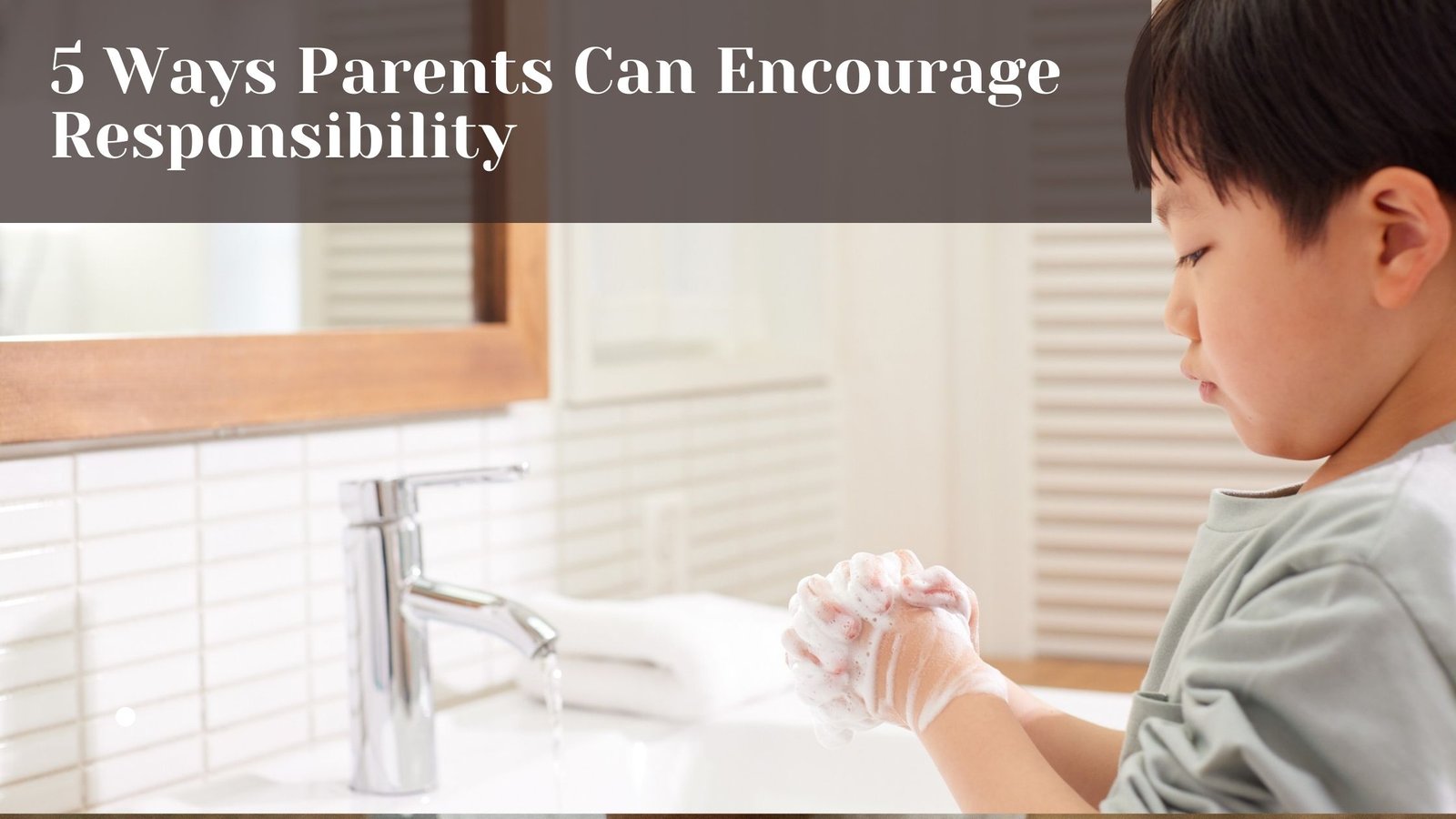
This is the most direct and empirically established route to responsibility in children, and also one of the most consistently underused, for reasons that are genuinely understandable. Doing a chore yourself takes six minutes. Teaching a child to do the same chore, tolerating the imperfect result, holding the expectation even when it’s easier to just do it yourself — takes considerably longer. In the short term. In the medium and long term, the investment data is as clear as anything in parenting science.
A longitudinal cohort study at the University of Virginia — tracking children from early elementary school through subsequent developmental stages — found that performing chores in early elementary school was directly associated with later development of self-competence, prosocial behavior, and self-efficacy. The children who did chores consistently didn’t just learn to do the specific tasks. They developed a generalizable sense of themselves as people who could accomplish things and contribute meaningfully to the people around them.
Age-appropriate chores are associated with increased feelings of autonomy, improved prosocial behaviors, and greater life satisfaction. Of emerging interest is the relationship between household chore engagement and cognitive development — particularly executive functioning. Research suggests this is because chores require planning, self-regulation, transitioning between tasks, and holding instructions in working memory — exactly the executive functions that underlie responsible behavior across all life domains.
The critical distinction the research draws is between chores framed as contribution and chores experienced as punishment. Chores offer a window into the unseen work that keeps a household running. As children help with tasks like setting the table or unloading the dishwasher, they begin to understand the work that goes into managing a household — moving beyond their own experience to see the world as others see it. The child who understands that their contribution matters to the functioning of the family is acquiring something more than a skill. They’re acquiring a role — and roles carry responsibility in a way that tasks assigned and monitored do not.
What this looks like:
Start younger than feels comfortable. Two-year-olds can put toys in a bin. Four-year-olds can set the table. Six-year-olds can load and unload a dishwasher. Ten-year-olds can do their own laundry, start to finish. The task matters less than the expectation that it will be done consistently, without reminding, and that the imperfect result is tolerated — because the learning is in the doing, not in the perfect execution. When the chore doesn’t get done, the consequence is natural: something the family needed didn’t happen, and someone noticed.
2. Let Natural Consequences Do the Teaching You Keep Trying to Do with Words
Most parents have had the experience of explaining the same consequence to the same child seventeen times — and watching the child encounter that consequence as if it’s arriving for the first time. This is not because the child wasn’t listening. It’s because information delivered by a parent does not carry the same experiential weight as information delivered by reality.
Natural consequences — the outcomes that occur directly from a child’s choices without parental intervention — are among the most potent teachers available in childhood development, and among the most frequently disabled by well-intentioned parents who absorb the consequence before the child has to feel it. The child who leaves the water bottle at home doesn’t feel thirsty, because the parent runs it to school. The child who doesn’t do the homework doesn’t face the teacher’s response, because the parent stays up finishing it. The child who spends their allowance by Tuesday doesn’t experience an empty weekend, because the parent provides a bridge loan.
Each of these rescues, taken individually, is an act of love. Assembled across years, they are an education in the lesson that consequences are things parents talk about but not things that actually happen — because the parent will handle it.
Natural consequences are the naturally occurring result of a child’s actions. Allowing children to experience these teaches them how to make choices and be responsible for them. Research has shown that natural and logical consequences are related to healthier child development — the price a child pays today to learn commitment, decision-making, responsibility, and relationships is the cheapest it will ever be.
The research on overparenting establishes the cost of consistently preventing natural consequences from reaching the child. Overparenting has been found to relate to a wide range of child issues including mental health problems, school burnout, and poor relationships with others. A major developmental concern about overparenting is that it ill-prepares young people for adulthood and often handicaps their future. As adults, they may lack essential critical thinking and life skills and remain dependent on their parents or some other adult.
The mechanism is Seligman’s learned helplessness applied to child development: a child who has been systematically protected from experiencing the consequences of their choices learns, eventually, that their choices don’t really have consequences — because someone else will manage the outcome. That lesson is not what any parent is trying to teach. But it is, accumulated across thousands of rescues, what gets learned.
What this looks like:
When the consequence is safe to experience, let it land. Sit with your own discomfort — which is often the harder part — while your child experiences theirs. When your child asks you to fix a problem that is theirs to fix, ask: “What do you think you should do about it?” Not as a deflection, but as a genuine question. You can be present, warm, and available without removing the natural consequence from the equation. Being a supportive witness to your child’s experience of their own choices is not abandonment. It is one of the most educationally rich things a parent can offer.
3. Ask Instead of Doing — Resist the Urge to Take Over
This way is closely related to the one before it, but distinct in a specific and important sense. Where natural consequences are about what happens after a choice is made, this is about what happens before — in the moment when a parent sees a task that needs doing, a problem that needs solving, or a challenge that needs navigating, and makes a choice about whether to handle it or hand it back.
The research on overparenting and learned helplessness is consistent: the more a parent does for a child, the less the child believes they are capable of doing for themselves. Self-efficacy — an individual’s belief in their ability to manage tasks and overcome challenges — is a central mechanism by which parenting behaviors shape young adult outcomes. Diminished self-efficacy amplifies the consequences of overparenting, including feelings of helplessness, dependency, and avoidance behaviors.
This is not theoretical. Overparenting — taking over and completing developmentally appropriate tasks for children — is pervasive and hurts children’s motivation. Studies show that parents who perceived tasks as greater learning opportunities reported taking over less. Framing the everyday, non-academic task of getting dressed as a learning opportunity reduced parents’ taking over by nearly half. The reframe that changes the parent’s behavior is recognizing that the child struggling with the task is not a problem to be solved. It is the developmental work of building competence, and it cannot happen if the parent does it for them.
The most important phrase in this context is the one that replaces “let me do that for you.” It’s: “What do you think you could try?” It doesn’t abandon the child. It places the problem firmly back in their hands — with a parent present, available, and genuinely interested in what the child comes up with. That position — coach rather than doer — is both more effective at building responsibility and more sustainable as a parenting posture. A parent who is constantly doing is exhausted. A parent who is consistently coaching is invested in a different and more rewarding way.
What this looks like:
The next time your child brings you a problem that is theirs to solve, notice the impulse to immediately provide the solution. Sit with it for a moment. Then ask: “What have you already tried?” or “What’s one thing you could do?” This isn’t withholding. It is the active practice of communicating to your child that you believe they are capable — which is, the research suggests, one of the most fundamental things a child can learn about themselves.
4. Give Them Real Choices — and Honour What They Decide
Responsibility doesn’t develop in a vacuum of compliance. It develops in the experience of having genuine choices, living inside the outcomes of those choices, and gradually building a track record of one’s own judgment that can be trusted. A child who is never given real choices — whose environment is controlled, whose decisions are pre-empted, whose autonomy is restricted in the name of safety or efficiency — does not develop the internal machinery of responsible decision-making. They develop the appearance of following rules in the presence of authority.
Parental autonomy support — the use of positive guidance, responsiveness, and avoiding negative control during parent-child interactions — predicts children’s autonomous behavior. The relationship is not merely correlational. The child whose choices are consistently honored — who experiences genuine ownership of decisions about things that fall within their developmental capacity — internalizes the experience of being a person whose judgment matters. That experience is the foundation of the responsibility that appears, later, as a trait.
The key is to provide structure within the context of an autonomy-supportive relationship so that guidelines can be better accepted and internalized. Permissive, laissez-faire parenting — letting children do as they please without guidance or structure — is not what’s called for. What’s needed is structure and autonomy support simultaneously. These are not opposites. A child can have clear expectations and genuine choices within those expectations. “You need to finish your homework before dinner” is a structure. “Would you like to do it right after school or at 4pm?” is autonomy within that structure. Both things are present. The responsibility the child practices is real.
The SDT longitudinal research makes this sequence explicit. Autonomy plays an important role in children’s internalization of societal norms and rules, the development of motivational orientations, and self-regulation. From an autonomy-supportive context, children develop the capacity to author their own actions — which is the psychological core of responsible behavior.
What this looks like:
Look for the places in the day where real choices can be offered and then genuinely honored. Not choices that are retracted when the child chooses the “wrong” option, but choices whose outcomes you can genuinely live with either way. As the child’s judgment develops and their track record builds, the scope of genuine choices can expand. The fifteen-year-old who has been trusted with small choices since age six has a much larger reserve of practiced judgment than one who has been managed through the same period.
5. Model Responsibility Where Your Child Can See It
This is the one that tends to get underestimated — perhaps because it requires nothing from the child and everything from the parent. Children do not primarily learn responsibility through instruction. They learn it through observation of the significant adults in their lives, over years of watching how those adults handle their own commitments, acknowledge their own failures, repair their own mistakes, and follow through on the things they said they would do.
Parenting styles and behaviors play a pivotal role in shaping children’s moral development — their understanding of right and wrong, empathy, and prosocial behavior. Parental warmth fosters the moral self throughout middle childhood, creating a supportive environment where children can explore moral values and internalize them. The parent who lives by the standards they’re asking the child to hold is not just enforcing a rule. They are being a moral environment — the context inside which the child develops their own sense of what responsible people do.
This is specific and observable. The parent who says “I told them I’d be there at 6 and I need to leave on time” is modeling commitment. The parent who says “I forgot to do that — I’m going to call and apologize” is modeling accountability. The parent who says “I made a mistake with that and here’s what I’m going to do differently” is modeling repair. The parent who says “I’m tired and I don’t want to do it, but I said I would” is modeling follow-through in the face of inconvenience — which is what responsibility, most of the time, actually asks.
The research on moral self-development confirms what intuition suggests: parental warmth could be related to children’s moral self-development by fostering secure attachments and serving as moral role models. Parents who model moral behavior create a supportive environment where children can explore moral values, internalize moral standards, and develop a stable moral self.
None of this requires performing responsibility for the child’s benefit. It requires actually being responsible — not perfectly, but consistently enough that the child is growing up inside an environment where the relationship between commitment and follow-through is something they observe in the adults they love most.
What this looks like:
Think about where your follow-through is visibly imperfect. The promise made to the child that quietly dissolved. The commitment to yourself that gets dropped when things get busy. The accountability that doesn’t happen because acknowledging the mistake feels exposing. Children are watching these things with exactly the same attentiveness that they’d give to a formal lesson. The informal lesson is the one that lands deepest.
The Through Line
Running through all five of these ways is a single principle: responsibility is not installed from the outside. It grows from the inside, given the right conditions.
Those conditions are: real things to be responsible for, real consequences when the responsibility isn’t met, the experience of one’s own choices mattering enough to be honored, the regular encounter with problems that are yours to solve, and the sustained observation of what responsible adults actually look like.
What undermines those conditions, reliably, is excessive protection: from consequences, from struggle, from the imperfect execution of a task you could do better yourself, from the frustration of a problem that isn’t going to be solved immediately. This protection comes from love. It is also, the research consistently shows, one of the most effective ways to raise a child who does not develop the responsibility the parent is hoping for.
The shift that five ways are pointing toward is not a withdrawal of love. It is a shift in how love expresses itself — from protecting the child from difficulty toward trusting the child through it. That trust, communicated daily through small acts of stepping back rather than stepping in, is what the research consistently identifies as the environment in which responsible children grow.
Which of these five is the one you find hardest to hold? For most parents, it’s one specific one — the area where the instinct to step in is strongest. That’s usually the most revealing place to start. Share what you’ve tried in the comments — and what shifted when you did.
Sources & Further Reading:
- Ryan, R.M. & Deci, E.L. — Self-Determination Theory (American Psychologist, 2000 and ongoing): The Three Universal Psychological Needs — Autonomy, Competence, Relatedness — and Their Role in Intrinsic Motivation, Value Internalization, and Self-Regulation
- Neubauer, A.B. et al. — DIPF Leibniz Institute, Frankfurt (Child Development / PMC, 2021): A Little Autonomy Support Goes a Long Way: Daily Autonomy-Supportive Parenting, Child Well-Being, and Adjustment During COVID-19 — Intrinsic Motivation, Competence, and Relatedness Pathway
- Martinovich, V.V.A. & Rinaldi, C.M. — University of Alberta (Clinical Child Psychology and Psychiatry / PMC, 2021): Parental Autonomy Support and Preschool-Aged Children’s Display of Autonomy — Positive Guidance, Negative Control, and Responsiveness in Mother-Child and Father-Child Interactions
- White, E.M., DeBoer, M.D. & Scharf, R.J. — University of Virginia Children’s Hospital (Journal of Developmental & Behavioral Pediatrics, 2019): Associations Between Household Chores and Childhood Self-Competency — Longitudinal Cohort Study — Chores in Early Elementary School Predict Self-Competence, Prosocial Behavior, and Self-Efficacy
- Tepper, L. et al. — La Trobe University (PMC / BJOD, 2022): Executive Functions and Household Chores: Does Engagement in Chores Predict Children’s Cognition? — Chores, Autonomy, Prosocial Behavior, Life Satisfaction, and Executive Functioning — Children Ages 5–13
- Making Caring Common Project — Harvard Graduate School of Education (2024): The Everyday Tasks That Make Responsible and Caring Kids — Chores, Empathy, Self-Efficacy, Family Connection, and Contribution Framework
- Rende, R. — Brown University (Child and Adolescent Behavior Letter, 2021): Chores: Why They Still Matter and How to Engage Youth — Participation in Household Chores Cultivates Skills Extending into Adulthood, Contributing to Long-Term Academic, Social, Physical, and Mental Well-Being
- Oklahoma State University Extension — Cline, F. & Fay, J. (2019): Parenting With Natural and Logical Consequences — Natural Consequences, Child Choice, Cause and Effect, and Healthy Child Development
- Schiffrin, H.H. et al. / Overparenting UCLA White Paper (smhp.psych.ucla.edu): Overparenting as a Barrier to Development, Learning, and Responsibility — Overparenting, Critical Thinking Deficits, Life Skills Failure, Dependency, and Entitlement in Young Adulthood
- Cui, M. et al. — Florida State University (2022, systematic review of 74 empirical studies — cited in PMC 2023): Overparenting Outcomes Across Development: Mental Health, School Burnout, Relationship Difficulties, Self-Efficacy, and Environmental Mastery in Emerging Adulthood
- Joussemet, M. & Mageau, G. (ResearchGate, 2023): Supporting Children’s Autonomy Early On: A Review of Studies Examining Parental Autonomy Support Toward Infants, Toddlers, and Preschoolers — Structure Within Autonomy-Supportive Context, Internalization, and Positive Child Outcomes
- Burnett, A. et al. — Study on Task Framing and Overparenting Reduction (2022–2023): Framing Everyday Non-Academic Tasks as Learning Opportunities Reduces Overparenting by Nearly Half — N=140, Parents of 4–5 Year Olds, Tasks Including Getting Dressed
- Kochanska, G. (1993–2010) / Stability and Cross-Lagged Associations Between Parenting and Children’s Moral Self (ScienceDirect, 2025): Parental Warmth and the Moral Self Throughout Middle Childhood — Warm Parents as Secure Attachment Figures and Moral Role Models — Longitudinal Associations
- Seligman, M.E.P. & Maier, S.F. (1967, foundational): Learned Helplessness — PMC Review (PMC9928164): Learned Helplessness as Consequence of Early Socialization Experiences — Rigidity, Overprotection, and Child Competence Development
- Szwedo, D.E. et al. — James Madison University (Emerging Adulthood / PMC, 2023): Parental Autonomy Restricting Behaviors During Adolescence as Predictors of Dependency on Parents in Emerging Adulthood — Longitudinal Multi-Method Study, Diverse Sample