
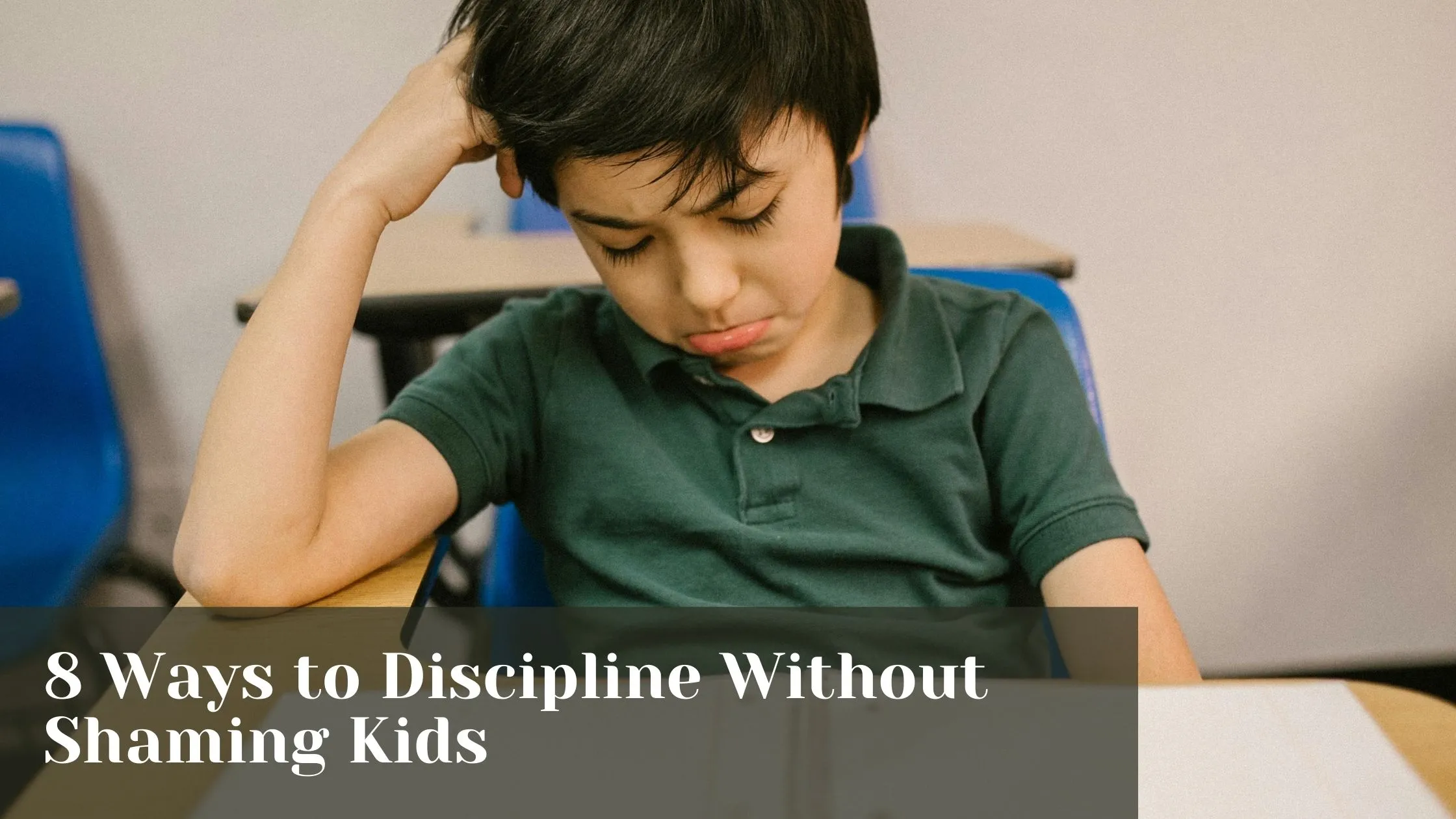
There is a kind of correction that makes a child want to do better. And there is a kind of correction that makes a child want to disappear.
The difference is not always obvious in the moment. Both can arrive in response to the same behavior. Both can come from parents who are genuinely trying to raise children who understand right from wrong. But the experience of receiving them is completely different — and the research on what they each produce in the child, over time, is some of the most unambiguous in developmental psychology.
The first kind activates guilt: a specific, corrective, forward-facing emotion that says I did something wrong, and I want to make it right. Guilt is prosocial. It motivates repair. It produces a child who can sit with having made a mistake, understand its impact, and work toward doing differently.
The second kind activates shame: a global, corrosive, identity-level emotion that says I am wrong. I am bad. Something is fundamentally wrong with me. Shame is not corrective. It doesn’t produce better behavior. It produces withdrawal, defensiveness, externalized blame — and in its more entrenched forms, anxiety, depression, and the particular kind of aggression that emerges when a child’s sense of self is under attack.
Most parents never intend to shame their children. It happens anyway, in the language we use, the tone we take, the moment we choose, the audience that happens to be present. It happens because we were disciplined this way ourselves. It happens because we’re activated and the thing that comes out first is the thing that feels most urgent.
This blog is about eight specific, evidence-backed ways to discipline that keep correction in the guilt lane and out of the shame one.
What the Research Tells Us About Shame First
The distinction between guilt and shame is not academic. It is one of the most consequential in all of child development research.
Guilt typically involves feelings of remorse or regret, inspires greater attention to and empathy for others, and leads people to make amends for their behavior. Guilt-proneness has few significant associations with internalizing problems such as anxiety, depression, or low self-esteem and is linked with decreased antisocial and risky behavior. In contrast, shame involves feelings of worthlessness and powerlessness, inspires an inward focus, and leads to defensive behaviors, such as withdrawal or anger. It is generally perceived as more acutely painful than guilt and is linked with increased internalizing and externalizing problems.
Children tend to experience maladaptive guilt and shame if, in consequence of a transgression, parents tend to blame the whole person — the child themselves — rather than the specific action or behavior. In this case, children end up feeling as if they are being criticized as individuals, for what they are, rather than for their actions.
Shame-proneness and maladaptive guilt have been found to mediate pathways from parental behavior to psychopathological symptoms. The causal chain runs directly from how a parent disciplines to whether a child develops shame — and from shame, onward to mental health outcomes. These are not separate conversations.
The 8 Ways
1. Separate the Behavior from the Child — Every Time
This is the most fundamental of the eight ways, and the one from which everything else follows. The discipline that produces guilt addresses the behavior: “what you did was wrong.” The discipline that produces shame addresses the person: “you are wrong.”
The language difference is simple in principle and surprisingly difficult to sustain under activation. When something genuinely upsetting has happened — when the thing that was broken mattered, when the behavior affects others, when it’s the fourth time this week — the impulse is to express the full weight of the transgression in terms that reach the child. And those terms have a way of escalating from the behavior to the person: “you broke it” becomes “you’re so careless” becomes “why are you always like this” becomes “I don’t know what’s wrong with you.” Each step in that escalation moves further from the behavior — which is correctable — and deeper into the identity — which, once labeled, resists correction because identity is experienced as fixed.
Inductive discipline refers to a specific teaching style that can be summarized as “reasoning with the child,” pointing out the consequences of the child’s transgression for others. By inducing empathy-based guilt rather than shame, this approach is thought to help children internalize parental moral values. Induction — reasoning about the behavior and its consequences — is the mechanism by which correction stays in the behavior domain and out of the identity domain.
Children from parents who use victim-oriented induction practices are more prone to feel guilt, and consequently more prone to adopt reparative behaviors in sociomoral situations. In contrast, love withdrawal techniques predicted negatively guilt-proneness. The correction that reasons is the one that teaches. The correction that withdraws love is the one that shames.
What this looks like:
In discipline moments, practice the simplest possible version of the behavioral separation: “That behavior isn’t okay” rather than “you’re not okay.” “What you said was hurtful” rather than “you’re so mean.” “That was a careless thing to do” rather than “you’re careless.” The behavior is the problem. The behavior can change. The child — who is still the person you love — is the one who gets to change it.
2. Explain Why, and Invoke the Impact on Others
Discipline without explanation is power assertion: the child is told that the behavior was wrong, but not why, and not how it landed for whoever was affected by it. Power assertion produces compliance in the presence of authority and resentment in its absence. It does not produce internalization — the child’s own understanding of why the thing was wrong — because internalization requires understanding, and understanding requires being told.
Inductive discipline — the approach most consistently validated in the moral development literature as producing genuine internalization of values — does something specific: it explains the impact of the behavior on another person. It makes the consequence of the action visible in terms the child can understand and feel. The child who understands that their words hurt their sibling’s feelings, not merely that they broke a rule, is acquiring something more than behavioral compliance. They are acquiring the beginnings of moral reasoning.
Parental mental state language use and warmth are important for young children’s self-conscious emotions and their prosocial behaviors. The combination of frequent parental mental state language and high warmth was associated with children’s quicker helping behavior — the exact prosocial response that guilt, correctly socialized, is designed to produce. The parent who names inner states — “your brother felt left out when you did that” — is building the theory of mind infrastructure on which all genuine moral understanding rests.
Induction, which refers to reasoning with the child and pointing out the consequences of their transgression for the victim, induces empathy-based guilt, and this discipline technique is thought to help children internalizing parental moral values.
What this looks like:
When correcting a behavior, add the why — specifically, in terms of its impact on another person or the world: “When you took that without asking, your sister felt like her things don’t matter. That’s why we ask first.” “When you hit, it hurts. I want you to understand that, not just stop doing it.” The explanation is not a lengthy lecture. It is two sentences that make the invisible impact of the behavior visible — and in doing so, give the child something to feel genuinely responsible for.
3. Use Your Disappointment — But Not Your Contempt
There is a specific emotional register available to parents in discipline moments that is neither cold nor explosive: the warm, honest expression of disappointment. Not “I’m so disappointed in you” — which attaches the disappointment to the person rather than the act. But: “I’m disappointed by what happened. That’s not how I know you can treat people.” The second version does two things simultaneously: it communicates that the behavior has consequences for the relationship, and it holds open the possibility that the child is someone capable of better.
Contempt is different from disappointment in a way the research captures precisely. Contempt communicates that the other person is beneath consideration — it is the emotional experience of being looked down upon, dismissed, found fundamentally unworthy. In the family context, contemptuous discipline — the eye-roll, the “I can’t believe you’d do something like that,” the tone that communicates not frustration but disgust — is one of the most reliable shame activators available. The child whose parent looks at them with contempt in response to a mistake is a child receiving identity-level information: you are contemptible.
Negative and rejecting parents who provide little positive feedback have children at increased risk for shame expression. Retrospective studies found that adults who reported receiving low parental caring and greater indifference and rejection in childhood were more prone to feel shame. Rejection and indifference are not the same as contempt — but they share a family resemblance, and the research direction is consistent: the emotional register of discipline shapes whether the child feels corrected or condemned.
What this looks like:
When you feel contempt rising in a discipline moment — the impulse toward eye-roll, toward the dismissive tone, toward “I can’t believe you” — notice it. It is a signal that you’ve moved from addressing the behavior to judging the person. Return to disappointment, which can be honest and firm without being corrosive: “I’m really disappointed by this. I want to talk about it when we’re both ready.” That sentence is emotionally honest, holds the child accountable, and leaves the door open for repair — which contempt closes.
4. Keep the Correction Private — Audience Amplifies Shame
Shame is, by its nature, a social emotion. It is the experience of being exposed — of having one’s flaws or failures seen by others in a way that reduces one’s social standing. The same correction that a child might receive with manageable discomfort in private becomes a shame event in public: when siblings are watching, when friends are present, when a correction happens in a store or a classroom or any space where the exposure to others amplifies the experience of being found deficient.
The research on shame as a social emotion is clear: shame is activated by the perceived audience, not merely by the internal recognition that something was wrong. The child who is corrected in front of others — particularly in front of their peers — is not just receiving behavioral feedback. They are experiencing a public reduction of their social self. And the behavioral responses to that experience — defensiveness, aggression, shutting down, public denial — are not defiance. They are the specific responses that shame, neurobiologically, tends to produce: escape from the exposure.
The distinction between shame- and guilt-induction helps explain the distinctions between inductive discipline — which is behavior-focused — and love withdrawal. When children perceive discipline as normative, appropriate, and conducted with their best interests at heart, the more positive its results. Children are more likely to perceive discipline as fair and in their interests when it is delivered in a way that respects their dignity — which includes, concretely, keeping serious corrections private.
What this looks like:
When a correction needs to happen in a context where others are present, use the minimum necessary to address immediate safety or behavior, and save the fuller conversation for a private moment: “We’ll talk about this when we’re home.” The child who knows a conversation is coming but is spared public exposure experiences something entirely different from the child who is corrected in front of an audience. The message can be identical. The shame potential is not.
5. Watch Your Body Language and Tone — They Carry the Shame Signal
Words are the smallest part of what children receive in a discipline interaction. Long before they’re processing the content of what is being said, they are reading the parent’s body, tone, and face — and the information those channels carry often lands more deeply, and more lastingly, than any specific sentence.
The parent who delivers a perfectly behavior-focused correction in a tone that communicates disgust, while standing over a small child, with a face that expresses contempt, has not avoided shame-inducing discipline by choosing their words carefully. The verbal message was behavior-focused. The nonverbal message was identity-level. Children — particularly young children, whose emotional brain is more active and whose linguistic processing is less developed — are extraordinarily sensitive to these nonverbal channels. They read them accurately, and they internalize what they read.
Parental mental state language and warmth are important for young children’s self-conscious emotions and their consequent prosocial behaviors. Warmth is not primarily a verbal quality. It is a physical, tonal, and spatial quality: the body that stays open rather than defensive, the voice that lowers rather than rises, the face that expresses concern rather than contempt, the physical positioning that meets the child at their level rather than towering above them.
The co-regulation research is equally relevant here: shame-proneness and maladaptive guilt mediate pathways from parental behavior to psychopathological symptoms. The parent’s state transmits through all channels simultaneously. A discipline interaction in which the parent is physiologically activated — jaw tight, voice elevated, posture closed — is a shame-amplified interaction regardless of what the words say.
What this looks like:
Before delivering a correction, check the physical channels: lower your voice, not raise it. Open your posture, not close it. If possible, get to the child’s eye level rather than standing over them. Keep your face concerned, not contemptuous. These are not performance choices. They are regulatory choices — for the child’s nervous system, and for the quality of information the correction delivers through every channel simultaneously.
6. Give the Child a Clear Path Back
Shame traps the child in the state it created. Once a child has experienced the feeling that they are bad, that something is fundamentally wrong with them, there is no obvious path out of that state — because the problem is not a behavior, which is changeable, but an identity, which feels fixed. The shame-prone child doesn’t ask “what can I do differently?” They ask “how do I escape this feeling” — and the behavioral answers to that second question (withdrawal, denial, counter-attack, lying, avoidance) are the ones the research consistently documents as shame’s behavioral signature.
Discipline that doesn’t shame builds in the path back explicitly: it names the problem, it communicates its impact, and it points toward what repair or different behavior looks like. The child receives a problem with a solution, not an identity assessment with no exit. That clarity — that there is something concrete to do with the correction that has arrived — is the difference between guilt-as-corrective and shame-as-corrosive.
Children from parents who use victim-oriented induction practices are more prone to feel guilt and consequently more prone to adopt reparative behaviors in sociomoral situations. The reparative behavior is the path back. The parent who names what repair looks like — “I’d like you to apologize to your sister and ask what you can do to make it right” — is not just assigning a task. They are building the behavioral architecture of moral recovery: the capacity to do something with having gotten something wrong.
What this looks like:
After naming what the problem was and why it mattered, add the forward-facing sentence: “Here’s what I’d like to happen now.” Or: “What do you think you could do to make this right?” The question is genuine — it invites the child’s participation in the repair — and it moves the interaction from judgment (backward-facing) to agency (forward-facing). The child who leaves a discipline interaction with a concrete action to take is in a fundamentally different emotional position than the child who leaves it only with the feeling that they were wrong.
7. Stay Warm Inside the Correction — These Two Things Are Not Opposites
The most consistent finding in sixty years of parenting research is the one about authoritative parenting — the combination of high warmth and high expectations that consistently outperforms every other combination. High warmth without high expectations is permissive and fails to teach. High expectations without warmth is authoritarian and teaches through fear. Both together — warmth and standards simultaneously, in the same interaction — produce the conditions under which children internalize values rather than merely comply with them.
In discipline moments, this combination is most directly expressed in the simultaneous presence of two messages: what you did was wrong and you are still loved. These are not contradictory. They are the complete message — and the complete message is the one that produces guilt without shame. Guilt says the behavior was wrong. The warm relational context says the child who did it is still loved and still belongs. Shame arrives when one of those messages is absent — when the behavior is named as wrong inside a relational context that is cold, withdrawing, or contemptuous.
The more inductive discipline is used within a warm and loving context, the more positive its results. The warmth is not incidental to the correction. It is the container in which the correction can be received as instruction rather than condemnation.
When children perceive discipline as normative, appropriate, and conducted with their best interests at heart, they respond more positively to it. Children read the intention behind the correction — whether it comes from care or from contempt — and their experience of the correction is shaped by what they read.
What this looks like:
Discipline moments can include physical affection after the correction — a hand on the shoulder, a hug, a brief return to warmth — that communicates the relational continuity the correction could not have: the behavior was addressed, and the relationship is intact. This is not softening the correction. It is completing it. The child who experiences both — the clear expectation and the continued warmth — receives the full message rather than just its corrective half.
8. Repair When Shame Happens Anyway — Because It Will
Every parent who has disciplined a child has, at some point, done it in a way that crossed the line from guilt to shame — in a tone that was contemptuous, with words that landed on the person rather than the behavior, in public when privacy would have been better, at a volume that communicated more than the content required. This is not a failure of intention. It is the ordinary reality of parenting under stress, with limited sleep, in a relationship that is close enough and important enough that strong emotions are sometimes unavoidable.
The research on repair after difficult interactions is clear in its direction: parental warmth was associated with children’s quicker helping and prosocial responses. The return to warmth after a difficult moment — the genuine, uncomplicated reconnection — is not just emotional maintenance. It is the antidote to the shame that may have been inadvertently produced.
The repair doesn’t require a lengthy conversation about what went wrong or a formal apology that centers the parent’s guilt. It requires warmth, acknowledgment, and — when the parent recognizes that they crossed the line into shame territory — honest, brief ownership: “I was too hard on you earlier. What I wanted to say was that what you did was wrong — not that there’s something wrong with you. Those are different things.” That sentence, delivered genuinely to a child who experienced a shame-inducing correction, is one of the most important things a parent can say. It demonstrates modeling — that adults make mistakes and own them — and it provides the corrective narrative that shame had introduced: that the child is not their worst behavior.
What this looks like:
When you recognize, in retrospect, that a correction landed as shame rather than as behavioral feedback — when the child went quiet, or withdrew, or seemed smaller after the interaction rather than simply redirected — make contact afterward. “Are you okay? I want to check in about what happened earlier.” And then, simply and honestly: “I think I said that in a way that was too hard. What I meant was that the behavior was wrong — not that you are.” That’s the whole repair. It is enough.
The Thread Running Through All Eight
Every one of these eight ways is in service of the same distinction: the correction that tells the child their behavior is unacceptable, versus the correction that tells the child they themselves are. The first is discipline. The second is something else — something that may feel urgent and honest in the moment but that produces, over time, a specific set of outcomes the research documents with unusual consistency: withdrawal, aggression, defensiveness, anxiety, and the particular kind of compliance that lives only in the presence of the person whose disapproval the child is trying to avoid.
The child who grows up experiencing behavior-focused discipline inside a warm relationship doesn’t just behave better in the presence of their parents. They develop an internal moral framework that functions in their absence — because the values were internalized rather than merely performed. They know the difference between having done something wrong and being wrong. They have practiced the experience of making mistakes, receiving correction, repairing the damage, and returning to warmth. They have, in the language of the research, been socialized toward guilt rather than shame — and that socialization is one of the most consequential gifts of childhood.
These eight ways are where it begins.
Which of these eight feels most relevant to the discipline patterns in your household right now? And which one would require the most of you personally to change? Those two answers are sometimes the same — and when they are, that’s usually where the most important work is. Share what you’ve found in the comments.
Sources & Further Reading:
- van Eickels, R.L., Lichtenstein, M., Kieslich, K. et al. — Multiple Institutions (Child Development, 2025 PMC): The Parent-Child Relationship and Child Shame and Guilt: A Meta-Analytic Systematic Review — 65 Included Samples, Positive vs. Dysfunctional Parenting and Child Shame, Adaptive Guilt, Maladaptive Guilt, Psychopathology Pathways
- Nikolić, M., Brummelman, E., de Castro, B.O., Jorgensen, T.D. & Colonnesi, C. — University of Amsterdam (Scientific Reports, 2023 PMC): Parental Socialization of Guilt and Shame in Early Childhood — N=98 Children Ages 2–5, Mental State Language + Warmth → Guilt and Prosocial Helping, Shame vs. Guilt Socialization Mechanisms
- Tangney, J.P., Wagner, P. & Gramzow, R. (APA / Journal of Personality and Social Psychology, 1992): Proneness to Shame, Proneness to Guilt, and Psychopathology — Foundational Research — Guilt as Prosocial and Corrective, Shame as Corrosive, Withdrawal, Anger, and Internalizing/Externalizing Problems
- Flores, M.H.M., Serrano, M.J.B. & Olmedilla, M.D.M. — University of Murcia (Journal of Child and Family Studies / Springer, 2020): The Moral Emotions of Guilt and Shame in Children: Relationship with Parenting and Temperament — N=69 Caregivers + 81 Children Ages 8–10, Victim-Oriented Induction → Guilt + Repair, Love Withdrawal → Reduced Guilt
- Brazzelli, E. & Cavioni, V. — University of Milan-Bicocca (Frontiers in Psychology / PMC, 2023): A Narrative Review About Prosocial and Antisocial Behavior in Childhood: The Relationship with Shame and Moral Development — 58 Studies, Shame → Externalizing Dimensions (Anger, Blame Externalization), Inductive Discipline vs. Love Withdrawal
- Stuewig, J. & McCloskey, L.A. — University of Arizona (PMC / Child Development, 2005): The Relation of Child Maltreatment to Shame and Guilt Among Adolescents: Psychological Routes to Depression and Delinquency — Parental Negativity and Rejection, Shame-Proneness, Depression and Delinquency Pathways
- Kakihara, F. & Tilton-Weaver, L. — University of Rochester (UR Research, 2009): Children’s and Adolescents’ Perceptions of Parental Guilt Induction — Behavioral vs. Love-Oriented Discipline, Shame vs. Guilt Distinction, Children’s Adjustment and Internalizing/Externalizing Outcomes
- Barber, B.K. — University of Tennessee (Developmental Psychology, 1996): Parental Psychological Control: Revisiting a Neglected Construct — Love Withdrawal, Guilt Induction, Shame-Based Language, Children’s Autonomy Failure and Internalization Deficit
- Galanaki, E. et al. — University of Athens (PMC / Children, 2023): Exploring Parenting Styles and Children’s Socio-Emotional Skills — N=1,203 Greek Parents, Authoritative Style: High Warmth + High Expectations — The Complete Message in Discipline
- Baumrind, D. (1966–1991): Parental Authority and Authoritative Parenting — Warmth + Expectations Combination, Inductive Discipline, Behavioral Internalization vs. Fear-Based Compliance — Foundational Research, 50-Year Citation Base
- Canadian Paediatric Society / American Academy of Pediatrics (PMC / Paediatrics and Child Health, 2004/2019): Effective Discipline for Children — Behaviour-Focused vs. Person-Focused Correction, Guard Against Humiliation, Warm Limit-Setting — AAP and CPS Position Statement
- Tompkins, V. et al. — Ohio State University (PMC, 2022): Parent Discipline and Preschoolers’ Social Skills — Inductive vs. Power-Assertive Discipline, Reasoning About Impact, Social Competence Outcomes, N=37 Low-Income Preschoolers
- Grogan-Kaylor, A., Ward, K.P. et al. — University of Michigan (PMC / BMJ Open, 2023): Associations Between 11 Parental Discipline Behaviours and Child Outcomes Across 60 Countries — Psychological Aggression, Love Withdrawal, Non-Violent Discipline, and Child Prosocial Behavior — Cross-National Data