
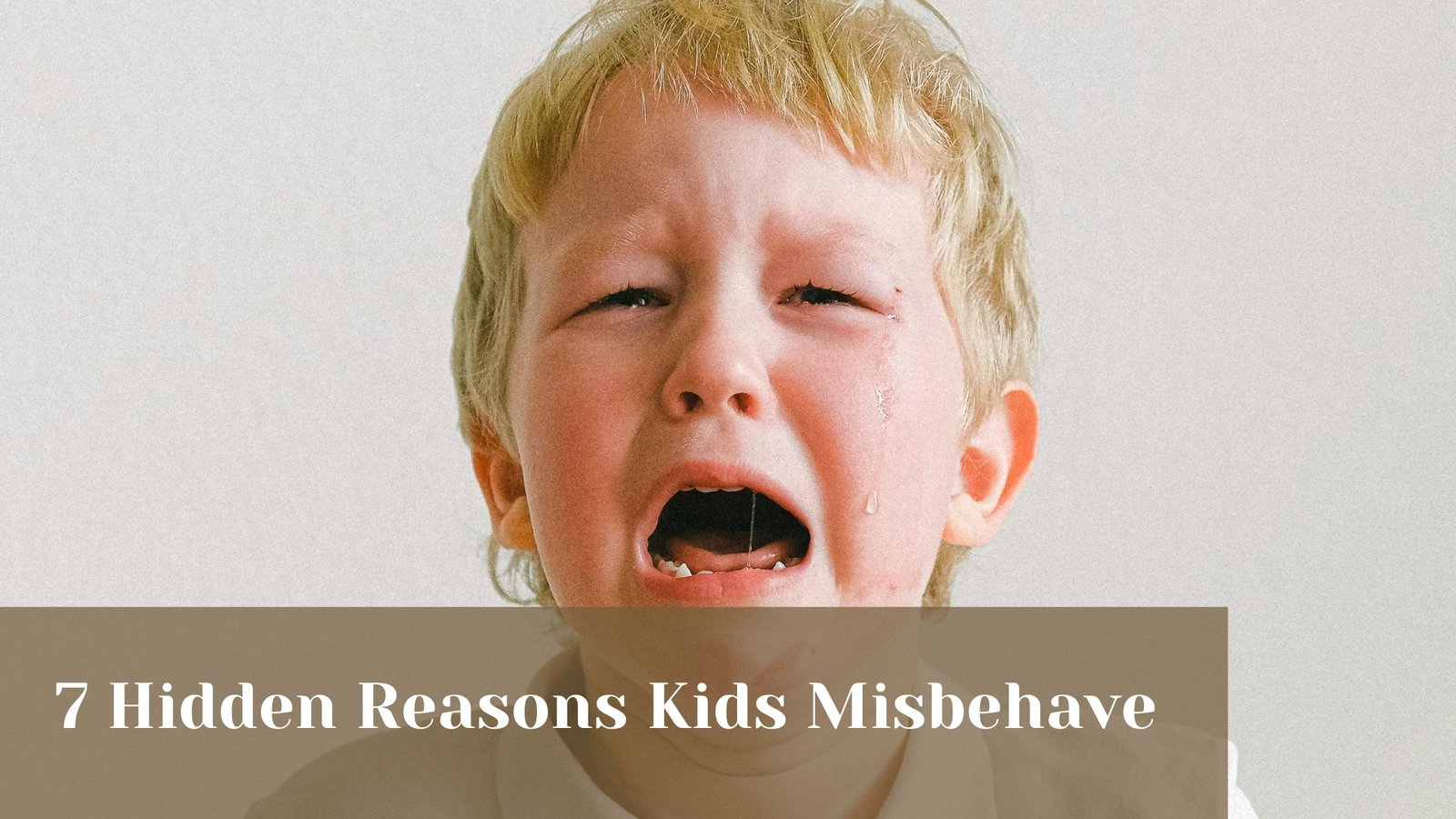
There is a version of misbehavior that is exactly what it looks like: a child who knows the rule, is choosing not to follow it, and is watching to see what happens next. This version is real, and it has its own research and its own set of responses.
But there is another version — one that is more common, less visible, and more frequently addressed in the wrong direction — where the behavior on the surface is a symptom of something running underneath that the child cannot access, articulate, or communicate by any other means. The behavior is not the problem in these cases. It is the most available signal the child has that a problem exists.
When parents treat the symptom without looking for the source, the behavior tends to cycle: addressed, suppressed temporarily, returned in a different form, addressed again. The cycle is exhausting, and it gives the impression that the child is persistent in their defiance. Often, they are persistent in their communication of something no one has yet understood.
The seven reasons in this blog are the ones that are hardest to see from the outside. They are the ones most likely to be mistaken for willful misbehavior, most likely to escalate under punishment, and most likely to shift when the hidden driver is identified and addressed.
What the Research Tells Us About Hidden Drivers First
The foundational insight across multiple areas of developmental psychology is this: children’s behavior — including behavior that appears intentionally disruptive — is almost always functional. It serves a purpose for the child, even when that purpose is entirely invisible to the parent observing it.
Instead of viewing children’s frustrating or annoying behavior as “misbehavior” that must be eliminated, research supports helping parents understand these moments as reflective of the child’s current capacity to understand, regulate, and express their emotions — and subsequently, as an opportunity for parents to guide and nurture important skills.
Behavior problems can arise from parental insensitivity to children’s cues causing children to escalate attention-seeking problematic behavior. Lack of positive attention can prompt children to seek alternative tangible reinforcers such as foods or risky, high-adrenaline activities. Some early child features increase the risk that parents will misread the signal entirely, which escalates the behavior rather than addresses it.
The question that changes everything is not “how do I stop this behavior” but “what is this behavior telling me about what my child needs right now?” The seven reasons below are seven possible answers to that question.
The 7 Hidden Reasons
1. They’re Seeking Connection — Not Causing Trouble
This is the hidden driver that is most counterintuitive to parents in the middle of a difficult behavioral moment, and the most consistently supported by the attachment research. It says, simply, that a child who is not getting enough positive, connected attention from the people they most need it from will find alternative routes — and those routes frequently involve behaviors that reliably produce the parent’s full, undivided, engaged attention. Even when that attention is negative.
The attachment research is precise about the mechanism. Behavior problems can arise from parental insensitivity to children’s cues causing children to escalate attention-seeking problematic behavior. Children who have learned through experience that direct bids for proximity and connection are inconsistently met will shift strategies: the escalated, disruptive bid is more likely to succeed than the quiet, direct one. This is not a deliberate calculation. It is a behavioral system adapting to the environment it has experienced.
The Learning Theory of Attachment research (Frontiers in Child and Adolescent Psychiatry, 2023) establishes this mechanism with clinical precision: when parents become insensitive to children’s cues, children escalate attention-seeking problematic behavior. Lack of positive attention can prompt children to seek alternative tangible reinforcers. The child who misbehaves consistently in the moments just before or just after a parent is present — or who misbehaves in ways that reliably produce engagement — is often a child whose connection account is running low and whose behavioral system has found the only route to a deposit.
The evidence-based intervention for this mechanism is direct and well-validated: the Hanf model, on which Parent-Child Interaction Therapy is built, begins with unconditional relationship building — re-establishing the parent as a source of positive reinforcement through child-directed play — before introducing any discipline strategy. The sequence matters. Behavior improves when connection is restored first because the misbehavior was, in many cases, the connection bid.
What this looks like:
When a child’s misbehavior is clustered around the parent’s presence — starting immediately when the parent enters the room, escalating specifically during moments the parent is distracted, occurring reliably in the transition when the parent is trying to work or rest — the hidden question worth asking is: when did this child last receive unhurried, positive, undivided attention? The answer is often more illuminating than the behavior itself.
2. They’re Carrying Stress From Somewhere Else
Children, particularly younger ones and those without a wide vocabulary for emotional experience, do not leave stress at the door. They carry it home from school, from the social environment, from the conflict they witnessed on the playground, from the rejection at lunch, from the anxiety about the test tomorrow — and they bring it through the front door as a physiological state that has no label attached to it. From the outside, it looks like irritability, defiance, and sudden inability to manage ordinary demands. From the inside, it is a nervous system carrying more than it can hold.
The behavioral and mental health problems research (PMC, 2023) identifies stress accumulation as one of the core mechanisms producing behavioral disruption in children: the stimulus-stress-behavior model describes how external stressors activate physiological stress responses that, when not addressed, manifest as behavioral problems. The home — where the child is most safe, where the relationship is most secure, where the defenses can come down — is precisely the place where carried stress most often surfaces. The parent who experiences the after-school meltdown is not experiencing the response to their morning’s parenting. They are receiving the decompression of a day they weren’t present for.
The accumulated stress research on the “afterschool restraint collapse” — the well-documented phenomenon in which children hold it together behaviorally all day at school and dissolve in the first hour at home — reflects exactly this mechanism. Home is safe enough to fall apart in. The misbehavior is not aimed at the parent. The parent is simply the person present when the held-together structure releases.
What this looks like:
When the misbehavior clusters in the late afternoon, after transitions, or in the first hour after school or structured activities — and when the child cannot articulate what is wrong — the most useful parenting response is often not a consequence. It is proximity, warmth, and a genuine question delivered without pressure: “How was today? What was the hardest part?” Not as an interrogation. As an offering. The behavior is the signal. The stress is the source. And the source, unlike the behavior, has a direct address.
3. They’re Testing Whether the Relationship Is Stable Enough to Hold
This one is the hardest for parents to hear, and the most important to understand. Children — particularly at key developmental transitions, or when something in the family environment has shifted, or when the child is carrying relational uncertainty they haven’t named — sometimes misbehave specifically to find out what happens to the relationship when they do. Not consciously. Not strategically. But functionally: the behavior is a stress-test of the relational container.
The question the behavior is asking — below the level of words, in the language of action — is: if I am at my worst, are you still here? Will you still be warm? Will the relationship survive my bad behavior, or will it break? The child who has experienced inconsistent parenting, relational rupture without repair, or conditional affection learns that the relationship’s stability is unclear. Testing it is a reasonable response to that uncertainty.
Behavioral problems arise from parental insensitivity causing children to escalate in ways that test the relationship. Children who experience parents as consistently unavailable for support develop insecure internal working models about parental availability. The testing behavior is a direct expression of that uncertainty: the child’s behavioral system is trying to gather evidence about whether the parent is reliably available.
The research on consistency and behavioral regulation is clear on what this behavior needs: not escalating consequence, which confirms the relational rupture the child fears, but consistent, warm follow-through that communicates simultaneously that the behavior is not acceptable and that the relationship is stable regardless. The child whose testing behavior is met with warmth-inside-firmness gradually accumulates evidence that the relationship can hold the worst of them — which reduces the need to test it.
What this looks like:
When misbehavior escalates just as the relationship has been under strain — after a period of parental stress, after a significant family change, after a conflict that was never fully repaired — consider what the testing is asking. The response that works longest is the one that holds the limit without withdrawing warmth: “That behavior is not okay, and I love you. Both of those things are true.” That sentence, delivered consistently, is the evidence the test is looking for.
4. They’re Communicating Something They Can’t Say in Words
Behind a significant proportion of child misbehavior — particularly in younger children, but not only in younger children — is an emotional state, an unmet need, or an experience that the child genuinely cannot access in verbal form. The behavior is not defiance. It is communication. It is the most expressive thing available to a child whose vocabulary for internal states doesn’t yet match the internal state they’re experiencing.
The research on behavior as emotional communication in young children is foundational in developmental psychology. Caregivers may also provide explicit guidance in identifying and understanding emotions by narrating children’s experiences. The inverse of this — the child who hasn’t had their emotional states named and narrated — is a child who has limited access to the vocabulary through which experience can be communicated directly. That child’s experience will be communicated indirectly, through behavior, until the vocabulary exists.
The externalizing behavior and self-regulation research (Frontiers in Psychology, 2025) establishes the mechanism: externalizing problem behaviors stem from self-regulation deficiencies. The child who hits, throws, refuses, or storms out is a child whose internal state has exceeded their available regulatory capacity — and whose communication repertoire doesn’t include a direct path to what they’re trying to express. The behavior is not the message. It is the carrier of a message the child doesn’t have better language for.
This is why the question “what were you feeling when that happened?” — asked later, in a calm moment, with genuine curiosity — is often more useful than any disciplinary intervention. It invites the child to translate the behavior into the language it was generated from. And over many such conversations, the child gradually develops the vocabulary that eventually makes the behavior less necessary: because the feeling can be said.
What this looks like:
When a misbehavior arrives without obvious cause, or when the child seems genuinely unable to explain what prompted it, treat the behavior as an incomplete communication: something was trying to get through that didn’t have words yet. In a calm moment afterward, be curious: “When you did that, what was going on for you inside?” The answer may be partial, or wrong, or unavailable at first. The practice of asking, without judgment, teaches the child that the internal state is worth exploring — and that there are better ways to express it than the behavior that started the conversation.
5. They’re Going Through a Developmental Leap
Children’s development does not progress smoothly and continuously. It moves in a pattern of consolidation and then reorganization — periods of relative stability followed by periods of significant neurological, cognitive, and social transition during which the behaviors that were manageable become temporarily unmanageable, and the child who was reliably regulated becomes unpredictably not.
These developmental transitions — the emergence of abstract reasoning in early adolescence, the shift from parallel to social play in toddlerhood, the onset of concrete operational thinking in middle childhood, the social complexity that arrives around age eight or nine — are periods of genuine neurological remodeling. During them, the behavioral and regulatory systems that were working are under reconstruction. The child who was handling transitions, managing disappointment, and following routines is temporarily less capable of doing all three — not because they have forgotten or are choosing not to, but because the architecture supporting those capacities is actively changing.
The developmental psychopathology literature on brain development and behavioral disruption establishes that developmental transitions are windows of both vulnerability and opportunity — the same neurological plasticity that makes the brain reorganizable also makes behavior temporarily less stable. In early adolescence, this is compounded by the specific brain changes documented in the Stanford fMRI research: the reward circuitry rebalances toward peer input and away from parental input, the prefrontal cortex undergoes significant pruning, and the risk-sensitivity of the behavioral system temporarily increases.
Knowing that a behavioral deterioration is developmentally timed — that it is happening because something is being built rather than because something is breaking — changes the frame entirely. The child is not regressing. They are reorganizing. The regression is temporary and a feature of the same plasticity that will eventually produce the more mature version the parent is waiting for.
What this looks like:
When misbehavior worsens noticeably during a developmental transition period — around 18 months, around 3 years, around 7–8 years, and again at the onset of puberty — recognize the pattern for what it is. Hold the expectations, offer more scaffolding, reduce the number of demands in the highest-vulnerability windows, and maintain the relationship warmth that will still be there when the transition is complete. The deterioration is not permanent. The relationship you maintain through it is.
6. They’re Bored and Understimulated
This one is consistently underestimated, particularly for children with higher cognitive capacity, higher sensory needs, or temperamental characteristics that drive exploration and stimulation-seeking. A significant proportion of disruptive behavior in children — particularly the repetitive, probing, boundary-testing variety — is driven by exactly what it appears to be on the surface: a brain and body that are not sufficiently engaged, and that are generating their own engagement in the ways most readily available.
The developmental behavior literature on stimulation-seeking and externalizing behavior (PMC, Childhood Externalizing Behavior review) documents the sensory-behavioral link: children with higher sensation-seeking and activity level show elevated rates of externalizing behaviors in environments that are insufficiently challenging or engaging. The behavior is not willful disruption. It is the activation of a regulatory system that is not getting what it needs through sanctioned channels — and is therefore finding it through unsanctioned ones.
This is particularly important to recognize in children who misbehave specifically when they have unstructured time, children whose behavior deteriorates during activities they find boring or repetitive, and children who are described as “always getting into something” — who seem to generate chaos not from malice but from an almost automatic orientation toward novelty, challenge, and stimulation. These children need more of the environment, not more consequences for taking it.
What this looks like:
When the misbehavior clusters specifically in unstructured time, during low-challenge activities, or immediately after transitions from highly engaging to less engaging situations, ask whether the environment is providing sufficient challenge and engagement. For some children, the intervention is structural: more physical activity, more cognitive challenge, more creative freedom, more hands-on engagement. The child who is adequately stimulated doesn’t need to create their own — which is what the disruptive behavior, in many cases, was.
7. They’re Absorbing and Reflecting the Family Environment
Children are extraordinarily sensitive instruments. They read the emotional climate of their family — the tension between parents, the parental stress that hasn’t been named, the household anxiety that is present but unspoken — with a precision that often exceeds the adults’ awareness of how much they are broadcasting. And they respond to what they read, through their behavior, often without any conscious awareness that they are doing so.
The stimulus-stress-behavioral response model (PMC, 2023) establishes the pathway: external stressors in the family and social environment induce stress responses in children that manifest as behavioral and mental health problems. The child is not the origin of the disruption. They are the expression of it — a readout of a household environment that the adults have not yet fully acknowledged or addressed.
The parent-to-child stress transmission research (Perlman and colleagues, PMC, 2022) is precise about the mechanism: parental emotional dysregulation transmits to children through physiological co-regulation processes that operate below the level of conscious communication. The parent who is experiencing significant stress, anxiety, or conflict — but who has not disclosed it and is attempting to manage it invisibly — is transmitting it to the child’s nervous system through the channels the parent cannot see or control.
The child who misbehaves during a period when the household is under strain is, in many cases, a child whose nervous system has absorbed the household’s stress and is expressing it through the behavioral register. The behavior isn’t aimed at anyone. It is a barometric reading of the environment.
What this looks like:
When a behavioral deterioration coincides with a period of parental or household stress — a difficult period at work, a relationship tension, a family loss, a significant transition — consider the possibility that the child’s behavior is a reflection of what the household is holding. Not always, and not exclusively. But often enough that it is worth asking. What the child needs in these moments is not more consequences. It is more conscious co-regulation: a parent who is managing their own state well enough to provide the stable, regulated presence the child’s nervous system is looking for but can’t find in the ambient household climate.
What All Seven Point Toward
Each of these seven hidden reasons is pointing toward the same truth, expressed from a different angle: children’s behavior is almost always communicating something — about their state, their environment, their relationships, their developmental moment, their unmet needs. The communication is imperfect. It is often disruptive. It is rarely the most convenient thing a parent could be receiving. But it is information — specific, meaningful, and valuable — about what this child needs right now that they don’t have.
The parent who responds to misbehavior with the question “what might this be trying to tell me?” is in a fundamentally different position than the parent who responds only with “how do I stop this?” Both questions matter. But the first one is where the durable answers live.
This doesn’t mean every misbehavior is a hidden message that requires therapeutic investigation before a response is possible. Children sometimes misbehave because they’re choosing to, and in those cases, the consequence is appropriate. But it means that when the behavior is recurring, persistent, escalating, or disconnected from any obvious cause — the seven reasons above are the most likely hidden drivers. And identifying the right one makes the difference between a consequence that changes something and one that changes nothing.
Which of these seven do you recognize in your household right now? Sometimes naming the hidden driver — even just to yourself — is the thing that shifts how the behavior feels. Share what you’ve found in the comments.
Sources & Further Reading:
- Durrant, J.E. et al. — Positive Discipline in Everyday Parenting (PDEP): Behavior as Reflective of Current Capacity Rather Than Willful Misbehavior — Misattribution of Intentional Non-Compliance, Parental Reframing, and Behavioral Improvement
- Gardner, F. — University of Oxford / Frontiers in Child and Adolescent Psychiatry (2023): Attachment, Behavior Problems and Interventions — Behavior Problems as Escalated Attention-Seeking, Lack of Positive Attention, Alternative Reinforcers, Hanf Model and PCIT Connection-Building Before Discipline
- Behavioral and Mental Health Problems in Children — Stimulus-Stress-Behavior Model (PMC / MDPI, 2023): External Stressors, Stress Activation, Behavioral Manifestation — Child Stress Accumulation, After-School Restraint Collapse, Home as Safe Decompression Environment
- Perlman, S.B. et al. — Washington University St. Louis (PMC, 2022): Parent-to-Child Stress and Anxiety Transmission Through Physiological Dyadic Synchrony — Parental Emotional State Transmitted Below Conscious Communication, Family Environment as Child’s Nervous System Input
- Stormshak, E.A. et al. — University of Oregon (PMC / JCCP, 2000): Parenting Practices and Child Disruptive Behavior — Relationship Testing Through Misbehavior, Predictability Hypothesis, Inconsistency → Oppositional Behavior to Elicit Predictable Response
- PMC Frontiers in Psychology (2025): Parenting Styles and Externalizing Problem Behaviors — Self-Regulation Deficiencies as Source of Externalizing Behavior, Behavior as Communication of Regulatory State, Emotional Management Skills
- Ellis, B.J. et al. — Developmental Psychopathology Perspectives (PMC / JCAT, 2023): Developmental Transitions as Windows of Vulnerability and Opportunity — Brain Reorganization, Temporary Behavioral Instability, Neurological Plasticity and Behavioral Disruption
- Moffitt, T.E. et al. (PMC / Childhood Externalizing Behavior Review): Biological and Psychosocial Risk Factors for Externalizing Behavior — Stimulation-Seeking, Sensation-Seeking and Understimulation, Understimulation as Driver of Boundary-Testing and Disruptive Behavior in High-Activity Children
- Nikolić, M. et al. — University of Amsterdam (PMC, 2023): Parental Mental State Language and Warmth in Early Childhood — Behavior as Incomplete Emotional Communication, Naming Internal States as Bridge from Behavior to Language
- Skowron, E.A. & Cipriano-Essel, E. (PMC / Development and Psychopathology, 2023): Importance of Parent Self-Regulation and Parent-Child Co-Regulation — Family Environment as Co-Regulatory Input, Parental Stress and Child Behavioral Absorption
- Lunkenheimer, E. et al. — Penn State University (PMC / Development and Psychopathology, 2020): Parent-Child Co-Regulation Patterns Shaping Child Self-Regulation — Household Emotional Climate, Positive vs. Negative Synchrony, Behavioral Readout of Family Environment
- Groh, A.M. et al. — Meta-analysis of attachment and externalizing problems: Insecure Attachment Predicts Internalizing and Externalizing Problems Across the Lifespan — Attachment as Relational Container Test, Testing Behavior as Uncertainty Expression
- Holliday, M. et al. — Positive Discipline Parenting Program (PMC / Child Psychiatry and Human Development, 2022): Developmental Reframing of Misbehavior — Moving from Willful Defiance Attribution to Capacity-Based Understanding, Parental Attunement and Behavioral Improvement