
You are not looking for a craft project. You are not looking for something Pinterest-worthy. You are looking for something that will actually hold your toddler’s attention for 20 to 30 minutes while you make a phone call, finish a work email, cook dinner without a small person attached to your leg, or simply sit down and breathe like a human being.
That is a completely reasonable thing to need. And the fact that you reached for this article instead of the TV remote says something about you as a parent.
Here is the problem with most screen-free toddler activity lists: they are designed for joint play. They need you to set them up, explain them, manage them, and monitor them every few minutes. They buy you four minutes of peace before your toddler looks up and says “what do I do now.”
This list is different. Every activity on it is specifically chosen because a toddler can sustain it independently once it is set up. That is the only criterion that matters here. Not education. Not Pinterest aesthetics. Can your toddler do this alone for 20 to 30 minutes? That is the bar.
Why Needing 30 Minutes to Yourself Is Not Selfish — It Is Developmental
Before the activities, one important thing to clear up.
Giving your toddler independent play time is not a parenting shortcut. It is one of the most beneficial things you can do for their development.
A landmark Australian longitudinal study published in ScienceDirect, following children from toddlerhood through early elementary school, found that time spent in unstructured quiet play at ages 2 to 3 and 4 to 5 modestly but significantly predicted self-regulation abilities two years later — even after controlling for earlier self-regulation levels. The children who played independently as toddlers arrived at school better equipped to manage their attention, emotions, and behaviour.
A 2023 review published in the Journal of Pediatrics by Gray, Lancy, and Bjorklund drew a direct connection between the decades-long decline in children’s independent play and the equally significant rise in childhood anxiety, depression, and declining mental health. Children who are constantly entertained — by screens or by adults — do not develop the capacity to manage boredom, generate their own ideas, or self-soothe through difficulty.
The AAP’s clinical report on the power of play, reaffirmed in January 2025, states clearly that developmentally appropriate play promotes the social-emotional, cognitive, language, and self-regulation skills that build executive function. Independent play is not a lesser version of adult-led play. It is a different kind of developmental work — and one toddlers need regular doses of.
Your 30 minutes of quiet is not taking something from your toddler. It is giving them something they need.
How to Set Up Any Activity So It Runs Itself
The setup is what determines whether you get 5 minutes or 30. Do these three things before you walk away from any activity.
Reduce the decisions your toddler has to make. Put out exactly what is needed for the activity, nothing more. A toddler presented with a box of 200 crayons will spend three minutes choosing and then lose interest. A toddler presented with eight crayons and a piece of paper will start drawing. Constraint creates focus.
Start the activity with them for two minutes. Sit down, engage, show what is possible, then say “your turn” and physically get up and move away. A cold start — handing something over and leaving immediately — rarely works. A warm start followed by a physical exit does.
Resist going back for at least 10 minutes. The single most common reason independent play collapses early is a parent returning to check in, redirect, or add encouragement. That check-in resets your toddler’s attention back to you. Wait longer than feels comfortable. If things are quiet, stay where you are.
The 10 Activities That Actually Buy You 30 Minutes
Activity 1: Dry Pasta Pouring Station
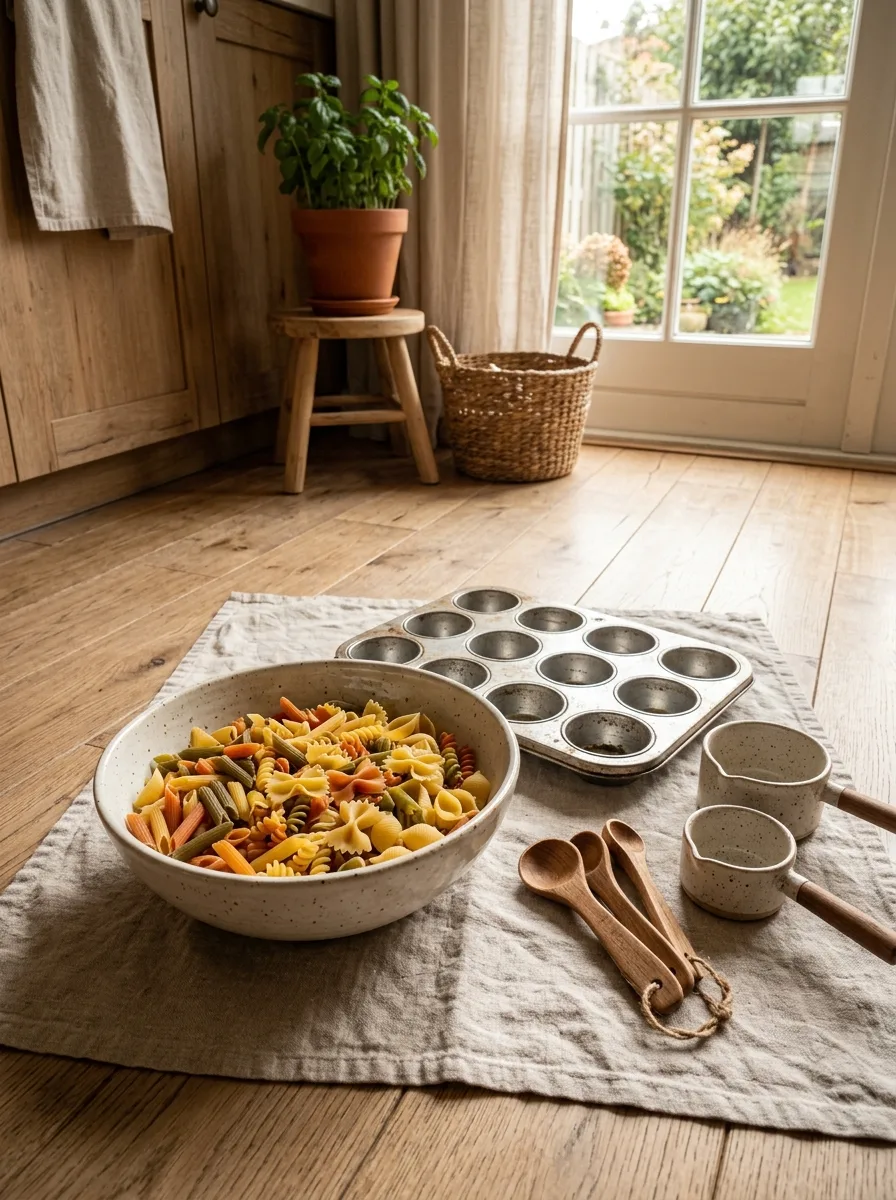
What you need: A muffin tin, a large bowl of dry pasta in different shapes, a set of measuring spoons or small cups.
What to do: Set the muffin tin on a towel on the floor. Put the pasta bowl beside it with the measuring tools. Show your toddler how to scoop pasta into the tin cups. Then walk away.
Why it holds attention independently: Pouring and transferring activities are intrinsically satisfying for toddlers because they offer immediate, predictable cause-and-effect feedback with infinite repeatability. There is no right or wrong way to do it. The pasta can be sorted by shape, poured from cup to cup, dumped out and started again, counted, lined up, and mixed. A toddler can generate their own variations without any adult input because the activity has no fixed end state.
Realistic hold time: 20 to 35 minutes for toddlers aged 18 months to 3 years. Older toddlers will begin inventing their own rules and extend even longer.
Mess level: Low. Dry pasta on a towel is easy to sweep up in thirty seconds.
Activity 2: The Tape Road or Shape Game
What you need: Painter’s tape. That is it.
What to do: Before your toddler enters the room, use painter’s tape to create roads on the floor — a simple loop, a straight road, an intersection. Add some shapes — a square, a triangle, a circle — if you have time. Bring your toddler in and tell them the road is ready. Then leave.
Why it holds attention independently: Painter’s tape roads hit a specific developmental sweet spot for toddlers aged 2 to 4. They are big enough to be physically engaging — toddlers walk on the tape, run toy cars along it, jump between the shapes — and abstract enough to invite imaginative extension. The road becomes a city. The shapes become houses, lakes, a farm. Your toddler’s imagination builds the rest of the activity from the framework you created.
Childcare.gov notes that a little boredom is good for development because it prompts children to plan, organise, be flexible, and manage frustration. The tape road provides just enough structure to avoid boredom while leaving enough open space for that creative problem-solving to kick in.
Realistic hold time: 25 to 40 minutes. This is consistently one of the longest-hold independent activities available for toddlers.
Mess level: Zero. Painter’s tape removes cleanly from most floors.
Activity 3: Sensory Bin With a Mission
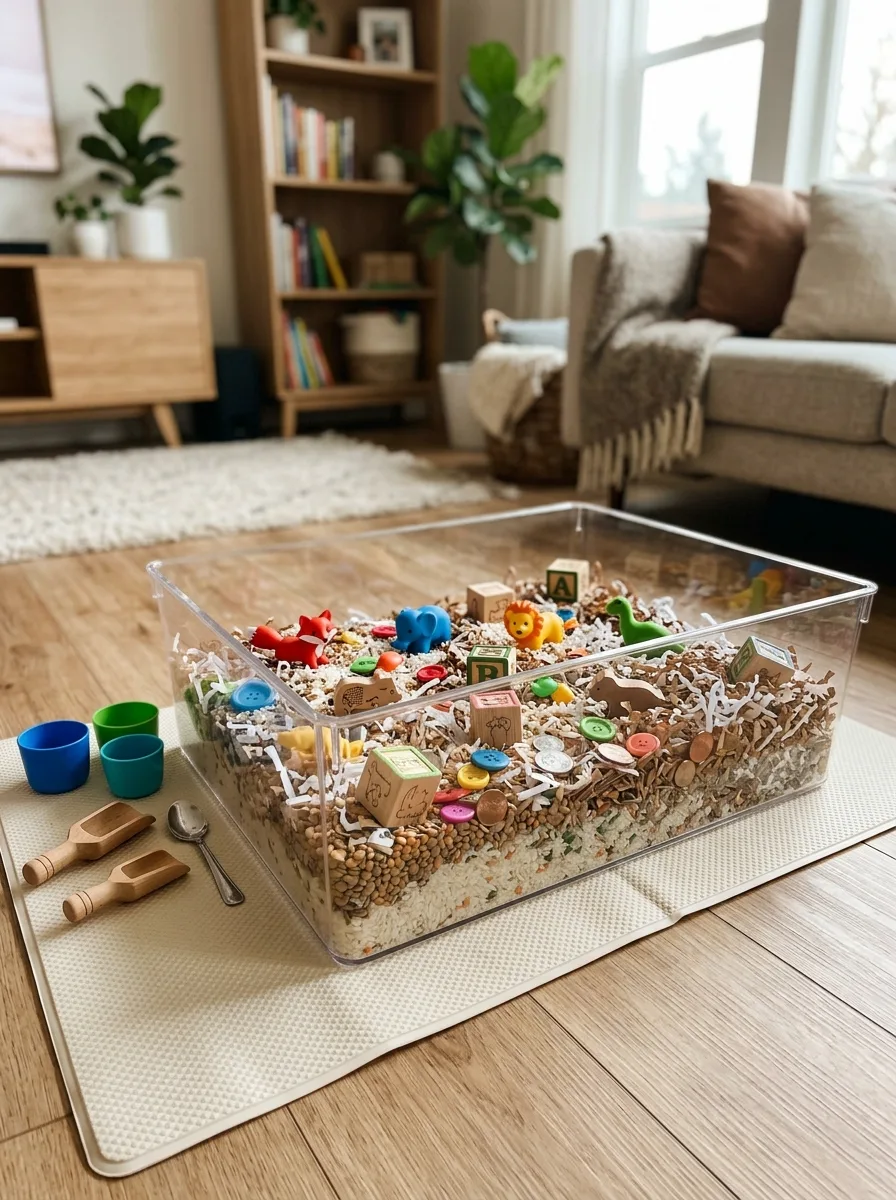
What you need: A plastic storage bin or deep baking dish. A filler — dry rice, dried lentils, sand, or shredded paper. Small objects hidden inside — toy animals, coins, buttons, small blocks, whatever you have.
What to do: Fill the bin. Hide the objects inside. Hand your toddler a small cup and tell them there are hidden things to find. Walk away.
Why it holds attention independently: Sensory bins work for independent play because they combine two powerful engagement mechanisms: sensory satisfaction and a search task. The texture of the filler is intrinsically calming and pleasurable to handle — toddlers will run their hands through it repeatedly without any external motivation. The hidden objects layer on a mission, which gives the activity a purpose and a series of small completion moments that reset the engagement cycle.
A 2023 systematic review cited by Kong Academy found that free play nurtures emotional, physical, and cognitive development simultaneously precisely because of its autonomous nature. Sensory bins are one of the closest approximations to fully autonomous play available to toddlers — once set up, there is nothing left for a parent to do.
Realistic hold time: 20 to 30 minutes for toddlers aged 18 months to 4 years.
Mess level: Medium. Put the bin on a cheap shower curtain or large towel. The cleanup is manageable.
Activity 4: Sticker Book or Sticker Scene
What you need: A sheet of stickers — any kind — and a large piece of blank paper or cardboard. Draw a simple scene on the paper first: a house, a park, a road, the sky. Then set the stickers and scene out for your toddler.
What to do: Show your toddler where the scene is and where the stickers are. Say “decorate it however you want.” Walk away.
Why it holds attention independently: Sticker activities hold toddler attention longer than almost any other fine motor task because they offer the perfect ratio of challenge to reward. Peeling a sticker is genuinely difficult for small hands — it requires pincer grip, bilateral coordination, and persistence. Placing it is immediately satisfying. The repeating cycle of peel, place, peel, place runs itself without any adult input.
The open-ended scene removes the decision paralysis of a blank page while still leaving complete creative freedom. Your toddler is not doing it wrong, no matter what they do.
Realistic hold time: 20 to 30 minutes. Some toddlers will use every sticker on one small corner. Others will cover every inch of paper. Both are fine.
Mess level: Zero.
Activity 5: Water Play at the Sink or Tub
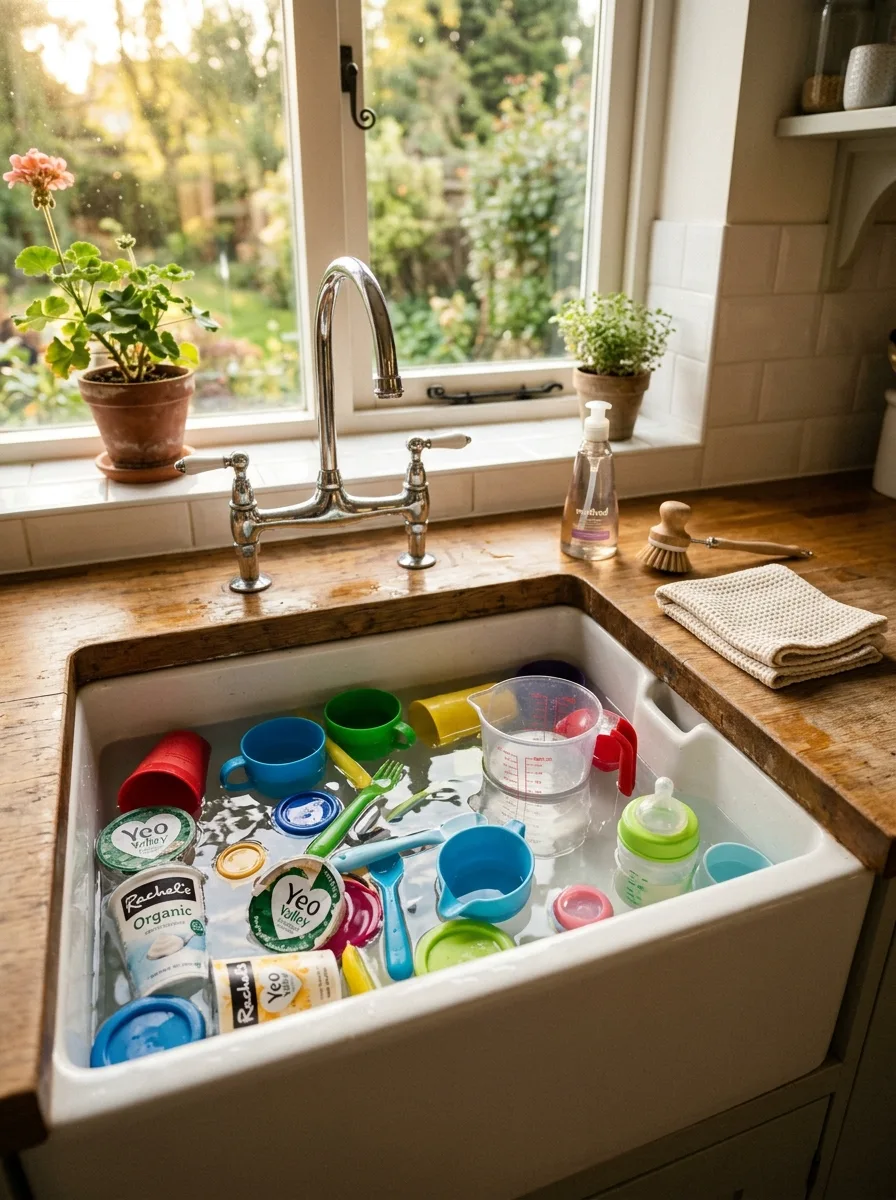
What you need: The kitchen sink or bathroom tub. A few inches of water. Three or four containers of different sizes — a cup, a small jug, a yogurt tub, a plastic bottle. A towel on the floor.
What to do: Fill the sink or tub with a few inches of warm water. Set the containers in. Put your toddler in front of it — or in the tub if that is easier. Walk to the adjacent room.
Why it holds attention independently: Water play is the single most reliable extended independent play activity for toddlers under four. The sensory satisfaction of water — its temperature, its movement, the sound it makes pouring — is deeply regulating for the toddler nervous system. A 2023 study in Pediatric Research found that more screen time was directly associated with less time in the kinds of exploratory play that build developmental skills — water play is exactly the kind of rich exploratory experience that screens displace.
Toddlers do not need instructions for water play. They pour, splash, fill, dump, watch, and repeat without any adult direction. The activity is self-resetting by nature — there is always more water to pour.
Realistic hold time: 25 to 45 minutes. Water play is consistently the longest-hold independent activity at this age. Many toddlers will stay for an hour.
Mess level: Medium at the sink, contained in the tub. The towel handles most of it.
Activity 6: Cardboard Box Transformation
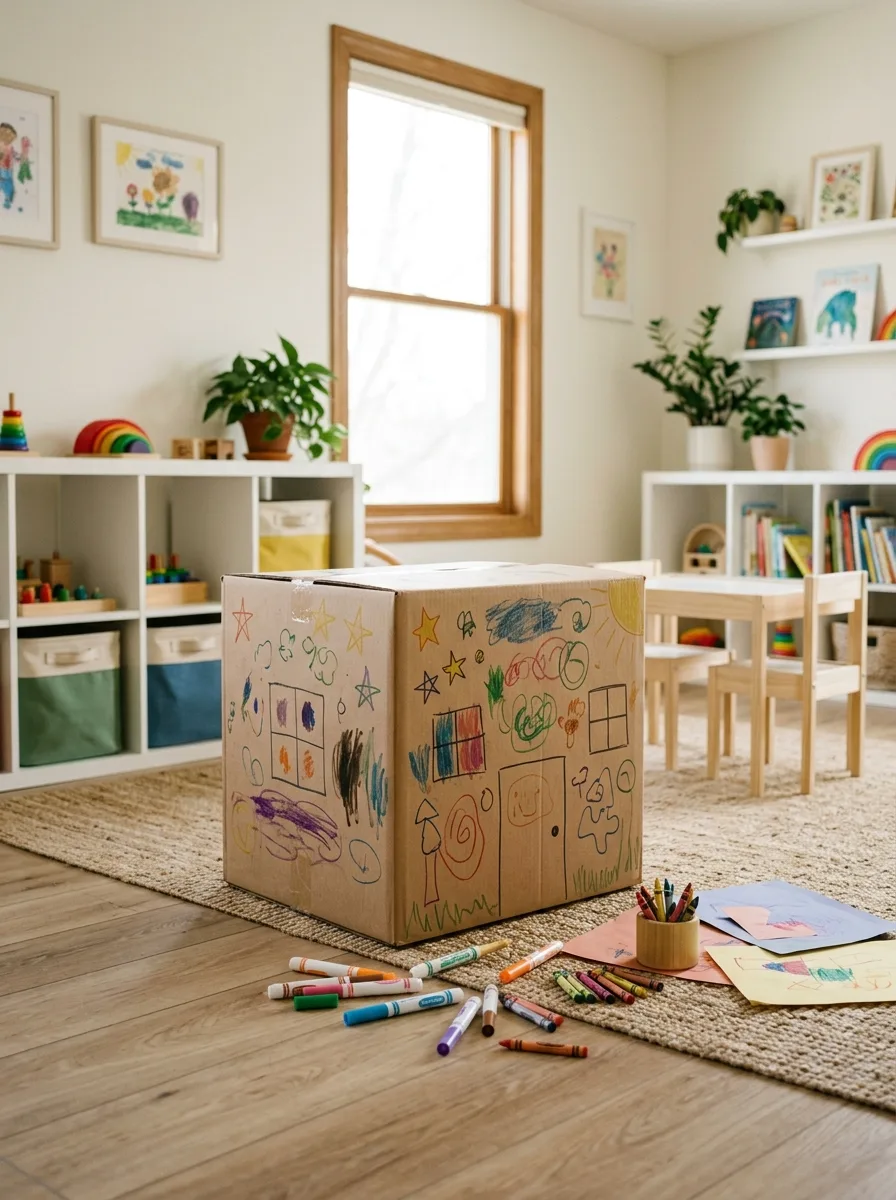
What you need: A large cardboard box — an Amazon delivery box, an appliance box, anything big enough for your toddler to get inside or interact with. Some crayons or washable markers.
What to do: Put the box in the middle of the room. Tell your toddler it is theirs — they can draw on it, get inside it, decorate it, cut windows in it with supervision, or decide what it is going to be. Then leave.
Why it holds attention independently: Cardboard boxes are one of the most studied objects in child play research precisely because they inspire such extended, self-directed engagement. KidKraft’s analysis of unstructured play research notes that when children are given open-ended objects and time, their imagination generates the activity. A box is a spaceship, a house, a cave, a shop, a boat. A toddler who has decided what the box is will defend that narrative and extend it for far longer than any structured activity would hold them.
The drawing element also activates fine motor engagement — your toddler is marking, decorating, and transforming the object. Every mark they make changes the box, which extends the activity.
Realistic hold time: 30 to 50 minutes. Possibly longer if the box is large and the toddler gets inside it.
Mess level: Low if using washable markers. Zero if crayons only.
Activity 7: Threading and Lacing
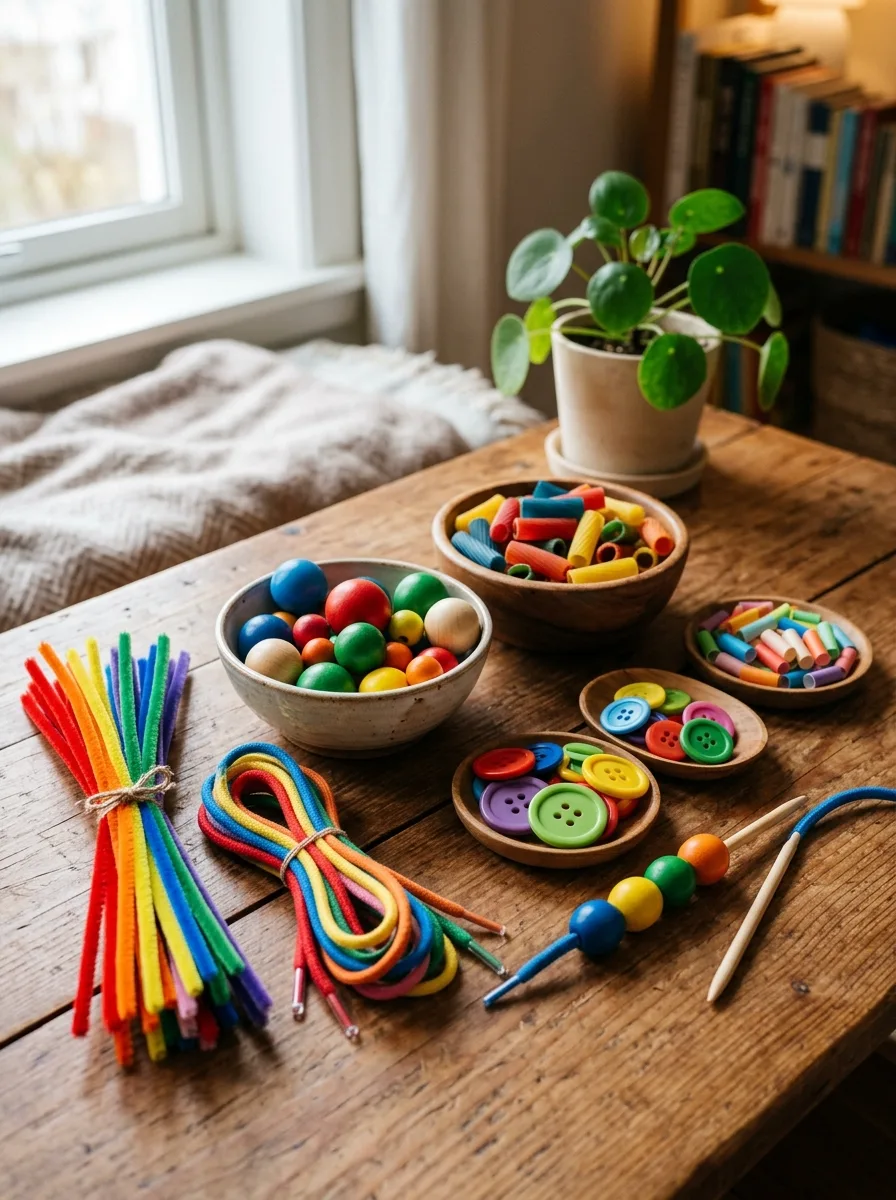
What you need: A shoelace, a thick piece of string, or a pipe cleaner. Objects to thread — large pasta tubes (rigatoni, penne), large wooden beads if you have them, cut straws, large buttons with big holes.
What to do: Knot one end of the string so objects do not slide off. Show your toddler how to push a piece of pasta onto the string. Hand it over. Walk away.
Why it holds attention independently: Threading activities are one of the most focused, quiet, and independently sustainable fine motor activities for toddlers aged 2.5 and older. The task is simple enough to start independently but demands enough precision to keep the brain engaged. There is a clear, satisfying build — the necklace, bracelet, or long string of pasta grows visibly with each piece added.
Crucially, threading is a convergent activity — there is one right way to do each step. That removes the decision-making burden that overwhelms some toddlers in fully open-ended activities. Every piece goes on the string. That clarity keeps toddlers engaged without requiring you to explain what comes next.
Realistic hold time: 20 to 30 minutes for toddlers aged 2.5 to 4 years.
Mess level: Zero.
Activity 8: Animal or Toy Small World
What you need: A tray, a plate, or just a defined area of floor. A handful of small toys — plastic animals, small figures, toy vehicles, blocks. Optional extras: a small cup of water as a lake, a piece of fabric as a field, some dried leaves or sticks if you have them.
What to do: Set out the tray with the animals or figures arranged loosely. Add any optional extras. Tell your toddler this is their world and they can do whatever they want with it. Walk away.
Why it holds attention independently: Small world play — also called small world imaginative play — is one of the most studied forms of toddler independent play and consistently produces some of the longest engagement times. The defined boundary of the tray or the rug creates a contained play space that helps toddlers focus rather than scatter their attention across a whole room.
Once a toddler begins assigning roles and relationships to the figures, the narrative becomes self-sustaining. They do not need a parent to tell them what happens next because the story they are building drives the next move. NCBI’s developmental research on toddler imaginative play confirms that by age two to three, toddlers actively enjoy and sustain pretend play scenarios — expressing and exploring emotions like frustration, sadness, and fear through the figures they are directing.
Realistic hold time: 20 to 40 minutes for toddlers aged 2 to 4.
Mess level: Low. Everything stays on the tray.
Activity 9: Sorting Tray With Tweezers or Tongs
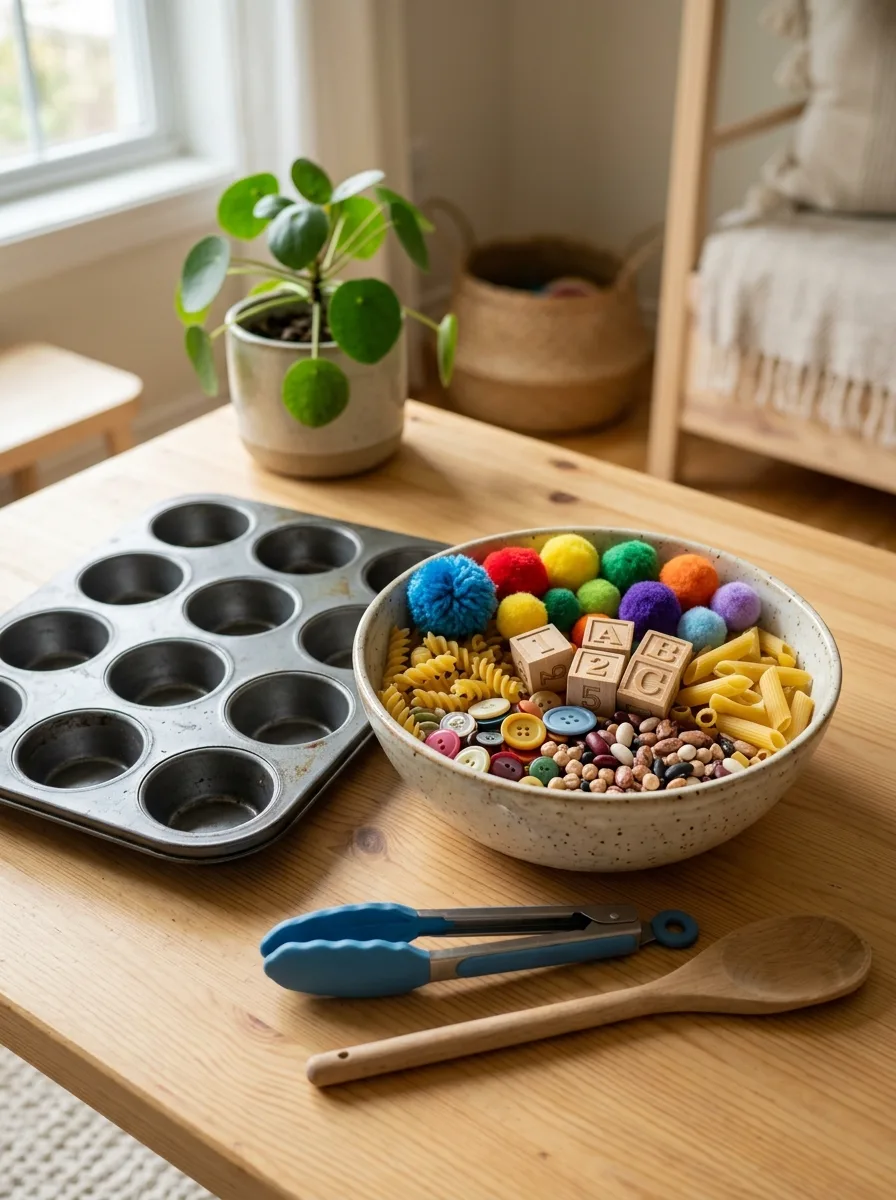
What you need: A muffin tin or egg carton. A collection of small mixed objects — dried beans and pasta mixed together, different coloured pompoms if you have them, buttons, small blocks, coins. A pair of kitchen tongs, a spoon, or toddler-safe tweezers.
What to do: Mix the objects in a bowl. Set the muffin tin beside it. Show your toddler how to pick up one object with the tongs and place it in a tin cup. Define one sorting rule if helpful — “beans in this cup, pasta in that one.” Then walk away.
Why it holds attention independently: The tongs or tweezers element transforms what would be a simple sorting activity into a genuine fine motor challenge that holds attention because it requires real concentration. Using tongs demands bilateral coordination, hand strength, and precise control — all of which are sufficiently demanding for a toddler that the task itself provides the engagement without any adult input needed.
The muffin tin provides a clear visual target for each placement, which removes ambiguity and gives your toddler a satisfying completion moment every time an object lands in a cup. That repeating completion cycle is what keeps the activity going independently.
Realistic hold time: 20 to 30 minutes for toddlers aged 2.5 to 4 years.
Mess level: Low. Small objects stay on the table surface.
Activity 10: Duplo or Block Build With a Photo Challenge
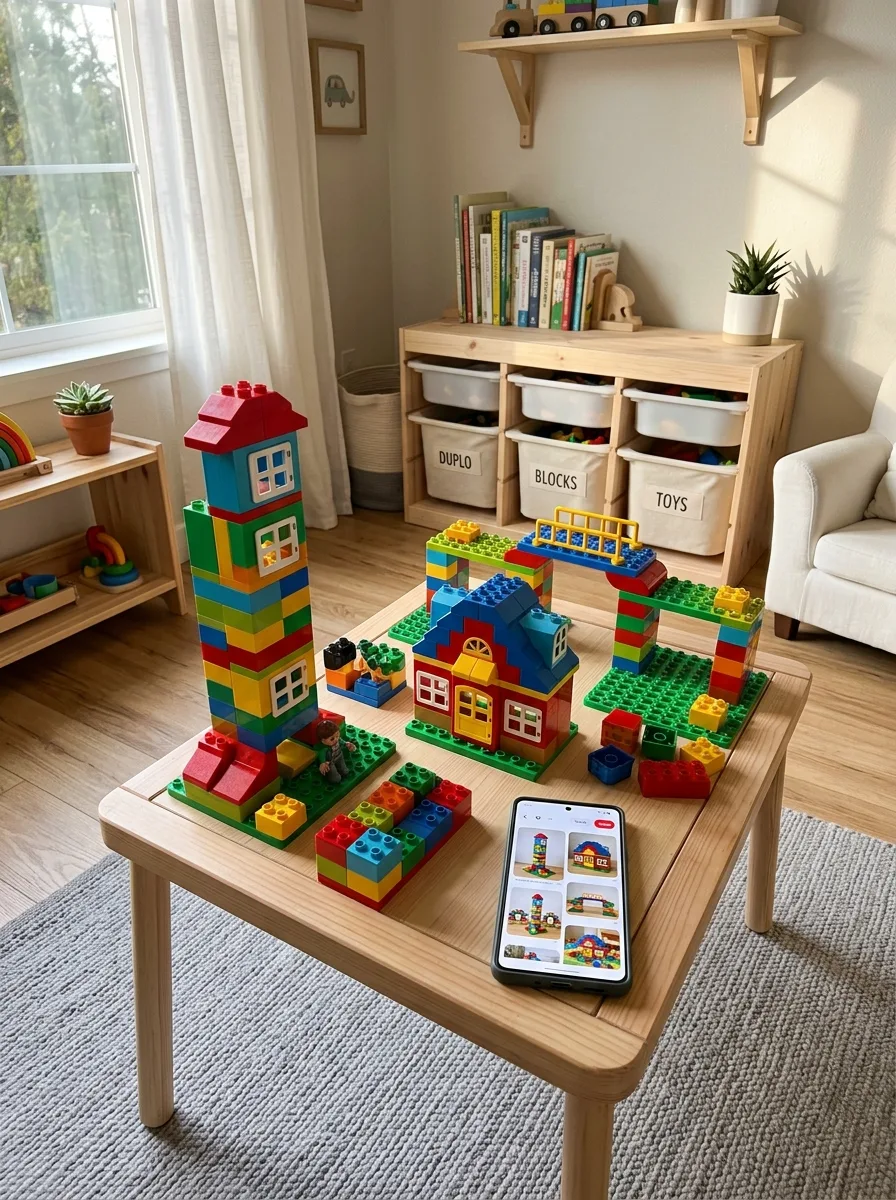
What you need: Duplo, large blocks, or any building material you have. Your phone.
What to do: Build three simple structures with the blocks — a tower, a house, a bridge. Take a photo of each one on your phone and show the photos to your toddler. Tell them their job is to build the same things. Leave the phone with them showing the photos, or print them if that is easier.
Why it holds attention independently: This activity works for extended independent play because it turns free building — which can feel goalless to some toddlers — into a structured challenge with a clear target. The photo gives your toddler a reference point to check their work against, which keeps them engaged through multiple build-and-adjust cycles without needing you to evaluate their progress.
The ScienceDirect longitudinal study on free play found that unstructured quiet play at home during toddler years predicted self-regulation two years later. Block building with a photo challenge sits at the exact intersection of structured enough to sustain attention and unstructured enough to allow creative problem-solving — which is the zone where developmental growth happens.
Realistic hold time: 25 to 40 minutes for toddlers aged 2 to 4.
Mess level: Zero.
Why Most Toddler Activity Lists Fail at Independent Play
Most activity lists are designed with a different goal in mind. They want to create a beautiful joint play experience between parent and child. That is a worthy goal. But it is not the goal here.
Activities that fail for independent play share the same problems. They require setup your toddler cannot do alone. They have no clear end state, so your toddler does not know when they are done. They involve materials that run out or get stuck. Or they are simply not compelling enough to hold a toddler’s attention without an adult there to keep them engaged.
The activities that work for genuine independent play all share the opposite qualities. They are self-contained. They have enough variation to stay interesting. They do not require you to explain the next step. And crucially, they match your toddler’s current developmental level so they are challenging without being frustrating.
A frustrated toddler calls for you. A bored toddler calls for you. A toddler who is appropriately challenged stays in the zone and keeps going.
How to Build Up to 30 Minutes If Your Toddler Currently Lasts 4 Minutes
If your toddler is not used to independent play, 30 minutes will not happen on day one. That is not a problem. It is a starting point.
Independent play is a skill that builds with practice, exactly like any other skill. The same ScienceDirect longitudinal study found that the association between independent play time in toddlerhood and self-regulation outcomes was modestly but significantly predictive — which means the amount of practice matters. More practice, stronger outcomes.
Start with 5 minutes. Set a timer. Return at exactly 5 minutes — not before. Praise the playing, not the child. “You were building that whole time” rather than “good job.” The praise stays specific and process-focused, which builds the toddler’s identity as someone who can play independently rather than someone who performed for your approval.
The following day, try 7 minutes. Then 10. Add two to three minutes every two or three days. Within two to three weeks, most toddlers who have been practicing daily are sustaining 20 to 30 minutes without difficulty.
The goal is not 30 minutes for your sake. It is 30 minutes for theirs. A toddler who can play independently for 30 minutes is a toddler who can manage their own attention, generate their own ideas, and regulate their own frustration. Those are the skills that carry them through school, friendships, and everything else.
Your 30 minutes of quiet is the side effect. Their development is the point.