
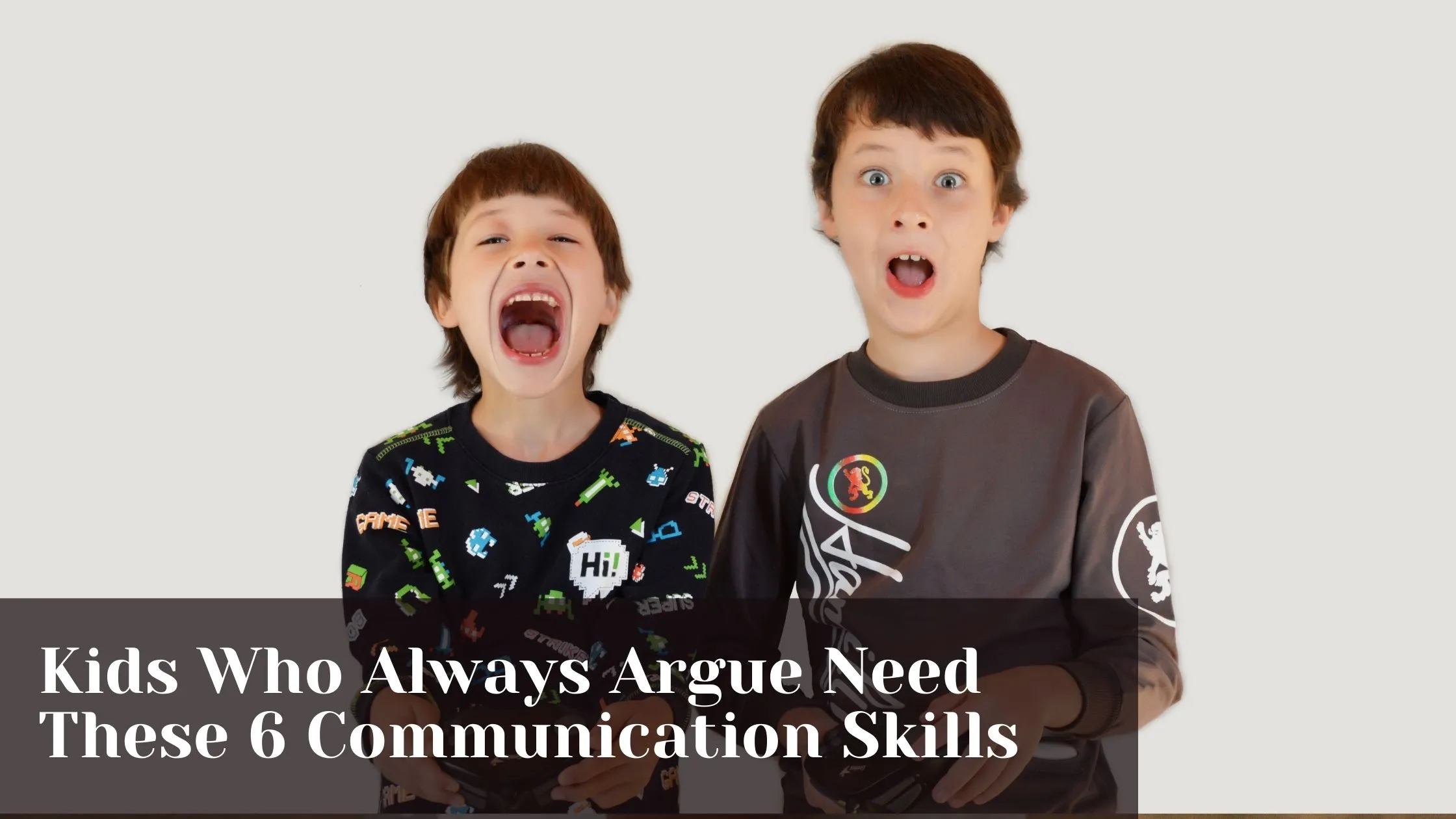
You tell your eleven-year-old to put down the tablet and come to dinner. What follows is not compliance. What follows is a negotiation — an immediate, detailed, surprisingly articulate case for why right now is the wrong moment, why the rule is unreasonable, why five more minutes would make everything fair, why you’re being inconsistent, and why, actually, their sibling got to finish whatever they were doing last Tuesday so technically this is a double standard.
You stand in the kitchen doorway. The food is getting cold. You’ve been through this before.
By the time dinner is on the table, you’re no longer hungry. You’re tired. You’ve already had three sub-arguments inside the original argument, and you’re dimly aware that somehow you ended up defending yourself rather than the person who was supposed to be following a basic household instruction.
You know this child. You know they’re not stupid. In some lights, you can even see that they’re going to make an excellent lawyer one day — if they don’t first drive everyone around them to distraction. But in this moment, that future excellence is small comfort. What you need, right now, is for someone in this house to be able to have a disagreement without turning it into a full geopolitical incident.
Here is what that requires. Not louder consequences. Not a firmer hand. Six specific communication skills that the arguing child almost never has, and almost never knows they’re missing.
What Arguing Constantly Is Actually Signaling
There’s a pull in parenting culture to frame the child who always argues as fundamentally oppositional — a child who simply refuses to cooperate, who finds conflict satisfying, who is wired for resistance as a personality feature.
The research tells a more useful story.
A 2022 systematic review of family factors in Oppositional Defiant Disorder — led by researchers at Beijing Normal University, Brigham Young University, and the University of California Berkeley, published in PMC — examined the full landscape of ODD research and found that the most consistent predictors of argumentative and defiant behavior weren’t child temperament alone, but the interaction between individual child characteristics and the communication environment they grew up in. Specifically, family communication patterns, consistency of boundaries, and the model of conflict resolution the child observed at home each predicted argumentative behavior more robustly than personality traits did.
And here’s the part that reframes the whole picture: a landmark 2024 birth cohort study from Trondheim, Norway, tracking 1,079 children from age 4 to 16 — published in PMC (Wichstrøm and colleagues) found that increased social skills in children predicted reduced symptoms of oppositional behavior in both parent and teacher reports — and this effect held across the full span from preschool to adolescence. The direction matters: it wasn’t that less-oppositional children happened to develop social skills. It was that building social skills reduced the oppositional behavior. Communication skills and argumentative behavior are causally, not merely correlatively, linked.
In other words: most children who argue constantly are not doing it because conflict feels good. They’re doing it because they’re missing the specific skills that would allow them to get what they need — or disagree, or feel heard, or resist something — in a way that doesn’t derail every conversation they’re part of.
Dr. Ross Greene, clinical psychologist and former Harvard Medical School faculty member, synthesizes decades of this research in his Collaborative and Proactive Solutions model: behaviorally challenging children are not unmotivated — they are under-skilled. The behavior is the signal. The missing skills are the message underneath.
Here are the six skills underneath most chronic arguing.
The 6 Communication Skills Chronic Arguers Need
Skill 1: Cognitive Flexibility — The Ability to Hold More Than One Possibility at Once
At the foundation of most chronic arguing is a cognitive limitation that parents rarely identify correctly because it looks exactly like stubbornness: inflexibility of thought.
The child who argues every instruction isn’t just being difficult. They are, in many cases, genuinely unable in that moment to consider that their perspective might be one of multiple legitimate ones — or that the adult’s request might have a logic the child hasn’t fully processed yet. They lock onto their initial frame (“I should be allowed to finish”) and cannot fluidly shift away from it under social pressure. That’s not defiance. That’s a developmental gap in cognitive flexibility.
A 2023 PMC developmental psychology study (Patwardhan, Gordon et al., published in Developmental Psychology) tracked kindergarten and first-grade children across four time points and found two distinct developmental trajectories for cognitive flexibility: early normative developers and delayed developers. Critically, children in the delayed flexibility group showed significantly higher rates of externalizing behavior in second grade — including arguing, fighting, getting angry, acting impulsively, and disturbing ongoing activities. The externalizing behavior was not a separate problem from the cognitive delay. They were the same problem expressed differently.
A PMC review on cognitive flexibility in early and middle childhood (Ionescu, 2012) explains the mechanism: cognitive flexibility is the ability to shift between mental sets, consider alternative perspectives, and adapt behavior when the situation changes. It’s what allows a person to hear “no” and think, okay, what else is possible rather than why not, and here’s my entire case for why the answer should be yes.
This skill develops. It responds to practice. And the child who argues most rigidly often has the most room to grow — with the right kind of support.
What building this looks like:
In low-stakes, non-conflictual moments, introduce “yes, and” thinking — a framework borrowed from improvisational theater that requires building on another person’s contribution rather than opposing it. Play games that require rapid perspective-switching. Have conversations where you both argue both sides of an issue, switching halfway through, just for practice.
After an argument has fully de-escalated, revisit it together: “You were really fixed on finishing before dinner. Let’s try to think of three other ways that situation could have ended where you still felt okay.” The goal isn’t agreement. It’s mental loosening — the experience of discovering that multiple frames can coexist.
Skill 2: The Ability to Feel Heard Without Winning
Here is one of the most counterintuitive insights in child communication research: most chronic arguers are not trying to win. They are trying to feel heard. And they keep arguing because nothing else they’ve tried has made them feel that way.
The argument escalates, gets louder, gets more elaborate, produces more sub-arguments — not because the child is addicted to conflict, but because the child has discovered, through trial and error, that making the argument bigger is the only thing that eventually produces adult acknowledgment of their perspective.
A 2021 PMC study on parent-child communication and child aggression (Meter, Ehrenreich et al., from Utah State University, tracking 297 youth from ages 9–18) found that negative communication patterns in parent-child conversations during preadolescence predicted higher trajectories of social and physical aggression nine years later. Conversely, families that fostered conversation orientation — where children felt free to express themselves, where parents treated communication as the primary vehicle of values and relationship — produced children with better conflict communication skills and more tools to navigate interpersonal conflict without escalating it.
The same study draws on Koerner and Fitzpatrick’s foundational family communication pattern theory: conversation orientation in families leads children to acquire better conflict communication skills and more tools to mitigate the negative consequences of interpersonal conflict. The child who has grown up experiencing their perspective as genuinely welcome — not always agreed with, but consistently acknowledged — has far less need to argue it into the ground.
What building this looks like:
Practice separating acknowledgment from agreement. These are completely different acts, and children who argue constantly almost never experience them as distinct: “I hear that you think that’s unfair. You might even be right that it feels that way. And the dinner is still getting cold.” The acknowledgment is real. The limit holds. Neither cancels the other.
When your child starts to argue, try reflecting the core of their case back to them before responding: “It sounds like you’re saying you were in the middle of something important and five more minutes would have let you get to a good stopping point. Is that right?” Often, when the child experiences genuine acknowledgment of their logic — not agreement, just acknowledgment — the argument itself loses most of its urgency. The engine of escalation is feeling unheard. Genuine reflection cuts it off at the source.
Skill 3: Frustration Tolerance — The Ability to Sit With “No” Without Catastrophizing
Many children who argue constantly are, at their core, arguing against a feeling rather than a rule. The rule (“come to dinner”) triggers a feeling (frustration, disappointment, a sense of injustice) that is genuinely uncomfortable — and the argument is the automatic, reflexive response to that discomfort. Not a deliberate choice. A nervous system looking for relief.
A PMC study on frustration tolerance and cognitive control in children (Spielberg et al., Johns Hopkins, published in PMC 2020) studied 105 children ages 8 to 12 and found that frustration measurably impairs cognitive control — the ability to maintain goal-directed behavior and flexibly adapt responses. When children experience frustration, their prefrontal processing degrades, which means the very skills they most need to navigate the situation (perspective-taking, flexibility, impulse control) are exactly what frustration most effectively dismantles.
The child who argues isn’t choosing to be irrational under frustration. Frustration, neurologically, is making them irrational. And the parent who responds to escalating irrationality with escalating demands for reason is fighting physics.
The same Trondheim birth cohort study (PMC, 2024) establishes that frustration tolerance is a component of social skills — and that improving social skills, including frustration tolerance, produced within-person reductions in oppositional behavior that were sustained across development. This isn’t a short-term behavioral fix. Improved frustration tolerance changes the developmental trajectory.
What building this looks like:
Frustration tolerance is built in exactly the same way any tolerance is built: through repeated, supported, survivable exposure to the thing being tolerated. The child who has never sat with a “no” without arguing has never had the experience of discovering that “no” is survivable. That discovery can only come from actually sitting with it.
This means not rescinding the limit when the argument intensifies. It means staying regulated yourself — not cold, not dismissive, but calm — while the child experiences the frustration of not getting their way. And it means, afterward, naming what happened: “You were really frustrated when I said no. That’s a hard feeling. You got through it. I noticed that.”
Skill 4: The Ability to Disagree Specifically Rather Than Globally
There is a quality of arguing that many parents recognize and almost none can name: the way a child who is frustrated takes one specific grievance and inflates it into a universal indictment. “That’s not fair” becomes “you’re always unfair.” “I don’t like this dinner” becomes “you never make things I like.” “That rule is dumb” becomes “all the rules here are stupid.”
This is called overgeneralization — and it’s not just a rhetoric technique. It’s a cognitive pattern that emerges under emotional pressure and makes specific, resolvable disagreements feel like permanent, sweeping injustices. The child who argues in global terms isn’t being manipulative. They are experiencing the argument through the lens of accumulated emotional activation rather than the specific event in front of them.
The Family Communication Pattern research synthesized in the 2021 PMC study on parent-child communication (Meter, Ehrenreich et al.) found that children in conversation-oriented families developed more specific, targeted conflict communication. They learned, through modeled and practiced language, to address particular situations rather than issuing sweeping judgments — a skill that children in conformity-oriented families, where challenges were shut down rather than engaged, consistently lacked.
Specific disagreement is a skill. So is teaching a child to stay in the lane of the actual problem rather than veering into the ditch of global critique.
What building this looks like:
After a full de-escalation, coach specificity: “Let’s talk about what actually happened, just that one thing. You were frustrated because you couldn’t finish before dinner. That’s the specific thing. Can you say just that?” Over time, introduce a simple phrase for high-frustration moments: “What’s the one thing you’re actually upset about right now?”
Also model specificity in your own disagreements — with them and with other adults. When you’re frustrated with something your child did, say “I’m frustrated that you didn’t do your homework before screen time” rather than “you never follow through on anything.” Specific criticism is easier to receive, easier to respond to, and teaches the linguistic pattern you want them to replicate.
Skill 5: The Understanding That Timing and Tone Carry the Actual Message
A child can have a completely legitimate grievance, a logically sound argument, and an entirely reasonable request — and still lose the entire interaction because of the moment they chose to raise it and the tone they delivered it in. This is one of the most practically important communication lessons any person can learn. And most children who argue constantly have never been taught it explicitly.
The child who chooses the moment of maximum parental stress — the fifteen minutes before guests arrive, the commute home when everyone is hungry, the exact second a phone call ends — to raise a complex complaint has not yet learned that timing is content. How you say something and when you say it changes what is actually received, regardless of what the words objectively mean.
The parent-child communication systematic review (PMC, 2023 — Helm and colleagues, based on 106 studies across 12 instruments) found that communication quality between parent and child — specifically openness, frequency, and the nature of the exchange — was one of the most consistent predictors of psychosocial outcomes in children ages 8 to 21. Open, warm, two-way communication produced better outcomes across nearly every measure. The inverse was equally consistent: communication characterized by hostility, closed channels, or confomity-pressure predicted worse behavioral and emotional outcomes. Tone and timing aren’t incidental to communication. They are the communication.
The child who has never been taught that how and when they raise something matters as much as what they raise is a child perpetually confused about why their technically valid arguments keep failing to produce the results they want.
What building this looks like:
Have an explicit family conversation about timing and tone — not as a lecture, but as a genuine discussion with examples. “When do you think is the best time to bring up something you’re frustrated about?” “What happens to the message when the tone is already angry before the conversation starts?” Let the child generate the answers, which makes them more durable than any rule you could impose.
Introduce a phrase the child can use to request a better moment: “Can we talk about this after dinner?” That phrase, practiced and accepted by both parties, gives a child an alternative to in-the-moment confrontation. It requires the parent to actually follow through on the conversation — which teaches the child that using the proper channel produces results, rather than making it the empty formality that teaches them to ignore it.
Skill 6: Collaborative Problem-Solving — The Experience of Arriving at Solutions Together
The most durable shift in a child who argues constantly is not a new rule they follow. It’s a new experience they’ve had: the experience of bringing a real concern, in an appropriate way, at an appropriate time, with an appropriate tone — and having that concern taken seriously enough to become part of a solution.
This is what Ross Greene’s Collaborative and Proactive Solutions model — developed over decades of work with the most behaviorally challenging children in clinical, school, and juvenile detention settings — identifies as the turning point. The CPS model, described in Greene’s published PMC work and implemented in hundreds of institutions worldwide, involves three steps: an empathy step (gathering the child’s genuine perspective on the problem), a define-adult-concerns step (articulating the adult’s legitimate perspective), and an invitation step (jointly generating solutions that address both). The research shows not just behavioral improvement but skill development — children learn, through the collaborative process itself, the communication skills they were previously missing.
The children who argue most chronically have, in many cases, been arguing instead of being heard — and being managed, punished, or overridden rather than genuinely engaged. The argument is their last remaining tool in a toolkit that never received anything more sophisticated. When collaboration becomes available, the argument often becomes unnecessary.
The Frontiers in Psychology research on children’s emotional comprehension and conflict resolution strategies (Cao, Wang, Lv and Xie, 2023 — PMC) found something that applies directly here: children whose family backgrounds included positive conflict resolution were significantly more likely to prefer peaceful, collaborative strategies in peer conflicts. The more tolerant the parents, the more children used positive strategies. Children are likely to adopt similar strategies to their parents when solving conflicts. Collaborative problem-solving is not a parenting concession. It is a communication curriculum.
What building this looks like:
Choose one recurrent conflict — the homework before screen time battle, the bedtime negotiation, the sibling dispute about the TV — and try solving it collaboratively before it happens again. Bring the child in when everyone is calm: “This situation keeps being a problem for both of us. I want to understand your side better, and then we’re going to figure out something that works for both of us.”
Then actually listen to their side. Not to evaluate it. Not to prepare your counter-argument. To genuinely understand what’s getting in their way. You might be surprised by what you learn. And the child who discovers that their perspective was actually sought and integrated into a real solution has experienced something that argument never gave them: the felt sense that communication, when used properly, actually works.
What Changes When the Skills Are There
Parents who build these six skills in a chronic arguer often report a specific, unexpected experience after a few months: an argument that, in another life, would have consumed twenty minutes and left everyone depleted gets resolved in three exchanges. The child says the frustrating thing, catches themselves, uses the specific language, asks for the right moment, and the situation — somehow — just closes.
Not every time. Not linearly. Not without plenty of old-pattern arguments in between. But with enough of those three-exchange resolutions that the parent can genuinely say: something here is different.
What’s different isn’t the child’s temperament. It isn’t the rules. It isn’t the consequences. It’s that the child has finally been given the tools to want the same thing you want — a resolution — and to get there without needing to flatten everything in the path to the door.
A Note on When Professional Support May Help
Some children argue chronically because their argumentativeness is part of a clinical picture that includes significant mood difficulties, ADHD, anxiety, or Oppositional Defiant Disorder that hasn’t been identified or treated. The 2023 Nature Reviews Disease Primers on ODD (Hawes, Gardner, Dadds, Frick et al., University of Sydney) establishes that ODD affects approximately 3–5% of the population, with onset typically before age 8, and that it responds well to relatively brief parenting interventions in early childhood when identified. The earlier the recognition, the more effective the intervention.
If your child’s arguing is severe, persistent across more than six months, causing significant impairment in family and school functioning, and is accompanied by marked irritability, vindictiveness, or mood difficulties — a consultation with a pediatric psychologist or child psychiatrist is appropriate and worthwhile. The six skills above are meaningful for all argumentative children. Children who meet clinical criteria for ODD often need professional support alongside the parenting changes described here.
The Long View
Here is the thing worth remembering when you’re standing in the kitchen doorway and the dinner is cold and the argument has just produced three sub-arguments: the child who argues is a child who believes that words can change things.
That belief is not wrong. That belief is, in fact, one of the foundations of every productive negotiation, every successful advocacy, every functional democracy.
What the child is missing is not the passion for argument. It’s the skill of it — the ability to choose the moment, calibrate the tone, hear the other side, stay specific, tolerate a “no,” and sometimes collaborate their way to a better outcome than either side had imagined. Those are learnable things. They take time, modeling, and patient practice. They do not take a child who is fundamentally different from the one you have.
They take the child you have, being taught — clearly and consistently and warmly — the skills that make their passion for argument into something everyone around them can actually live with.
Has a specific phrase, approach, or shift in how you engaged with your arguing child changed the dynamic at home? What worked? Share in the comments — parents in the thick of this need strategies that have actually been field-tested.
Sources & Further Reading:
- Hawes, D.J., Gardner, F., Dadds, M.R., Frick, P.J., Kimonis, E.R. et al. — University of Sydney & Oxford (Nature Reviews Disease Primers, 2023): Oppositional Defiant Disorder — Epidemiology, Mechanisms, Treatments
- Lin, X., Xu, F., Chi, P. et al. — Beijing Normal University, BYU, UC Berkeley (PMC, 2022): A Systematic Review of Multiple Family Factors Associated with Oppositional Defiant Disorder
- Wichstrøm, L. et al. — Trondheim Birth Cohort, N=1,079, ages 4–16 (PMC, 2024): Social Skills and Symptoms of ODD and Conduct Disorder — Bidirectional Relations from Preschool to Adolescence
- Patwardhan, I. & Gordon, C. et al. — Boys Town Research Center (PMC / Developmental Psychology, 2023): Trajectories of Cognitive Flexibility Through Kindergarten and First Grade — Implications for Externalizing and Internalizing Behaviors in Second Grade
- Ionescu, T. (PMC, 2012): Exploring the Nature of Cognitive Flexibility — Development and Plasticity in Early and Middle Childhood
- Meter, D.J., Ehrenreich, S.E. et al. — Utah State University (PMC, 2021): Listening In: How Parent-Child Communication Relates to Social and Physical Aggression from Ages 9–18
- Spielberg, J.M. et al. — Johns Hopkins (PMC, 2020): The Validity of a Frustration Paradigm to Assess Frustration Tolerance and Cognitive Control in School-Age Children (N=105)
- Helm, S. et al. (PMC / Springer Child Psychiatry & Human Development, 2023): Systematic Review of Parent–Child Communication Measures — 106 Studies, 12 Instruments, Ages 8–21
- Cao, J., Wang, J., Lv, J. & Xie, J. (PMC / Frontiers in Psychology, 2023): The Influence of Children’s Emotional Comprehension on Peer Conflict Resolution Strategies
- Greene, R.W. & Ablon, J.S. (PMC / Psychiatric Services, 2006): Collaborative Problem Solving — Treating Explosive Kids
- Greene, R.W. (Lives in the Balance / CPS Connection): Collaborative & Proactive Solutions — Model Overview and Research Base
- Tremblay, R.E. et al. (CCSE Journal of Educational and Developmental Psychology, 2013): Developmental Trajectories of Oppositional Behavior During Elementary School — N=1,929 Children, Annual Teacher Assessment