
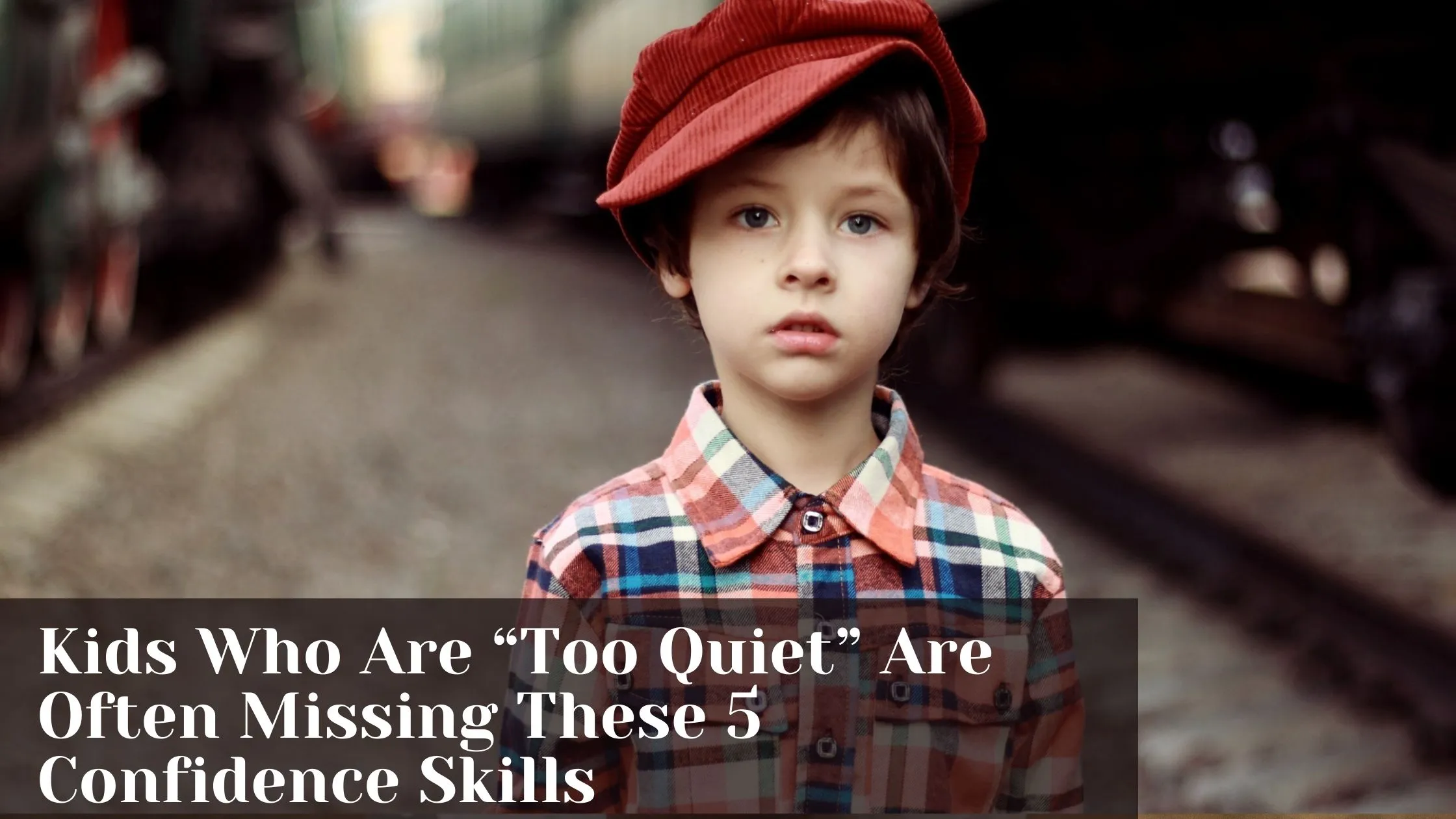
She’s been at the birthday party for forty-five minutes and hasn’t spoken to anyone except you. She stands at the edge of the room, watching the other children with an expression that is hard to read — part longing, part dread — her cup of juice becoming a prop she holds rather than drinks, something to do with her hands.
You watch from across the room and feel the particular helplessness of a parent who cannot fix this without making it worse. You know that if you march over and engineer a conversation, the moment will calcify into something more painful than the current silence. So you wait. And she waits. And the party continues around her like a river that hasn’t quite found a way to include her yet.
Later, on the way home, you try to open it up: “Did you have fun?” She shrugs. “Did you talk to anyone?” “A little.” You know that “a little” means probably no.
Here’s the thing most parents in this position don’t know: the child at the edge of the party is not being difficult. She is not being rude. She is not choosing aloofness over connection. What she almost certainly wants more than anything in that room is to be inside the flow of it — talking, playing, belonging — and something in her nervous system is making the gap between where she is and where she wants to be feel completely uncrossable.
Understanding what that something actually is changes everything about how to help her get across.
First, the Essential Distinction Every Parent Needs to Make
Before we talk about confidence skills, there’s a distinction that matters more than almost anything else in this conversation — one that research has clarified but that parenting culture still largely blurs together.
“Too quiet” is not a single thing. Silence in children can come from several completely different places, and treating them identically produces interventions that help some children and unintentionally harm others.
Dr. Robert Coplan, Professor of Psychology at Carleton University and one of the world’s leading researchers on children’s social withdrawal, has spent decades making exactly these distinctions. His foundational work on childhood solitude, reviewed in PMC (Coplan & Rubin, 2021 — Child Development Perspectives) distinguishes between at least three meaningfully different reasons a child might be quiet or apart from others: shyness (wanting to engage but being held back by fear or anxiety), unsociability (a genuine preference for solitude that doesn’t cause distress), and social avoidance (withdrawal driven by fear of negative evaluation, with a stronger clinical risk profile).
The distinction isn’t academic. A child who is quiet because they genuinely recharge in solitude — the classic introvert, content with one deep friendship, not distressed by their own company — does not need confidence building in the same way a child who desperately wants to connect but cannot make themselves do it does. Pushing an introvert to be more social is not a confidence lesson. It is, at best, unnecessary pressure, and at worst, a message that who they naturally are is inadequate.
A PMC review by Rubin, Coplan and Bowker (Social Withdrawal in Childhood) makes this point with research precision: the key variable predicting negative outcomes is not quietness itself but whether the child wants connection and cannot access it. The shy child who watches from the periphery with longing while others play — what Coplan’s taxonomy calls “reticent” behavior — carries meaningfully different risk than the child who simply prefers to read alone and is perfectly at peace there.
This blog is for children in the first group: those who feel the pull of connection but have developed, through temperament and experience, a set of barriers that their current confidence skills are not yet sufficient to move past. Five of the most consistent barriers, and what to do about each, are below.
The 5 Confidence Skills “Too Quiet” Children Are Often Missing
Skill 1: Self-Efficacy in Social Situations — The Belief That They Can Actually Do This
The single most researched and replicated construct in the psychology of confident behavior is not self-esteem. It is self-efficacy — the specific belief that you are capable of performing a particular action in a particular context.
Dr. Albert Bandura, whose foundational 1977 paper Self-Efficacy: Toward a Unifying Theory of Behavioral Change began one of the most extensively studied lines of research in psychology, established something crucial: people do not attempt things they do not believe they can do. Not because they’re lazy or cowardly, but because the brain’s assessment of likely outcome shapes the decision to engage before the action has even begun. A child who, when approaching a group of peers, runs a rapid and automatic calculation that concludes I am not capable of pulling this off — that child will not approach, regardless of how much they want to.
A PMC review on self-efficacy as a positive youth development construct describes Bandura’s four primary sources from which self-efficacy beliefs are built: mastery experiences (having successfully done something before), vicarious experiences (watching someone similar succeed), social persuasion (being genuinely told by someone credible that you can do it), and physiological states (how calm or activated the body feels during the attempt). For a quiet child who has mostly watched from the periphery, all four sources are often running low. They have few mastery experiences to draw on. They’ve been watching others succeed, which provides some vicarious input but can also activate comparison. And their physiological state during social approach is typically elevated anxiety — the body sending signals that mean danger to a nervous system calibrated toward caution.
The implication is not to tell the child “you can do it” and push them in. Social persuasion alone, Bandura was clear, is the weakest source of self-efficacy among the four. What builds it most powerfully is mastery — actually doing the thing, even in a small, controlled version, and discovering that the predicted disaster did not occur.
What building this looks like:
Start one size below where the anxiety lives. If groups are overwhelming, practice with one known child in a low-stakes setting. If new adults are terrifying, practice with a familiar adult in a new context. The goal is not to eliminate discomfort but to accumulate enough small successes that the child’s internal calculation begins to shift: I’ve done this before, even when it was hard. I can probably do this version too. That shift, built through experience rather than reassurance, is the only way self-efficacy actually grows.
Skill 2: A Behavioral Approach Strategy — Something Specific to Do When They Don’t Know What to Do
One of the least-discussed but most practical drivers of social silence in children is the absence of a script. The socially anxious or inhibited child freezes at the moment of potential approach not only because of fear but because they genuinely do not know, at that moment, what to actually do. The other children are already talking, already playing, already in a flow that has rules the quiet child cannot quickly read. The approach feels not just scary but technically impossible: How do I get in? What do I say? What if they don’t want me there?
Research on behavioral inhibition in children — reviewed comprehensively in a 2021 PMC paper by Morales, Valadez, Fox and colleagues at the University of Maryland (published in Biological Psychiatry) — found that children with high behavioral inhibition tend to develop automatic control strategies: reactive, inhibitory responses to perceived threat that kick in before conscious deliberation can occur. The child’s nervous system, calibrated early for threat detection, activates withdrawal before the prefrontal cortex can generate an approach strategy. What these children need is a planned approach behavior — something prepared in advance, in calm, that can be deployed when the automatic inhibition fires.
The PMC review of social withdrawal research by Rubin, Coplan and Bowker notes that shy children “rarely initiate contact with available playmates and instead tend to withdraw from social interactions” — not because they don’t want to connect, but because the initiation step itself represents the moment of highest perceived social risk. The point of entry to a group is the exact moment the nervous system says stop.
What building this looks like:
Give the child a concrete, rehearsed approach strategy — literally practiced at home, not just discussed. “When you want to join what someone is doing, walk close, watch for a moment, and then say: ‘Can I play too?’ or ‘What are you doing?’ That’s it. Just those words.” Then role-play it. Do it silly, do it serious, do it with a stuffed animal, do it with a sibling. The goal is that the script becomes familiar enough in the body that it can survive the activation of anxiety when the real moment arrives.
Research on Cool Little Kids and Turtle — two evidence-based early interventions for behaviorally inhibited children reviewed in a 2023 Springer systematic review of preschool-based interventions (Grist & colleagues) — both include parent and child coaching components that explicitly practice approach behaviors in structured, graduated ways. The interventions don’t tell children to be brave. They give children a specific, rehearsed behavioral tool to use in the exact moment courage would otherwise run out.
Skill 3: A Regulated Nervous System During Social Exposure
Here is something many parents don’t realize: for a child with high behavioral inhibition or shyness, the act of entering a social situation is physiologically activating in a way that is genuinely difficult to override through will.
Jerome Kagan — one of the most influential developmental psychologists of the twentieth century — identified behavioral inhibition as a biologically based temperamental predisposition, identifiable as early as four months of age in approximately 15% of infants. His research, and the decades of replication it generated, established through extensive longitudinal work (reviewed in PMC, Fox and colleagues, 2021) that children with high behavioral inhibition show elevated amygdala activation in response to novelty — a pattern that persists into middle childhood and adolescence and directly predicts the social reticence parents observe.
This isn’t anxiety born of bad experiences alone. It is, in part, a nervous system that is genuinely more sensitively calibrated to social threat than average. The child at the edge of the birthday party is not being dramatic. Their nervous system is detecting signals the less-inhibited child beside them is simply not registering.
But here is what the same research consistently finds: the trajectory of behavioral inhibition is not fixed. The Annual Research Review on developmental pathways from behavioral inhibition to anxiety (PMC, Chronis-Tuscano, Fox and Rubin, 2024) makes this explicit: only about 40% of children with high behavioral inhibition go on to develop anxiety disorders. The 60% who don’t share something in common: supportive parenting that neither pushes the child into overwhelming situations nor protects them from all social discomfort, and gradual exposure that allows the child’s nervous system to calibrate against accumulated evidence of safety.
The nervous system learns by surviving the thing it fears, at a manageable dose, with support.
What building this looks like:
The principle here is what researchers call graduated exposure: structured, incremental, supported contact with the anxiety-provoking situation. Not immersion — forcing the child into the deep end of social situations — which research consistently shows backfires, intensifying inhibition rather than reducing it. And not avoidance — which confirms the nervous system’s assessment that the situation is genuinely dangerous.
The dose matters as much as the exposure. One new child, in a familiar place, for a contained amount of time — followed by time to decompress — teaches the inhibited nervous system more than three hours at a party it never recovers from. Coplan and colleagues’ research on parenting and social withdrawal found that the outcomes for shy children were significantly better when parents were characterized by high agreeableness and an authoritative parenting style — warm, structured, reasoning — rather than overprotective or intrusive parenting. It is the quality of the scaffold, not the removal of it, that matters.
Skill 4: A Positive Internal Narrative About Who They Are Socially
A child who has been quiet for long enough begins to identify as someone who is quiet — and that identity, once formed, becomes predictive in its own right. It shapes which situations they seek, which they avoid, what they tell themselves is possible, and what they have given up imagining.
A 2021 PMC study on behavioral inhibition and social competence (Rudasill and colleagues) found that children with higher behavioral inhibition tended to be rated as less socially effective by both parents and teachers — but with important variation. The children who showed better social competence despite high inhibition were those in environments where they received consistent positive regard and warm, patient support. Social identity — the story a child carries about who they are in relation to other people — is shaped as much by the social environment as by temperament.
When a child is consistently labeled “shy” — by teachers, by relatives, by parents in front of them (“she’s just shy, she’ll warm up”) — that label becomes a self-concept. The child stops trying to approach not only because approach is hard but because “I’m shy” has become the answer to why they’re standing alone, and an answer implies no further action is required. The label explains the situation and, in doing so, forecloses it.
Research on self-concept in children with behavioral inhibition — drawing on Bandura’s social cognitive theory — confirms that how children narrate their own social competence directly affects their actual social behavior. Children who hold positive self-efficacy beliefs in social domains engage more, persist longer, and ultimately develop more social competence. Children who have internalized narratives of social inadequacy show the opposite pattern. The story the child tells about themselves arrives at the social situation before they do.
What building this looks like:
Be deliberate about the language you use around this child and within their hearing. Not forced positivity — children can detect its falseness immediately. But specific, accurate reframing: instead of “she’s shy,” try “she takes her time getting comfortable, and once she does, she’s really connected.” Instead of explaining their absence from social situations as personality fixed in amber, narrate it as a current state with movement in it: “This was a hard one. You’ll find it easier when you know the people better.”
Notice — and specifically name — every moment of social courage, no matter how small. The quiet child who introduced herself to one new person at the party, or who stayed in the room even though it was hard, or who answered one question even though they were anxious — these are the moments that, named specifically and warmly, begin to revise the internal narrative. Not “good job being social” but “I noticed you went up to that girl and started talking. That took guts. I’m proud of you for doing it.” Specific. Real. Tied to a chosen action rather than a fixed trait.
Skill 5: The Experience of Being Genuinely Known in at Least One Relationship
The last skill is perhaps the most counterintuitive. It doesn’t involve social exposure, approach strategies, or nervous system regulation. It involves depth: giving the quiet child the experience of being truly known and accepted in at least one relationship — with a parent, a sibling, a single close friend — that operates entirely outside the performance pressure of the group.
Research on shy and withdrawn children consistently finds that the quality of their closest relationships, not the quantity of their social contacts, is the most robust protective factor against negative outcomes. A review of longitudinal work on social withdrawal subtypes published in PMC (2025) found that shy withdrawn children who had access to high-quality friendships showed significantly fewer internalizing problems over time than those who were withdrawn without any close relationship. The friend didn’t make them extroverted. The friend gave them a base.
Dr. Coplan’s research on the best friendships of shy children (Rubin and colleagues) established that friendship quality matters more than friendship quantity for inhibited children — and that even one stable, warm, accepting peer relationship acts as a buffer against the peer victimization and exclusion that withdrawn children are otherwise at elevated risk of experiencing. A single relationship in which a child feels genuinely seen — where they don’t have to perform, don’t have to be louder or more animated than they naturally are, don’t have to apologize for needing time to warm up — does more for their confidence than a dozen forced social successes in groups where they felt invisible.
What building this looks like:
Facilitate depth rather than breadth. Instead of playdates with multiple children, arrange one-on-one time with a child who matches your child’s temperament and interests. Instead of encouraging your child to “put themselves out there” in large group settings, look for one sustained, low-pressure relationship — a consistent neighbor, a regular class, a structured activity with the same small group over time — where the relationship can develop gradually without the volatility of large peer environments.
And within your own relationship with your child: be the person who knows them. Ask about their inner world with genuine curiosity, not with the subtext of hoping they’ll report that they’re becoming more social. Let them know — regularly, warmly, without agenda — that who they are is already more than enough. The child who feels genuinely known in even one relationship stops using all their available energy on self-protection and begins to have something left for connection.
A Note for Parents Who Are Also Quiet
If you are reading this and recognizing yourself in your child — if you too have spent your life at the edge of rooms, if parties have always been more exhausting than energizing, if you understand from the inside what your child is navigating — there is something specific worth naming here.
Longitudinal twin research reviewed in PMC (Blair et al.) found that behavioral inhibition runs in families, and that children of anxious parents are at elevated risk for developing similar patterns — through both genetics and the parenting environment an anxious parent creates. The parent who unconsciously overprotects their shy child, or who arranges the world to avoid social discomfort for them, may be acting from pure love and genuine recognition of what their child is feeling. And they may, inadvertently, be confirming the child’s nervous system’s assessment that the world is as dangerous as it feels.
If this is you: your recognition of what your child is experiencing is a gift. Your instinct to protect is love made visible. And the hardest thing you might do is let them be slightly uncomfortable anyway — not because their feelings don’t matter, but because accumulated experience of surviving discomfort is the only thing that will eventually teach their nervous system that it can.
What “Quiet” Actually Is, in the Right Light
A child who moves carefully through social situations, who takes time to warm up, who finds one close friend more sustaining than a dozen casual ones, who observes before speaking — this is not a child who is broken. This is a child whose nervous system is calibrated toward depth and caution, a child who, with the right scaffolding, often becomes the kind of adult who listens better than most, connects more deeply than most, and brings something to rooms that the loudest person in them cannot.
The goal of building these five confidence skills is not to make a quiet child loud. It is to make the quietness a choice rather than a cage — to build enough social self-efficacy, enough approach capacity, enough nervous system regulation, enough positive self-narrative, and enough deep relational experience that the child can enter a room and decide, from inside their own agency, how much of themselves to offer.
That is what confidence actually is. Not volume. Not ease. The capacity to choose.
Does your child struggle with social confidence, or have they always leaned toward quiet and found their own way? What’s helped most in your experience? Share in the comments — quiet kids’ parents often feel alone in navigating this, and they shouldn’t.
Sources & Further Reading:
- Coplan, R.J. & Rubin, K.H. (PMC, 2021): Perspectives on Social Withdrawal in Childhood: Past, Present, and Prospects — Child Development Perspectives
- Rubin, K.H., Coplan, R.J. & Bowker, J.C. (PMC, 2013): Social Withdrawal in Childhood — Annual Review of Psychology
- Morales, S., Valadez, E.A., Fox, N.A. et al. — University of Maryland (PMC / Biological Psychiatry, 2021): Understanding the Emergence of Social Anxiety in Children with Behavioral Inhibition
- Chronis-Tuscano, A., Fox, N.A. & Rubin, K.H. (PMC, 2024): Annual Research Review: Developmental Pathways Linking Early Behavioral Inhibition to Later Anxiety
- Rudasill, K.M. et al. (PMC, 2024): Behavioral Inhibition and Social Competence Through the Eyes of Parent and Teacher Informants
- Galanaki, E. et al. (PMC, 2025): Subtypes of Childhood Social Withdrawal and Adult Relationship and Parenting Outcomes
- Guedes, C., Grist, H. et al. — Springer (2024): Evidence-Based Interventions Targeted at Behavioral Inhibition, Shyness, and Anxious Withdrawal During Preschool — Rapid Review
- Blair, C. et al. (PMC, 2011): Early Temperamental and Family Predictors of Shyness and Anxiety — Longitudinal Twin Study (N=242)
- Bandura, A. (1977): Self-Efficacy: Toward a Unifying Theory of Behavioral Change — Psychological Review
- Lam, C.B. et al. (PMC, 2012): Self-Efficacy as a Positive Youth Development Construct: A Conceptual Review — Scientific World Journal
- Gandola, D. (2020): The Power of Self-Efficacy: Helping Your Child Believe in Themselves — Family Perspectives (BYU ScholarsArchive)
- Coplan, R.J. & Rubin, K.H. (2016): Quiet at School: An Educator’s Guide to Shy Children — Teachers College Press
- Susan Cain (2013): Quiet: The Power of Introverts in a World That Can’t Stop Talking — Crown Publishers