
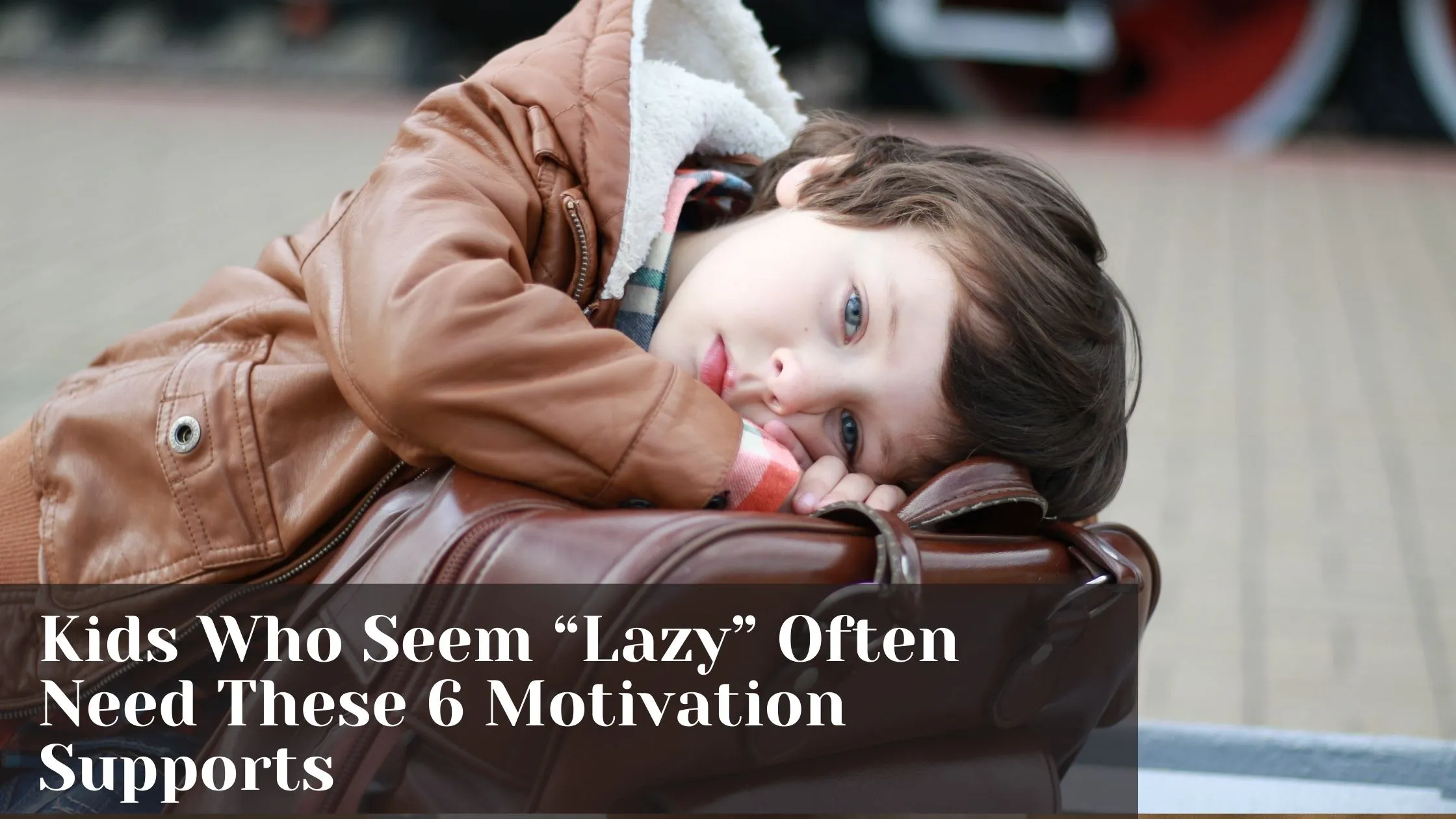
The science project has been due in three weeks. Now it’s due in two days. Your twelve-year-old is on the couch.
Not sleeping. Not sick. Just… there. Present in body, apparently absent in every other dimension. The project exists — they told you about it, you bought the supplies, the materials are on the kitchen table where they’ve been for ten days — and yet nothing has happened, and when you ask about it, the response is a shrug so practiced and fluid that it must require some kind of effort to produce.
You’ve tried reminders. You’ve tried incentives. You’ve tried removing privileges, restoring privileges, sitting down together, expressing concern, expressing frustration, and one very long speech about responsibility and the future that you knew wasn’t landing even as you were giving it.
And your child has been nodding through all of it with the specific glazed politeness of someone who has learned that if you just wait long enough, most adult weather systems pass.
This is the child who gets called lazy. Maybe by teachers. Maybe by relatives. Maybe, in tired and honest moments, by you.
Here is what decades of research on children’s motivation says about that label: it is almost never accurate. And it is almost always harmful. Because the word “lazy” forecloses exactly the inquiry that would actually help — the question of what’s missing that would make this child want to begin.
That question has answers. Here are six of them.
Why “Lazy” Is the Wrong Diagnosis
Before we get to what’s missing, it’s worth sitting with why the word itself is such a problem — beyond the obvious harm of labeling a child.
“Lazy” implies a stable, dispositional characteristic — something the child simply is, rather than something they’re experiencing or missing. It’s the same cognitive move we saw in the lying blog, the losing blog, the blaming blog: taking a behavior that is signaling an unmet need or an undeveloped skill and attaching it to identity, where it calcifies into something permanent and unfixable.
Research reviewed in Nurturing Wisdom Tutoring’s motivational analysis makes the point cleanly: laziness is not part of a child’s personality, nor is it a permanent condition. Labeling the behavior rather than the child’s personality is the first critical step in getting them back on track. If a child believes that adults think they’re lazy, they’ll continue to act that way. The label becomes the self-fulfilling prophecy.
What looks like laziness in children is almost always one of several identifiable, addressable things: a brain that doesn’t yet have the executive infrastructure to initiate tasks independently, a psychological need for autonomy or competence that isn’t being met, an anxiety about failure that makes not starting safer than starting and failing, a mismatch between the task and the child’s zone of genuine engagement, or a reward environment that has inadvertently stripped motivation from activities that used to carry their own.
None of these are laziness. They are all, however, problems with specific solutions. Here are the six that matter most.
The 6 Motivation Supports “Lazy” Children Are Missing
Support 1: A Brain That Can Actually Start Things
Let’s begin with the piece most parents never consider: the child who won’t start the project may not be choosing not to start. They may have a brain that is genuinely struggling to initiate.
Task initiation is a core executive function — the cognitive ability to begin an activity without undue delay. It sits alongside working memory, cognitive flexibility, and impulse control in the prefrontal cortex’s management of goal-directed behavior. And as the Pediatric Neurodevelopmental Center at Atlanta’s clinical analysis of low motivation notes: the emotional and executive skills weaknesses contributing to avoidance, procrastination, and low motivation can be teased apart with careful assessment — and they often have neurological rather than motivational roots.
Dr. Russell Barkley’s extensive research on ADHD and executive function established a core distinction that applies far beyond formal ADHD diagnoses: the difference between a skill deficit and a will deficit. A child who doesn’t do their homework because they’d rather watch television has a will deficit in that moment — they’d prefer something else. A child who sits in front of blank paper for forty minutes, genuinely wanting to start, with the supplies right there, and still cannot begin — that child has a skill deficit. The engine won’t turn on. It’s not about wanting.
OT4ADHD’s clinical framework on task initiation makes this concrete: chronic difficulty with task initiation is frequently misunderstood as work avoidance, laziness, procrastination, and defiance. The first step is to validate by naming the problem — “looks like you’re having trouble getting started” — using a non-judgmental, curious tone. Typically the child is well aware of the expectations but is having difficulty performing them. They don’t know why they can’t get started and are aware of peers going ahead all around them.
What building this support looks like:
The research-backed approach for genuine task initiation difficulty is breaking the start into something so small that the friction nearly disappears. Not “do your science project” — which is a multistep project that requires the brain to organize dozens of micro-decisions before a word is written — but “open the document and type your name at the top.” That’s it. Just that.
A 2023 study in Motivation Science found that breaking tasks into smaller, goal-oriented actions increased task persistence and completion rates. The mechanism is dopamine: each micro-completion creates a small motivational signal that makes the next step accessible in a way the whole project never was. The child who has typed their name has started. And starting, research consistently shows, is the hardest part.
Support 2: Autonomy — A Real Sense of Ownership Over Something
Here is a finding that runs through the most well-replicated motivational research of the past fifty years, and one that most parenting culture has still not fully absorbed: children who feel controlled become less motivated, not more. And the response most parents and schools reach for when a child isn’t doing something — more pressure, more surveillance, more external consequence — is precisely what the research consistently identifies as making the problem worse.
Drs. Richard Ryan and Edward Deci’s Self-Determination Theory (SDT), developed at the University of Rochester and representing over five decades of motivational research, identifies three innate psychological needs whose satisfaction or frustration determines the quality of human motivation: autonomy (the sense that you’re initiating your own behavior), competence (the sense that you’re capable of succeeding), and relatedness (the sense that you matter to others). When all three are met, motivation is intrinsic, sustained, and self-directed. When any of them is chronically thwarted, motivation deteriorates.
The autonomy need is the one that collides most directly with how children experience school and household task demands. A PMC meta-analysis on pathways to student motivation (Vasconcellos, Parker et al., PMC 2022) — synthesizing SDT research across multiple populations — found that competence was the strongest predictor of self-determined motivation, followed closely by autonomy, and that both were powerfully supported by autonomy-supportive environments: places where children feel they are engaging freely and voluntarily rather than under perceived coercion.
The 2020 Ryan & Deci Contemporary Educational Psychology review makes the practical consequence stark: students experiencing autonomy perceive that they are engaging in learning tasks freely and voluntarily, without perceived coercion. When that perception disappears — when every task is framed as mandatory, every deadline is external, every step is monitored — the child’s motivation shifts from “I want to do this” to “I do this to avoid consequences.” And that shift, once it calcifies, produces exactly the glazed inertia that gets called laziness.
What building this support looks like:
Where genuine flexibility exists, give it. Let the child choose the order of tasks, the location they work, the approach they take. Provide the goal, explain the logic, and release the method. Ask “what do you want to tackle first?” rather than prescribing the sequence. These aren’t small concessions — they are, according to SDT’s decades of research, the specific inputs that reactivate the intrinsic motivation that external pressure gradually shuts down.
Support 3: Competence — The Experience of Being Genuinely Able
A child who doesn’t believe they can do something doesn’t try it. Not because of laziness — because the brain, rationally, does not invest effort in projects it has already assessed as likely to fail.
This is self-efficacy again — Bandura’s foundational construct from the previous blog in this series. But the competence need in SDT is related and distinct: it’s not only about believing you can, it’s about regularly experiencing that you did. The sense of mastery — the felt experience of being capable, of improving, of producing something that reflects your genuine ability — is one of the most powerful motivational forces available. And it disappears almost immediately when tasks are consistently too hard, too easy, too vague, or so surrounded by external pressure that the child no longer experiences any of the effort as their own.
Lev Vygotsky’s foundational concept of the Zone of Proximal Development (ZPD) — work that has been confirmed and extended in decades of subsequent educational research — identifies the precise window in which learning and motivation are optimal: tasks that are challenging enough to be genuinely interesting but not so overwhelming that the child loses confidence in their ability to succeed. When work consistently falls outside this zone — either too easy for the child who has tuned out because they’re bored, or too difficult for the child who has quietly stopped trying because failure has become the expected outcome — motivation decays.
Drs. Ryan and Deci’s SDT research is explicit on how competence is structurally supported: well-structured environments that afford optimal challenges, positive feedback, and opportunities for growth feed the competence need directly. Clear criteria, specific rather than vague feedback, and challenge pitched at the right level are not pedagogical niceties. They are, according to the research, necessary nutrients for motivational health.
What building this support looks like:
If your child appears unmotivated across multiple areas, ask a harder question: is the work consistently at the right level? If school content is reliably too easy, boredom masquerades as laziness. If it’s reliably too hard, avoidance masquerades as laziness. Both require adjustment to the task, not the child.
At home, look for domains where the child shows up — sports, music, gaming, cooking, building, whatever it is — and pay attention to what the task environment in that domain has that the homework environment doesn’t. Usually the answer is: immediate feedback, clear progress, appropriate challenge, and the experience of genuine mastery. That is what intrinsic motivation runs on.
Support 4: A Reward Environment That Hasn’t Accidentally Killed the Interest
Here is the one that many well-meaning parents don’t want to hear: the reward system you set up to motivate your child may be making them less motivated, not more.
The landmark 1999 meta-analysis by Deci, Koestner, and Ryan — covering 128 experimental studies — published in Psychological Bulletin found that expected, tangible, task-contingent rewards significantly undermine intrinsic motivation: engagement-contingent rewards showed an effect size of d = -0.40, and the undermining effect was stronger for children than for college students. The study’s practical implication is stark: although tangible rewards may control immediate behaviors, they have negative consequences for subsequent interest, persistence, and preference for challenge — especially for children.
This is the “overjustification effect” — a concept from SDT’s Cognitive Evaluation Theory. When a child receives an external reward for an activity that carried its own internal interest, the child’s brain gradually revises its explanation for why they were doing it: not because it was interesting, but because they were getting paid for it. Once the reward is removed, the activity loses both the external incentive and the internal one. The child has been systematically demotivated by the very tool that was supposed to motivate them.
Research demonstrates that when children who naturally love reading receive external rewards for reading, their intrinsic motivation often diminishes once the rewards cease. The same pattern has been documented for art, mathematics, prosocial behavior, sports, and nearly every other domain of child activity where it has been studied.
The critical nuance — and it is important — is that not all rewards produce this effect. Positive feedback and verbal rewards that communicate competence (informational rewards) can enhance intrinsic motivation (d = +0.33 for free-choice behavior). The harmful rewards are tangible, expected, and contingent: “you’ll get screen time for finishing your homework” is exactly the reward structure that the research identifies as most destructive to the homework interest that was already fragile.
What building this support looks like:
Audit the reward environment at home. If your child’s engagement with tasks has declined steadily over a period of months or years during which they’ve been on a reward system for those tasks, the research suggests the system may be part of the problem rather than part of the solution. Replacing tangible contingent rewards with specific, informational positive feedback — “I noticed how you worked through that difficult part instead of stopping” — is what the research identifies as the switch that supports rather than undermines intrinsic motivation.
Support 5: A Relationship With Failure That Doesn’t Make Starting Feel Catastrophic
Many children who appear unmotivated are not indifferent to the outcome. They care intensely — so intensely that the prospect of trying and failing is more threatening than the prospect of not trying at all. The science project never gets started not because the child doesn’t care about it, but because caring about it and then failing at it is a combination the child’s nervous system has decided it cannot afford.
This is the intersection of performance anxiety and task avoidance, and it shows up in the Pediatric Neurodevelopmental Center’s clinical cases with reliable consistency: anxiety and perfectionism can exacerbate the difficulties children face in getting started. The fear of failure or making mistakes can paralyze them, leading to avoidance behaviors and procrastination. Children may become overwhelmed by the perceived magnitude of the task or worry about failing to meet expectations, hindering their ability to take the initial step.
The self-determination research reviewed in the 2024 SDT interventions meta-analysis (Wang, Wang et al., Learning and Motivation) identifies amotivation — the complete absence of motivation — as one outcome of chronic competence frustration: when children have been confronted with failure often enough, in environments that did not support recovery and learning from it, motivation doesn’t just decline. It disappears. The child has learned, from accumulated data, that effort doesn’t produce mastery. So they stop trying.
Dweck and Yeager’s 2019 PMC review on mindset — connecting five decades of the fixed vs. growth mindset research — finds the motivational consequence of this pattern precisely: in a fixed mindset environment, every performance is a verdict. Not starting means never having the verdict delivered. That’s not irrational. It’s self-protective. And the child who protects themselves this way will look, from the outside, exactly like someone who doesn’t care.
What building this support looks like:
The same Dweck framework that applies to losing applies here: deliberately separate the act of trying from the outcome of succeeding. Praise the attempt explicitly: “I noticed you tried that problem three different ways before asking for help. That is the actual skill.” Make failure mundane in your household — talk about yours, narrate your recoveries, make “I got that wrong and here’s what I figured out” a regular part of dinner conversation. The child who grows up in an environment where trying something and failing is just a piece of data, not a verdict, gradually loses the reason not to start.
Support 6: Enough Energy to Actually Care
This is the support that gets overlooked most consistently, and it is frequently the one doing the most damage.
A child who is chronically underslept, or chronically overscheduled and depleted, or managing significant background anxiety, or malnourished, or sitting inside an undetected learning difference that makes every school task three times as effortful as it should be — that child is not lazy. They are running on a neurological fuel deficit, and what they’re showing you is the behavioral output of a system that has been consistently asked to produce more than its current resources can support.
Research reviewed by Psychology Today’s Self-Reg framework, drawing on neuroscience of motivation and self-regulation, makes this point directly: the question “why is my child so mentally lazy” is best approached not as a lament but as genuine inquiry — because what looks like low motivation is often a nervous system already at or beyond its sustainable load, conserving resources by reducing output on things that feel non-essential. The brain under chronic stress or depletion does exactly what any depleted system does: it allocates what’s left to survival, not to homework.
The Pediatric Neurodevelopmental Center’s clinical framework identifies the conditions that most often underlie apparent laziness — including anxiety, depression, ADHD, processing disorders, and chronic sleep deprivation — and makes the key point that if these are longstanding behaviors, the cause is likely related to a cognitive or neurodevelopmental difference rather than a motivational one. Development is very discontinuous, meaning new challenges can emerge across critical developmental stages and initially look like motivational collapse.
What building this support looks like:
Before you address the science project, address the basics. Is your child sleeping enough? Are they overscheduled to the point of genuine exhaustion? Is there anxiety, depression, or mood difficulty that has gone unaddressed? Has anyone ever evaluated whether there’s a learning difference making their schoolwork disproportionately effortful?
These aren’t distractions from the motivation problem. They are frequently the motivation problem. A child whose nervous system is running hot with anxiety cannot produce sustained effort on demand. A child losing an hour or two of sleep each night is cognitively impaired in ways that look indistinguishable from disengagement. A child with an undiagnosed reading difficulty spends six times the energy on reading tasks that their peers do — and what remains looks like nothing, because it is nothing.
Fix the fuel supply before blaming the engine.
What You’re Actually Building
A child who learns to initiate, who feels genuine ownership over their effort, who experiences the pleasure of being genuinely capable, who hasn’t been systematically demotivated by the reward structures designed to help them, who can try something and fail and try again — that child is not just “less lazy.” They have developed something that the education system and most parenting frameworks fail to name precisely: intrinsic motivation. The self-sustaining engine that doesn’t need to be started from outside every morning.
SDT’s fifty years of research arrives at a conclusion that is both simple and demanding for anyone who works with children: people — children and adults alike — are inherently inclined toward growth, mastery, and engagement, when the three basic psychological needs of autonomy, competence, and relatedness are met. The child who seems lazy is, in almost every case, a child whose psychological needs for self-determination are being frustrated — by the task environment, by the reward structure, by chronic depletion, by the fear of failing, or by a brain that hasn’t yet been given the tools to bridge the gap between intention and action.
None of those are laziness. All of them are addressable.
The child on the couch with the overdue project doesn’t need a better lecture. They need someone to ask a better question: not why aren’t you doing this but what would make it possible for you to start?
That question, taken seriously and answered specifically, is where motivation actually begins.
A Note on When Professional Evaluation Helps
If the apparent unmotivation is severe, pervasive across multiple domains, accompanied by mood changes, persistent sleep disruption, significant academic decline, or social withdrawal — please consult a pediatric psychologist, a developmental pediatrician, or a neuropsychologist. ADHD, anxiety, depression, and learning disabilities are among the most common and most frequently undetected conditions driving what looks like laziness in children. A neuropsychological evaluation separates motivational issues from skill deficits and neurological differences — and the earlier a real underlying condition is identified, the more effective and less costly the support.
Has something specific shifted your child’s motivation — a change in how you framed the task, a reduction in rewards, a conversation that opened something up? Share it in the comments. The specific turning point that worked for one family is always more useful to another than any general principle.
Sources & Further Reading:
- Ryan, R.M. & Deci, E.L. (2000): Self-Determination Theory and the Facilitation of Intrinsic Motivation, Social Development, and Well-Being — American Psychologist
- Ryan, R.M. & Deci, E.L. (2020): Intrinsic and Extrinsic Motivation from a Self-Determination Theory Perspective — Contemporary Educational Psychology
- Vasconcellos, D., Parker, P.D. et al. (PMC, 2022): Self-Determination Theory Applied to Physical Education — Meta-Analysis on Pathways to Student Motivation
- Wang, Y., Wang, X. et al. (Learning and Motivation, 2024): Systematic Review of SDT-Based Interventions in Education — PRISMA Approach
- Deci, E.L., Koestner, R. & Ryan, R.M. (1999): A Meta-Analytic Review of 128 Experiments on Extrinsic Rewards and Intrinsic Motivation — Psychological Bulletin
- Deci, E.L., Koestner, R. & Ryan, R.M. (2001): Extrinsic Rewards and Intrinsic Motivation in Education: Reconsidered Once Again — Review of Educational Research
- Dweck, C.S. & Yeager, D.S. (PMC, 2019): Mindsets: A View From Two Eras — Perspectives on Psychological Science
- Smith, Z.R., Flax, M. & Becker, S.P. — Loyola University Chicago (JCPP, 2023): Academic Motivation Decreases Across Adolescence for Students With and Without ADHD
- Barkley, R.A. — Dr. Russell Barkley (Tiimo App, 2024): Task Initiation, Dopamine, and the Interest-Based Nervous System in ADHD
- OT4ADHD (2022): Task Initiation and ADHD — Skill Deficit vs. Will Deficit — Strategies for Getting Started
- Pediatric Neurodevelopmental Center, Atlanta (2025): My Child Is Lazy and Unmotivated — Emotional and Executive Function Roots of Task Avoidance
- Nurturing Wisdom Tutoring (2021): Is My Child Just Lazy? Diagnosing Motivation Problems — Vygotsky’s Zone of Proximal Development and Label Effects
- Shanker, S. (Psychology Today / Self-Reg, 2017): Why Is My Child So Mentally Lazy? — Neuroscience of Motivation and Self-Regulation
- Executive Functions Coach (2024): Task Initiation Hacks — The 5-Minute Rule and Goal-Directed Behavior, citing 2023 Motivation Science study