
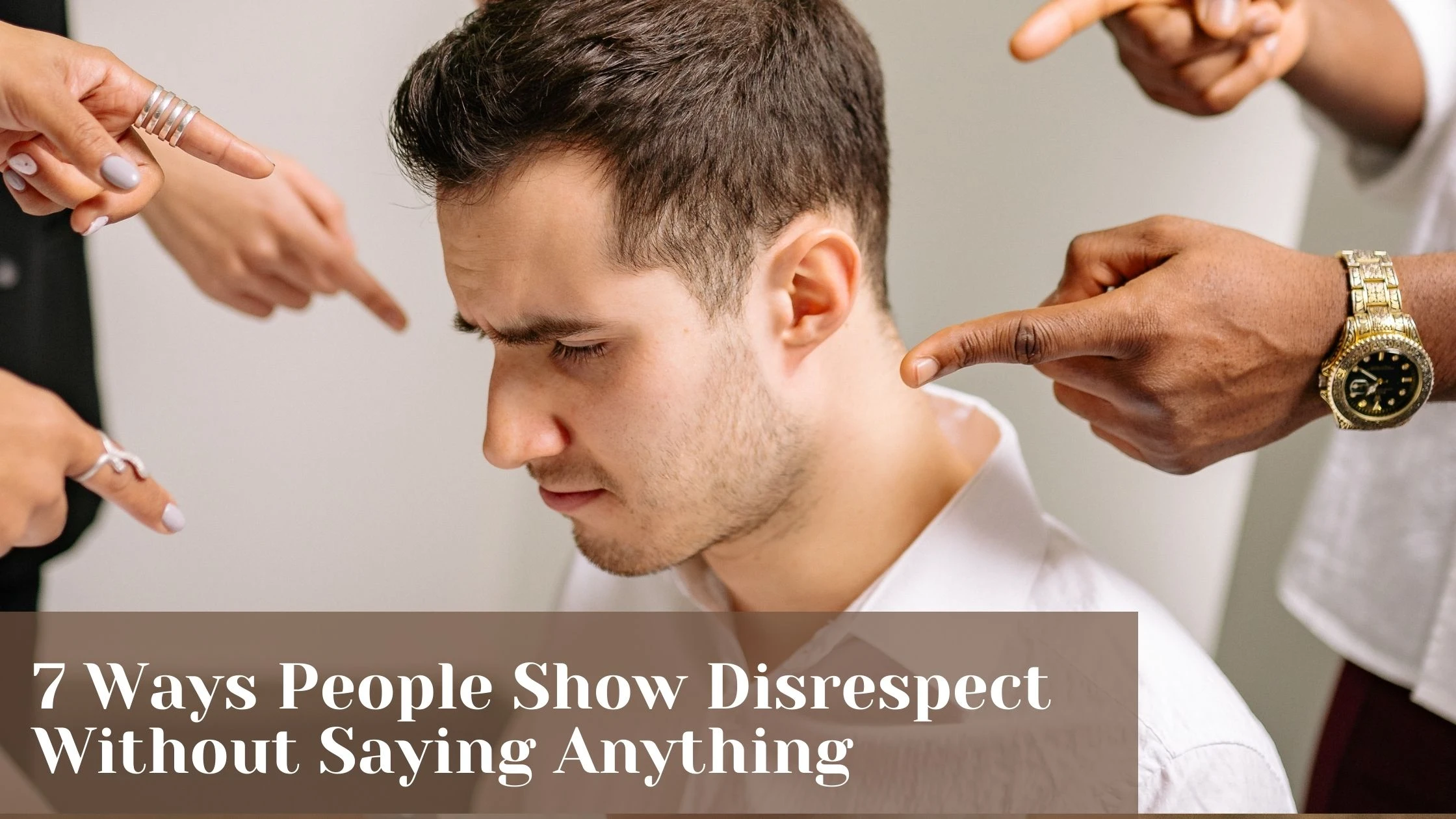
You’re in the middle of sharing something that genuinely matters to you — a problem you’ve been carrying, an idea you’re excited about, a story you’ve been waiting to tell. And the person across from you is technically present. They haven’t walked away. They haven’t interrupted. They haven’t said a single unkind word. But somewhere in the middle of your sentence, their eyes drift to their phone. Their body angles slightly toward the door. Their response, when it comes, makes it quietly clear that they weren’t really listening.
Nothing was said. And yet something was communicated — unmistakably, uncomfortably, and in a way that lingers long after the conversation ends.
This is the nature of nonverbal disrespect. It operates beneath the surface of language, in the register of glances and gestures and silences and sighs. Because it never quite becomes explicit, it is difficult to name, difficult to challenge, and — for the person on the receiving end — difficult to fully trust. There is always the possibility of being told you’re too sensitive, that you misread it, that nothing was meant by it. And that very deniability is part of what makes it so quietly corrosive.
Disrespect doesn’t always arrive loudly. More often, it accumulates — in small moments, repeated over time, that chip away at dignity and erode the sense of being genuinely valued. Research in interpersonal communication consistently shows that nonverbal cues carry significantly more weight than verbal content in how messages are received and relationships are experienced. Studies by communication researchers suggest that body language and tone shape perceptions of others — and of ourselves in relation to them — far more powerfully than the actual words exchanged.
Understanding the specific ways disrespect gets communicated without words isn’t about becoming suspicious or hypervigilant in relationships. It’s about developing the literacy to recognize what is actually happening in the interactions around you — so that what is felt can be named, and what is named can be addressed.
1. They Give You Their Distracted Attention
Full presence is one of the most profound gifts one person can offer another. And its absence — the split, divided, half-there quality of distracted attention — is one of the most common and quietly painful forms of nonverbal disrespect in contemporary life.
Distracted attention looks like eyes that drift to a screen while someone is mid-sentence. It looks like the kind of listening that is really just waiting — nodding at intervals, producing the sounds of engagement, but not actually absorbing what is being shared. It looks like responses that veer slightly off-course because the person wasn’t quite tracking, asking questions that were already answered, returning the conversation to themselves without registering the weight of what was just offered.
What makes this particularly difficult is that distraction has been normalized to an extraordinary degree. Phones sit face-up on tables during meals. Laptops stay open during conversations that deserve full attention. The cultural tolerance for divided presence has grown so high that offering undivided attention has become almost remarkable — the exception rather than the expectation.
But the nervous system registers the absence of real attention, even when the mind rationalizes it away. Research by psychiatrist Edward Hallowell, who has written extensively on the crisis of attention in modern relationships, describes the experience of receiving distracted attention as producing what he calls “a sense of not mattering” — a quiet but persistent erosion of the belief that one’s presence and words are worth someone else’s full engagement.
The message distracted attention sends, without a word being spoken, is this: whatever is on that screen, whatever is in my own thoughts right now, is more interesting than what you have to say. That message lands. It always lands.
2. They Use Dismissive Body Language
The body speaks an entire language that runs parallel to words — and sometimes runs directly contrary to them. Someone can say “I’m listening” while their posture communicates the opposite. Someone can say “I respect your opinion” while their micro-expressions tell a different story. The body is a remarkably honest communicator, and learning to read it is learning to understand what is actually being conveyed beneath the surface of polite language.
Dismissive body language includes eye-rolling — a gesture so universally understood as contemptuous that relationship researcher John Gottman, in his landmark studies on marital communication, identified it as one of the four most reliable predictors of relationship breakdown, alongside criticism, contempt, and stonewalling. It includes crossed arms that close the body off, turned-away posture that orients away from the speaker, sighing or exhaling heavily in response to what someone shares, or the slight but perceptible facial expression of someone who has already decided that what they’re hearing isn’t worth taking seriously.
It also includes checking the time — glancing at a watch or phone clock during a conversation in a way that signals the desire to be elsewhere. It includes turning the body toward an exit before the interaction has concluded. It includes the flat, affect-less expression of someone who is choosing not to engage, which communicates not neutrality but deliberate withholding of recognition.
These signals are processed rapidly and largely unconsciously by the human brain. Research in social neuroscience shows that the threat-detection system responds to social dismissal in ways that parallel its response to physical threat — activating the same neural pathways, producing similar stress responses, and leaving a similar emotional residue. The body remembers being dismissed even when the mind tries to minimize it.
What makes dismissive body language particularly difficult to confront is its plausible deniability. Eye-rolling can be attributed to tiredness. The sigh might be about something else entirely. The turned posture might be coincidental. But when these signals appear consistently, in specific contexts, with specific people, the pattern they form is not ambiguous — even if any single instance can be explained away.
3. They Consistently Interrupt or Talk Over You
Interrupting, at its most charitable, can be a sign of enthusiasm — a conversation moving quickly enough that thoughts spill over before others have finished. But chronic interruption, the pattern of consistently cutting someone off before they’ve reached the end of their sentence, is something different entirely. It is a nonverbal declaration of hierarchy: my thoughts take precedence over yours. What I have to say is more valuable than what you were in the process of saying. Your words can be overridden.
Research in conversational dynamics — including foundational work by sociolinguist Deborah Tannen — has explored how interruption functions as a power mechanism in social interactions, and how the experience of being consistently interrupted correlates with lower perceived status in a relationship or group. The person who gets talked over learns, slowly and without any explicit statement being made, that their voice is considered less important. That lesson accumulates quietly and powerfully over time.
Talking over someone is a variation of the same dynamic — a voice raised in volume or force to simply continue past another person’s words, as though they weren’t spoken. It communicates not just “I want to share my perspective” but “your perspective does not need to be completed before mine begins.” The effect, even in relatively low-stakes situations, is a subtle but consistent message of devaluation.
What this looks like in everyday relationships:
- Being mid-story and having someone redirect the conversation entirely
- Sharing a thought and watching it get immediately capped by “yes, but…” before it has landed
- Having contributions to a group discussion consistently spoken over, only to hear the same point credited when someone else raises it shortly after
- Finishing someone else’s sentences in a way that steers them away from where they were actually going
It’s worth noting that not all interrupting carries the same weight. The frequency matters. The pattern matters. The relationship context matters. But when someone consistently cannot seem to wait for another person to finish speaking, that consistency is communicating something — about how much that person’s words are valued, and about who the interruptor understands to be worth listening to fully.
4. They Respond With Minimal Effort
There is a particular experience of having shared something carefully considered, something that required effort or vulnerability or genuine thought — and receiving in return the conversational equivalent of a shrug. A one-word reply. A vague “mmhm.” A distracted “yeah, totally” that makes it clear the content didn’t register. A response so thin it communicates, without any explicit statement, that what was offered wasn’t worth a real engagement.
Minimal responses — what communication researchers sometimes call low-elaboration replies — signal a lack of investment in the interaction and, by extension, in the person initiating it. They shut down conversational flow rather than contributing to it. They convey that the topic being raised, the question being asked, or the experience being shared doesn’t merit the energy of a genuine reply.
This pattern shows up in texting and digital communication with particular force. The one-word reply to a thoughtful message. The “lol” returned to something that was genuinely shared. The read receipt with no response. Each of these is a small but legible signal about where someone’s priorities sit — and who they place in which tier of those priorities.
It also appears in professional contexts: the perfunctory response to a carefully crafted email, the brief dismissal of an idea that took significant thought to develop, the colleague who engages at length with some people’s contributions and offers monosyllabic responses to others. The differential itself is the message. It communicates not just indifference but a kind of sorting — some people are worth the effort of full engagement, and some are not.
What this looks like in everyday life:
- Sharing news and receiving a response that doesn’t acknowledge what was shared
- Asking a question and getting an answer so brief it closes rather than opens the exchange
- Noticing that the energy given to an interaction is consistently higher than what is returned
- The experience of feeling like all the work of maintaining a conversation is falling to one side
Psychologists studying responsiveness — defined as the degree to which people feel understood, validated, and cared for by those around them — identify it as one of the core ingredients of felt respect in relationships. Its absence, even without hostility, leaves people feeling unseen in a way that is difficult to articulate but impossible to ignore.
5. They Treat Your Time as Less Valuable Than Theirs
Chronic lateness is perhaps the most socially accepted form of nonverbal disrespect — because it comes packaged in apology, in the narrative of being busy, in the cultural shorthand of “that’s just how they are.” And yet what it communicates, consistently and clearly, is a hierarchy of value: my time, my schedule, my priorities take precedence over the time allocated for this interaction. Your waiting is less costly than my punctuality.
This isn’t about occasional lateness — traffic happens, emergencies are real, and life is genuinely unpredictable sometimes. The pattern being described here is the chronic and consistent experience of someone for whom other people’s time is apparently always negotiable. Who is reliably late, reliably vague about scheduling, reliably willing to reschedule or cancel with little notice, and reliably unapologetic once the pattern is established enough that apologies have become formulaic rather than genuine.
Time disrespect extends beyond lateness. It includes arriving at a meeting unprepared, communicating that the other party’s investment of preparation was not worth matching. It includes extending a half-hour conversation to two hours without acknowledgment of what that costs the other person. It includes being kept waiting — in a room, on a call, in an email thread — without acknowledgment or explanation, as though waiting is simply the expected condition of engagement with this particular person.
Research in organizational psychology consistently identifies time respect — or its absence — as one of the most significant factors in how people experience their sense of value within professional and personal relationships. Being kept waiting activates the same social threat responses as other forms of dismissal. It communicates, wordlessly but effectively, where someone sits in the implicit hierarchy of another person’s priorities.
What this looks like in everyday life:
- Sitting past a confirmed appointment time without acknowledgment or explanation
- A friend who is late every single time and whose apologies have stopped feeling like apologies
- Meetings that begin late because the person who called them hasn’t arrived
- Having scheduled time cut short because someone else overran theirs, without acknowledgment that this is a cost
The baseline is simple, though not always easy: treating another person’s time with the same seriousness as your own. Not as a favor extended in good moments, but as a consistent expression of the belief that their time carries value equivalent to yours.
6. They Exclude You From the Conversation
Exclusion doesn’t always announce itself dramatically. More often it operates in the texture of ordinary interactions — in who gets included in the huddle, who receives the important information, who is spoken to directly and who is spoken around. It is the workplace where updates circulate freely among certain people and stop before reaching others. The social group where plans are made in a thread someone has been quietly left out of. The conversation where eye contact gets distributed generously among most participants and consistently withheld from one.
Social exclusion, even in its mild and everyday forms, activates what neuroscientist Naomi Eisenberger describes as the social pain network — a neural system that overlaps substantially with the systems that process physical pain. Research using neuroimaging has shown that the experience of being excluded, even in low-stakes simulated environments, produces measurable changes in brain activity in regions associated with pain processing. The body does not experience social exclusion as trivial, even when the mind works to convince itself that it is.
Being visually excluded is one of the most common and least-named forms of this pattern. Eye contact in conversation is a fundamental signal of recognition — an acknowledgment that someone’s presence registers, that they are a participant rather than an observer. When eye contact is withheld from one person in a group while freely offered to others, the message is wordless but precise: you are not quite fully part of this.
What this looks like in everyday life:
- Being in a group conversation where others speak to each other as though you are not present
- Discovering that information was shared with everyone except you
- Being the person whose contributions to a conversation don’t seem to land — acknowledged briefly, if at all, before attention moves on
- Noticing that invitations arrive only as afterthoughts, once a threshold of others has already confirmed
Exclusion communicates a sorting — a ranking of who belongs fully and who belongs conditionally. And because it operates largely through absence rather than action, it is among the hardest forms of disrespect to name or address. The very thing being experienced — not being seen, not being included — makes it difficult to find the footing to say: this is what is happening, and it deserves to be acknowledged.
7. They Withhold Basic Acknowledgment
There is a last form of nonverbal disrespect that is perhaps the most fundamental, and the most quietly devastating: the simple, consistent failure to acknowledge another person’s presence, effort, or experience. Not through dramatic cold-shouldering or the obvious silent treatment, but through a low-level, ongoing pattern of not seeing — of withholding the basic human recognition that communicates: you are here, you matter, what you do and feel and say registers with me.
This can look like walking past someone without greeting them in a context where greeting is expected. It can look like the absence of any recognition when effort has been made — the work completed without comment, the kindness offered without receipt, the emotional vulnerability expressed and then left to hang in the air unacknowledged. It can look like the conversation where an experience is shared and the other person simply moves the discussion elsewhere, without any bridge or recognition that something meaningful was just offered.
Psychologist William James wrote that the deepest principle in human nature is the craving to be appreciated. More contemporary research in attachment theory and interpersonal neurobiology — particularly the work of Daniel Siegel — speaks to the fundamental human need to be “felt” by others, to have inner experience acknowledged as real and meaningful rather than passed over or ignored. When that acknowledgment is consistently withheld, the impact is not trivial. It erodes the sense of mattering. It produces a particular kind of loneliness — the loneliness of being physically present with someone while feeling completely invisible to them.
What this looks like in everyday life:
- Sharing something personal and receiving no acknowledgment before the conversation moves on
- Putting significant effort into something and receiving not even a brief recognition of that effort
- Greeting someone and being met with the minimum possible warmth, or none at all
- The experience of being in a relationship where you have to wonder, repeatedly, whether your presence makes any difference to the other person
The withholding of acknowledgment is sometimes deliberate — a power move, a punishment, a way of communicating displeasure without the vulnerability of actually saying so. But it is also sometimes unconscious — a person so preoccupied with their own inner world that they genuinely don’t register the impact of their inattention. In either case, the experience on the receiving end is the same: invisible, undervalued, and quietly questioning whether the effort of showing up is worth what is — or isn’t — returned.
What to Do When You Recognize These Patterns
Identifying nonverbal disrespect is one thing. Knowing what to do with that recognition is another, and it deserves to be addressed honestly rather than dismissed with vague advice to “set boundaries” or “communicate your needs” — phrases that are true in principle and often frustratingly unhelpful in practice.
Start by Trusting What You Felt
One of the primary effects of consistent nonverbal disrespect is that it makes the person on the receiving end doubt their own perception. Because nothing was explicitly said, because it’s all technically deniable, there is a strong pull toward self-questioning — toward wondering whether the reaction was too sensitive, whether something was being misread. The first and most important step is practicing trust in the data of one’s own experience. Something was felt. Something was communicated. The absence of explicit words does not make that communication less real or less worth taking seriously.
Name It Specifically and Calmly
Vague expressions of hurt are easier to dismiss than specific observations. Rather than “you always make me feel like I don’t matter,” which is easy to argue with, try naming what was actually observed: “When you checked your phone while I was talking, it felt like what I was sharing wasn’t worth your attention.” Specificity is harder to deny. It also makes the conversation more productive — because it gives the other person something concrete to respond to, rather than a general accusation to defend against.
Notice the Pattern, Not Just the Instance
Any single instance of these behaviors might genuinely be unintentional, situational, or uncharacteristic. What matters is the pattern — the consistency with which someone’s nonverbal behavior communicates a particular message about another person’s value to them. Patterns are worth naming. Patterns are worth addressing. And when patterns are addressed and nothing changes, those patterns become important information about what a relationship actually offers and what it realistically can.
Consider What the Relationship Can Hold
Not every relationship can be rehabilitated through honest conversation. Some people are not capable of or interested in changing patterns of nonverbal disrespect, particularly if those patterns have been operating for a long time without consequence. Part of what recognizing these behaviors requires is the willingness to honestly assess: is this person someone who, when the pattern is named, can reflect and make genuine effort to change? Or is this a pattern that has been named before — perhaps many times — without meaningful shift? The answer to that question shapes what the appropriate response looks like, and how much continued investment is warranted.
Seek Support When Needed
If chronic nonverbal disrespect is a feature of a significant relationship — a partnership, a family dynamic, a workplace — the emotional toll it takes is real and cumulative. Working with a therapist can offer a space to process that impact, develop clearer language for what has been experienced, and build the groundedness necessary to respond from a place of genuine self-respect rather than reactivity or resignation. Choosing to take the impact of disrespect seriously enough to seek support for it is itself an act of self-regard — and it deserves to be named as such.
A Final Thought
Respect, at its most basic, is the acknowledgment that another person’s presence, time, feelings, and words have value. It doesn’t require grand gestures. It lives in the small, daily, easily overlooked moments — in whether someone puts the phone down, makes eye contact, waits for a sentence to be finished, shows up on time, responds with care, and offers the simple but profound gift of genuine attention.
Its absence, in those same small moments, communicates something too. And it’s worth developing the clarity to recognize what is being communicated — not to become resentful or hypervigilant, but to make honest, well-grounded decisions about where energy is invested and with whom, based on an accurate read of how those relationships actually feel rather than how they appear on the surface.
Everyone deserves to be in relationships — personal and professional — where their presence registers. Where their words are received. Where their time is treated as valuable. Where wondering, persistently, whether they matter to the person across from them is not a regular part of the experience.
That’s not asking for too much. That’s asking for the minimum that genuine respect requires.
Did any of these patterns feel familiar — either as something experienced or as something caught in your own behavior? Share your thoughts in the comments below. These conversations are worth having, and your perspective might give someone else the language they’ve been searching for.
If this post resonated, please share it with someone who might need it. Sometimes naming what’s been felt — finally, clearly, without self-doubt — is the first step toward something better.