
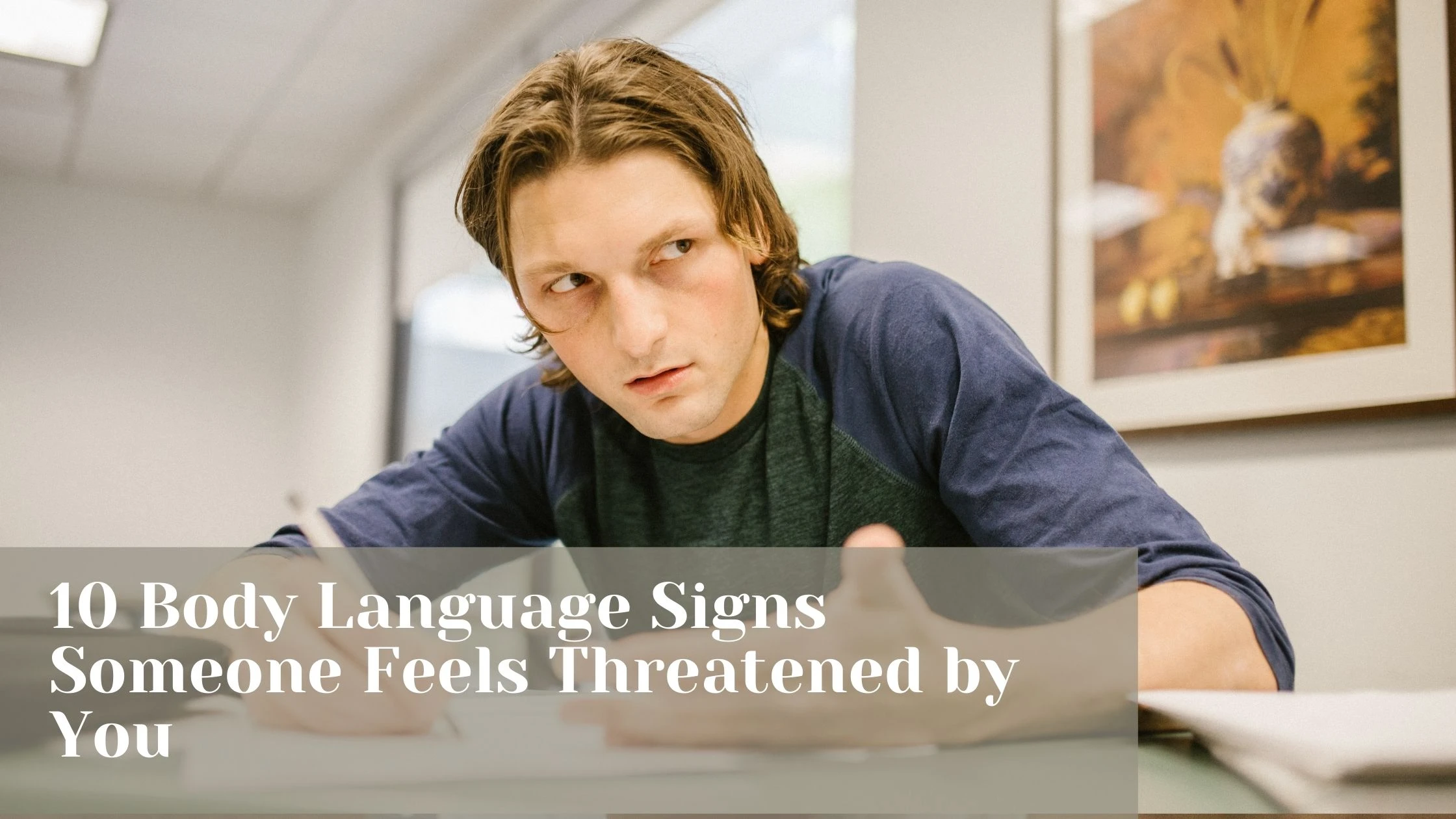
You walk into a meeting room, say good morning, and take your seat. Nothing unusual. But the colleague across the table has quietly crossed their arms, angled their chair slightly away from you, and stopped making eye contact. The conversation that follows feels oddly flat — clipped answers, a tense jaw, zero warmth. You leave wondering what just happened.
Or maybe it’s a social gathering. You’re telling a story and the person next to you keeps glancing toward the door, their body slowly turning away mid-sentence, like they’re mentally already somewhere else. Did you say something wrong? Do they not like you?
Here’s what most people never consider: they might not dislike you at all. They might feel threatened by you.
That’s a very different thing — and understanding the distinction could change how you navigate almost every relationship in your life.
The Science Behind the Signal
When a person feels threatened, their brain doesn’t consult their rational mind first. The limbic system — the brain’s ancient emotional command center — kicks in automatically. According to former FBI counterintelligence agent Joe Navarro, whose 2008 book What Every Body Is Saying became one of the most cited works in nonverbal communication, the threatened brain triggers one of three hardwired survival responses: freeze, flight, or fight. Every physical cue that follows is downstream from that one primal decision.
The critical thing to understand is that the person experiencing this usually isn’t aware of it. A 2021 study published in Frontiers in Psychology by Burgoon, Wang, Chen, Pentland, and Dunbar found that nonverbal signals communicating dominance, nervousness, and distrust are largely automatic — produced below conscious awareness and incredibly difficult to suppress. In other words, when someone feels threatened by you, their body will almost always tell the truth even when their words don’t.
And in a 2023 paper published in Perspectives on Psychological Science, Patterson, Fridlund, and Crivelli confirmed that nonverbal behaviors are among the most reliable indicators of a person’s internal emotional state — more reliable, in many cases, than what they actually say.
So what does that look like in real life?
1. Their Feet Point Away from You
It sounds almost too simple. But foot direction is one of the most honest signals a body can give. Navarro spent 25 years interrogating spies and criminals for the FBI and consistently noted that feet — not faces — were where genuine emotional truth lived. The face we can manage. The feet, most of us forget about entirely.
When someone feels threatened or wants to exit an interaction, their feet will rotate toward the nearest door or escape route, even if their upper body is still politely facing you. The next time a conversation feels off, glance down. If someone’s torso is turned toward you but their feet are angled away, their body has already left the room.
The tell: One or both feet pointing away from you, especially combined with a slight lean in the same direction.
2. They Shrink Their Posture — The “Turtle Effect”
Think about the last time you felt genuinely intimidated. Chances are, your shoulders crept upward and your neck seemed to disappear slightly into your collar. That instinct has a name. Navarro calls it the “turtle effect” — when the threatened limbic brain raises the shoulders to protect vulnerable areas of the neck and throat.
It’s a deeply ancient response, shared across mammals. What makes it fascinating is how subtle it can be in human social settings. It’s not dramatic cowering. It’s a quiet contraction — shoulders inching upward, posture compressing, the person making themselves physically smaller in your presence.
The tell: Raised shoulders, a compressed or hunched posture, or the person visibly taking up less space when you’re around.
3. They Create Physical Barriers Between You
When the limbic system shifts into flight mode and actual escape isn’t possible, the brain improvises. It creates symbolic distance using whatever is available — a coffee cup held close to the chest, arms crossed tightly, a bag placed deliberately between two people, a laptop screen angled like a shield.
The 2021 Frontiers in Psychology study noted that tense, rigid body behaviors are strongly associated with both nervousness and distrust in interpersonal interactions — and crossed arms, in particular, register as one of the clearest discomfort signals the body produces.
It’s worth noting: crossed arms aren’t always a sign of being threatened. Sometimes people are just cold. Context matters. But when arm-crossing appears suddenly in response to your presence or something you’ve said, and accompanies other signals on this list, it’s worth paying attention.
The tell: Arms folded tightly across the chest, objects repositioned to create distance, or the body oriented away from you.
4. They Stop Mirroring Your Movements
Mirroring — unconsciously adopting another person’s gestures, posture, or speaking pace — is what humans do when they feel comfortable and connected. It happens below awareness and signals rapport, affiliation, safety. Watch any two people who genuinely enjoy each other’s company and you’ll see it everywhere: they lean at the same angle, reach for their drinks at the same moment, use similar hand gestures.
When someone feels threatened, mirroring evaporates. The synchrony breaks. Their body language becomes deliberately different from yours — a subconscious way of communicating distance and non-alignment.
Carmichael and Mizrahi’s 2023 review in Current Opinion in Psychology confirmed that mirroring and nonverbal synchrony are among the most powerful signals of perceived safety and connection in interpersonal relationships. The absence of mirroring, then, speaks just as loudly as its presence.
The tell: Their body language is consistently out of sync with yours — they pull back when you lean in, go still when you animate, break rhythm in ways that feel slightly off.
5. They Touch Their Neck or Face More Frequently
This one surprises people. Neck touching — specifically the suprasternal notch (that small hollow at the base of the throat) — is one of Navarro’s most frequently cited comfort-seeking behaviors. When a person feels unsafe, insecure, or emotionally destabilized, they instinctively touch their own neck. Women often cover the notch with their hand. Men more often rub or scratch the sides of the neck or beneath the collar.
The logic is neurological: the skin of the neck is rich in nerve endings, and self-touch there activates the parasympathetic nervous system, providing a mild calming effect. It’s self-soothing under stress — the body trying to regulate itself when it feels threatened.
Face touching — rubbing the cheek, pressing lips together, covering the mouth — follows the same principle. Navarro notes that the greater the perceived threat or stress, the more frequent these pacifying behaviors become.
The tell: Repeated touching of the neck, face, or collar, especially spiking after specific things you say or do.
6. They Give You Clipped, Minimal Answers
Language compression is a subtler sign, but a real one. When someone feels threatened, their cognitive bandwidth gets redirected toward monitoring the perceived threat — which is you. That leaves fewer mental resources for full, relaxed conversation. Answers get shorter. Elaboration disappears. Questions back to you dry up.
This is different from someone who is simply introverted or having a quiet day. The key is the contrast — if this person is normally talkative, warm, and engaged, but becomes monosyllabic specifically around you or after a particular topic comes up, that’s data worth noting.
The tell: Answers that are shorter than the situation calls for, without warmth or elaboration, particularly in contrast to how they communicate with others.
7. Their Eye Contact Becomes Extreme — Either Too Much or Too Little
Here’s where it gets counterintuitive. We often assume that someone who avoids eye contact is submissive or simply shy. And sometimes they are. But when it comes to feeling threatened, both extremes can signal the same underlying state.
Some people who feel threatened break eye contact frequently — looking away, checking their phone, glancing around the room — as a subtle flight behavior. Others, particularly those whose response tends toward “fight” rather than “flight,” engage in an intense, almost unblinking stare. Navarro describes this as a “target stare” — narrowed eyes locked directly on the perceived threat, a behavior that law enforcement professionals are trained to recognize as a sign of emotional escalation.
The middle ground — comfortable, relaxed, natural eye contact — is what ease looks like. Deviations in either direction warrant attention.
The tell: Either unusually avoidant eye contact or an unnervingly fixed, intense gaze — particularly when it shifts noticeably in response to your arrival or involvement.
8. Their Jaw Tightens or Their Lips Press Together
The face does try to hide feelings. But some facial signals are harder to suppress than others. Jaw clenching is one of them. When a person is holding back frustration, anxiety, or the feeling of being threatened, the masseter muscles — the jaw muscles — contract. You can sometimes see it as a slight rippling along the jaw line, or just a general tightness in the lower face.
Navarro also highlights pressed lips — where the lips compress inward until they nearly disappear — as a reliable indicator that someone is suppressing something. Not lying necessarily, but holding something back. Something about the interaction is making them uncomfortable enough to lock down their expression.
The tell: A visibly tight jaw, compressed lips, or a face that looks like it’s working to stay neutral in response to your presence or words.
9. They Go Quiet When You Enter a Group Conversation
You’ve probably felt this one even if you never named it. You walk into a room or join a group, and the energy shifts slightly. A conversation that was flowing freely becomes a little more careful. Laughter settles. Eyes dart. Not dramatically — just enough to register if you’re paying attention.
This happens when your presence creates unease in someone. The group doesn’t necessarily feel threatened by you, but the person who does will unconsciously signal it by pulling back — going quieter, contributing less, angling their body toward someone else in the group rather than including you.
The tell: A noticeable shift in one person’s participation or energy specifically when you join — not a broad social change, but targeted quieting from one individual.
10. They Fidget Suddenly and Specifically Around You
Stillness is comfort. Movement is often stress. This is why — as the Frontiers in Psychology (2021) study notes — nervousness is expressed through rigid tension in some people and restless movement in others. Both are signs of the same underlying dysregulation.
Sudden fidgeting that appears specifically in your presence — rapid leg bouncing, objects being repeatedly picked up and set down, clothes being straightened over and over, pens clicking — suggests that something about you has activated their nervous system. Navarro specifically notes that when a previously still person suddenly begins fidgeting, or when a person who has been fidgeting abruptly stops, something has shifted emotionally — usually triggered by something they’ve just seen, heard, or felt.
The tell: Fidgeting behavior that begins, intensifies, or changes when you arrive or speak — particularly if it’s inconsistent with how they behave in other interactions.
Why This Matters More Than You Might Think
Reading these signs isn’t about gaining an advantage over people or cataloging their weaknesses. It’s about understanding what’s actually happening beneath a surface interaction — and responding to the real situation rather than the performed one.
Someone might feel threatened by you for reasons that have almost nothing to do with you. Your confidence may remind them of someone who once diminished them. Your competence might touch an insecurity they carry. Your calm might unsettle someone who only knows how to operate in chaos. Sometimes people feel threatened simply because you’re new, or different, or because they sense that your presence changes a dynamic they were comfortable in.
None of that is your problem to fix. But if you’re paying attention, you can adjust: soften your approach, create more conversational space for them, make your intentions clearer. Or simply understand why a relationship that should work keeps producing friction.
The body doesn’t lie. Once you know what to watch for, you’ll never miss it again.
A Few Things to Keep in Mind
No single signal means anything in isolation. A person crossing their arms might be cold. Someone who avoids your eyes might be exhausted. Someone who goes quiet might be processing something unrelated to you entirely.
What you’re looking for is clusters — multiple signals appearing together, or signals that shift noticeably in response to your presence. The more of these behaviors appear simultaneously, and the more clearly they’re triggered by your involvement, the more reliable the read.
And remember: if you discover someone feels threatened by you, that’s information — not a verdict. It’s an invitation to ask yourself what about the dynamic might be creating that response, and whether you want to do anything about it.
Have you ever sensed that someone felt uncomfortable or threatened in your presence, even when nothing overtly hostile was said? Drop your experience in the comments below — you might help someone else make sense of a situation they’ve been quietly puzzling over.
If this gave you a new lens for reading the people around you, share it with someone who navigates a lot of interpersonal dynamics — whether at work, in relationships, or both.