

Most parents spend hours choosing the perfect crib, the right swaddle, the best white noise machine. Then they hang bright colorful art above the crib, install a cool-white overhead light, and wonder why their baby keeps waking up.
The sleep environment is not just a backdrop. It is an active part of whether your baby sleeps well or not. Light temperature, wall color, visual clutter, airflow, and even where the nursing chair sits all send signals to your baby’s nervous system — signals that say settle down or stay alert.
The rooms on this list are stunning. But more importantly, each one does something specific that supports better sleep. Here is what to steal from each one.
Why Your Nursery Design Is Either Helping or Hurting Sleep
Babies do not fall asleep the way adults do. Their nervous systems are immature, easily overstimulated, and highly sensitive to environmental cues. A room full of visual noise — bold patterns, bright colors, clutter — keeps the brain processing when it should be winding down.
A 2023 review published in Sleep Medicine Reviews found that consistent environmental cues, including light, sound, and visual simplicity, play a measurable role in reducing bedtime resistance and nighttime waking in infants and toddlers. In other words, the room itself is part of the sleep routine.
The good news is this: the nurseries that look most calm almost always are most calm. Good design and good sleep science point in the same direction.
The Lighting Mistake Almost Every Parent Makes
Before looking at individual rooms, there is one thing worth understanding first.
Most nurseries are lit wrong.
Cool-white overhead lights — the kind in most homes — emit blue-spectrum light. Blue light suppresses melatonin, the hormone that makes your baby (and you) feel sleepy. Using bright overhead lighting during the wind-down routine, feeds, or nighttime wake-ups tells your baby’s brain it is daytime.
The fix is simple. Warm-toned, dim light sources used from about an hour before bed and through all nighttime interactions. You will see this principle at work in every room below.
10 Nurseries That Get the Sleep Environment Right
The Boho Natural Wood Nursery: The Case for Visual Simplicity
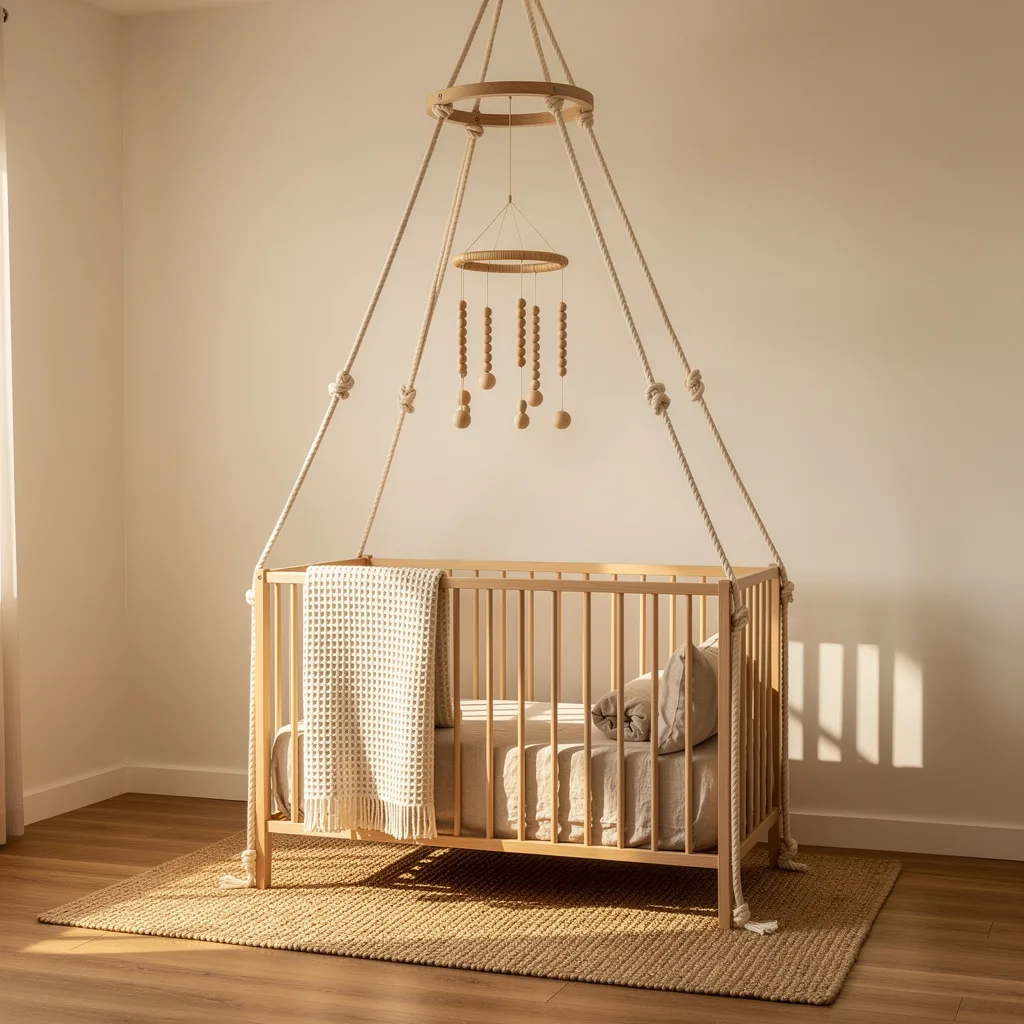
Bare cream walls. Natural wood crib. A rope canopy with a simple wooden bead mobile. A woven jute rug. Nothing else. This room works because it gives a tired baby’s visual system nothing to process. Newborns and young infants cannot filter stimulation the way older children can. A room full of busy patterns and competing colors keeps the brain engaged. A room this simple does the opposite.
The still, non-motorized mobile is also worth noting. It is not spinning, lighting up, or playing music. It hangs quietly as a visual anchor during wake windows and disappears into the background at sleep time. That distinction matters. What to steal: Strip the room back further than feels comfortable. You can always add later. You cannot un-stimulate a wired baby at 10pm.
The Pink Floral Wallpaper Nursery: How to Use Pattern Without Ruining Sleep
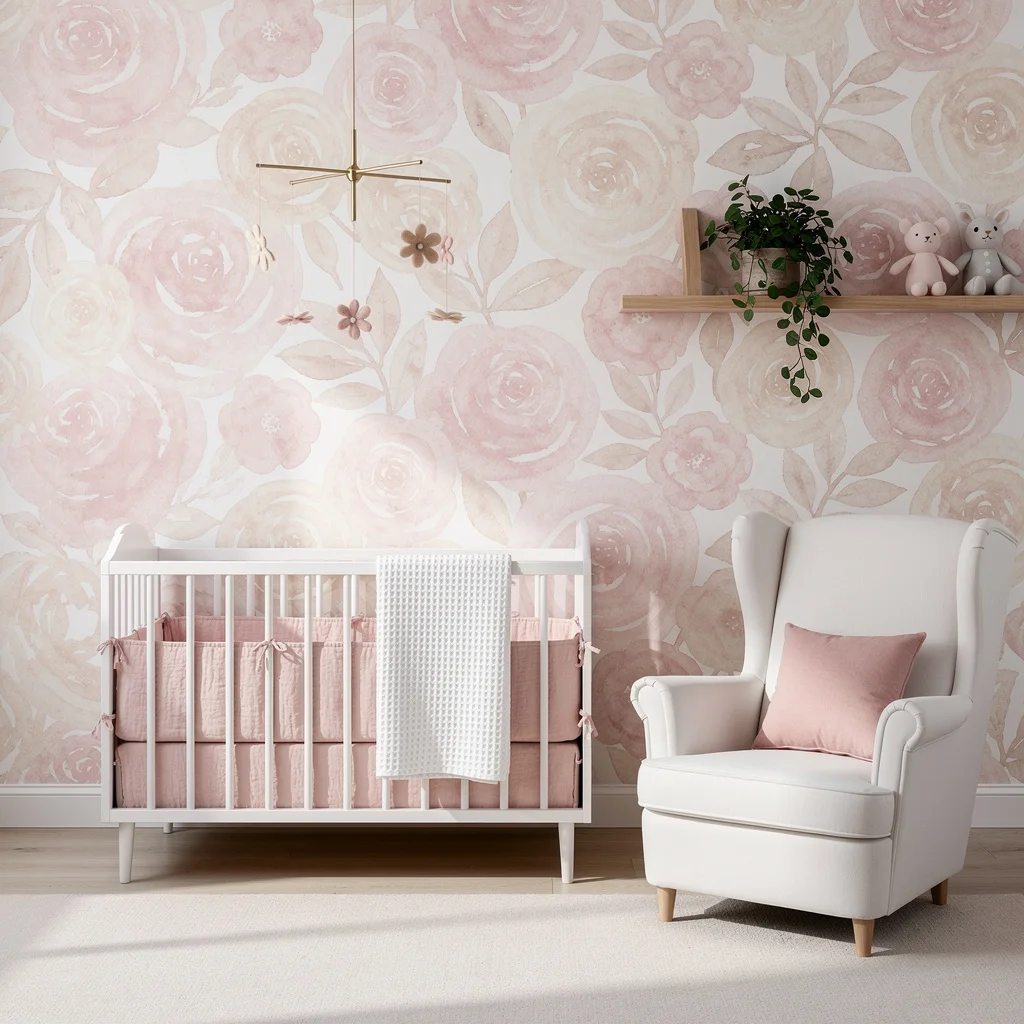
Soft watercolor roses cover the full accent wall. White crib. Cream nursing chair. Blush bedding. A brass geometric mobile. This room proves that pattern does not have to mean stimulating. The roses are painted in muted, desaturated pinks and creams — not bold saturated colors. The difference between a wall covered in bright cartoon characters and one covered in soft watercolor florals is significant. The first raises alertness. The second genuinely does not.
Notice where the nursing chair sits: slightly to the side of the crib, not directly facing it. This is a small but smart placement. A chair that faces the crib head-on means your baby sees your face clearly during feeds — which is engaging and stimulating. A slight offset makes the drowsy-to-crib transfer much easier without full eye contact pulling them back awake. What to steal: If you love pattern, choose it in the most muted version possible. Soft watercolor always beats bold graphic print for a sleep space.
The Moss Wall Botanical Nursery: Using Color Psychology Intentionally
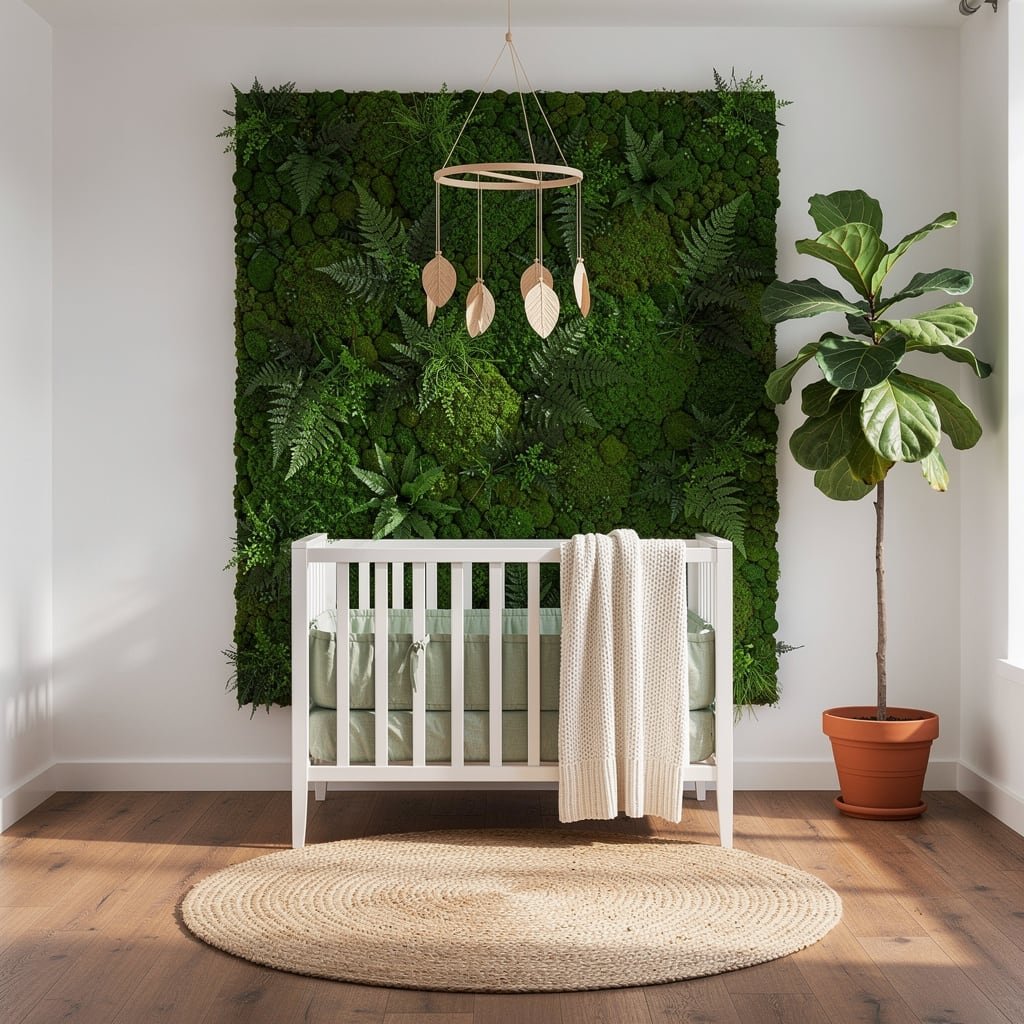
A full preserved moss wall behind the crib. Wooden leaf mobile. Fiddle leaf fig in the corner. White crib, cream blanket, jute rug. Green and earth tones have a documented association with calm alertness in color research — they are why so many therapeutic and medical spaces use them. This room applies that principle directly. Every element sits in the green and natural-brown family. Nothing introduces a contrasting hue that could create visual tension.
Preserved moss is not live plants. It is dried, treated, and maintenance-free. No moisture, no upkeep, no effect on nursery air quality. It adds rich organic texture without adding any complexity that a baby’s nervous system needs to process. What to steal: If you want a statement wall, earth tones and botanical greens are the safest choice for a sleep space. They add visual depth without adding stimulation.
The Scandinavian Minimalist Nursery: Let the Night Light Do the Work
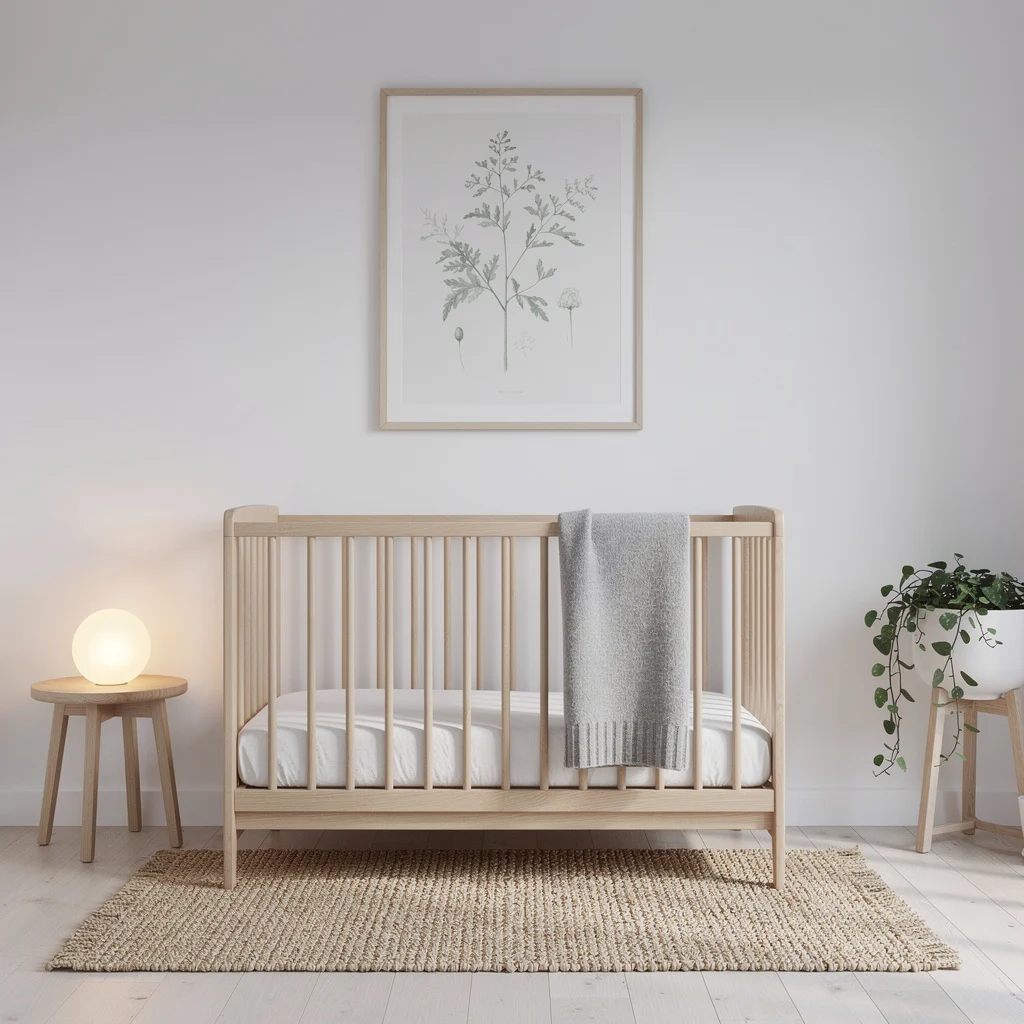
Almost entirely white and pale wood. One framed botanical print in soft gray-green. A round warm-toned globe night light on a small side table. A single trailing plant. The globe night light in this room is doing more work than it looks like. It is warm-toned, positioned low, and produces a dim, diffused glow rather than directional light. This is exactly the specification for a sleep-supporting light source. It does not project upward into the baby’s eyes. It does not wash the room in cool white. It creates a warm, dim environment that supports melatonin production instead of suppressing it.
The botanical print above the crib is soft gray-green watercolor — no bright colors, no cartoon characters, no bold shapes. Even the art was chosen with the nervous system in mind. What to steal: Replace your overhead nursery light with a warm-toned lamp or night light for all evening and nighttime interactions. This single change costs almost nothing and makes a real difference.
The Linen Canopy Crib Nursery: Creating a Sleep Boundary Without a Wall
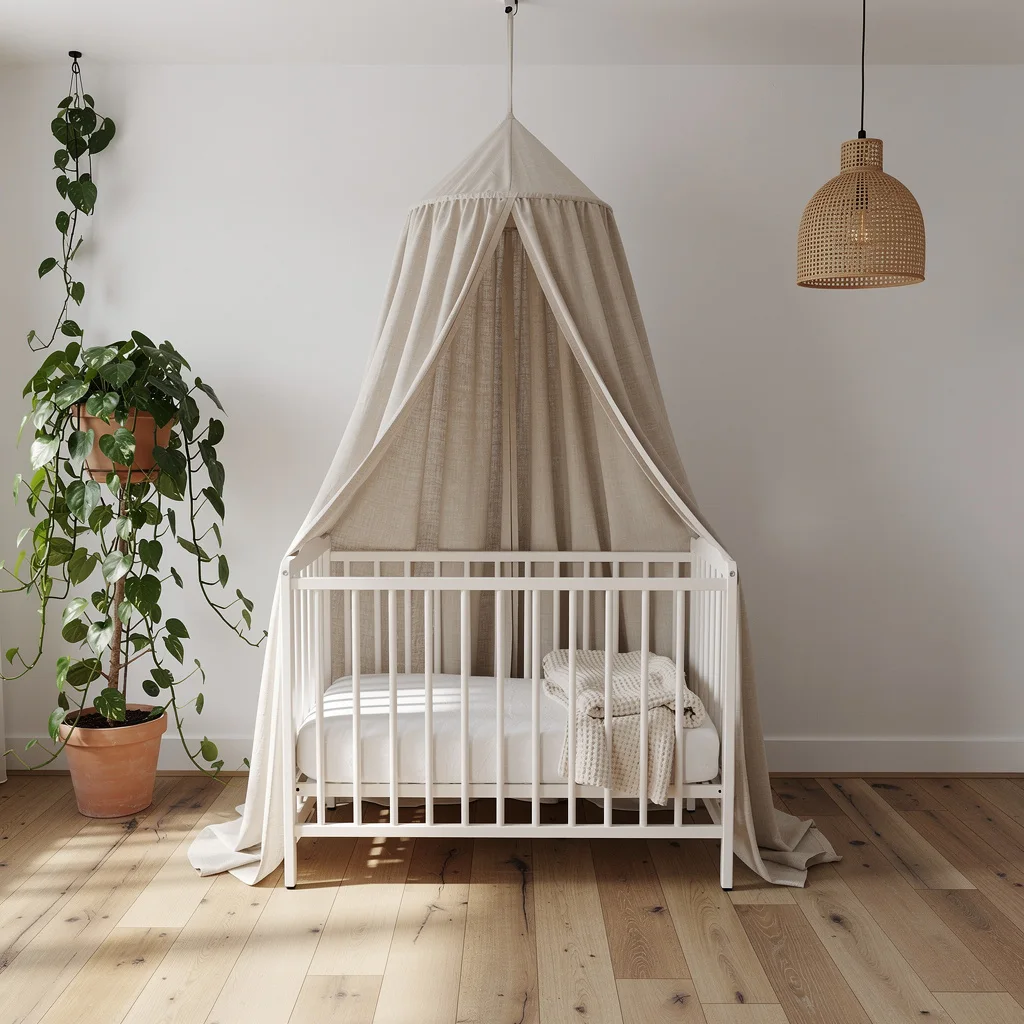
A tall cream linen canopy drapes from a single ceiling hook down around the crib. Large trailing pothos plant. Rattan pendant light. White crib, white bedding. The canopy creates a sense of enclosure around the crib without physically restricting airflow. Babies who startle awake frequently sometimes respond better to a sleep space that feels bounded — it reduces the visual field without reducing ventilation. The canopy is mounted to the ceiling and drapes outside the crib frame. Nothing loose or fabric-based is inside the sleep surface.
The rattan pendant light above diffuses warm light softly across the ceiling instead of projecting it directly downward. Overhead lights that shine into a baby’s eyes during settling or feeding spike alertness at exactly the wrong moment. What to steal: A canopy can be added to almost any crib. If your baby startles easily or seems overwhelmed in an open room, a simple ceiling-mounted canopy is worth trying before assuming the issue is a sleep method problem.
The Moon and Stars Nursery: Using Light as a Behavioral Cue
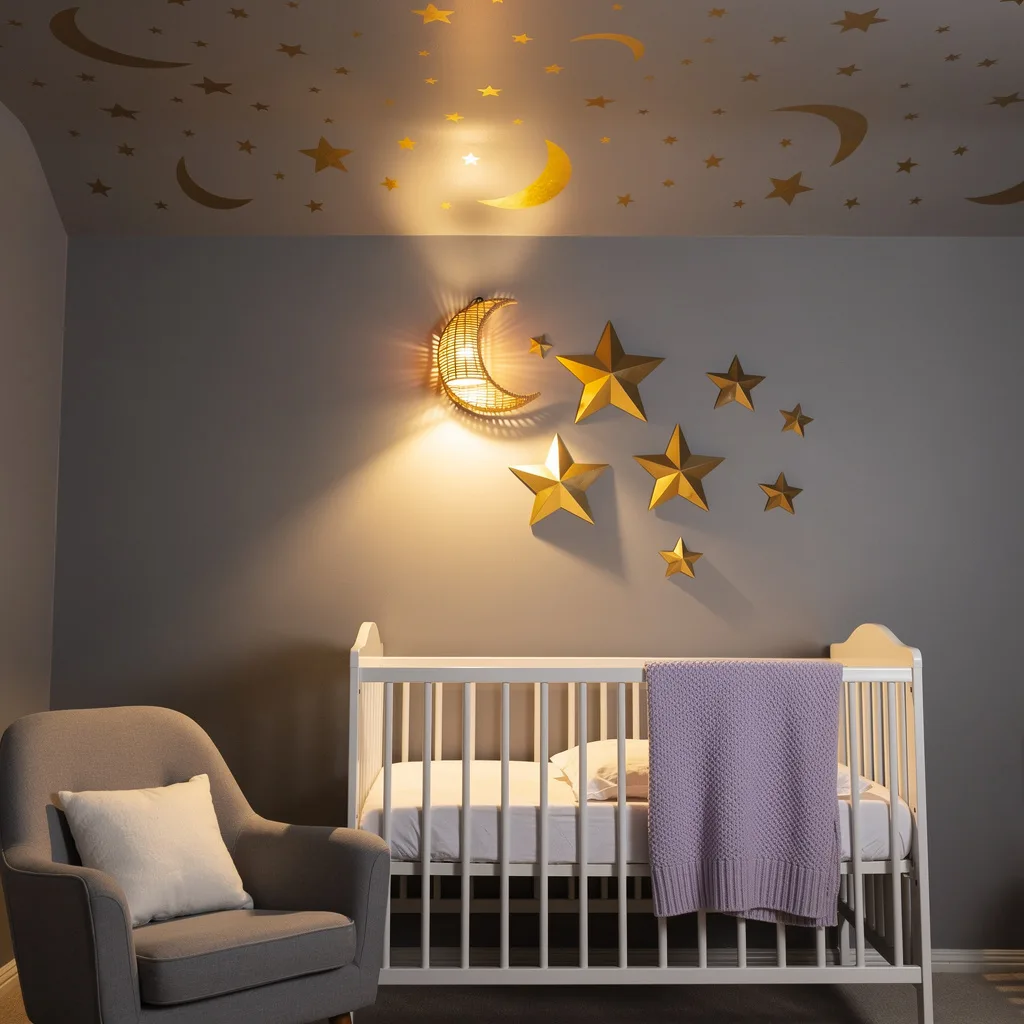
Gray walls. Gray glider. Wall-mounted crescent moon sconce in warm amber. Gold star decals. Ceiling star projector. White crib, soft lavender blanket draped over the rail for photos. This room is built around one idea: light as a sleep signal. The moon-shaped wall sconce produces warm amber light at a low level — the right kind for a sleep space. The star projector, used as part of a consistent bedtime routine, becomes a cue that sleep is coming. When the same environmental signals appear in the same order every night, babies learn to anticipate sleep. That anticipation is what makes settling faster over time.
The lavender blanket on the crib rail is styling for the photo. Loose blankets do not belong inside the sleep space for babies under 12 months. Once your baby is past 12 months and out of a sleep sack, a lightweight blanket becomes appropriate. What to steal: Use your ceiling projector or night light as a consistent bedtime-only cue. Turn it on at the same point in your wind-down routine every single night. Within a few weeks it becomes a sleep trigger on its own.
The Watercolor Tree Mural Nursery: The Rattan Light Trick
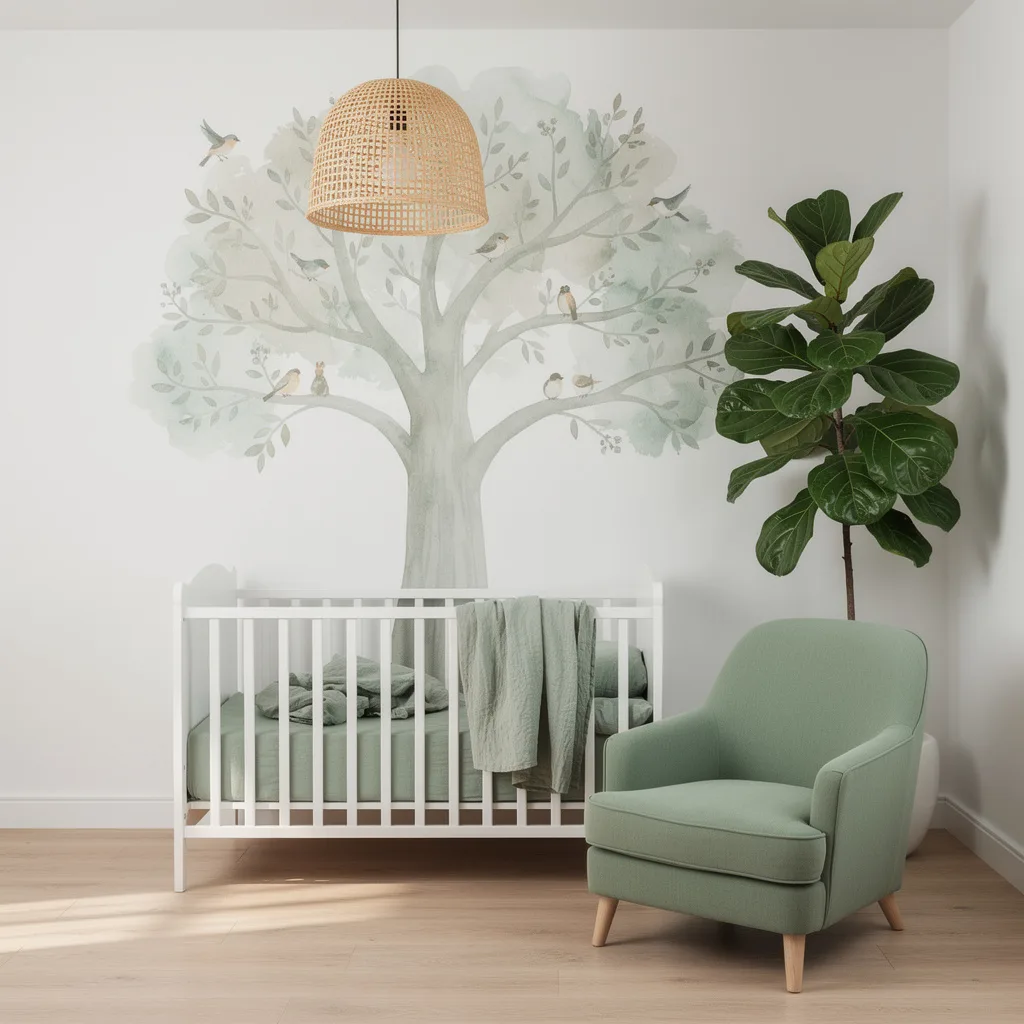
A large watercolor tree in sage green and soft gray covers the accent wall. Small painted birds in the branches. White crib with sage bedding. Sage green nursing chair. Rattan pendant light overhead. The rattan pendant is the detail most worth copying in this room. Woven or rattan shades scatter light in multiple soft directions instead of projecting it downward as a beam. The result is warm, diffused ambient light that feels softer than any overhead fixture. During the wind-down routine and early evening feeds, this kind of light keeps the room feeling calm instead of clinical.
The sage green throughout this room — walls, bedding, chair — creates a tight, cohesive palette. When every element sits in the same color family, the room reads as visually quiet even though it has multiple pieces of furniture and a large wall mural. What to steal: Swap a standard pendant or ceiling fixture for a rattan or woven shade. The light quality change is immediate.
The Boho Rattan Crib Nursery: Airflow as a Sleep Tool
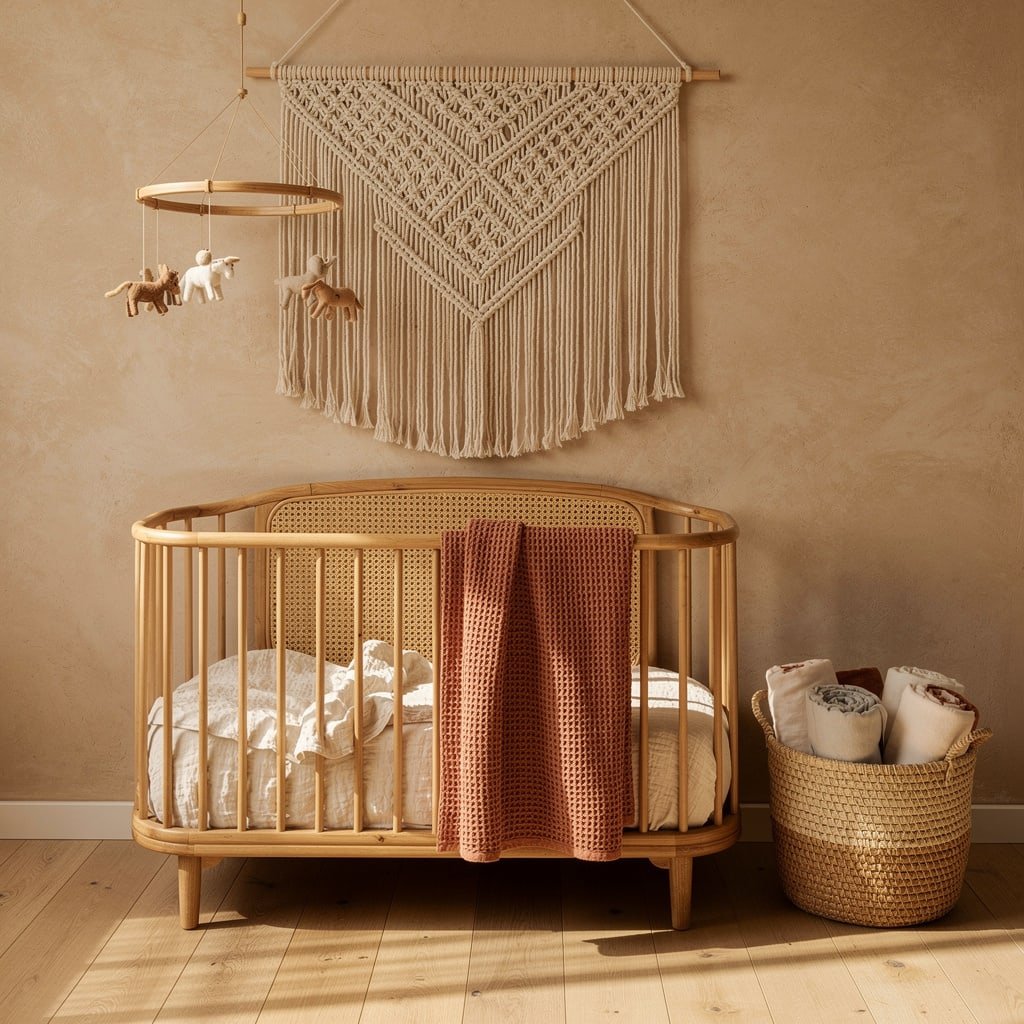
Warm terracotta walls. Rattan crib with open sides. Woven storage basket. Macramé wall hanging. Small felt animal mobile on a wooden hoop mounted to the side. The rattan crib is the functional standout here. The open weave sides allow air to circulate around the sleeping baby. The American Academy of Pediatrics recommends keeping the sleep space between 68 and 72 degrees Fahrenheit and avoiding overheating as a key safe sleep practice. An open-sided crib in a well-ventilated room supports that goal better than a solid-panel crib in a warm room.
The macramé wall piece hangs above and behind the crib on the wall — not over the sleep surface. The mobile is mounted to the side, not directly overhead. Both choices follow safe positioning while still giving the room its distinct boho personality. What to steal: If your nursery runs warm, consider how much your crib itself allows airflow. A breathable mattress paired with an open-sided or slatted crib makes a meaningful difference in sleep temperature.
The Navy and Gold Modern Nursery: Why Dark Walls Help Daytime Naps
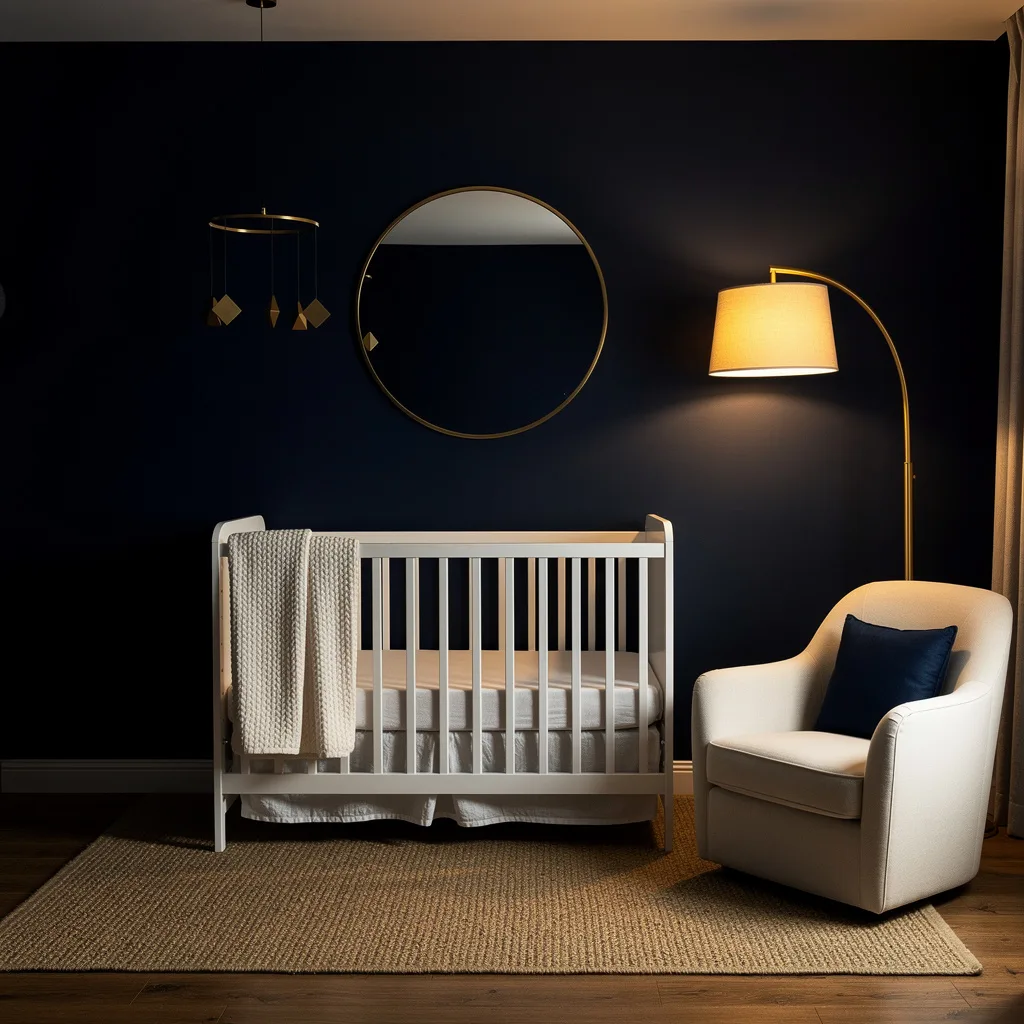
Deep navy walls. White crib. Arc floor lamp with warm linen shade. Round gold-framed mirror. Cream glider with a navy pillow. Simple geometric gold mobile. This room does not look like a nursery. It looks like a carefully designed room that happens to have a crib in it. And the dark wall color is doing real work. Navy, charcoal, and deep green walls absorb light rather than reflecting it. This helps the room skew naturally darker during daytime nap windows without relying solely on blackout curtains.
Light is the most powerful external regulator of circadian rhythm — even in newborns. A room that stays dim and tonally dark makes it easier to signal sleep time around the clock, not just at night. The arc floor lamp sits behind and to the side of the glider. During nighttime feeds this allows you to see your baby without flooding the room with overhead light. Keeping nighttime interactions dim, quiet, and low-stimulation is one of the most effective ways to reinforce day-night difference in the first few months. What to steal: Do not be afraid of dark walls in a nursery. Combined with a warm lamp, they create one of the most sleep-supportive rooms possible — and they photograph beautifully too.
The Sky Blue Cloud Nursery: When Color Itself Is the Tool
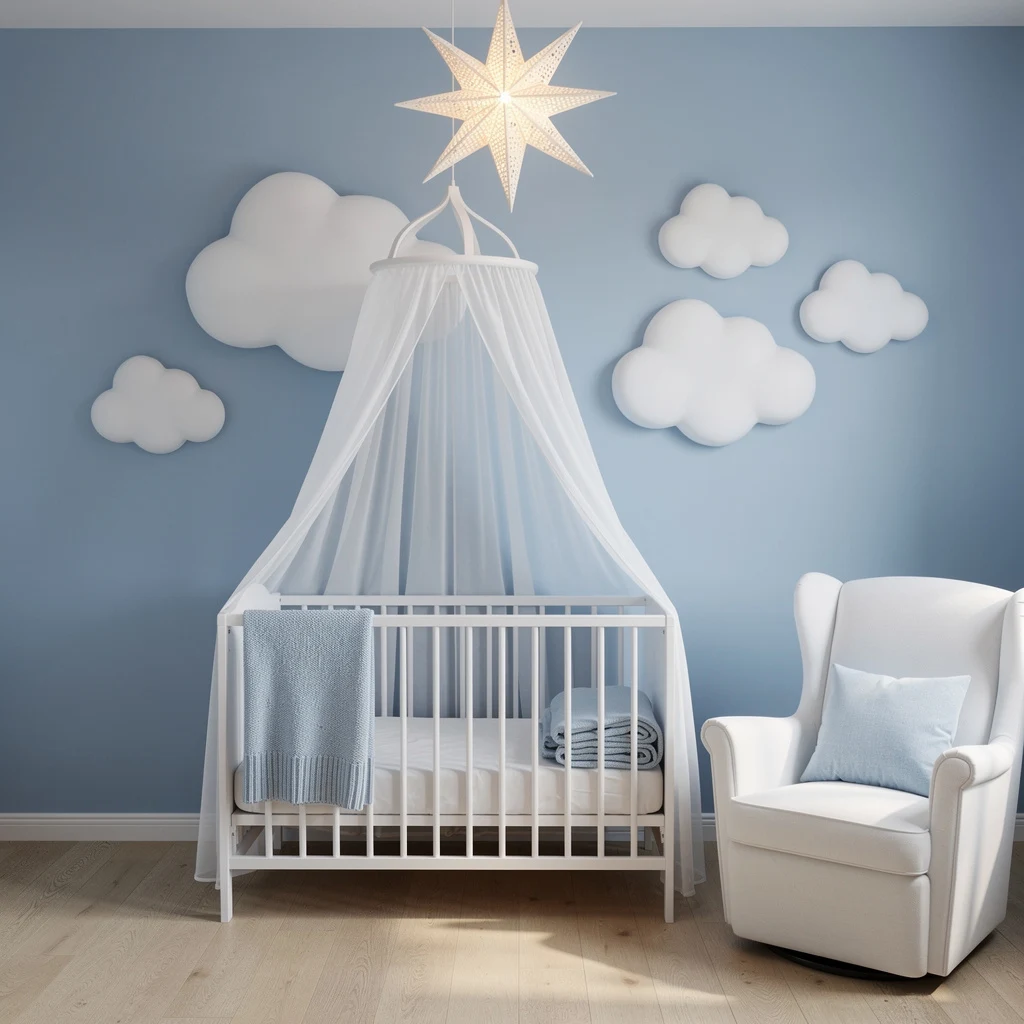
Soft blue walls. White 3D cloud shapes mounted in relief. Sheer white round canopy over the crib. Star-shaped paper pendant light. White glider with a blue pillow. Soft, desaturated blue has a well-documented association with lower heart rate and reduced physiological arousal in multiple research contexts. It is used in hospitals, therapy spaces, and sleep clinics for a reason. This nursery applies that directly — not with a bold cobalt or bright turquoise, but with the softest, most muted version of blue possible.
The 3D cloud sculptures add texture and visual interest without introducing any color contrast. Everything in this room sits in a tight white-to-soft-blue range. For a baby waking at 3am and scanning the room, there is nothing new, alerting, or visually complex to land on. That consistency is calming in a way that is easy to underestimate. The round canopy creates the same bounded, enclosed feeling as the linen canopy in room five — a cocooned sleep space within the larger room. What to steal: If you are choosing wall color and want something that actively supports sleep, soft desaturated blue is one of the best evidence-adjacent choices available. Avoid bright or saturated versions entirely.
The 6 Things Every Sleep-Friendly Nursery Has in Common
Look across all 10 rooms and the same principles appear regardless of style, budget, or aesthetic:
- Warm light only. Every room uses warm-toned, dim light for evening and nighttime. No cool-white overhead lights.
- A muted, tight palette. Even the colorful rooms stay in one desaturated color family. Nothing competes visually.
- Visual simplicity near the crib. The area directly around the sleep surface is always the calmest part of the room.
- Natural materials. Wood, rattan, linen, cotton, and jute appear in almost every room. They add warmth without stimulation.
- Nothing inside the crib. A firm flat mattress and a fitted sheet. Everything else is outside the sleep surface.
- Intentional chair placement. The nursing chair is positioned to minimize eye contact during feeds and make crib transfer easier.
None of these require a big budget. Most require a decision — to remove something, reposition something, or swap a light bulb. Start with light. It is the fastest change and one of the most effective.