
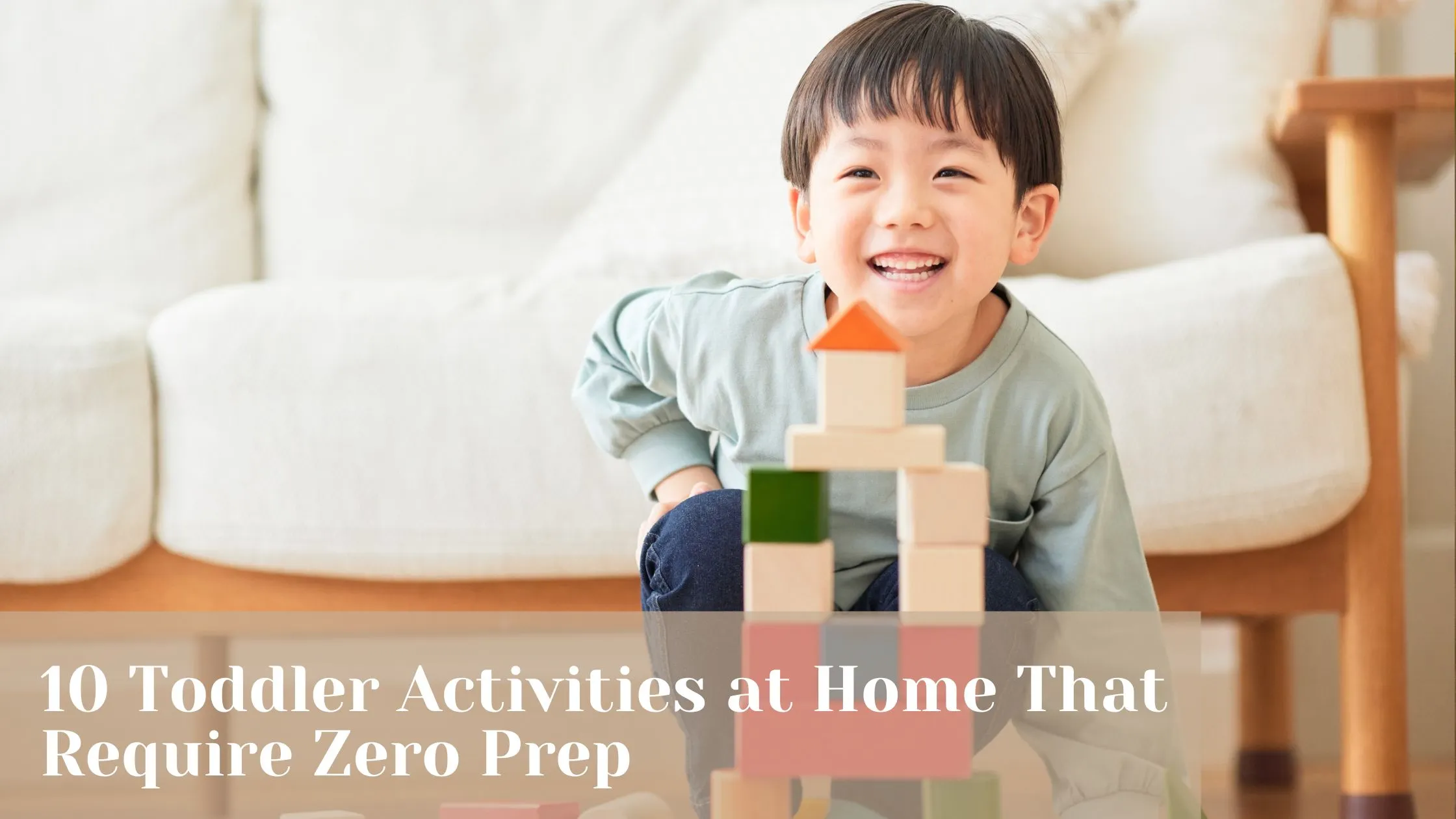
You are twenty minutes into a rainy Tuesday with a toddler who has already rejected every toy in the house and is now staring at you with the energy of someone who slept ten hours and expects to be entertained. The craft supplies are buried. The playdough is somewhere. You have approximately nothing ready and approximately two minutes before the whining starts.
Here is the thing about toddler activities: the best ones do not require anything you do not already have. Not because zero-prep is a compromise — but because the research on toddler development is consistent on this point. Unstructured playtime correlates strongly with self-regulation skills, and limiting it can increase anxiety among children. The American Academy of Pediatrics has stated that free play helps children deal with feelings, grow strong, and build resilience. What toddlers need is not elaborate setups — they need permission, space, and a parent or caregiver who is willing to start something.
Every activity on this list uses what is already in your home. Most take under sixty seconds to start. All of them have genuine developmental value — not as a justification for the list, but because understanding what each one builds helps you pick the right one for your child’s mood and energy level right now.
Before You Start: The One Thing That Makes Any Activity Work
Research has shown that children who do not have an adult visibly hovering are more likely to play more vigorously and adventurously. This does not mean you leave the room — it means that once you have started an activity, stepping back slightly and letting your toddler lead it produces better play than managing it from above.
Your job is to start the spark. Once it catches, get out of the way.
Activity 1: Obstacle Course

What it is: Move the couch cushions onto the floor. Add a pillow, a folded blanket, and a step stool if you have one. Tell your toddler this is an obstacle course and show them how to get through it — crawl over the cushion, step over the pillow, walk around the blanket. Then let them run it.
Why it works: Play fosters physical strength while enhancing decision-making and problem-solving skills. An obstacle course specifically builds gross motor skills — balance, coordination, spatial awareness — while also engaging the planning part of the brain as your toddler figures out the sequence of how to get through it. The rearrangeable nature of it means the course can evolve as your toddler masters each configuration.
Age range: 18 months to 4 years. Younger toddlers need simpler configurations — one or two elements only. Older toddlers can help design the course themselves, which adds a cognitive layer to the physical one.
How to extend it: Add a rule. “This time you have to crawl the whole way.” “This time jump over instead of stepping.” “Now do it backwards.” Each variation resets the challenge.
Activity 2: Simon Says
What it is: The classic. You are Simon. You give instructions that your toddler should only follow if preceded by “Simon says.” Start slow and simple: “Simon says touch your nose. Simon says jump three times. Simon says sit down.” For very young toddlers, drop the catching element entirely and just use it as a movement game.
Why it works: Simon Says is one of the best executive function games available for this age group. A longitudinal study from Australia confirmed that time spent in free, unstructured play at ages 2–3 and 4–5 years predicted self-regulation development. Simon Says specifically targets the inhibitory control component of executive function — the ability to hear an instruction and choose not to follow it. This is the same skill that eventually helps children wait their turn, manage impulses, and focus in classroom settings.
Age range: Best from about 2.5 years onward when the rule-following aspect is developmentally achievable. Under 2.5, use it as a pure movement game with no catching.
How to extend it: Let your toddler be Simon. Listening to them issue instructions — often in wildly inventive directions — tells you a great deal about what they have been paying attention to. “Simon says eat a dinosaur” is completely valid.
Activity 3: Storytelling and Role Play
What it is: Start a story. “Once upon a time there was a little bear who lived in this house” — and gesture around your living room. Then pause and ask your toddler what happens next. Or simply announce: “Let’s pretend you are the chef and I am a very hungry customer who needs a sandwich.” Then play your role and let them play theirs.
Why it works: Imaginative play expands vocabulary — a child pretending to be a chef might learn words like ingredients, recipe, or oven. Role play also introduces sentence structure, dialogue, and expressive language. Toddlers who engage regularly in storytelling through play are better prepared for classroom communication and literacy development.
Pretend play is not just charming — it is neurologically significant. Studies show that the most creative forms of play bring natural materials and real environments into the narrative, rather than representative figurines. Your living room is an infinitely better stage than any toy set.
Age range: 2 to 5 years. At 2, your toddler will mostly mirror what you do in the role play. By 3 to 4, they will direct it, correct your performance, and take it in directions you did not anticipate.
How to extend it: Follow their lead absolutely. The moment you introduce a story element that does not interest them, the play collapses. The moment you accept their narrative direction completely, it can run for thirty minutes.
Activity 4: Couch Cushion Storytelling Pile
What it is: Pull every cushion off the couch and pile them in the centre of the floor. Sit beside the pile with your toddler. Pick up one cushion and announce it is now a magic portal, a birthday cake, a flying carpet — whatever comes out of your mouth first. Hand your toddler the next cushion and ask them what theirs is. Build the story one cushion at a time until you have used them all or until the narrative collapses into something completely unrecognisable, which is equally valid.
Why it works: Object transformation play — using one object to represent something entirely different — is one of the most developmentally significant things a toddler can do. It requires abstract thinking, the ability to hold two representations of the same object in mind simultaneously, and flexible cognitive processing. Research published in ScienceDirect in 2024 on infants and toddlers in imaginary play situations found that the most cognitively engaging forms of play involve transforming real, familiar objects into narrative elements rather than using toys designed for a specific purpose. A cushion that becomes a spaceship demands more from a toddler’s brain than a toy spaceship that is already a spaceship.
The pile also provides a physical, tactile element — toddlers can climb it, rearrange it, throw cushions onto it — which means the activity satisfies both the physical energy need and the imaginative one at the same time.
Age range: 2 to 5 years. Younger toddlers will engage with the physical pile more than the storytelling. By 3, the narrative element becomes the main event and they will start correcting your story contributions with authority.
How to extend it: Ask your toddler to assign each cushion a character and give it a voice. Then use the cushions as puppets to act out the story. The physical objects become anchors for the narrative — toddlers who struggle to sustain imaginative play verbally often sustain it for much longer when there is an object to hold and manipulate.
Activity 5: Shadow Play
What it is: Close the curtains in a room until it is dim. Use a torch, a phone flashlight, or a bright lamp directed at a blank wall. Show your toddler how to make their hands cast shadows on the wall — a simple hand shadow, fingers spread wide, a fist. Then start telling a story using the shadows.
Why it works: Shadow play sits at the intersection of sensory exploration, cause-and-effect learning, and imaginative play. When a toddler moves their hand and sees the shadow change, they are experiencing direct cause-and-effect feedback — one of the most powerful learning mechanisms at this developmental stage. Activities that demonstrate cause and effect while teaching new words help babies and toddlers develop their sense of how the world works. Shadow play does this with a level of magic that keeps attention far longer than most other activities at this age.
Age range: 18 months to 5 years. Younger toddlers are fascinated by the phenomenon itself — the shadow, the movement, the relationship between hand and wall. Older toddlers want the story.
How to extend it: Give the shadow a name and a voice. Let your toddler name theirs. Now you have two characters and the beginning of a shadow puppet show that costs nothing.
Activity 6: I Spy
What it is: The classic travel game works just as well at home. “I spy with my little eye, something that is… red.” Your toddler scans the room. When they find it, they take a turn. For toddlers under about 2.5, use the full description rather than just colour — “I spy something round and smooth” — and point toward the general area to scaffold the search.
Why it works: I Spy builds vocabulary, colour recognition, shape recognition, and sustained attention in one activity. The toddler who is looking for something red must hold the category “red” in working memory while visually scanning the room — a genuine cognitive task that is appropriately challenging at this age without being frustrating. When toddlers play simple sorting and categorising activities, they are simultaneously developing language, cognitive skills, and fine and gross motor skills in an interconnected way.
Age range: 2 to 5 years. Simplify the clues for younger toddlers. Add complexity — “I spy something that starts with the letter B” — for children approaching preschool age.
How to extend it: Play a version where the spy has to describe what the object does rather than what it looks like. “I spy something you use to eat.” “I spy something that keeps you warm.” This shifts the activity toward functional vocabulary and abstract categorisation.
Activity 7: Blanket Fort
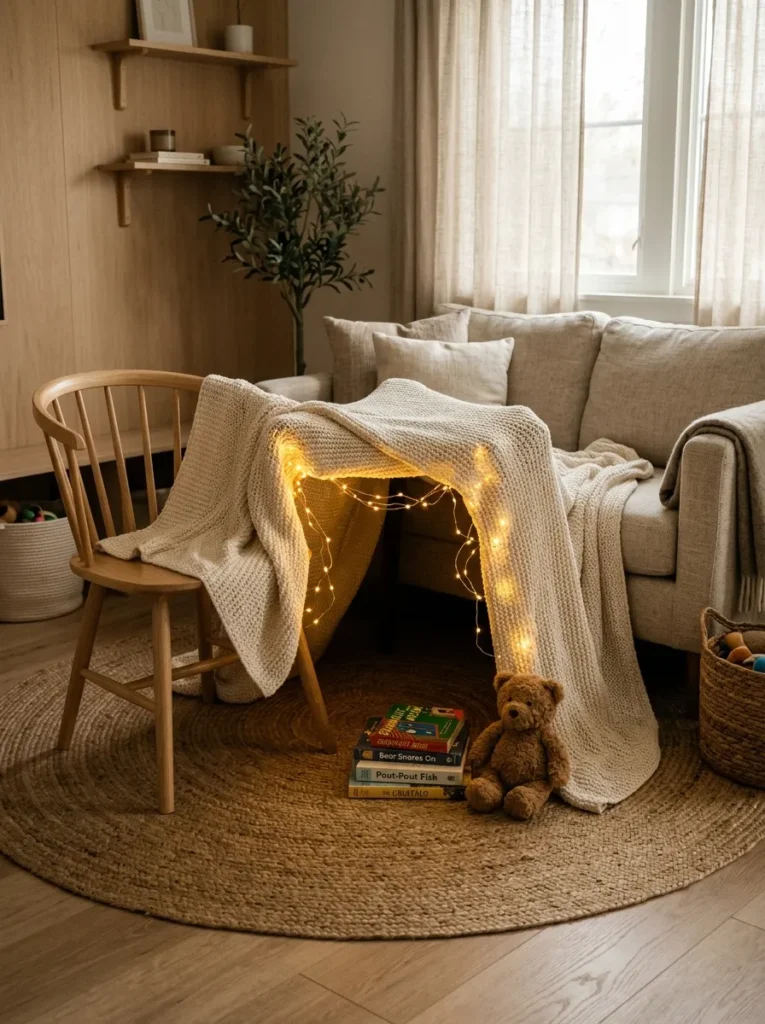
What it is: Drape a blanket over a table, the back of a couch, or between two chairs. Put a cushion inside. Declare it a cave, a rocket ship, a bakery, or whatever your toddler decides it is. That is the activity.
Why it works: Children engaged in imaginative role-play and building activities develop motor skills, emotional resilience, problem-solving abilities, and social interactions. The fort specifically does something that most structured activities do not: it creates a psychological space that belongs entirely to the child. Toddlers who have a defined “their space” within the home show increased engagement, longer play duration, and more elaborate imaginative scenarios than those playing in open, adult-defined spaces.
The construction element — even at the level of “help me hold this corner while I drape this blanket” — engages spatial reasoning and physical problem-solving. Constructive play typically starts in toddlerhood and becomes more complex with practice, promoting creativity, imagination, and problem-solving skills.
Age range: 18 months to 6 years. The toddler who cannot yet build it themselves will still play in it with full commitment. As they get older, they increasingly want to build it themselves, which is where the real developmental value is.
How to extend it: Ask to be invited in. Knock on the blanket and wait. The social ritual of answering the door, deciding who to admit, and playing host inside the fort is an entire social skills curriculum in one small space.
Activity 8: Sorting by Colour, Size, or Shape
What it is: Empty a kitchen drawer of safe items — wooden spoons, silicone spatulas, measuring cups — or gather whatever objects are nearby. Ask your toddler to sort them. “Can you put all the big ones together and all the small ones together?” Or: “These go in the blue pile, these go in the yellow pile.” Let them decide the categories if they want to — their sorting logic will tell you something interesting about how they are thinking.
Why it works: When toddlers play a simple sorting game, they might be counting, naming colours, using their pincer grasp, and learning to follow directions — all simultaneously. Sorting is one of the foundational early mathematics activities, building the categorisation skills that underpin later classification, pattern recognition, and logical thinking. It also builds fine motor control and sustained attention.
The household objects element matters. Research on toddler play consistently shows that children engage more deeply with real objects that they see adults use than with toy versions of the same objects. A real wooden spoon is more interesting than a toy wooden spoon.
Age range: 18 months to 4 years. Very young toddlers can sort by one attribute — big or small. By 3 to 4, they can sort by two attributes simultaneously — big and red versus small and blue — which is a genuine cognitive leap.
How to extend it: Let them set the sorting rules and ask you to follow them. If they decide that “spiky things” and “smooth things” are the categories, play along. Their invented categories reveal their observational priorities.
Activity 9: Mirror Play and Silly Faces
What it is: Sit in front of a bathroom mirror or any large mirror with your toddler. Make a face. Ask them to copy it. Then let them make a face for you to copy. Name the emotions — “this is my surprised face, this is my sleepy face, this is my absolutely delicious food face.” Escalate into full body poses, silly sounds attached to the faces, or a slow-motion mirror game where one person moves and the other mirrors them in slow motion.
Why it works: Mirror play builds emotional literacy — the ability to recognise, name, and produce emotional expressions — which is a foundational social-emotional skill. Imaginative play sparks creative thinking by encouraging divergent thinking, allowing children to explore multiple solutions to problems. Pretend play enhances communication skills, vocabulary, and language development.
The slow-motion mirroring game in particular requires sustained attention and motor control in a way that is developmentally appropriate and deeply engaging. The child who is mirroring must watch carefully, delay their response fractionally, and reproduce movement accurately — all of which are attentional and motor skills with direct developmental value.
Age range: 12 months to 4 years. Even very young toddlers are captivated by their own reflection. The emotional naming element becomes meaningful from about 2 years onward.
How to extend it: Tell a story using only faces. No words — just expressions — and see whether your toddler can follow the narrative. This is a sophisticated social-cognitive game at the upper age range.
Activity 10: Treasure Hunt

What it is: While your toddler is in another room or distracted, hide five to ten small objects around the living area — a toy car under a cushion, a block behind a plant, a sock in a shoe. Then announce that there is a treasure hunt and name the objects they are looking for. For non-readers, describe each object rather than writing clues. Walk through it with them on the first round; let them do it independently on subsequent rounds.
Why it works: A treasure hunt is pure executive function exercise. The child must hold the target object in working memory, plan a search strategy, inhibit the impulse to pick up everything that is not the target, and self-regulate frustration when an object takes longer to find. Children improve their executive functioning, working memory, and self-regulation while strengthening motor skills and confidence through play.
The hide-and-seek structure also builds spatial memory — your toddler is building a mental map of where objects have been hidden, which areas have been searched, and which remain unexplored. This is genuine early geography and spatial reasoning in action.
Age range: 2 to 5 years. For younger toddlers, make the objects partially visible and keep the search area small. For older toddlers, add progressive clues or let them hide the objects for you to find — which requires planning and memory of a different kind.
How to extend it: Let your toddler hide the objects next time. The act of hiding requires them to think from your perspective — what will you be able to see, what will you look for first, where is a good hiding spot — which is a direct exercise in theory of mind.
A Note on Screen-Free Time
All ten of these activities are screen-free. This is not a moral position — screens have appropriate uses in family life and this is not the article to debate them. It is a practical observation: children who grow up with rich, creative play experiences often become more independent thinkers, resilient problem-solvers, and empathetic collaborators. These activities build the same neural pathways that structured learning will later require — they just do it through movement, imagination, and play rather than instruction.
You do not need to do all ten. Pick one. Start it in the next five minutes. The toddler staring at you right now does not need an activity that took you three hours to prepare on Pinterest. They need you to tip the couch cushions onto the floor and say “obstacle course.”
That is enough. That is actually a lot.
Sources: American Academy of Pediatrics, The Importance of Play in Promoting Healthy Child Development (2023); Colliver et al. (2022), Longitudinal Study on Unstructured Play and Self-Regulation, Australia; ScienceDirect (2024), Infants and Toddlers in Imaginary Play Situations; Expressable, New Research: How Play Helps Kids Mental Health and Development (March 2025); ParentingScience.com, The Role of Play in Child Development (June 2025); UNICEF Parenting, 21 Learning Activities for Babies and Toddlers; PMC/NIH, Pretend Play as the Space for Development of Self-Regulation (2024)