
Your toddler just dumped an entire pot of dried pasta onto the kitchen floor. Again. And yet the expensive shape sorter you bought sits untouched in the corner.
Here’s the thing — that pasta on the floor? That was learning.
Two year olds do not need specialty toys, elaborate craft kits, or Pinterest-perfect setups to grow their brains. They need things to touch, pour, sort, stack, and pretend with. Most of that is already in your home right now.
This list gives you 10 activities that use everyday household items — things like muffin tins, socks, cardboard boxes, and plastic bags. Each one targets real developmental skills your 2 year old is actively building right now. No store runs. No prep time. No special equipment.
What a 2 Year Old Is Actually Ready to Learn
Before getting into the activities, it helps to know what’s happening in your child’s brain and body at this age — because the activities on this list are designed around exactly that.
During the second year, toddlers are moving around more, exploring new objects, and becoming more aware of themselves and their surroundings. They tend to imitate the actions of adults and older children, show greater independence, and can recognize themselves in pictures or a mirror. They should also be able to recognize the names of familiar people and objects, form simple phrases, and follow simple instructions. CDC
On the language side, a 2 year old may have a vocabulary of around 50 words, using a mix of nouns, verbs, adjectives, and pronouns. Two year olds are approximately 50% intelligible to unfamiliar listeners — meaning even strangers can understand about half of what they say. That number grows fast through this year. TherapyWorks
Key milestones at 2 years include pointing to things in a book when asked, saying at least two words together like “more cookies,” pointing to at least two body parts, running, kicking a ball, and eating with a spoon. CDC
Cognitively, 2 year olds are working on holding something in one hand while using the other — for example, holding a container and taking the lid off — trying to use switches, knobs, or buttons on toys, and playing with more than one toy at the same time. CDC
Every activity in this list hits at least one of these development areas. Some hit three or four at once.
Why You Don’t Need to Buy Anything
There’s a persistent idea that good learning activities require good toys. The research says otherwise.
The American Academy of Pediatrics’ clinical report on play, reaffirmed in January 2025, found that play in a variety of forms — including play with traditional toys and basic household objects — improves children’s skills. When children were given blocks to play with at home with minimal adult direction, preschool children showed improvements in language acquisition at a 6-month follow-up, particularly low-income children. American Academy of Pediatrics
The AAP also notes that research shows play can improve children’s abilities to plan, organize, get along with others, and regulate emotions — and that play helps with language, math, and social skills, and even helps children cope with stress. HealthyChildren.org
None of that requires a trip to the toy store. A cardboard box, a muffin tin, a pile of clean socks — these are developmentally rich tools when you know how to use them. The activities below show you exactly how.
10 Learning Activities for 2 Year Olds (Using What You Already Have)
1. Kitchen Drawer Sort
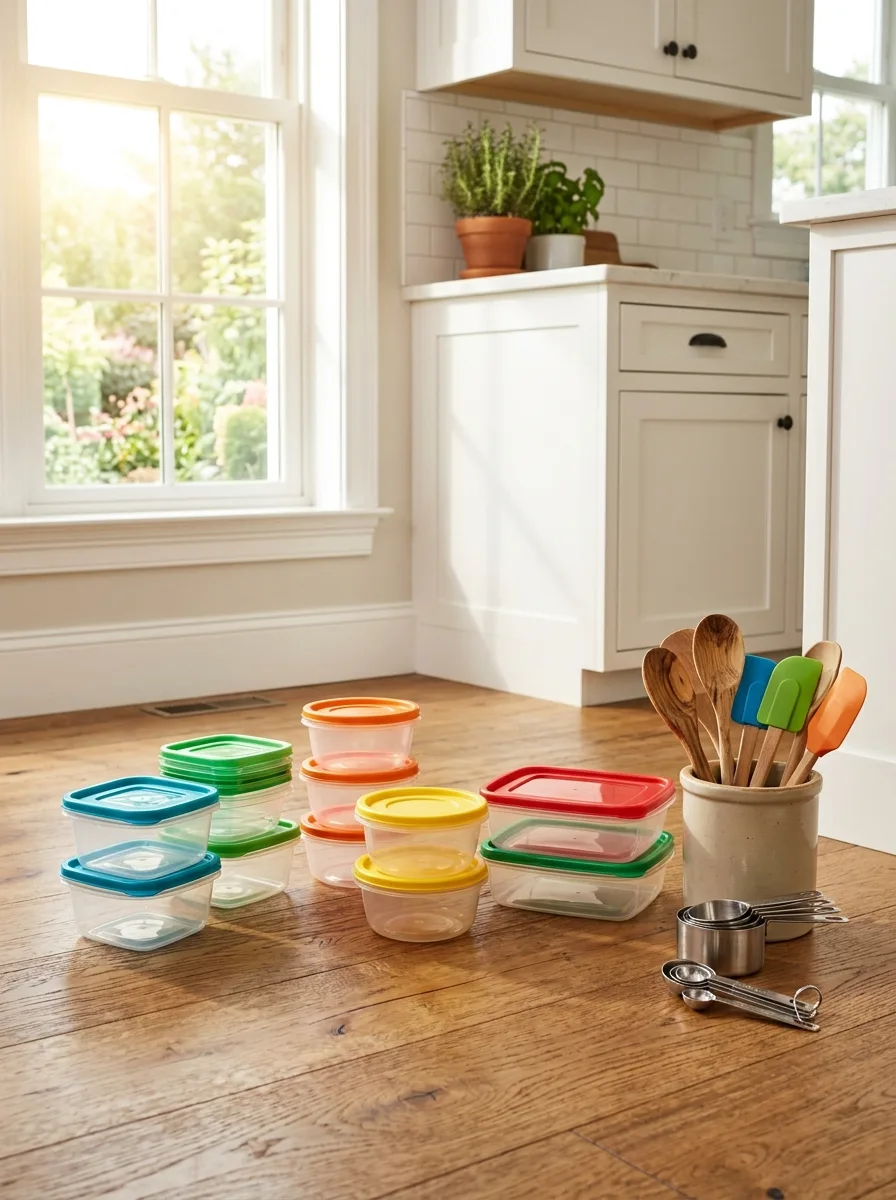
What you need: Tupperware containers and lids, or a mix of spoons, spatulas, and kitchen tools
What it teaches: Matching, early math concepts, fine motor control, and problem-solving
Two year olds are working hard on the skill of matching — figuring out which things go together and why. The kitchen drawer is a goldmine for this.
Pull out a handful of plastic containers and their lids and set them on the floor. Let your toddler figure out which lid fits which container. Don’t guide them right away. Let them try, fail, flip the lid around, and try again. That back-and-forth problem-solving is exactly what their brain needs right now.
You can also pull out a mix of wooden spoons, rubber spatulas, and plastic tools and simply ask them to put “all the spoons together.” Sorting by category is early math — it’s the beginning of classification, which builds into counting and eventually grouping numbers.
Make it harder: Add lids with different sizes that look similar. Ask them to find the “big lid” versus the “little lid” to layer in size vocabulary.
2. Laundry Sock Match
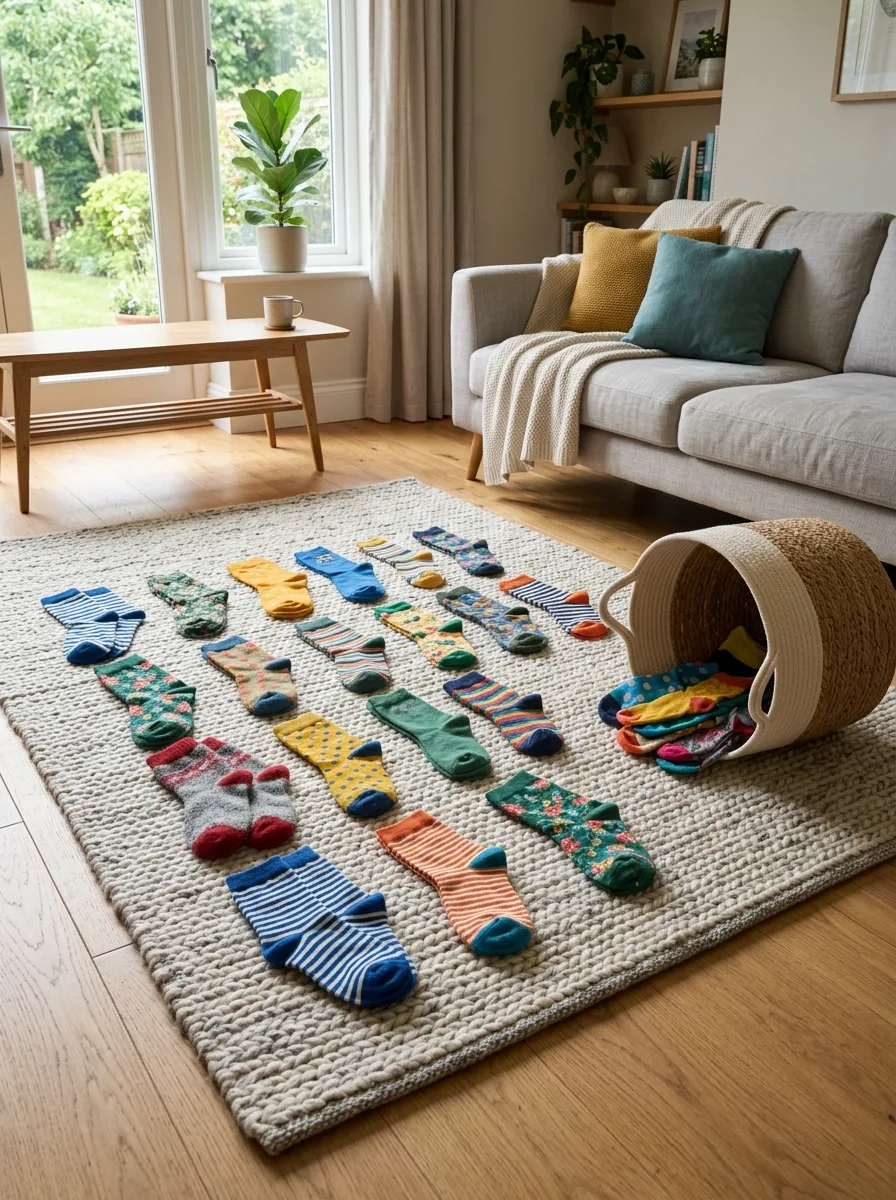
What you need: A pile of clean, mismatched socks
What it teaches: Matching, memory, color recognition, and early logic
This one sounds too simple. It works.
Dump a pile of clean socks onto the floor and ask your toddler to find the pairs. For a 2 year old, start with four or five pairs — enough to make it a real task but not so many that it becomes overwhelming. Say the colors out loud as they pick them up. “That one’s blue. Can we find another blue one?”
Matching socks is a genuine cognitive task for a 2 year old. They’re holding a visual image in their working memory, scanning a group of objects, and finding a match. That’s the foundation of early reading — pattern recognition and memory working together.
The bonus here is language. Name the colors, talk about the sizes, say whose socks they are. Every word you say during this activity is building vocabulary.
Make it harder: Once they’ve mastered color matching, try pattern matching — stripes with stripes, dots with dots.
3. Muffin Tin Color Drop
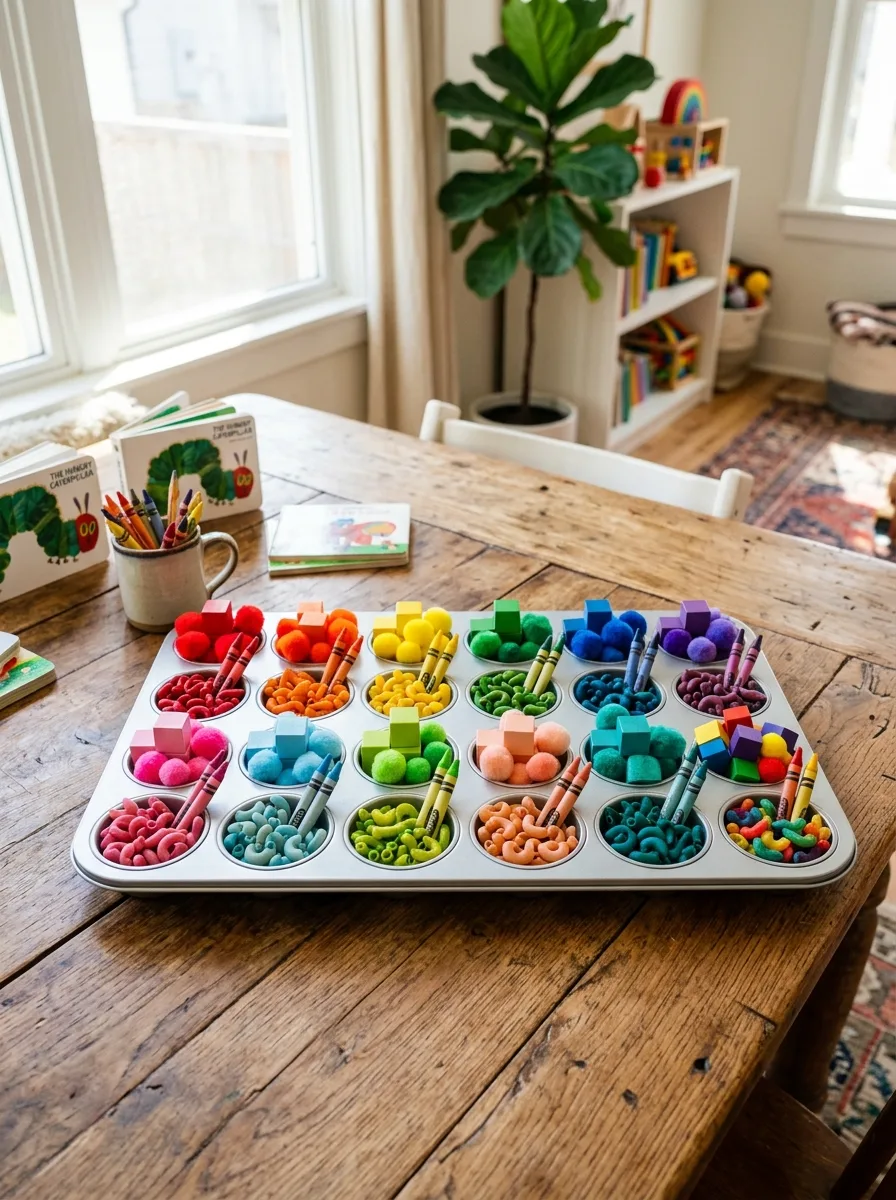
What you need: A muffin tin and small safe objects sorted by color — think colored blocks, crayons, pom-poms, or even dry pasta dyed with food coloring
What it teaches: Color sorting, counting, fine motor skills, and one-to-one correspondence (an early math concept)
Put a colored piece of paper or a sticker inside each cup of the muffin tin to mark the color. Then give your toddler a handful of objects and let them drop each one into the matching cup.
The physical act of picking up a small object and placing it carefully into a small space is fine motor work — the same grip and control they’ll eventually use to hold a pencil. At the same time, they’re matching colors, which builds the visual discrimination skills that support early reading and math.
Count out loud together as they drop each item in. “One red block. Two red blocks.” You’re not drilling numbers — you’re embedding math language into play, which is exactly how toddlers absorb it.
Make it harder: Ask them to count how many are in each cup when they’re done, or try sorting by shape instead of color.
4. Water Pour Station
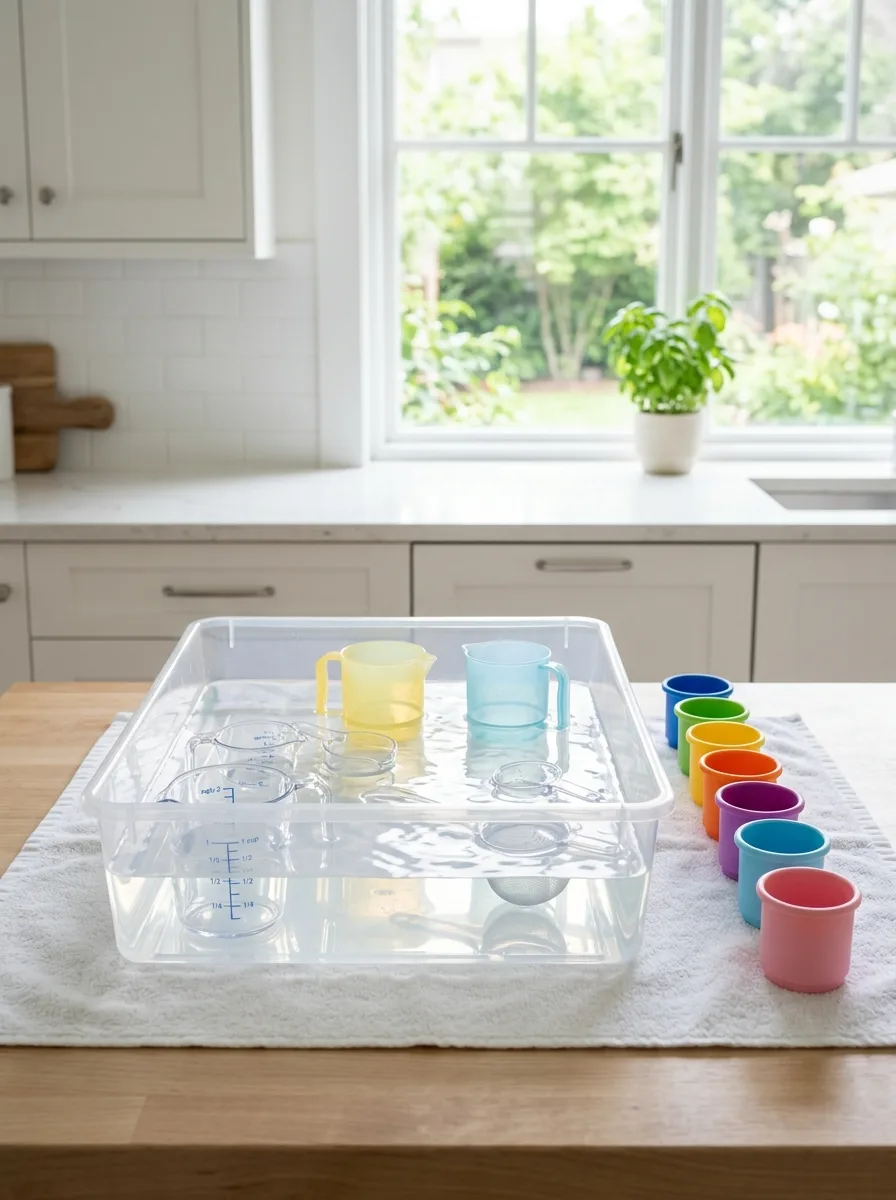
What you need: A large plastic bin or the kitchen sink, a few cups of different sizes, and a small pitcher or measuring cup
What it teaches: Cause and effect, fine motor control, early science thinking, and focus
Set this up at the sink or put a towel under a bin on the floor. Fill a small pitcher partway with water and let your toddler pour it from one cup to another.
This activity might look like just splashing. It is not. Pouring water between containers of different sizes teaches your toddler that the same amount of liquid looks different depending on the container — an early science and math concept called conservation. They’re also working on hand-eye coordination and grip strength with every pour.
The focus this produces is remarkable. Most 2 year olds will stay engaged with water pouring far longer than with any structured toy. That sustained attention is itself a skill being practiced.
Add food coloring to make it more interesting. Drop a little red into one cup and blue into another, then let them pour them together. They’ll be stunned when it turns purple.
Make it harder: Give them a turkey baster or medicine dropper to transfer water drop by drop. This is intense fine motor work.
5. Cardboard Box Town
What you need: Empty cardboard boxes of any size — cereal boxes, shoe boxes, delivery boxes
What it teaches: Imaginative play, spatial reasoning, language development, and creativity
Flatten some boxes, leave others open, stack a couple, and stand back. Tell your toddler you’re building a town. Then let them direct it.
“Is this a house or a car?” Let them decide. Don’t correct. If the cereal box is a boat, it’s a boat. Pretend play at this age is not trivial entertainment — the AAP notes that pretend play directly builds the social-emotional, cognitive, and language skills that form executive function and a prosocial brain. American Academy of Pediatrics
While they play, narrate what’s happening. “The car is driving to the house. Who lives there?” You’re modeling storytelling, which directly supports language development. Studies consistently show that back-and-forth conversation during play — even simple narration — builds vocabulary faster than passive listening.
Small toy figures, stuffed animals, or even folded paper people can populate the town. Let it evolve over multiple days. Leave it out so they can return to it.
Make it harder: Ask them to build something specific — “Can you make a garage for the car?” — to layer in planning and following instructions.
6. Painter’s Tape Road
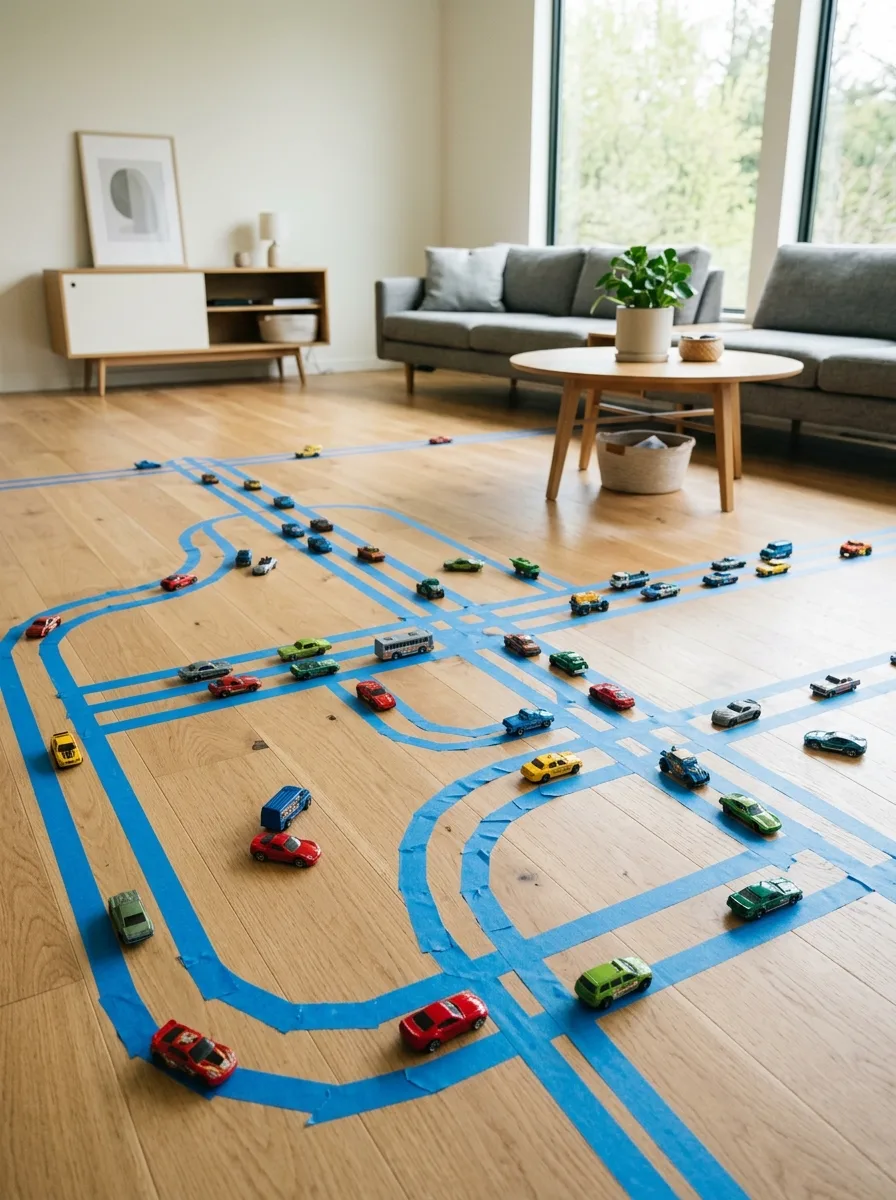
What you need: Painter’s tape (low-tack, won’t damage floors)
What it teaches: Gross motor skills, spatial awareness, body control, following a path, and early geometry concepts
Pull out the painter’s tape and make roads on your floor. Straight lines, curves, a T-intersection, a roundabout. Keep it simple for a 2 year old — two or three connected lines is enough to start.
Then let your toddler drive toy cars along the roads, walk along the lines with their feet, or push a stuffed animal “bus” from one point to another.
Walking along a taped line requires balance and body awareness — both gross motor skills your 2 year old is actively developing. It also introduces early spatial language naturally. “Go straight. Now turn. The garage is at the end of the road.”
You can also make shapes — a big square, a triangle, a circle — and name them as your toddler walks around them. Geometry at 2 looks like this.
Make it harder: Make the lines narrower. Ask them to walk the line without stepping off. Or set up “traffic” — one direction only, stop at the X.
7. Sound Shaker Bottles
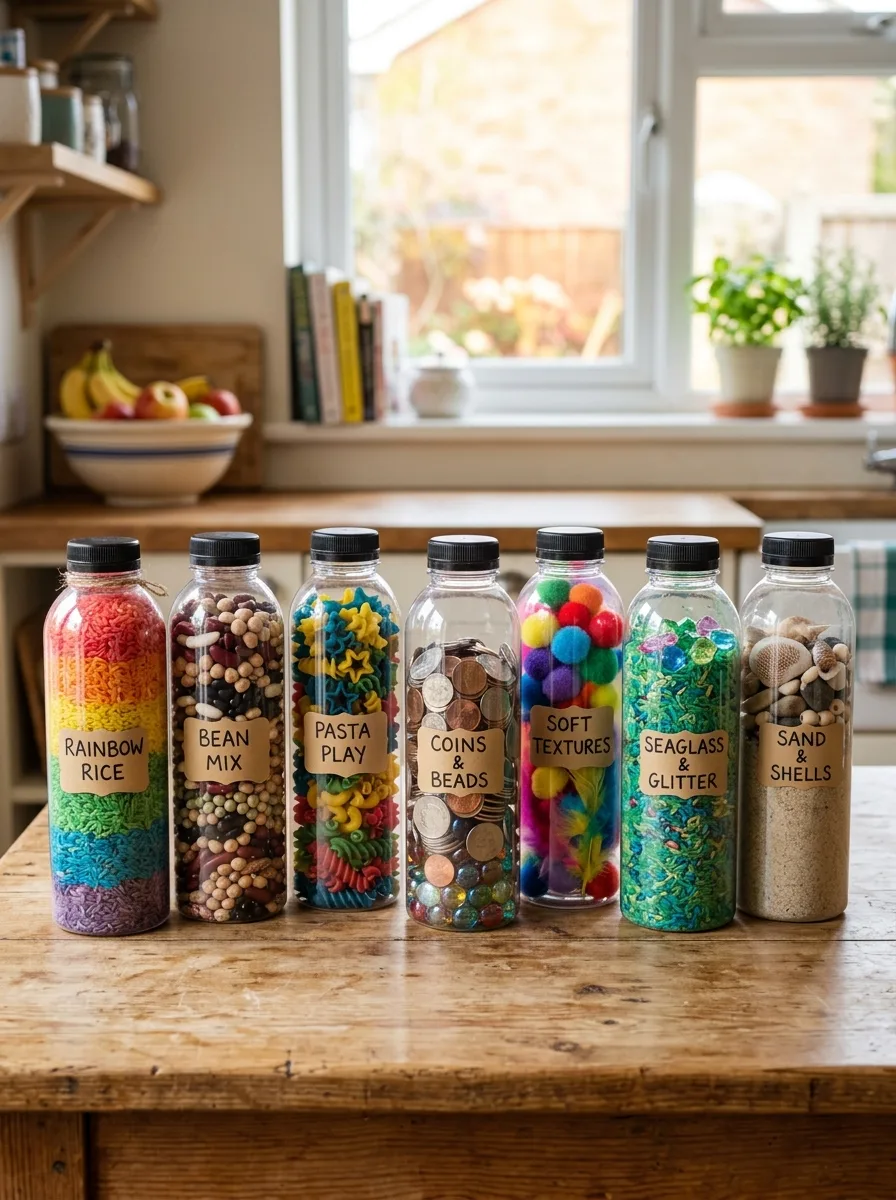
What you need: Empty plastic water bottles with secure lids, and small items to put inside — rice, dried beans, coins, small pasta, bells
What it teaches: Auditory discrimination, cause and effect, early science thinking, and vocabulary
Fill each bottle with something different. Rice makes a soft shhhh. Coins make a sharp clatter. Dried beans land somewhere in between. Hot-glue or tape the lids tightly before handing them over.
Shake one together with your toddler. Ask: “Is it loud or quiet? Does it sound like rain? What do you think is inside?”
Listening carefully and comparing sounds is called auditory discrimination. It’s one of the pre-reading skills — the ability to notice differences in sounds is the same skill that later helps children hear the difference between letter sounds. This activity builds it in the most natural way possible.
Name the sounds together. Make up words for them. If your toddler says the rice one sounds like “swooshy,” use that word. Inventing language for sensory experiences builds vocabulary and description skills.
Make it harder: Make two of each type so you have matching pairs, then shake them and try to find the ones that sound the same — a listening memory game.
8. Picture Scavenger Hunt
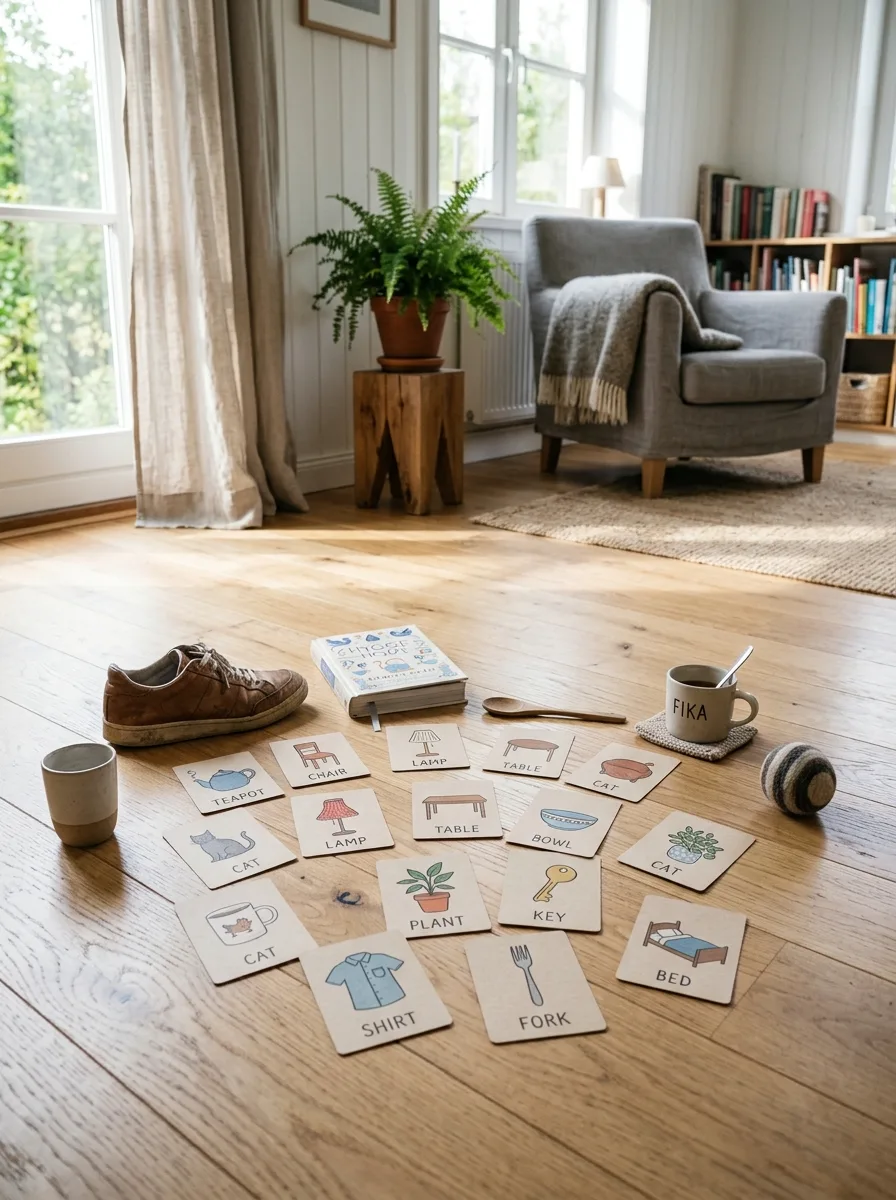
What you need: A piece of paper and a pen, or printed photos from your phone
What it teaches: Vocabulary, following directions, problem-solving, visual recognition, and memory
Draw simple pictures of five objects around your home — a cup, a shoe, a ball, a book, a spoon. Stick figures are fine. Hand the “list” to your toddler and send them to find each one.
For a 2 year old, keep it to three items to start. Point to the picture, name it, and say “Can you find the cup?” Then let them go.
This activity works on multiple skills at once. They’re reading picture symbols (a pre-literacy skill), following a multi-step direction, holding a task in their working memory, and moving their body through space to complete a goal. That’s executive function in action.
The moment they bring back the item is genuinely exciting for them — task completion at this age produces a real sense of pride. That feeling of “I did it” builds motivation and confidence for learning.
Make it harder: Once they’ve found all the objects, ask them to put them back exactly where they found them. Memory plus navigation.
9. Color Mixing in a Ziplock Bag
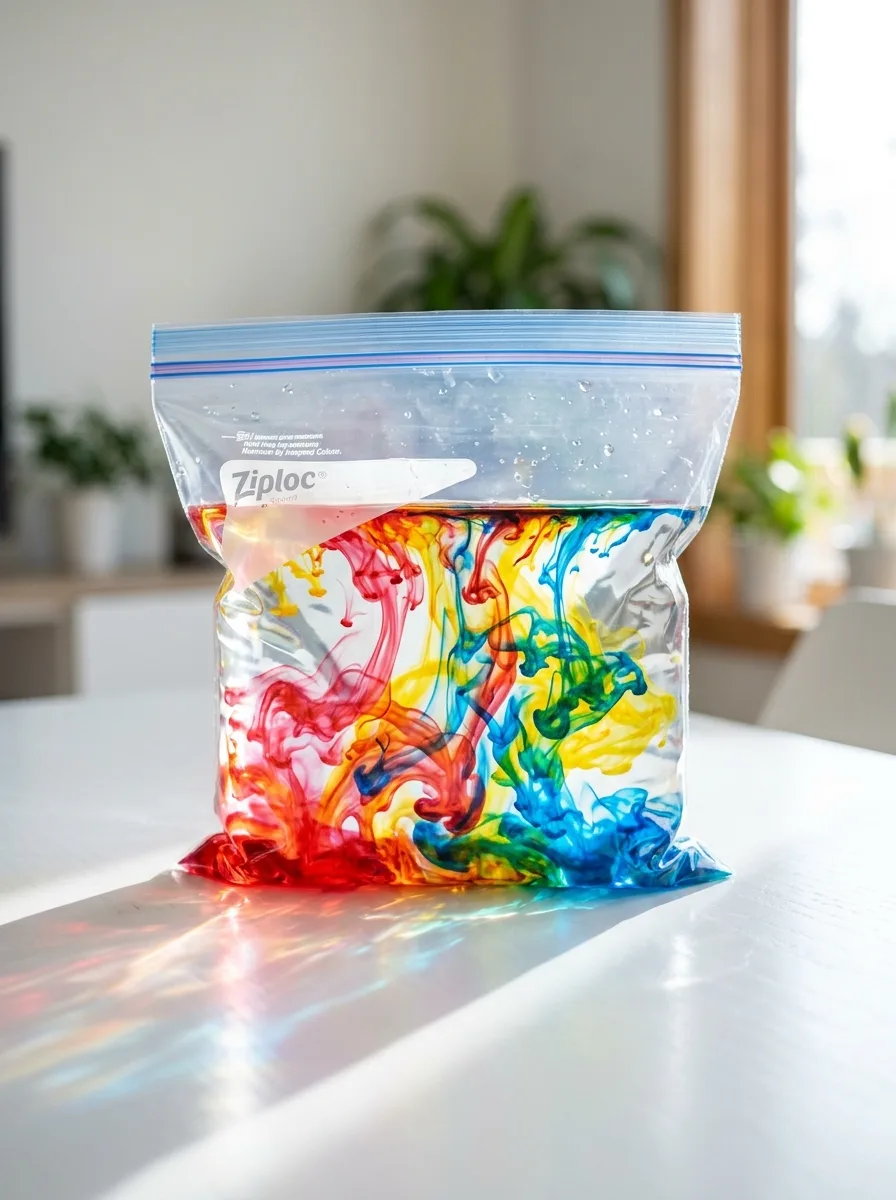
What you need: A ziplock freezer bag, water, and food coloring in two colors
What it teaches: Cause and effect, color learning, sensory development, and early science concepts — completely mess-free
Add a small amount of water to the bag. Drop in two blobs of different food coloring — red and yellow, blue and red, blue and yellow. Seal the bag tightly (double-seal if you want to be safe, or tape the top). Place it on a flat surface or tape it to the window.
Let your toddler squish and press the bag to mix the colors. They will be absolutely captivated by the color change.
Name the colors as they work. “That’s red and yellow — what color is it turning? Orange!” This cements color vocabulary in a way that sticks because it’s tied to a physical, surprising experience. Memory research consistently shows that information attached to a sensory experience is retained far better than information delivered verbally alone.
The squishing and pressing is also sensory work — building tactile tolerance and hand strength without any mess on your hands or floors.
Make it harder: Use three colors and try to predict what will happen before mixing. Ask them to tell you what they see as they squish. Narrating what you observe is a foundational science skill.
10. Pretend Restaurant with Real Kitchen Items
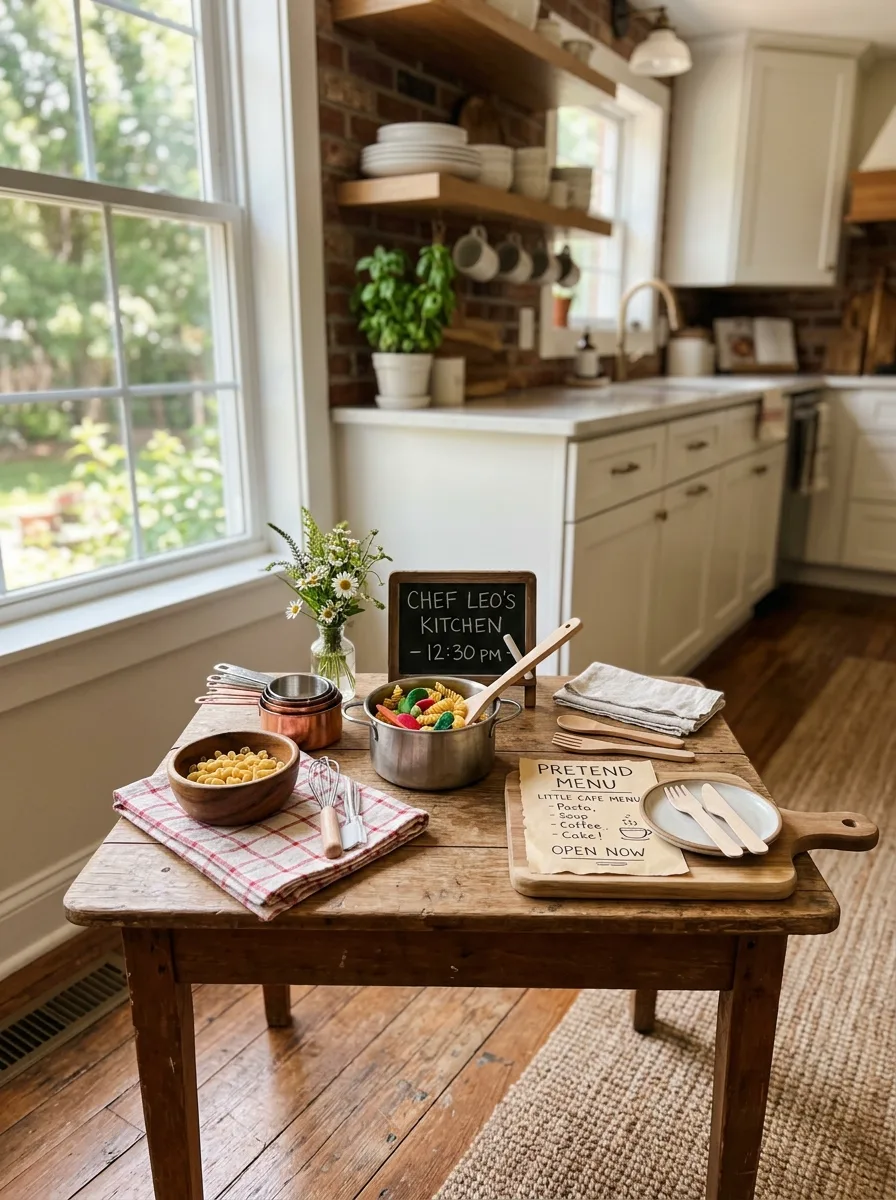
What you need: Pots, wooden spoons, measuring cups, dried pasta or rice, plastic bowls, and a dish towel
What it teaches: Imaginative play, language development, social-emotional skills, sequencing, and math vocabulary
Set up a low table or a section of the kitchen floor as the restaurant. Give your toddler the pots, spoons, and dry ingredients. You sit down and become the customer.
Ask for things. “Excuse me, can I have the soup please? What kind is it today?” Let them make it, bring it to you, and serve it. Say thank you. Ask for more. Ask for the check.
This kind of pretend play is far more educational than it looks. According to the CDC, toddlers this age tend to imitate the actions of adults and older children — this is a primary way they learn and practice new skills. Playing restaurant lets them rehearse real-world sequences: take order, cook food, serve food, clean up. CDC
The language that emerges during pretend restaurant is rich — “more,” “hot,” “ready,” “please,” “thank you,” food names, action words. Every back-and-forth exchange is a language opportunity.
You can extend it into math by asking for “two bowls of pasta” or “a big cup and a small cup.” Let the game run as long as they want. When a 2 year old is deep in imaginative play, don’t interrupt it.
Make it harder: Add a “menu” — a piece of paper with drawings of three things they can “cook.” Ask them to take your order and remember it.
How Long Should Each Activity Last?
Here is the honest answer: not very long. And that is completely fine.
A 2 year old has a typical attention span of roughly 4 to 6 minutes per year of age — so somewhere between 8 and 12 minutes at a stretch, on a good day, for something they’re genuinely interested in. For something new or challenging, it may be far less.
This does not mean the activity failed. It means they got what they needed and moved on. Toddlers are incredibly efficient learners — they extract information fast and then they’re done.
If your child does the sock match for four minutes and then runs off, that was a successful activity. If they dump the muffin tin out, watch the objects scatter, and walk away, they still learned something about cause and effect. Completion is not the goal. Engagement is.
A few tips for extending activities naturally:
- Get on the floor and play alongside them. Your presence extends their engagement more than anything else.
- Add a new element partway through. If the water pouring is losing steam, add food coloring.
- Follow their lead. If they’ve started using the muffin tin as a drum, go with it. That’s music exploration now.
Aim for two or three focused activities spread through the day, with plenty of unstructured free play in between. That balance is what research consistently supports for healthy toddler development.
What Learning Actually Looks Like at 2
Before closing, one thing worth saying directly: learning at 2 does not look like focused sitting. It does not look like completing the task you set up. It does not look like doing things the “right” way.
Learning at 2 looks like dumping the bin over to see what happens. It looks like repeating the same step twelve times because repetition is how toddlers build neural pathways. It looks like wandering off mid-activity and coming back three minutes later. It looks like using the spoon as a drumstick and the bowl as a hat.
All of that is normal. All of that is learning.
During the second year, toddlers learn to explore their world, develop the beginnings of self-awareness, and use their parents as a home base — frequently checking to make sure that the world they’re exploring is safe. As children become independent, their ability to socially self-regulate becomes apparent: they can focus attention and solve problems more efficiently, and they can begin to manage the stress of strong emotions. American Academy of Pediatrics
Your job during these activities is not to teach. It’s to set up the environment, stay nearby, and talk about what’s happening. That’s it. The learning takes care of itself.
Put the pasta on the floor again. Call it science.
For more on what your 2 year old is developmentally ready for, the CDC’s developmental milestone checklist is a free, reliable resource worth bookmarking. The American Academy of Pediatrics’ guidance on the power of play is also worth reading if you want the research behind why these simple activities matter so much.