
Rain is hitting the windows. Your toddler has already lapped the living room fourteen times and asked you for a snack twice. It’s 9:47am.
Rainy days with a toddler can feel endless — but they don’t have to. The right activity doesn’t need to be elaborate. It doesn’t need a craft kit, a sensory bin from Amazon, or a setup that takes longer than the activity itself. It just needs to be the right fit for where your toddler is developmentally right now.
This list gives you 11 indoor activities that actually hold a toddler’s attention, teach something real, and work in a normal house on a normal rainy day. Each one comes with exactly what it builds, what you need, and how to make it last longer when you need it to.
Why Indoor Play Matters More Than You Think
Before getting into the list, here’s something worth knowing.
According to the American Academy of Pediatrics, play is not frivolous. It is brain-building, a central part of healthy child development, a key to executive function skills, and a buffer against the negative impacts of stress. Play also builds the bond between parent and child. American Academy of Pediatrics
That’s not just about outdoor parks or organized activities. It applies directly to what happens on your living room floor when you can’t go outside.
Play provides sensory, physical, and cognitive experiences that build connections in the brain. Unstructured play is important because it allows toddlers to lead activities, follow their own interests, explore their environment, make decisions, and use their imagination. American Academy of Pediatrics
And here’s something that takes the pressure off: a 2024 study published in Developmental Psychology, following 2,400 children across twelve countries, found that children experiencing multi-sensory learning demonstrate 34 percent better engagement and retention compared to traditional single-sense approaches. Touching, hearing, seeing, and moving — all at once — is how toddler brains absorb information most effectively. Every activity on this list is built around that. FirstCry
One Thing to Know About Toddler Attention Spans First
If your toddler abandons an activity after five minutes, that is not failure. That is developmentally normal.
The average attention span of a 2-year-old falls between 4 and 6 minutes — and that bumps to 6 to 8 minutes for 3-year-olds. Most toddlers can play on their own for short stretches, but they require support and encouragement from a grown-up to stick with an activity for longer. Great Speech
The goal with rainy day activities is not to find something that entertains your toddler for an hour. The goal is to have six or seven good options ready so you can move between them as your child’s interest shifts. That’s the real rainy day strategy.
Now, the activities.
11 Indoor Activities for Toddlers on Rainy Days
1. Homemade Playdough (From Your Pantry)
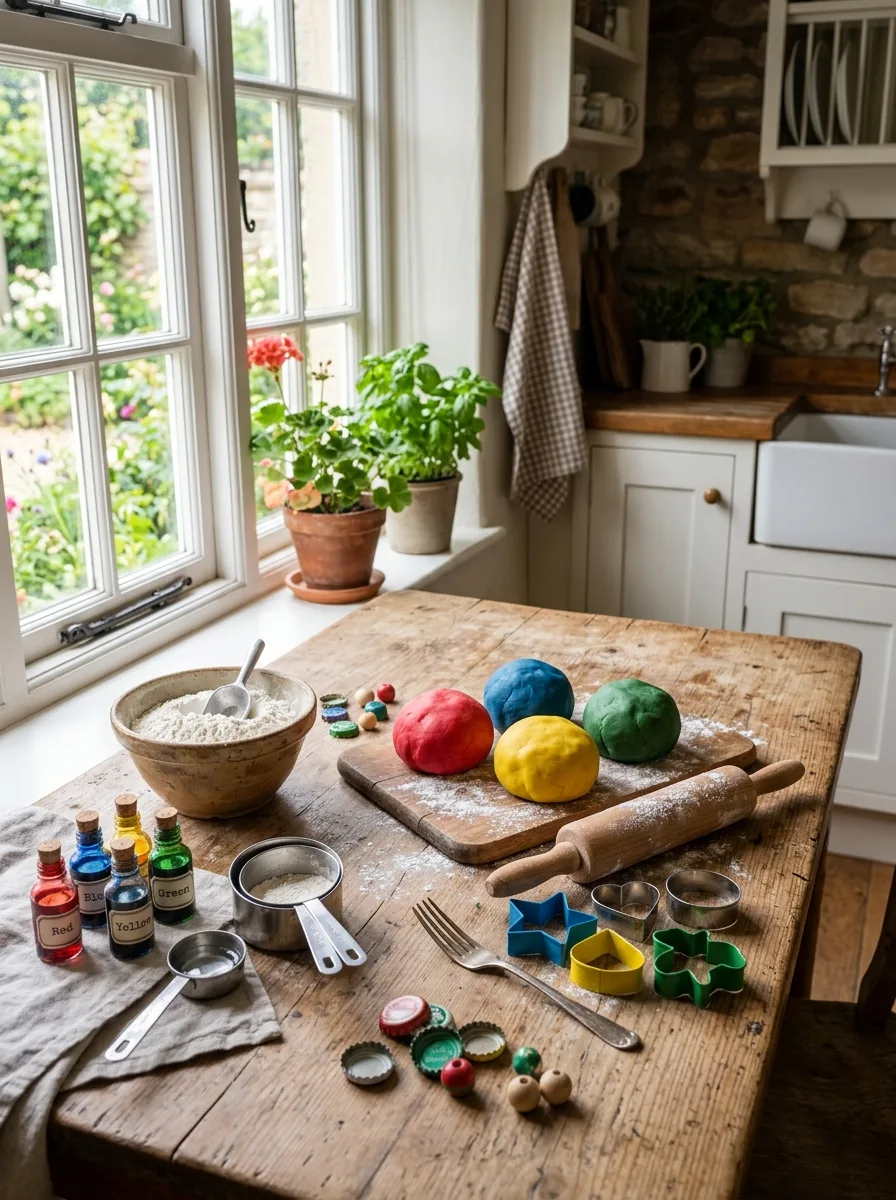
What you need: Flour, salt, water, cream of tartar, oil, food coloring
What it builds: Fine motor skills, sensory processing, creativity, color recognition
Making playdough together is a legitimate activity in itself — not just a precursor to the real thing. Let your toddler pour the flour, stir the mixture, and watch the texture change. Then give them ten minutes with the finished product to poke, roll, squish, and flatten it however they like.
When a child engages in sensory play, they’re helping their brain develop and learn from certain aspects of their environment. Language skills develop naturally through sensory play, as children learn to describe what they’re doing and how it feels — eventually using more descriptive words to communicate. Keiki
The basic recipe: 2 cups flour, 1/2 cup salt, 2 tablespoons cream of tartar, 2 tablespoons oil, 1.5 cups boiling water, food coloring. Stir together until smooth. Cool before playing. It keeps in a sealed bag for weeks.
The sensory input from squishing and rolling playdough is calming for many toddlers — it can genuinely help regulate a child who is overtired or overstimulated from being stuck inside. Add small household objects like a fork, a bottle cap, or a comb to press patterns into the dough.
Make it last longer: Roll small balls together and count them. Make a “birthday cake” with toothpick candles. Ask them to make something for a stuffed animal.
2. Indoor Obstacle Course
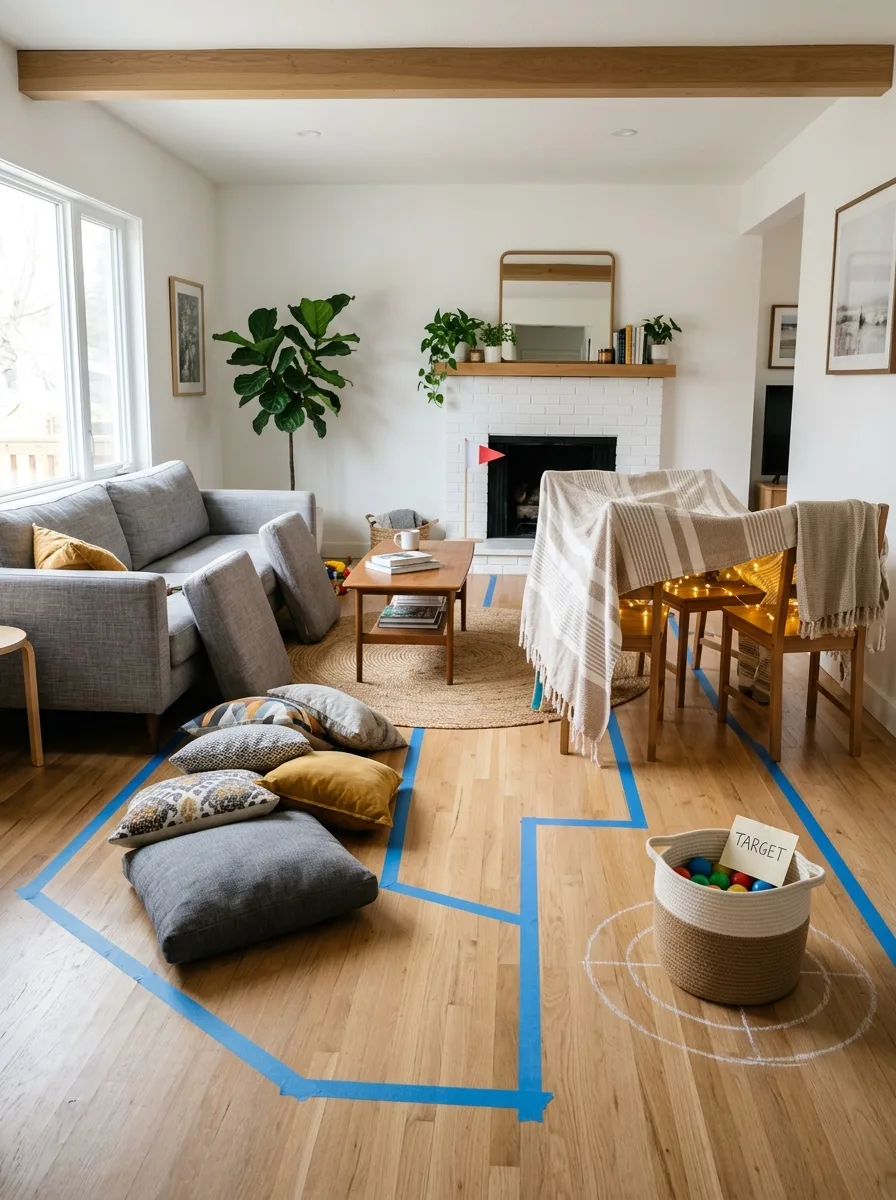
What you need: Couch cushions, pillows, a roll of painter’s tape, a laundry basket, a hula hoop if you have one
What it builds: Gross motor skills, body coordination, balance, following directions, and sequencing
Push the furniture back and build a course. Cushions to crawl over. A taped line to walk along. A laundry basket to toss a ball into. A tunnel made from a blanket draped over two chairs.
This burns real energy — and that matters. The positive effects of physical movement on children’s concentration last for roughly one hour, so regular opportunities to move throughout the day have a direct impact on a child’s ability to focus. An obstacle course mid-morning can reset a toddler’s focus for the next activity. TherapyWorks
Demonstrate the course first. Then let your toddler go through it. Then reverse the order. Then time it with a phone timer. Toddlers who are old enough for simple counting absolutely love hearing “go!” and seeing how fast they can do it.
Keep it low to the ground and padded. The point is not challenge — it’s movement.
Make it last longer: Add a new element every couple of runs. A step to jump off. A zone where they have to crawl. An area where they have to “freeze” when you call out.
3. Water Painting on Construction Paper
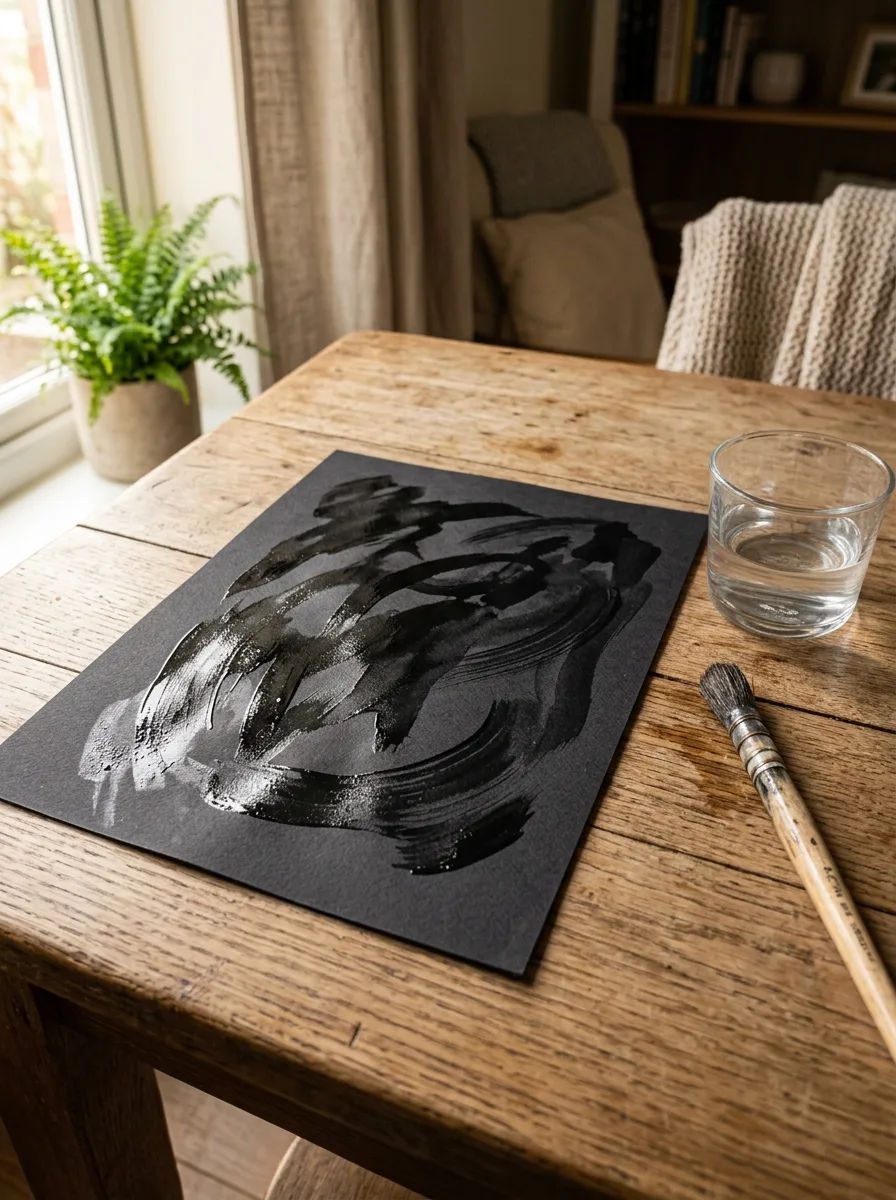
What you need: Dark construction paper (black, navy, or dark green works best), a small cup of water, a paintbrush
What it builds: Fine motor skills, creativity, cause and effect, focus
This one surprises parents. Give your toddler a cup of plain water and a paintbrush and tell them to paint on the dark paper. The wet marks show clearly on dark paper and dry in a few minutes — so they can paint the same sheet over and over.
Zero mess. Zero setup beyond grabbing a piece of paper. No staining.
The act of dipping, wiping, and applying pressure with a paintbrush is fine motor work — the same grip and control needed later for holding a pencil. The back-and-forth of dip-and-paint builds rhythm and focus. And watching the marks appear and disappear is genuinely captivating for a toddler who is old enough to understand cause and effect.
Narrate what you see while they paint. “That’s a big swoosh. You made a circle. The paper is getting darker.” You’re adding vocabulary to a sensory experience, which is one of the most effective ways toddlers learn new words.
Make it last longer: Try the same activity with a wider brush, then a smaller one. See what kind of marks they make. Ask them what they’re painting.
4. Sensory Rice Bin
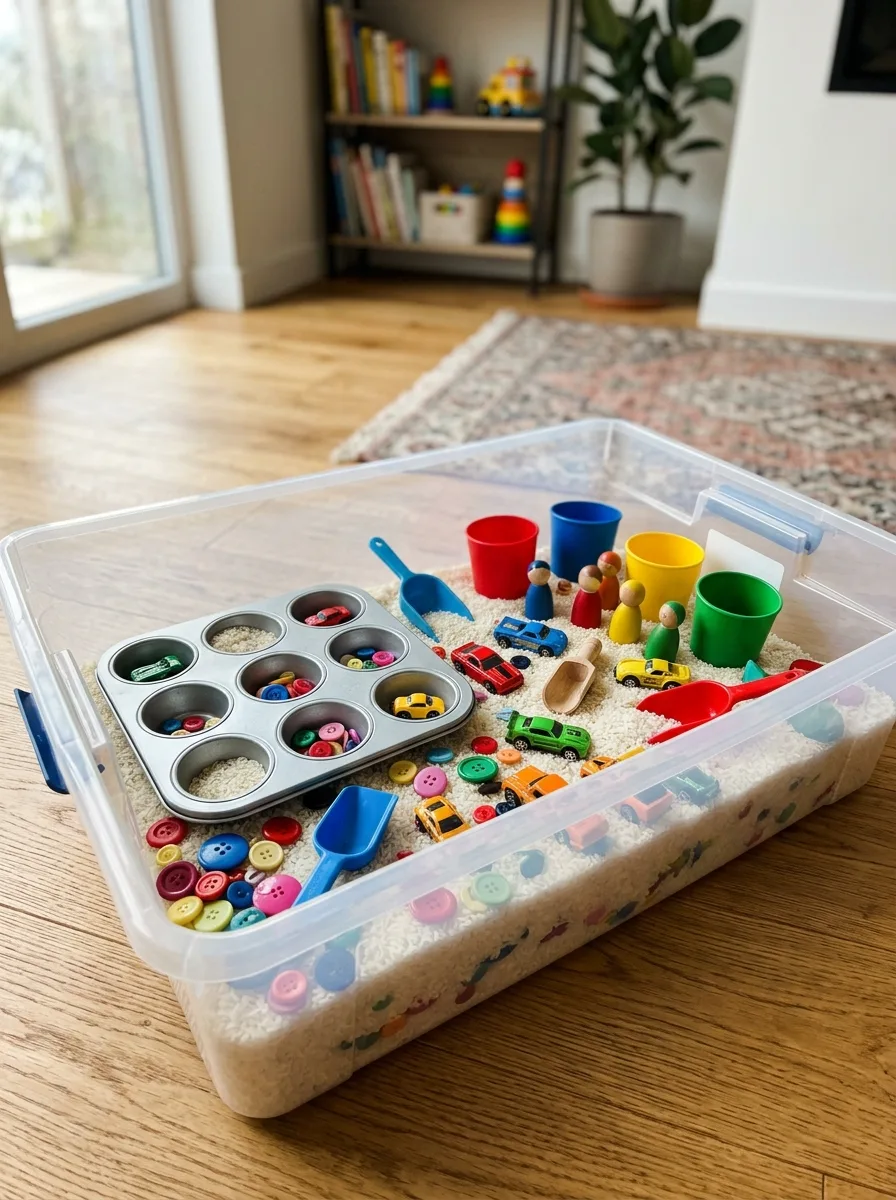
What you need: A large storage container, 2–3 cups of dry rice, and small items to hide and find — a few toy figures, large buttons, coins, small cars
What it builds: Sensory processing, fine motor skills, focus, early math (counting, sorting), language
Pour the rice into the bin. Bury a handful of small items. Hand your toddler a spoon, a small cup, and a scoop — and let them dig.
The benefits of sensory play include enhanced brain development, improved memory, stronger problem-solving abilities, refined fine motor skills, better language and social capabilities, sharper observation skills, and increased creative and independent thinking. FirstCry
The rice bin works because it hits multiple senses at once — the sound of rice moving, the texture against small hands, the visual search for hidden objects. That multi-sensory input is exactly what keeps a toddler’s attention longer than a single-channel toy would.
Add a muffin tin nearby. Ask them to sort what they find by color or by size. Set up a small tray with cups and let them pour rice between them. The same bin can run three or four mini-activities in a row.
Put a shower curtain or old sheet under the bin. Rice does scatter — but it’s easy to scoop back in.
Make it last longer: Hide the same objects again after they’ve found them all. Add a second bin with water next to the rice bin and let them transfer items between the two.
5. Tape Shape Puzzle on the Floor
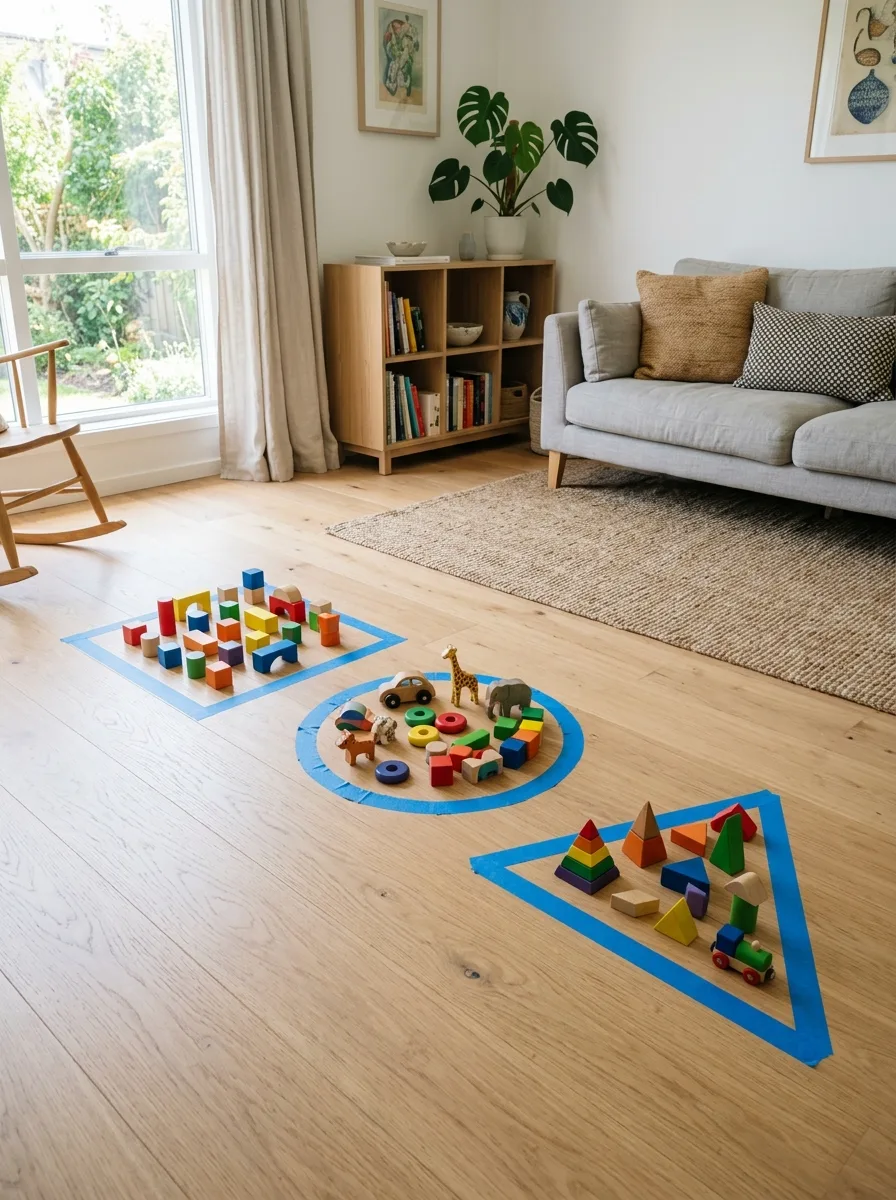
What you need: Painter’s tape
What it builds: Shape recognition, spatial reasoning, gross motor skills, early math
Use painter’s tape to make large shapes on the floor — a circle, a square, a triangle. Make them big enough that your toddler can sit inside them. Then give them simple instructions.
“Can you jump inside the circle?” “Can you put your toy in the square?” “Stand outside the triangle.”
This is spatial language — words like inside, outside, beside, above, and below — which directly supports early math and reading comprehension. Unstructured play allows toddlers to lead activities, explore their environment, and make decisions. But adult-scaffolded play, where a caregiver introduces language and prompts around what’s happening, accelerates language development significantly. American Academy of Pediatrics
Once they’ve got the basics, add more shapes. Make the circle tiny and the square huge. Put a toy in the corner of the triangle and ask them to find it.
Make it last longer: Tape letters or numbers once you’ve done shapes. Drive toy cars along the lines. Play a “Simon says” version — “Simon says sit inside the square!”
6. Mess-Free Sensory Bag Painting
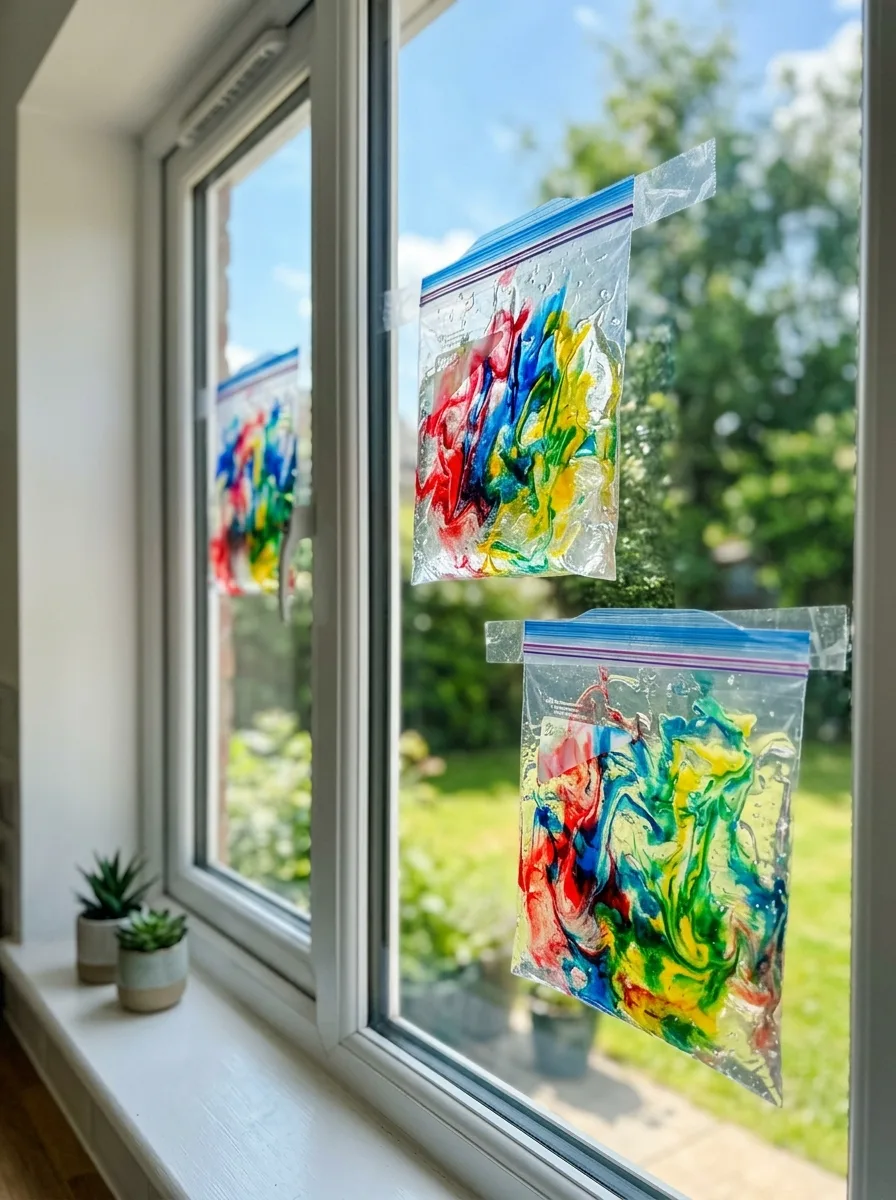
What you need: A ziplock freezer bag, a few tablespoons of hair gel, and food coloring or washable paint in two colors
What it builds: Sensory processing, color learning, fine motor skills, cause and effect — completely mess-free
Squirt a few tablespoons of clear hair gel into a freezer bag. Add two drops each of two different food colors on opposite sides of the bag. Press the air out and seal it tightly. Tape it flat to a table or window.
Let your toddler push, swirl, and squish the bag to mix the colors. The gel moves slowly, which makes the color mixing visible and satisfying. The sealed bag means there is genuinely nothing to clean up.
The squishing motion builds hand strength. The color change — red and blue becoming purple, yellow and blue becoming green — teaches early science (mixing, transformation) in a way that sticks because it’s tactile and surprising.
Tape it to a window and the light makes the colors glow. That alone will buy you a solid ten minutes.
Make it last longer: Use three colors in a larger bag. Tape it low on the wall so they can press with their whole hand and forearm. Ask them to predict what color will appear before they mix.
7. Cardboard Box Theater
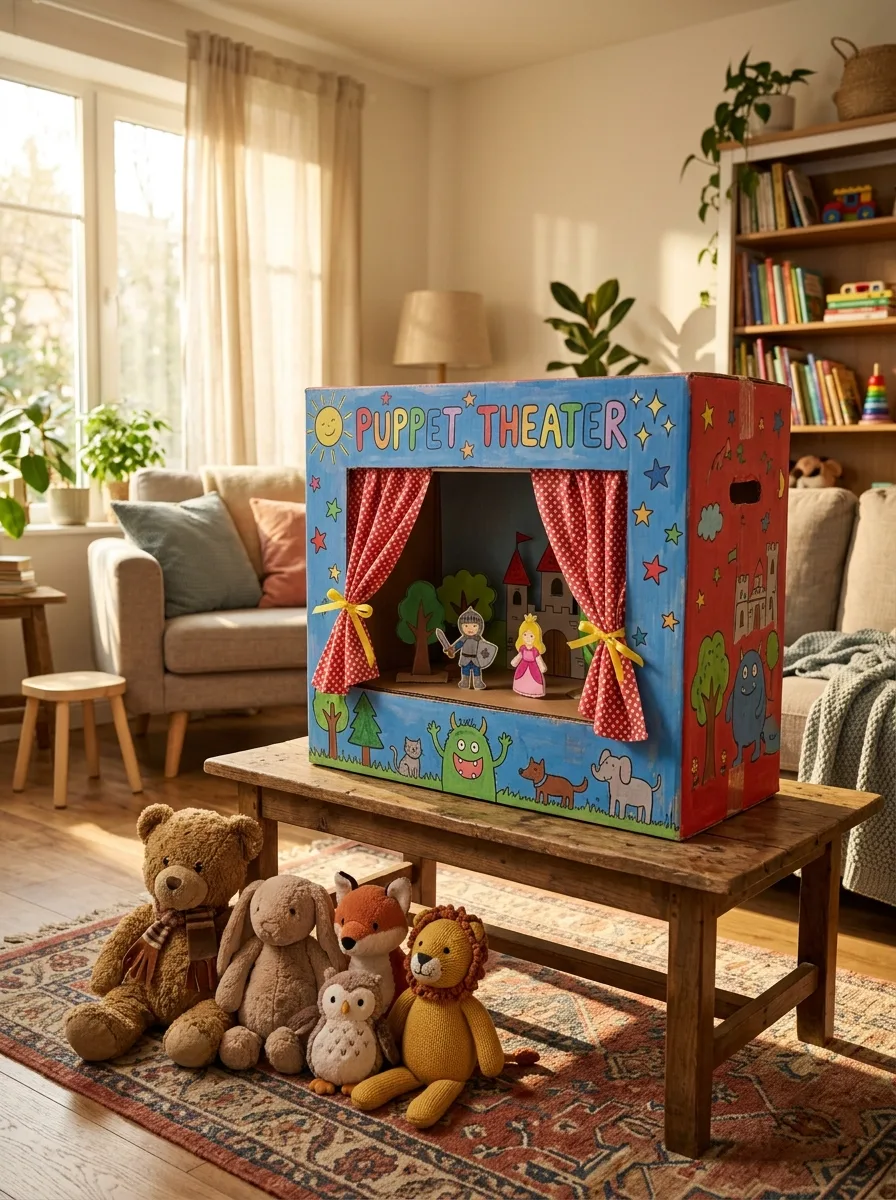
What you need: One large cardboard box (delivery or appliance box), a pair of scissors, optional markers or stickers
What it builds: Imaginative play, language development, social-emotional skills, storytelling, creativity
Cut a rectangle out of one side of the box to make a puppet theater window. Set it up so your toddler stands behind it and puts stuffed animals or finger puppets through the opening.
Then become the audience.
Ask what’s happening. Who is that character? Where are they going? What happens next? Let them narrate, perform, or just make the animals talk to each other. There is no wrong way to do this.
Research indicates that learning thrives when children are given some agency — control of their own actions — to play a role in their own learning. The demands of today’s world require creativity, innovation, and problem-solving, all of which emerge through this kind of child-directed play. uspto
When your toddler is in charge of the story, they’re building narrative structure — the same underlying skill that supports reading comprehension years later. They’re also practicing language in a low-stakes, joyful context, which is when language learning is most efficient.
If you don’t have a large box, drape a blanket over a low table and let them perform from underneath. Same concept.
Make it last longer: Join the theater yourself with a sock puppet. Make simple puppets from paper bags or old socks with button eyes. Ask them to make up a story about their favorite toy.
8. Kitchen Measure and Pour Station
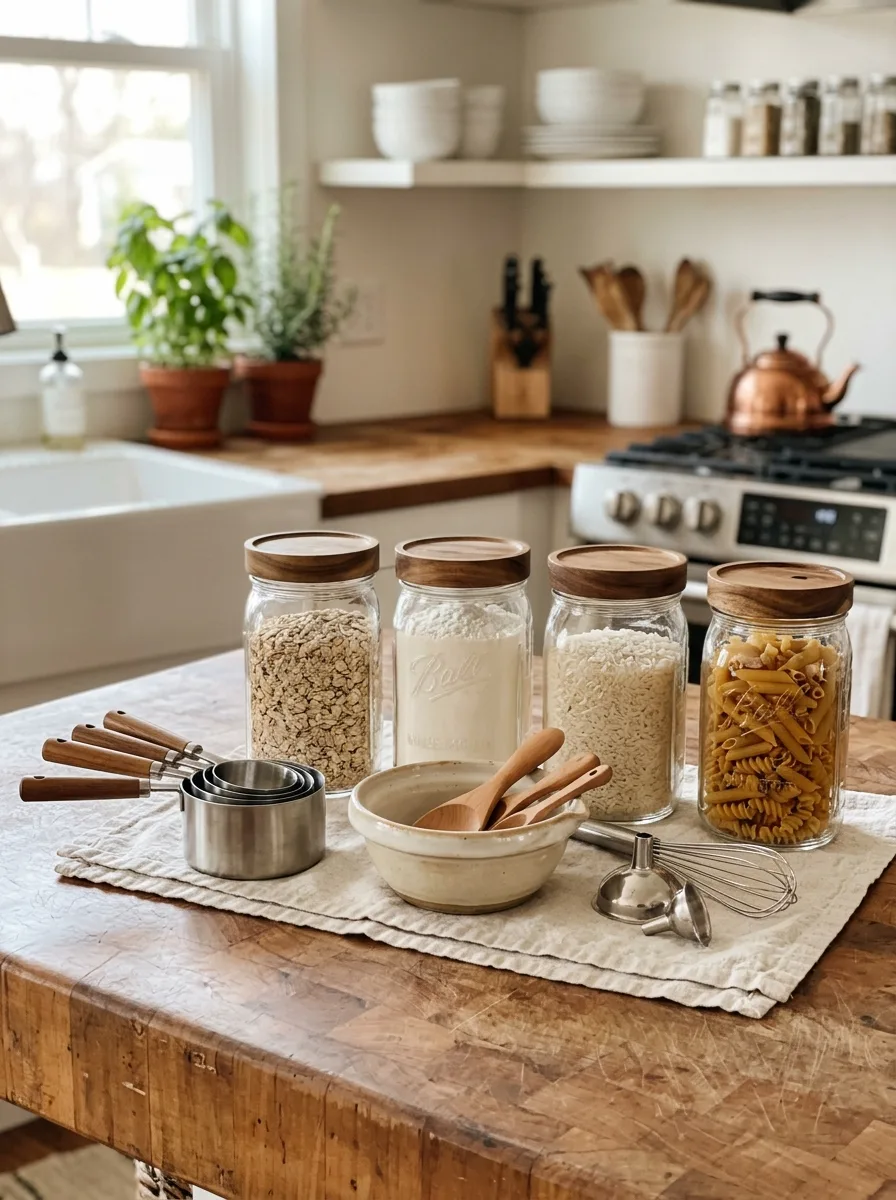
What you need: Measuring cups, measuring spoons, a large bowl, and dry ingredients — flour, oats, rice, or dried pasta
What it builds: Fine motor skills, early math concepts (volume, measurement), cause and effect, focus
Set up a low surface with a large mixing bowl in the center and a collection of measuring cups, spoons, and containers filled with different dry ingredients. Then step back.
Toddlers are drawn to pouring and measuring almost instinctively. They will scoop, pour, compare, and transfer — often without any prompting — for longer than most structured activities would hold their attention.
What looks like kitchen chaos is actually early math. Pouring a quarter cup versus a full cup builds an intuitive sense of volume. Comparing which cup holds more is early measurement. Scooping with a spoon to fill a cup is one-to-one correspondence.
Talk while they pour. “That cup is full. That one is empty. You put the oats in — now the flour. What happens when you mix them?” You’re layering vocabulary onto physical experience, which is exactly how toddlers absorb math and science language.
Make it last longer: Add water to the mix (outside or with a waterproof mat underneath). Give them a funnel. See if they can fill a container to a line you mark with tape.
9. Sticker Sorting and Decorating
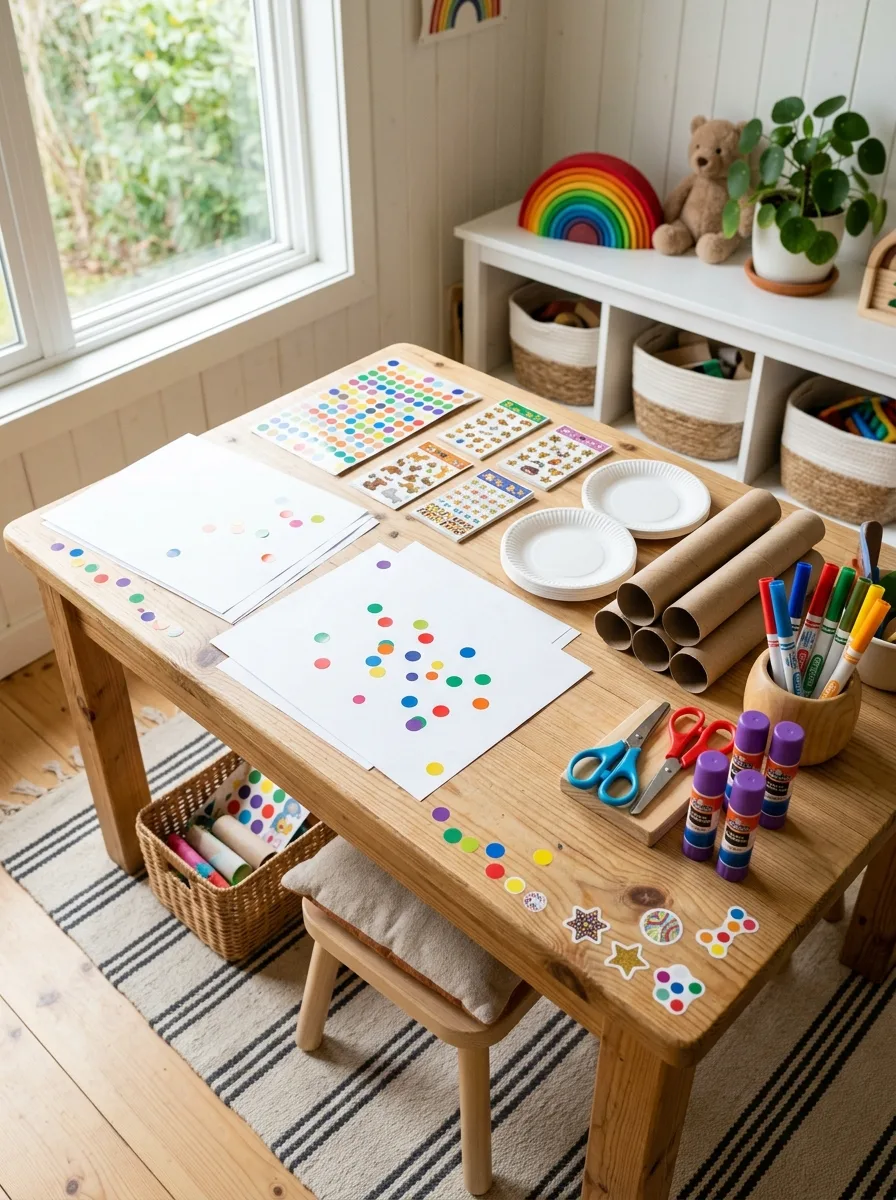
What you need: A sheet of stickers (any kind — dot stickers from an office supply store work perfectly and cost almost nothing), plain paper, and optional markers
What it builds: Fine motor skills, color and pattern recognition, early categorizing, creativity
Peel-and-stick is serious fine motor work for a toddler. The pincer grip required to peel a sticker from backing and place it precisely where intended is the same grip development needed for writing. What feels like a simple activity is genuinely building hand control.
Give your toddler a big piece of paper and let them cover it in stickers however they like. Then try some light structure. “Can you make a pattern? Red, blue, red, blue.” “Can you make a smiley face out of stickers?” “Can you sort the colors into groups?”
Dot stickers are particularly useful because you can draw letters, numbers, or simple pictures on them before stickering, turning the whole activity into a matching or sorting game.
Make it last longer: Sticker a paper plate, a brown paper bag, or an empty cardboard tube. Make a sticker book from stapled papers. Use stickers to decorate homemade bookmarks.
10. Indoor Scavenger Hunt (With Picture Clues)
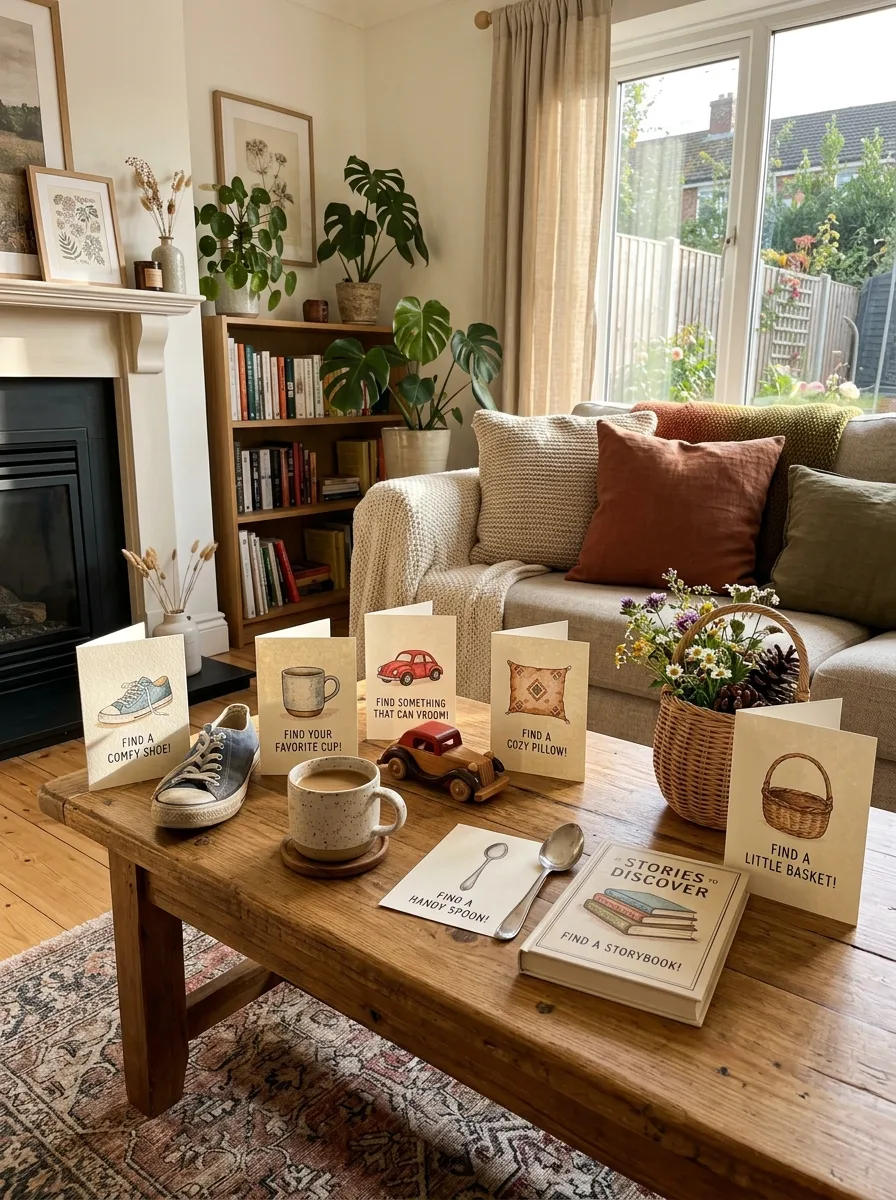
What you need: Paper, a pen, and 5 to 6 household objects to find
What it builds: Vocabulary, following directions, memory, problem-solving, gross motor skills
Draw simple pictures of objects around your home — a cup, a shoe, a pillow, a book, a spoon, a toy car. Keep it to three items for younger toddlers, five or six for those closer to three. Hand them the “list” and send them to find each one.
This activity hits an impressive range of developmental skills at once. Your toddler is reading picture symbols (a pre-literacy skill), holding a task in working memory, following multi-step instructions, and navigating space with purpose. That combination is early executive function in action.
The moment they find each object and bring it back produces a genuine sense of achievement. That feeling matters — it builds the intrinsic motivation to tackle problems and see tasks through.
Once they’ve found everything, you can reset: they hide the objects in new spots and you have to find them using their descriptions. That role reversal — now they’re the one giving directions — builds language and perspective-taking simultaneously.
Make it last longer: Add a “keep warm, getting cold” hint system as they search. Turn it into a two-step hunt where each item leads them to a clue for the next one.
11. Play-Restaurant with Real Kitchen Items
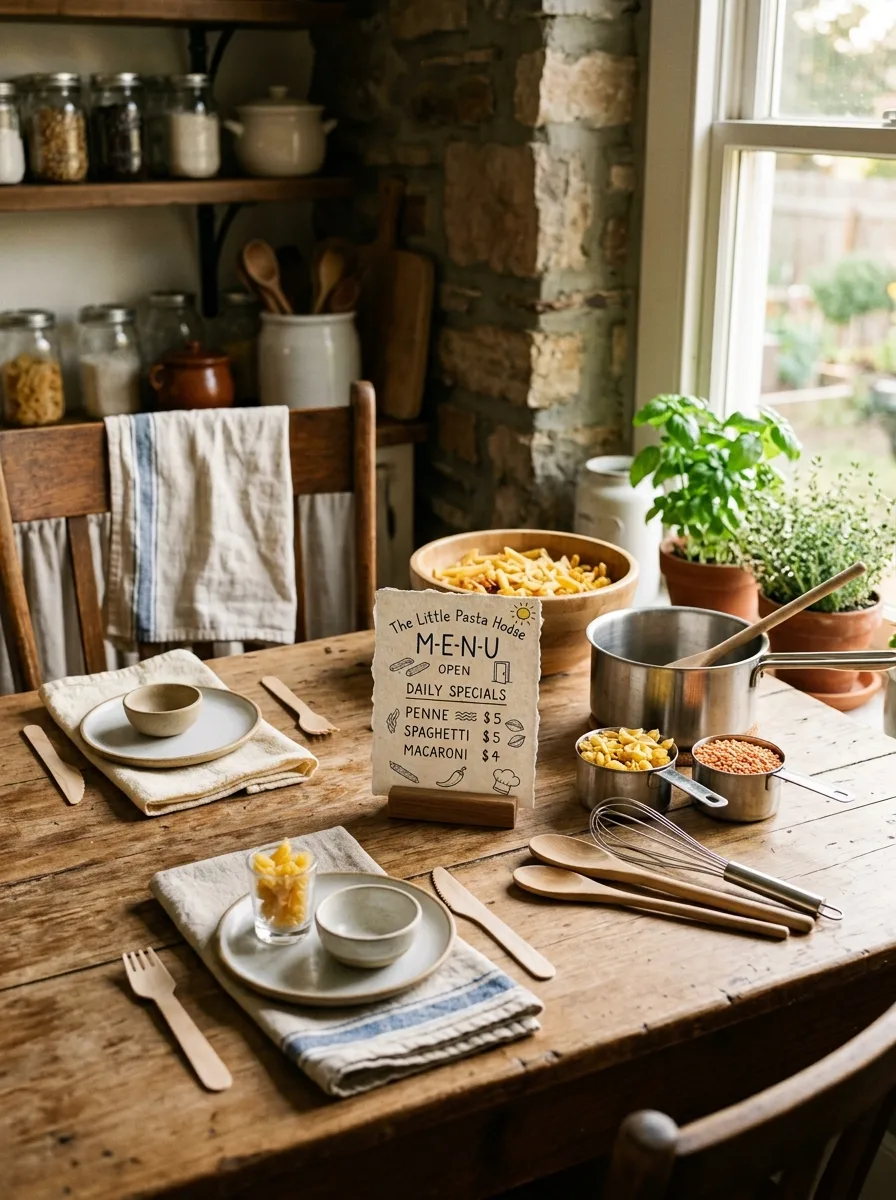
What you need: Pots, wooden spoons, bowls, dried pasta or rice, a dish towel, and a piece of paper for the “menu”
What it builds: Imaginative play, language development, sequencing, social-emotional skills, early math vocabulary
Set up a low table or section of floor as the restaurant kitchen. Give your toddler the pots, utensils, and dry ingredients. Draw a simple menu together — three items, each with a small picture. Then take your seat as the customer.
“Excuse me, what’s good today?” Let them explain the menu. Order two things. Wait while they prepare it. Ask if the soup is hot. Say thank you when it’s served.
This kind of open-ended pretend play is one of the richest developmental activities a toddler can do. According to the AAP, play builds executive function, prosocial skills, and the caregiver-child bond simultaneously — and these outcomes are directly supported by pretend play scenarios that involve back-and-forth interaction between adult and child. American Academy of Pediatrics
The language that emerges during pretend restaurant is dense and varied: action words, food names, polite language, descriptive words, numbers. Every exchange adds vocabulary in the most natural possible context.
Toddlers this age tend to imitate the actions of adults and older children — this is a primary mechanism through which they learn and practice new skills. Playing restaurant lets them rehearse real-world adult sequences in a safe, low-stakes way. nih
Make it last longer: Add a second role — now they’re the customer and you’re the chef. Give them a notepad and pencil to “take orders.” Set up a drive-through window using a cardboard box.
How to Use This List on a Real Rainy Day
You don’t need to do all eleven. On an average rainy day, aim for three or four activities spread across the day with free play and rest time in between.
Children’s brains, like adult brains, need time to make sense of new things they learn. Instead of racing from one activity to the next, giving children a little unstructured quiet time between activities helps them relax and process what they have just experienced. American Academy of Pediatrics
A rough rainy day rhythm that actually works:
Morning: One higher-energy activity (obstacle course, freeze dance) to burn off the energy that builds up from being indoors. Follow with free play.
Mid-morning: One creative or sensory activity (playdough, sensory bin, mess-free painting). This tends to produce the longest engagement windows.
After lunch: Lower-key activities work better when toddlers are tired. Sticker sorting, play restaurant, or cardboard box theater are all good post-lunch options.
Afternoon: Another short burst of movement if energy is rising again, then wind down with something quiet.
The goal is not to fill every minute. Boredom is fine. A little boredom is good for healthy development. When children decide what to play with and how to play, they develop the self-directed curiosity and problem-solving skills that matter most in the long run. nih
Rainy days are not something to survive. With a short list and low expectations, they can be some of the most connected time you spend with your toddler all week.
For more on toddler developmental milestones and age-appropriate play, the CDC’s Learn the Signs. Act Early. program is a free, reliable resource. The AAP’s guidance on the power of play is also worth reading for the full picture on why play is the most important work your toddler does.